
What Happened to Higher Education?
Cost, Ideology, Campus Safety, and the Conditions for Learning
In Brief. Higher education is near and dear to my heart. I spent much of my life inside it, first as a student and later as a professor and medical educator, and I remain convinced that a formal education can change the trajectory of a life. That is precisely why I find the current debate so important. Universities can no longer assume that their value is self-evident. Public confidence has fallen, costs remain high, and students now have alternatives that did not exist a generation ago, from apprenticeships and technical programs to online courses, podcasts, and AI. College graduates still enjoy substantial economic advantages on average, but returns vary enormously. The real cost of a degree includes not only tuition and debt but also the earnings a student loses while attending school.
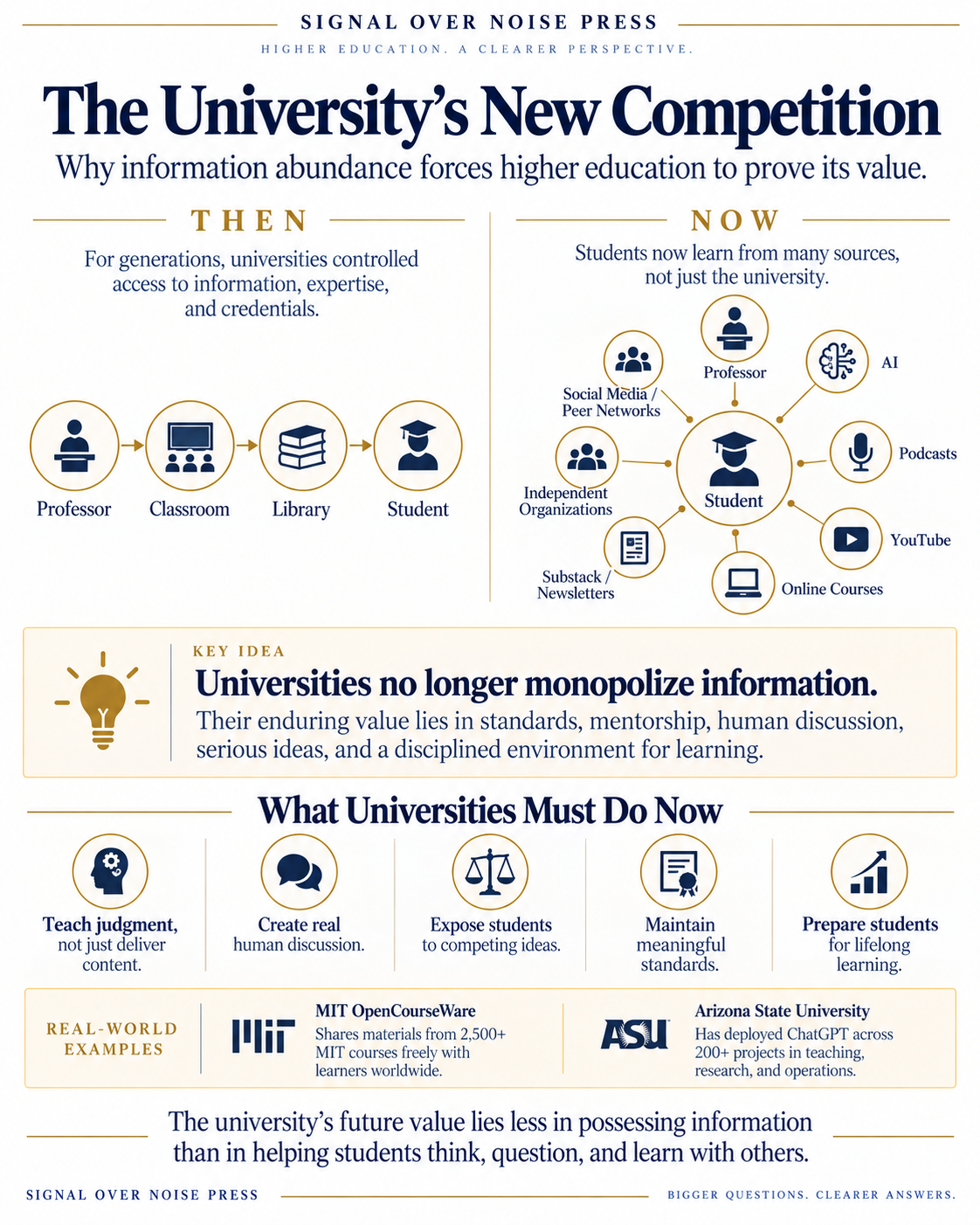
Universities also face a new challenge because they no longer control access to information. A motivated student can greatly expand their knowledge without ever entering a lecture hall. In theory, Universities provide expert instructors, logical learning structure, mentorship, networking that can last a lifetime, and sustained interaction with people who think differently.
However, evidence of self-censorship suggests that students sometimes learn which opinions are socially acceptable before they learn how to test those opinions for themselves. Peer pressure can create an illusion of consensus when people who disagree simply stop speaking. The 2024 campus protests raise an uncomfortable version of this. Recent studies found striking gaps in students’ knowledge of slogans they supported. Therefore, one must ask whether universities are producing independent judgment or merely environments in which borrowed certainty can spread quickly.
The campus turmoil also made clear that safety in education does not mean protection from uncomfortable ideas; it means preserving an environment in which those ideas can be confronted without intimidation or fear. Students should encounter ideas they dislike, arguments they find offensive, and people with whom they strongly disagree. That is part of learning. Antisemitic incidents rose substantially after October 7, 2023. Surveys of Jewish students found many hiding their identity, withdrawing from activities, or reporting that protests interfered with their ability to study. A healthy campus should make disagreement intellectually engaging, not personally threatening. Students should be expected to confront opposing ideas, defend their own, and remain part of the same community afterward. Protest and vigorous debate belong at a university; intimidation, coercion, obstruction, and exclusion do not. Before Title VI, conduct codes, federal investigations, and task forces, there is an older standard: treat other people as you would want to be treated. The Golden Rule should not require a university policy manual.
Finally, universities must be willing to stand behind the standards they claim to represent. Pass/fail grading is not inherently weak, and educational innovation is not inherently misguided, but a passing judgment should certify something real. In medicine, nursing, engineering, aviation, and other high-stakes professions, an institution that certifies competence is making a promise not just to the student but to the public. Compassion should help students reach competence; it should not alter the definition of competence. The same principle applies to educational reform. Welcome new methods when they work, but do not discard tradition merely because something newer has become fashionable.
Einstein and the “Conditions to Learn”
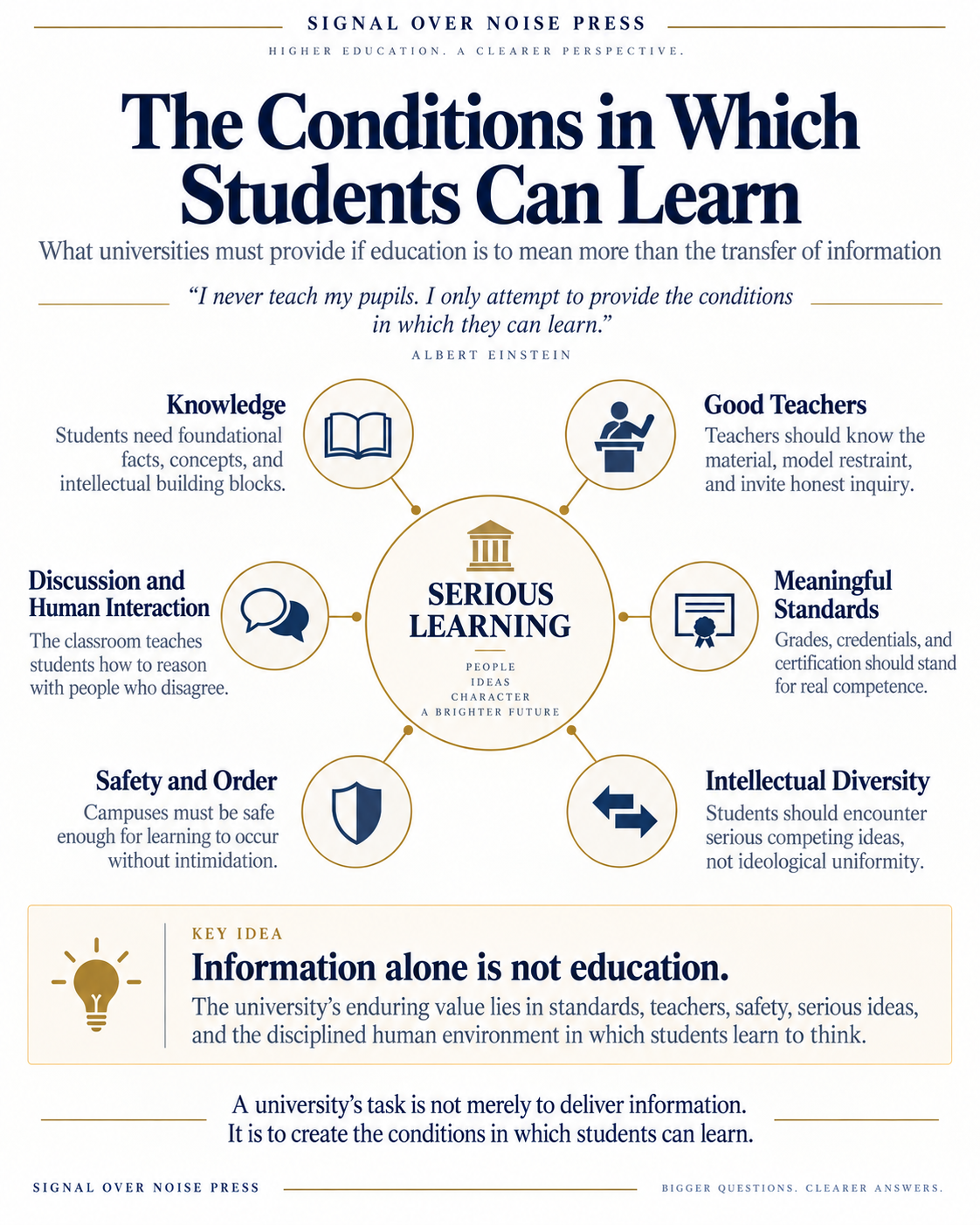
Years ago, I placed an Einstein quotation near the beginning of a medical textbook I wrote: “I never teach my pupils. I only attempt to provide the conditions in which they can learn.” At the time, I was thinking about medical students and the difficult transition from learning basic physiology to understanding disease. I have come to realize that Einstein’s observation says something much larger about higher education.
Universities cannot force students to learn. They can, however, create or destroy the conditions that make serious learning possible. Those conditions include knowledgeable teachers, meaningful standards, intellectual freedom, exposure to competing ideas, personal safety, order, and enough human interaction to turn disagreement into conversation rather than anger.
Something has clearly gone wrong in the relationship between higher education and the public. Gallup reported in July 2026 that only 38 percent of Americans had a great deal or quite a lot of confidence in higher education, down from 57 percent when Gallup first asked this question in 2015. Among those lacking confidence, the leading explanations were perceived political agendas on campuses, high cost, and inadequate preparation for the workforce. Pew similarly found in 2025 that seven in ten Americans believed higher education was generally headed in the wrong direction.
Those numbers are too large to dismiss as partisan grumbling. I have spent much of my life inside higher education, first as a student and later as a professor. I believe strongly in education. Because I value it, I think universities should be willing to answer the questions being asked of them now.
Three questions dominate the current debate. Is a college education worth what it costs? Have many prestigious universities become so ideologically homogeneous that students are no longer consistently exposed to serious competing arguments? And after the campus turmoil of recent years, particularly the rise in antisemitic incidents, are universities adequately preserving the environment in which students are supposed to learn?
Another question beneath those three may be more important. If education is expected to develop independent thinkers, what should we make of campuses where students sometimes conceal opinions they privately hold because of social pressure? What should we make of students joining political movements before they fully understand some of the slogans they are adopting? And what happens when a relatively small but highly visible group comes to be treated as though it speaks for an entire student body?
Those are not simply political questions. They are educational questions.
Behind all of this is the standard I keep coming back to:
Did the student leave better able to think independently, continue learning, and contribute meaningfully than when they arrived?
Is College Still Worth It?
The easy answer is yes. The more useful answer is that it depends.
College still produces a substantial economic return on average, but “college” is not one investment. Georgetown’s Center on Education and the Workforce provides one of the most useful comparisons of long-term returns across roughly 4,600 institutions. Its measure combines post-enrollment earnings with average net price and accounts indirectly for the time required to obtain different credentials. But even that is not a complete economic ROI calculation. A family should also consider financing costs and, importantly, the earnings a student gives up while attending school.
The public perception that college became dramatically more expensive is not imaginary, although the trend is subtler than the familiar headline suggests. For 2025–26, average published tuition and fees are $11,950 at public four-year institutions for in-state students and $45,000 at private nonprofit four-year institutions. Much of the large inflation-adjusted increase occurred earlier. Over the more recent decade, real tuition at public institutions has been relatively flat or lower. The more accurate description may be that college underwent a major upward repricing and then remained expensive. At the elite end, the numbers are especially arresting. Harvard estimates its total 2026–27 cost of attendance at roughly $95,000 to $100,000 before required health insurance for students who need it, while Princeton estimates $94,624. Both institutions provide substantial need-based aid, so many families may pay far less than those figures.
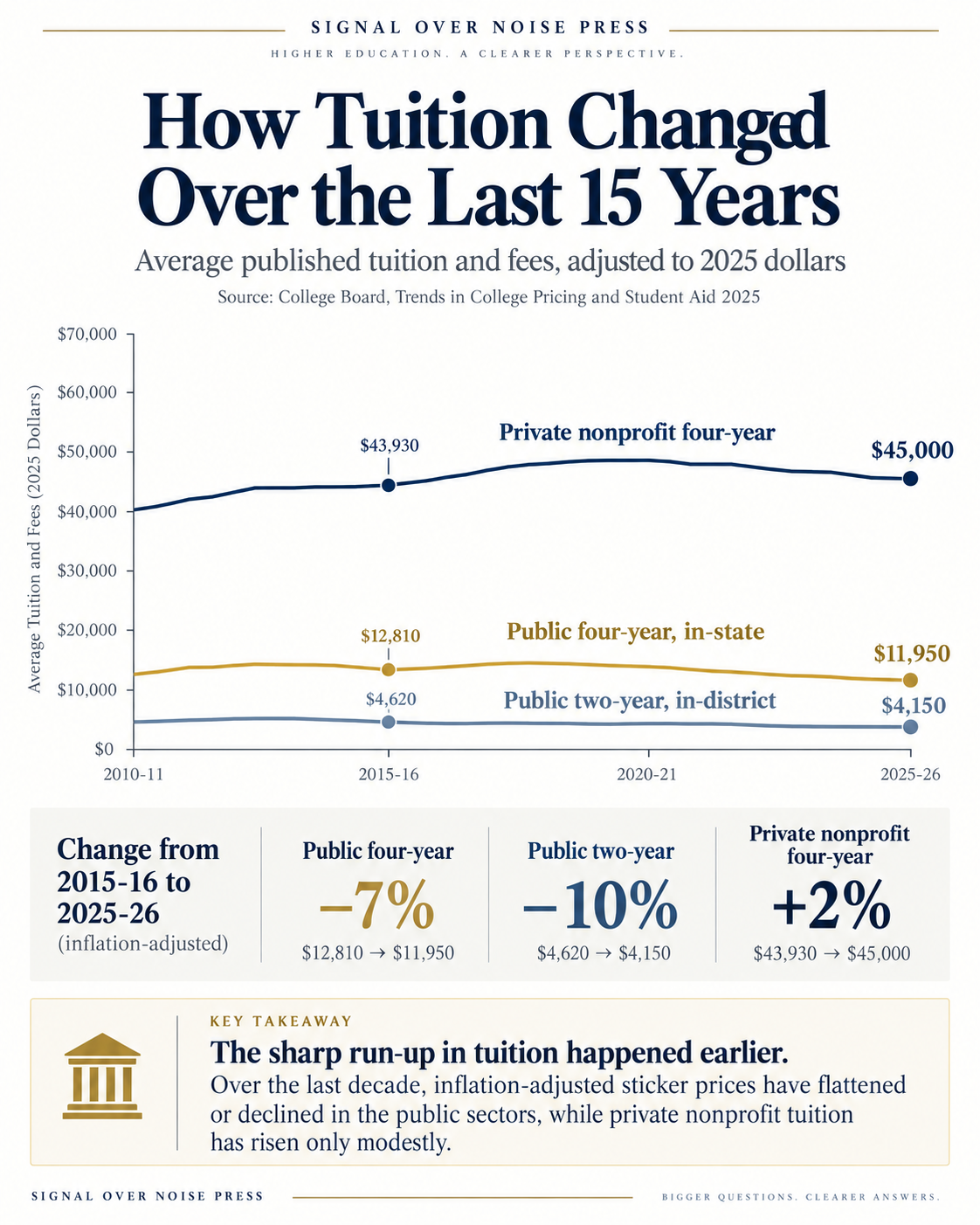
But tuition is only part of the cost. A student who could otherwise work full time for four years gives up substantial earnings while attending college, even if scholarships cover most of the tuition. A proper ROI calculation should therefore weigh net educational costs, financing costs, and foregone earnings against the additional lifetime earnings, opportunities, professional access, intellectual development, and other benefits attributable to the education. In other words, the relevant question is not simply what college costs, but what the student receives in return for the money and time invested.
That also helps put student debt in perspective. Among 2023–24 bachelor’s-degree recipients who borrowed, average cumulative debt was $29,560. That was down in inflation-adjusted terms from $35,600 a decade earlier, and only about 47 percent of bachelor’s recipients borrowed at all. Thirty thousand dollars matters, but I have difficulty treating it as impossible lifetime debt when it accompanies a credential that substantially improves earnings over several decades. The more troubling cases are better described as mismatched debt: debt without completion, debt attached to a weak-return program, debt greatly out of proportion to likely earnings, or very large graduate and professional-school balances.
Not every degree needs to maximize income. History, literature, teaching, social work, the arts, and other fields may have substantial intellectual, civic, or social value even when they do not generate the highest salaries. But every program should be able to explain what value it adds, and its price should bear some rational relationship to what students are likely to receive.
Once framed that way, a harder question follows. Why do institutions continue charging similar prices for programs with dramatically different economic outcomes? A $30,000 debt burden attached to a degree with a strong earnings premium is not economically equivalent to the same debt attached to a program with poor completion rates or weak employment prospects. If outcomes differ substantially, perhaps prices should too.
Should Some Programs Cost Less
This seems like surprisingly low-hanging fruit. If a program persistently combines high cost, low completion, substantial borrowing, and weak post-graduation outcomes, perhaps we should consider alternate approaches. For example, improve it, reduce its price, consolidate it, or provide greater aid. In some cases, universities may need to seriously consider whether to continue the program.
The federal government has already moved toward program-level accountability. Under the Department of Education’s 2026 STATS and Earnings Accountability rule, undergraduate programs generally must show that their graduates earn more than comparable working adults whose highest credential is a high school diploma. Programs that fail the earnings test in two of three consecutive award years can lose access to federal Direct Loans. The rule also requires warnings to students when a program is at risk and provides an orderly-closure option intended to protect students already enrolled. That is a meaningful development, but it establishes a floor rather than a complete ROI analysis. It does not fully account for tuition, financing costs, or foregone earnings, and it cannot recover the money and time students already invested before a poorly performing program is identified.
We also need to consider the difference between private economic return and public value. Suppose a talented student genuinely wants to become a social worker, teacher, rural physician, or enter another service-oriented field but concludes that the cost of obtaining the credential makes the decision financially irrational. We may have priced someone out of doing work that society simultaneously claims is essential. That is an undesirable outcome. We should not praise service in the abstract while pricing people out of serving.
If society believes a profession has substantial civic value but its wages are weak, then reducing educational costs may be more rational than encouraging large borrowing and debating forgiveness later. We already accept this principle in other settings. The Post-9/11 GI Bill exchanges public service for substantial educational benefits, while National Health Service Corps programs provide loan repayment in exchange for service in Health Professional Shortage Areas.
That approach has an appealing logic. The subsidy is attached prospectively to a public purpose. If we need social workers, teachers, nurses, rural physicians, or other professionals badly enough, states, employers, universities, and sometimes the federal government should consider directly financing the pathway.
The Endowment Question
The cost discussion inevitably led me to examine University endowments. The 657 institutions participating in the 2025 NACUBO-Commonfund study held $944.3 billion in endowment assets and withdrew $33.4 billion during the year. Almost half of endowment spending went to student financial aid, with additional distributions supporting academic programs, research, faculty positions, and facilities. Endowments funded about 15 percent of participating institutions’ operating expenses.
Endowments are frequently misunderstood. A $20 billion or $50 billion endowment is not the equivalent of that amount sitting in a checking account. Endowments are investment portfolios made up of many individual funds, often with donor restrictions. A gift may be legally designated for scholarships, a particular professorship, a library collection, or a specific research activity. Universities cannot simply redirect every dollar toward tuition.
They also deliberately spend only a fraction of the portfolio each year. The average effective spending rate in fiscal 2025 was 4.9 percent. Spending policies are designed to withstand market fluctuations, meet present needs, preserve purchasing power, and maintain what institutions call intergenerational equity so that future students benefit as well.
That is a perfectly reasonable model. Still, a legitimate philosophical question remains: how can some institutions hold tens of billions in tax-advantaged assets while published annual attendance costs approach six figures? How much should be preserved for students fifty years from now, and how much should benefit students today? No simple formula exists, but institutions charging extraordinary sums while holding extraordinary wealth should be expected to explain why both are necessary.
College Is Not the Only Road
I would be remiss not to acknowledge that perfectly acceptable alternatives exist to a standard four-year college degree. For generations, however, the bachelor’s degree became almost synonymous with educational success. That assumption deserves reconsideration. Trade schools, apprenticeships, community colleges, certificate programs, and increasingly sophisticated online programs can offer shorter, less expensive routes to productive careers. Electricians, HVAC technicians, industrial machinery mechanics, plumbers, line workers, and other skilled trades remain in strong demand, often offering solid earnings without four years of tuition or four years of foregone income.
The economic comparison can be striking. A student entering an apprenticeship at 19 may begin earning immediately while another student spends four years paying tuition and largely postponing full-time earnings. By age 23, the first may already possess several years of experience, little or no educational debt, and a marketable credential. The college graduate may ultimately earn considerably more, depending on the degree, but that outcome should be demonstrated, not assumed.
None of this diminishes the value of college. It argues for matching the educational pathway to the person and the goal. Some careers require extensive formal education. Others clearly do not. A society serious about education should be as comfortable celebrating a master electrician, skilled machinist, or advanced HVAC technician as a college graduate. Education should prepare people to become capable, productive, adaptable adults. A bachelor’s degree is one excellent way to accomplish that, but it is not the only one.
The growth of online learning adds another dimension. A motivated learner can now acquire technical skills, professional certifications, and substantial academic knowledge without ever entering a traditional residential campus. That does not make universities obsolete, but it does increase the pressure on them to explain what justifies the additional time and expense.
What Does a University Actually Add?
If a four-year degree is no longer the only route to knowledge or a productive career, universities have to be clearer about what students receive in exchange for the time and expense. At their best, universities provide much more than lectures. Students may gain access to knowledgeable faculty, laboratories and specialized facilities, accomplished classmates, research opportunities, internships, professional networks, advising, graduate-school pathways, cultural and intellectual experiences, and a community in which learning extends beyond the classroom.
Those advantages are not confined to elite private institutions. A large state university may offer exceptional faculty, world-class research facilities, major medical or engineering programs, and opportunities that a smaller institution simply cannot match. Community colleges may provide excellent teaching and highly effective pathways into particular professions. Different institutions can add value in very different ways. The important question is not whether the university is prestigious, but what it contributes to a student's development.
Selective institutions do raise an additional question, however. Harvard, Princeton, Stanford, Duke, and similar universities begin with students who are already unusually accomplished, intelligent, disciplined, and motivated. When those graduates succeed, the institution deserves some credit, but probably not all of it. The same issue exists, to varying degrees, throughout higher education: how much of the outcome reflects what the university did, and how much reflects the abilities, motivation, family background, and opportunities the student brought through the door?
That distinction matters because rankings usually measure outcomes far more readily than they measure value added. Graduation rates, salaries, graduate-school placement, research productivity, and alumni achievement tell us something important. But they do not necessarily tell us how much the institution changed the student. Perhaps universities should be judged less by the students they admit and more by the distance those students travel while they are there.
Measuring that is difficult, but not impossible. A meaningful value-added assessment would begin with what students bring to college and compare it with what they leave with: knowledge, critical thinking, communication skills, completion, employment, earnings, professional competence, and perhaps less easily measured qualities such as intellectual independence. Economists have attempted similar analyses by comparing actual graduate earnings with the earnings predicted from students’ incoming characteristics. Educational researchers have used pre- and post-college assessments of critical thinking and written communication. None is perfect, but all are closer to measuring what a university actually contributed than simply ranking the accomplishments of students who were already exceptional when they arrived.
We are exceptionally good at ranking the finish line. We are much less certain about how far each university moved the runner.
Musk Has a Point, but Only Part of One
Elon Musk has repeatedly questioned whether college is necessary to learn. His argument has become stronger as books, lectures, online courses, podcasts, and now AI have made information increasingly accessible.
Bill Gates left Harvard. Steve Jobs left Reed College. Mark Zuckerberg left Harvard. These examples are usually offered as evidence that extraordinary people do not need college.
They are also examples of spectacular selection bias. These were unusually intelligent, motivated, self-directed people who encountered opportunities outside college that became more valuable than continuing along the conventional path. Jobs, importantly, continued auditing courses at Reed after formally dropping out. He rejected the credential, not learning.
The proper lesson is not that college is unnecessary. It is that the university does not own education.
If the principal value of college is information delivery, Musk’s criticism becomes increasingly difficult to answer. But a good university should provide things that are much harder to replicate online: structure, sequence, mentorship, intellectual breadth, laboratories, professional networking, campus accountability, exposure to subjects the learner did not know enough to seek out, and a community of people who think differently. Another contribution, I think, has become undervalued. A good university teaches students not only how to think, but how to reason with people who disagree.
The Classroom Is Part of the Curriculum
At one point in my academic career, virtually all 110 medical students attended lectures in person. A full room had an energy that is difficult to describe. Students asked questions. You could visualize when they were confused. One unexpected question could alter the direction of a lecture and sometimes make the discussion more valuable than the material I had planned.
Students affected the teacher too. The process was reciprocal.
As more education migrated online, much of that interaction disappeared for me. The information remained, and online education has obvious advantages. It is accessible, flexible, repeatable, and particularly valuable for a self-motivated learner. But teaching increasingly felt distant and less human. That change was one reason I eventually decided it was time to leave academic teaching.
I have wondered whether something larger disappeared along with the physical classroom. A classroom imposes social friction. Students must listen while someone else speaks, wait their turn, make an argument in front of someone who disagrees, read the room's reaction, modulate their tone, and keep sitting next to those same people after the disagreement ends.
The traditional classroom therefore functioned as a kind of social guardrail. Not everyone had to agree. Quite the opposite. Students were expected to follow certain behavioral norms precisely so that disagreement could occur.
That is an important antidote to the Musk formulation. You may not need a university to acquire information. You may still need institutions that teach people how to live intelligently among people who disagree.
The Liberal Tilt Is Real. What Matters Is What It Does
Political imbalance at many elite universities is difficult to dispute. In the 2026 Harvard Crimson Faculty of Arts and Sciences survey, roughly 69 percent of respondents identified as somewhat or very liberal. Yet nearly 47 percent disagreed that Harvard had a troubling lack of ideological diversity, and more than 60 percent opposed a concerted effort to hire more conservative faculty.
None of that proves that liberal professors cannot teach conservative arguments fairly. Many surely do. Nor should departments be expected to hire Republicans and Democrats according to political quotas. The more serious question is whether ideological homogeneity affects what gets discussed, what gets challenged, what gets hired, and what students believe they can safely say.
FIRE’s 2024 national faculty survey found that 55 percent of conservative faculty said they at least occasionally concealed their political views to protect their jobs, compared with 17 percent of liberal faculty. FIRE is an advocacy organization, so you should read its findings in that context. But academic research increasingly suggests that self-censorship is a real phenomenon and that social pressure plays an important role.
Peer Pressure, Borrowed Convictions, and Independent Thought
College students are adults, but most are young adults. They are simultaneously acquiring knowledge, forming friendships, establishing professional networks, experimenting with identity, and deciding where they belong. The desire to fit in does not magically disappear when someone enrolls at an elite university. In most respects, the social stakes become higher.
That matters because education should make a student more intellectually independent, not more dependent on group approval.
The evidence that social pressure affects what students say is increasingly difficult to dismiss. In a 2024 American Economic Review study conducted in college settings, economist Luca Braghieri found that concerns about social image created a measurable difference between political attitudes expressed privately and those expressed publicly. More importantly, the public responses became less informative about what students actually believed. In other words, once social consequences entered the equation, conversation became a less accurate reflection of thought.
A 2025 study provides an unusually concrete example. Researchers compared privately reported political views with what 407 students in 14 Bowdoin College classes were willing to reveal publicly. Among students who privately identified as socially conservative, about 38 percent did not identify that way publicly. Among privately identified Republicans, the figure was about 45 percent. Students also underestimated the number of economic conservatives and nonpartisans among their classmates. The study was conducted at one institution and should not be generalized to every university, but it demonstrates something important: the opinions visible in a classroom may not be the opinions actually present in the room.
That can create a self-reinforcing problem. If dissenting students remain quiet, the dominant position appears even more dominant than it really is. Other students then become still less willing to challenge it. Professors may also come away with an inaccurate impression of what their students think. Before long, apparent consensus can become stronger than actual consensus.
Lauren Veldhuizen described something similar in her recent National Review essay about Wake Forest. She did not portray the university as an ideological prison. Her experience was subtler. She learned to soften or withhold some of her political beliefs around peers, particularly in the theater community. When she eventually spoke more openly, she lost some relationships but deepened others, including relationships with people who disagreed with her.
Indeed, silence is not necessarily evidence of agreement.
Peer influence is not inherently sinister. Human beings are social creatures, and every intellectual community influences its members. A good seminar should influence students. A great teacher should influence students. A powerful book should influence students. Friends influence one another. The problem begins when belonging substitutes for thinking.
Political movements are particularly susceptible because participation itself can become social. A randomized study of university students involved in Hong Kong protests found that an initial push toward protest participation was more likely to produce continued participation when enough members of the student’s social network participated as well. That study occurred in a very different political context and tells us nothing directly about American Gaza protests. But it demonstrates a broader point: political behavior can spread through social networks independently of the merits of the underlying argument.
That brings us to an uncomfortable question about the campus demonstrations that followed October 7. How many participants had reached their conclusions after studying the conflict, and how many were adopting the language and assumptions circulating around them?
We cannot answer that nationally, and it would be unfair to claim that protesters as a group did not understand the Israeli-Palestinian conflict. Many undoubtedly did. But one small study is provocative enough to make educators curious. Berkeley political scientist Ron Hassner commissioned a survey of 250 college students who supported the slogan “From the river to the sea.” Only 47 percent could correctly identify the river and the sea. Fewer than one-quarter knew who Yasser Arafat was, and more than one-quarter believed Israelis and Palestinians had never signed a peace agreement. Among one subgroup shown a map illustrating the geography implicit in the slogan, three-quarters reconsidered their support for it. The sample was small and specifically selected around support for the slogan, so it should not be treated as a national measure of student knowledge. But the finding illustrates the difference between holding a conviction and understanding it.
That distinction should matter enormously to universities. The educational question is not whether the student ultimately supports Israel or the Palestinians, votes Republican or Democratic, believes in climate activism or questions it, or arrives at any particular approved conclusion. The question is whether the student can explain: What exactly do I believe? Why do I believe it? What evidence supports it? What is the strongest argument against it? What facts would cause me to reconsider?
A university should want students asking those questions even when, perhaps especially when, everyone around them appears to agree. The opposite of education is not ignorance. Ignorance can be corrected. More troubling is borrowed certainty: holding a position with great confidence because the people around you hold it, without doing the difficult work of making the judgment your own.
If four years of higher education merely replace one social group's assumptions with another's, the student may have gained considerable information without becoming substantially more knowledgeable or intellectually independent.
That brings us back to the premise of the essay:
Did the student leave better able to think independently, continue learning, and contribute meaningfully than when they arrived?
Teachers Have the Greater Responsibility
Teachers should be held to a higher standard because their role carries greater authority.
A student enters the classroom to learn. The professor controls significant parts of the learning environment, including the subject matter, the framing of questions, the conduct of discussion, and often the evaluation that follows. That power creates obligations.
A professor should know the subject deeply, distinguish evidence from opinion, present serious competing arguments fairly, invite thoughtful challenge, and grade without ideological favoritism. Professors are entitled to political beliefs. They should be careful not to confuse those beliefs with the curriculum.
Perhaps teachers also have a responsibility to interrupt apparent consensus. When everyone in a room seems to agree, a good professor should occasionally ask for the strongest case on the other side, not because the other side must be correct, but because an argument that has never encountered resistance has not been tested rigorously.
If universities expect students to practice intellectual independence, faculty must model it. Einstein’s “conditions in which they can learn” are not abstract. Teachers help create them every day.
Campus Safety Is Not Separate From Education
Before discussing campus safety, it is worth correcting an impression easily created by television coverage of 2024: the protesters were not the student body.
A national Generation Lab survey of 1,250 college students conducted during the height of the demonstrations found that only about 8 percent said they had participated in protests on either side of the conflict. Students also ranked the Middle East conflict last among nine issues most important to them. One poll cannot describe every campus, but it reminds us that a relatively small, highly visible minority can dominate both news coverage and institutional attention.
Not everyone involved in the most disruptive actions was a student. When New York police arrested people at Columbia and City College on April 30, 2024, about 29 percent of the 112 people arrested at Columbia were unaffiliated with Columbia. At City College, 60 percent of the 170 people arrested were unaffiliated with that institution. “Unaffiliated” does not mean professional agitator. It can include alumni, local activists, or members of outside organizations, and most of those arrested at Columbia were still affiliated with the university. But the numbers show that some events on campus included substantial participation from people who did not attend the university at all.
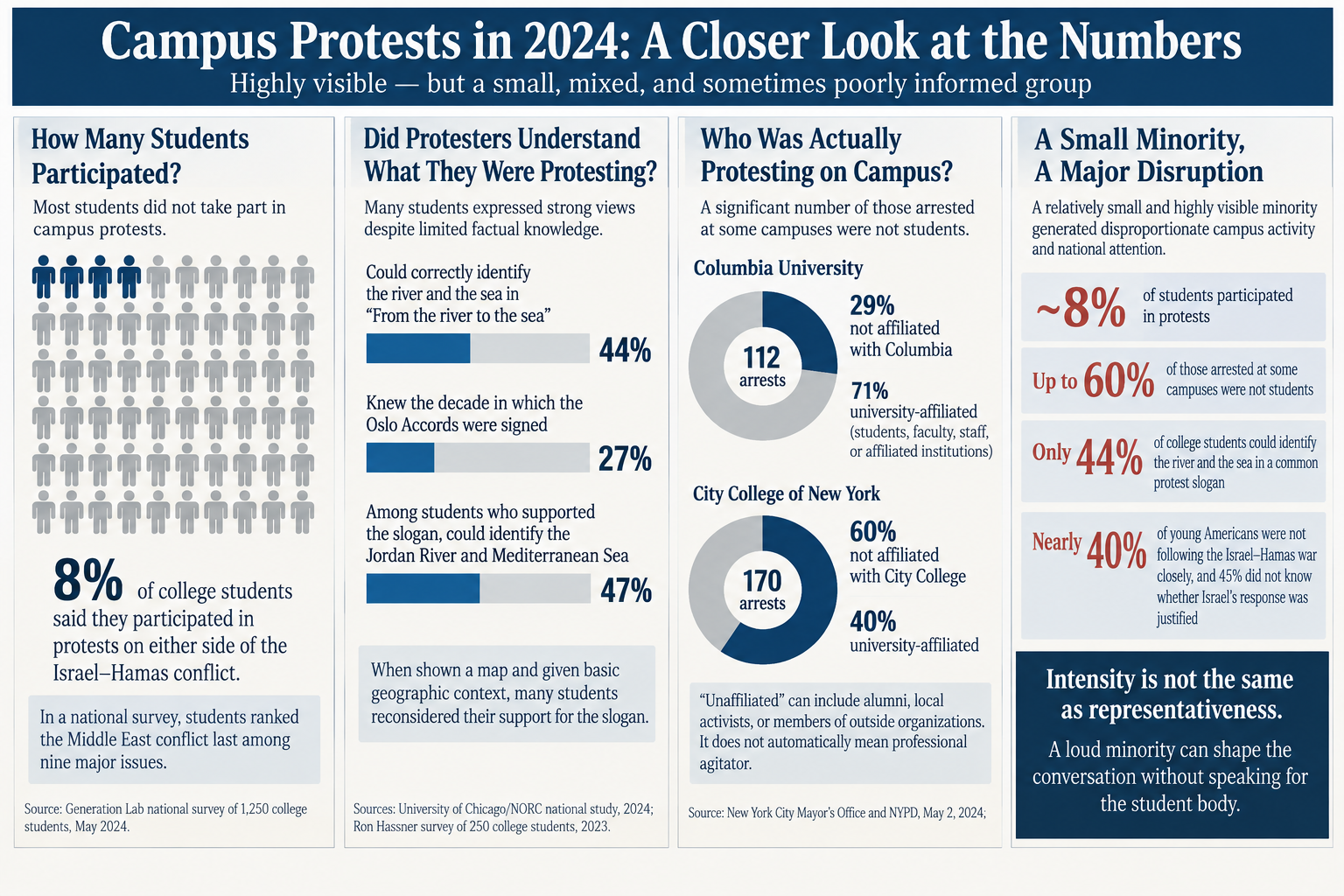
Those facts matter because a university's responsibility is to the entire academic community, not simply to its loudest faction. Intensity is not the same thing as representativeness, and conviction is not the same thing as authority. Campus safety is therefore not a secondary problem involving protest regulations, free speech, or civil-rights law. It is a prerequisite for education.
A university campus should be held to a higher standard than the street outside its gates. Students do not merely visit the campus. They live there, sleep there, eat there, study there, attend class there, and build much of their social world there. Their families are often making an enormous financial and personal commitment to the institution. From a parent’s standpoint, the expectation is remarkably simple. Educate my child, and create an environment safe enough for that education to occur. That does not mean intellectual safety. Students should hear arguments they dislike. They should encounter people they disagree with. They should occasionally feel uncomfortable, perhaps even offended. A university that merely confirms everything an 18-year-old already believes is not doing much educating.
Physical intimidation and coercion are different. A student should not have to calculate whether wearing a Star of David, hijab, political button, or other expression of identity will make crossing the campus hazardous. Students should not have to negotiate an encampment to reach a classroom, be surrounded because of their beliefs, or discover that a dormitory or library has effectively become part of somebody else’s political campaign.
Students remain citizens and are free to participate in political causes. Off campus, they can march, organize, and protest within the law. On campus, the institution has an additional mission. Political expression should coexist with the educational environment rather than commandeer it. A healthy campus should not be devoid of strong convictions or even anger. But an educational institution should expect students to convert conviction into argument rather than intimidation. We do not have to blurt out every thought that enters our minds simply because we possess the right to speak.
The classroom used to help teach that distinction. You listened. You waited. You argued. You learned that the person sitting opposite you was more complicated than the political label you had attached to them.
A campus should be a place where ideas collide, not where people do.
Before Title VI, There Is the Golden Rule
At some point, complicated legal analysis obscures something much simpler: common decency.
Universities now have detailed codes involving inclusion, belonging, dignity, harassment, discrimination, protest, and psychological safety. Those policies serve legitimate purposes, but one of civilization's oldest rules gets remarkably close to the core of the matter:
Treat other people as you would want to be treated.
Would I want my child blocked from class? Would I accept another group deciding that my son or daughter should feel uncomfortable wearing a religious symbol? Would I consider it reasonable for my child to avoid a section of campus because a political organization had effectively taken it over? Would I dismiss my child's concern because the people creating the problem believed deeply in their cause?
If the answer is no, I should not tolerate those conditions for someone else's child either. A university should not need a federal investigation to understand this. Nor should common decency require an accreditation standard or a civil-rights lawsuit. Students may disagree passionately about Israel, Gaza, religion, politics, or almost anything else. They still have an obligation to recognize that the person across from them belongs on the campus too.
University leaders bear greater responsibility because they define the institution's boundaries and decide whether those boundaries mean anything. Protest can be protected without permitting intimidation. Speech can be defended without surrendering access to classrooms, libraries, or shared spaces. Disagreement can be fierce without allowing the most organized faction to dominate the campus. The real test of leadership comes when enforcing those distinctions is unpopular, politically costly, or certain to anger one side. That is precisely when leadership matters most.
Antisemitism Put the Principle to the Test
The scale of what occurred after October 7, 2023 is hard to appreciate until you put the numbers in context. ADL, the Anti-Defamation League, recorded 219 antisemitic incidents on college campuses in 2022. That number rose to 922 in 2023 and then to 1,694 in 2024. Campus incidents rose more steeply than incidents at any other location type in 2024.
Those headline numbers require an important qualification. ADL changed its methodology after October 7 to include some anti-Zionist rhetoric and expressions of support for violent “resistance” that it previously would not necessarily have classified as antisemitic. Of the 922 campus incidents in 2023, 368 were included because of that methodological change. Yet even excluding those newly counted incidents, the 2023 campus total would have been 554, still 153 percent above 2022. The methodological change therefore complicates comparisons, but it does not explain away the underlying increase.
The scale of the surrounding protest movement is equally striking. ADL says it tracked more than 5,000 anti-Israel rallies nationwide during 2024. About half, 2,596, contained signs, chants, or speeches that ADL classified as antisemitic, and 930 of those occurred on college campuses. ADL counts such a rally as one incident regardless of how many qualifying signs or chants occurred there, so these figures should not be confused with thousands of physical assaults or individually targeted attacks. Still, the breadth of the mobilization was extraordinary.
Independent data reinforce the sense of scale. The Armed Conflict Location & Event Data Project, or ACLED, found that demonstrations with a pro-Palestine or anti-Israel component accounted for 28 percent of all demonstration activity it recorded in the United States and Canada in 2024, with roughly 40 percent of those demonstrations occurring on university campuses. This was not a scattering of isolated episodes. Campuses had become one of the principal arenas for a large political movement.
None of that means that every anti-Israel demonstration was antisemitic. ADL itself explicitly says that criticism of Israel and general anti-Israel activism are not automatically counted as antisemitism. Nor does it mean that every Jewish student experienced the campus in the same way. But it makes the institutional challenge much harder to dismiss.
What Did It Feel Like to Be a Jewish Student?
The numbers describing conduct are troubling. The numbers describing student behavior may be even more revealing.
In a national survey conducted by ADL, Hillel International, and College Pulse in late 2024, 41 percent of Jewish students said they had felt the need to hide their Jewish identity. About 13 percent reported withdrawing from campus or social activities, compared with roughly 2 percent of non-Jewish students. Two-thirds said they lacked confidence in their university's ability to prevent antisemitic incidents.
A separate Hillel survey conducted during the 2024 encampments found that 58 percent of Jewish students said the protests and encampments had made it more difficult for them to learn, study, or concentrate. Earlier survey data showed an equally disturbing shift in perceived safety. Before October 7, roughly two-thirds of Jewish students described themselves as physically and emotionally safe on campus. After October 7, fewer than half reported feeling physically safe and only about one-third emotionally safe.
These are survey results, and the organizations sponsoring several of them are themselves deeply engaged in combating antisemitism. They should be interpreted accordingly. But the reported behaviors are difficult to ignore.
Imagine arriving at college at eighteen, perhaps away from home for the first time, and discovering that an important part of your identity has suddenly become politically charged. Even without a direct physical threat, you may begin thinking about what you wear, where you walk, what you say in class, which events you attend, and whether the people around you regard you as a classmate or as a representative of a conflict thousands of miles away. At that point, the damage is no longer limited to an unpleasant political encounter. The conditions for learning have changed. Mental energy that should be available for curiosity, conversation, study, and friendship has been diverted toward vigilance and self-protection.
That should disturb anyone who cares about education, regardless of one's views about the Middle East.
Leadership Matters, and Clear Rules Matter
It is tempting to describe 2024 as an unprecedented situation that simply overwhelmed university administrators. There is some truth in that. Leaders faced difficult questions involving free speech, civil rights, faculty politics, student activism, donor pressure, security, and events unfolding thousands of miles away. But complexity does not excuse paralysis. Nor should administrators confuse the intensity of an activist movement with the student body's wishes. Most students were not participating in the protests. Some disruptive events included large numbers of outsiders. And at least some evidence suggests that conviction outran knowledge.
None of that invalidates protest. It does mean that leadership cannot simply defer to whoever occupies the quad.
The basic boundaries were not particularly exotic. Argue. Protest. Organize. Criticize Israel as harshly as you wish. Defend the Palestinians as passionately as you wish. But do not threaten people, obstruct classrooms, occupy buildings, target students because of religion or ancestry, or seize shared spaces indefinitely.
The latter experience suggests that clearer boundaries actually mattered. More than 160 campuses hosted encampments during the 2023–24 academic year. In 2024–25, that number fell to roughly a dozen, and the remaining encampments were often dismantled quickly. By 2026, 94 percent of the 150 universities assessed by ADL's campus report card prohibited both unauthorized encampments and event disruptions.
Campus antisemitic incidents also fell sharply in 2025, from 1,694 to 583. Incidents related specifically to anti-Israel protests and encampments fell 83 percent, while campus vandalism fell 51 percent and assaults 72 percent. The level remained almost three times higher than in 2021, so the problem did not disappear. But the change strongly suggests that disorder on the scale seen in 2024 was not inevitable. Institutional policies and enforcement appear to have mattered.
That may be one of the episode's most important lessons. When leadership hesitates, the loudest faction can begin governing the campus by default. When leaders establish clear rules and enforce them consistently, behavior changes.
The latest FIRE survey adds another uncomfortable dimension. Its 2026 rankings found record levels of student acceptance of shouting down speakers, blocking access to events, and even, in some cases, violence to prevent campus speech. The newest rankings, released in September 2026, show those numbers declining slightly from those record highs, which is encouraging. Yet half of students still identified the Israeli-Palestinian conflict as difficult to discuss openly and honestly.
That is not a healthy endpoint. Students should not have to choose between silence and confrontation.
On that measure, I find it difficult not to conclude that too many institutions failed in 2024. The failure was not that protests occurred. Universities should be able to accommodate political expression. The failure was allowing the distinction between speech and conduct to become blurred long enough that ordinary students sometimes bore the consequences. At some point this ceases to be a complicated policy question and becomes a question of leadership and common decency.
The Trump Administration and the Civil-Rights Question
The Trump administration has answered the campus antisemitism problem aggressively. Federal agencies reviewed grants and contracts, opened civil-rights investigations, and in Columbia’s case formally found that the university had acted with deliberate indifference toward harassment of Jewish students in violation of Title VI.
That gives the administration a legitimate basis for intervention. Universities receiving federal money are subject to federal civil-rights law, and Jewish students are entitled to protection under those laws just as other students are.
The question of proportionality remains separate. Civil-rights enforcement should protect students from discrimination without turning federal funding into a general mechanism for controlling curricula, faculty hiring, admissions, or academic speech. It is entirely possible to believe that universities failed badly in protecting some students while also being wary of excessive federal intrusion into academic institutions.
Several universities ultimately settled with the administration. Columbia agreed to pay $200 million to the federal government and $21 million in connection with employment claims while retaining authority over academic decisions. Brown agreed to $50 million in Rhode Island workforce-development grants, with no payment to the federal government and no admission of wrongdoing. Cornell agreed to pay $30 million to the Treasury and invest another $30 million in agricultural research while expressly denying liability. Columbia likewise did not admit wrongdoing but acknowledged that Jewish students and faculty had experienced unacceptable incidents and that reform was needed.
Settlement is therefore not an admission of guilt. Universities can rationally settle to restore research funding, end investigations, reduce litigation risk, and move forward.
But settlement is not meaningless either. When institutions agree to strengthen campus protections, alter procedures, conduct climate surveys, or make other reforms, it is fair to conclude that the underlying problem was serious enough to demand attention.
Perhaps the simplest test remains the parental one:
What if it were my child?
Universities speak frequently about inclusion, belonging, dignity, and safety. Those principles have to apply consistently to Jewish students, Muslim students, conservatives, progressives, Israelis, Palestinians, religious students, secular students, and students who simply want to attend class without becoming part of someone else’s political struggle.
A university can require students to tolerate disagreement. It cannot require them to tolerate intimidation.
Charlie Kirk and the Parallel Campus
Charlie Kirk belongs in this discussion for a different reason. Whatever one thought of his politics, he and Turning Point demonstrated that universities no longer have anything close to a monopoly on the intellectual and political lives of college students. Students now move constantly between classrooms and a vast parallel world of podcasts, YouTube, social media, independent organizations, Substack, and AI. Kirk became influential among young conservatives partly because he supplied a political community and an unapologetically conservative argument that some students believed was absent or caricatured within their universities.
That does not mean Kirk or any other outside political figure offered a more balanced education. Political organizations have agendas too. The institutional lesson is that when students believe a serious viewpoint is missing inside the university, they will look elsewhere. This also brings us back to the physical classroom. Online communities make it easy to find people who agree with us. A successful university should do something harder: put us in the same room with people who do not. That may be one of the strongest remaining defenses of campus education.
Pass/Fail, Standards, and the Courage to Say No
Several other important questions in higher education deserve separate essays, but grading belongs here because it goes directly to institutional accountability.
Pass/fail grading is not inherently weak. In medical education, studies have repeatedly found improved student well-being without clear deterioration in conventional academic outcomes. A 2025 scoping review found the evidence strongest for better short-term well-being and preserved preclinical academic performance, while significant uncertainty remains about motivation, clinical grading, learning, stress displacement, residency selection, and other downstream effects.
The problem arises when nobody is willing to say “fail.” Every passing judgment should represent a tangible standard that someone is prepared to own. The institution is, in effect, putting its name on the student and saying that the standard has been met. That becomes particularly serious in certain professions. In medicine, nursing, pharmacy, aviation, and engineering, an overly generous pass is not merely an educational mistake. It can transfer risk from the educational institution to patients, passengers, clients, or the public.
A medical school has a special responsibility. Its diploma does not declare that a student tried hard or completed the required calendar. It is one link in a certification process by which society eventually permits that person to assume responsibility for patients. Compassion matters. Remediation matters. Second chances matter. A demanding educational system does not have to be cruel. But compassion should shape the path to competence; it should not alter the definition of competence.
Institutional incentives also deserve more discussion. Failing a student can feel like admitting something failed upstream. Perhaps the admissions process selected poorly. Perhaps the curriculum did not work. Perhaps faculty missed warning signs or remediation failed. Nobody wants to derail a student’s career, so subtle pressures accumulate to give one more chance, adjust one more threshold, or move the student along. Eventually, however, somebody must be willing to say no. In high-stakes professions, the public is relying on the school to do precisely that.
Innovation, Accreditation, and the Moving Target
This becomes even more complicated when accreditation and curricular reform enter the picture. Accrediting bodies serve an essential function. Society needs assurance that educational institutions meet meaningful standards, especially when graduates will enter regulated professions. But accreditors can drift from defining outcomes toward prescribing methods. Medical education provides a useful example. Harvard’s New Pathway, launched in the 1980s, became highly influential in promoting problem-based learning, small-group work, self-directed study, and reduced reliance on conventional lectures. A later randomized evaluation found meaningful improvements in reflective learning, psychosocial knowledge, relational skills, and humanistic attitudes, but no improvement in measured biomedical knowledge or problem-solving ability compared with the traditional curriculum.
Around the same time, accreditation itself was becoming a force for curricular reform. A 1997 study by officials in the Association of American Medical Colleges reviewed 90 schools and described LCME standards that encouraged integrating basic and clinical sciences, along with active, small-group, independent, and hypothesis-based learning. The authors concluded that accreditation had become a significant force for educational change.
There is nothing wrong with innovation. The best teachers often love it. Finding a better illustration, a more effective case, or a better way to explain something difficult can be one of teaching's pleasures. But innovation has to be balanced against traditions that may have survived because they work. The problem becomes particularly acute when a successful professor is suddenly asked to teach in an unfamiliar way while the institution simultaneously changes the assessment system. Imagine taking someone who has successfully taught a subject for twenty years, telling that professor to replace a familiar method with a new pedagogy, and then asking for greater certainty in a binary pass/fail judgment. The teaching method has changed. The curricular sequence may have changed. The assessment system has changed. Yet we behave as though “pass” means exactly what it meant before.
It is difficult to know which part of the system produced the result when several variables move simultaneously. Accreditation should therefore define the destination and meaningful minimum standards without unnecessarily dictating every turn in the road. Educational pluralism has value. If two schools produce demonstrably competent graduates through different methods, the evidentiary bar should be high before insisting that one abandon a successful model simply because another approach has become fashionable or prestigious.
Sometimes you really do have to teach the alphabet before asking someone to spell.
That is not opposition to critical thinking. It is recognition that critical thinking requires something to think with. Innovation should improve the pathway through the fundamentals rather than eliminate the fundamentals themselves.
Tradition should not be immune from challenge. Innovation should not be immune from proof.
The Conditions in Which Students Can Learn
Several of the issues touched on here deserve essays of their own. How much foundational knowledge should precede problem solving? What has online education gained and lost? Can professionalism really be “taught,” or is much of it acquired from role models, books, stories, and experience? How should colleges measure value added rather than simply celebrating the accomplishments of students who were exceptional before they arrived?
Einstein’s formulation still seems right. Universities cannot force learning. They can provide the conditions in which students can learn.
Those conditions include knowledge, standards, teachers worthy of the title, exposure to competing ideas, physical and intellectual safety, accountability, and a culture in which disagreement is expected but intimidation is not. They also include something so elementary that it is easy to overlook amid policies, task forces, and legal disputes: the expectation that people will treat one another with basic decency. And perhaps another condition belongs on that list: enough intellectual independence to resist the crowd.
Thinking independently does not mean reflexively disagreeing with everyone around you. It means knowing why you agree. It means separating evidence from affiliation, argument from slogan, and conviction from the desire to belong. It means being able to discover that your friends are right without assuming it.
Musk is right that people can increasingly get information elsewhere. Gates and Jobs demonstrated that extraordinary people can leave universities and continue educating themselves. Kirk demonstrated that students will look outside universities when they believe important ideas are missing inside them.
None of this makes higher education obsolete. It simply raises the standard for what universities must contribute. Their competitive advantage may increasingly lie not in possessing information, but in organizing knowledge, creating human relationships, testing ideas, enforcing meaningful standards, exposing students to people unlike themselves, and teaching young adults to reason together.
That is a considerable mission, and it is worth paying for when universities actually accomplish it.
A second Einstein quotation is one I see every day: education is not simply learning many facts, but training the mind to think. The qualification I would add after a lifetime in education is that a mind still needs building blocks, teachers still matter, standards must mean something, the environment matters enormously, and independent judgment does not develop automatically.
Perhaps universities should pay renewed attention to both Einstein's observations.
First, provide the conditions in which students can learn. Then be prepared to demonstrate that the education actually taught them to think for themselves.
Selected References
Gallup. “Confidence in U.S. Higher Education Slips Back Slightly.” July 2026.
Pew Research Center. “Growing Share of Americans Say the U.S. Higher Education System Is Headed in the Wrong Direction.” 2025.
College Board. Trends in College Pricing and Student Aid 2025.
Georgetown University Center on Education and the Workforce. Ranking 4,600 Colleges by ROI. 2025.
U.S. Department of Education. STATS and Earnings Accountability final rule. 2026.
NACUBO/Commonfund. 2025 Study of Endowments.
Foundation for Individual Rights and Expression. 2024 Faculty Survey; 2024, 2026, and 2027 College Free Speech Rankings.
Braghieri L. “Political Correctness, Social Image, and Information Transmission.” American Economic Review. 2024.
Greenberg S, Stone DF. “Self-Censorship in the Classroom.” Journal of Behavioral and Experimental Economics. 2025.
Bursztyn L, Cantoni D, Yang DY, Yuchtman N, Zhang YJ. “Persistent Political Engagement: Social Interactions and the Dynamics of Protest Movements.” American Economic Review: Insights. 2021.
Hassner R. “From Which River to Which Sea?” Helen Diller Institute for Jewish Law and Israel Studies, University of California, Berkeley. 2023.
Generation Lab/Axios. National college-student survey of Israel-Gaza protest participation. May 2024.
New York City Mayor’s Office and NYPD. Columbia University and City College arrest-affiliation data. May 2, 2024.
Veldhuizen L. “Confessions of a Campus Conservative.” National Review. October 2026.
Anti-Defamation League. Audit of Antisemitic Incidents 2023, 2024, and 2025. ADL's post-October 7 methodology should be considered when comparing years.
Anti-Defamation League. Two Years of Turmoil: The Strategic Evolution of Anti-Israel Activism on U.S. Campuses and 2025–2026 Challenges. 2025.
ADL, Hillel International, and College Pulse. Campus Antisemitism One Year After the Hamas Terrorist Attacks. 2025.
Hillel International. Survey of Jewish college students on campus encampments and learning environment. May 2024.
Armed Conflict Location & Event Data Project. United States and Canada Overview. January 2025.
U.S. Department of Education. Columbia University Title VI findings. 2025.
Brown University, Columbia University, and Cornell University. Federal resolution materials. 2025.
Iyer AA, et al. “Should Medical School Grading Be Tiered or Pass/Fail?” Academic Medicine. 2025.
Kassebaum DG, Cutler ER, Eaglen RH. “The Influence of Accreditation on Educational Change in U.S. Medical Schools.” Academic Medicine. 1997.
National Health Service Corps and U.S. Department of Veterans Affairs materials on service-linked education and loan repayment.
Schmitz PG. The Renal System. Learning Innovations, 2020.
