
In Brief
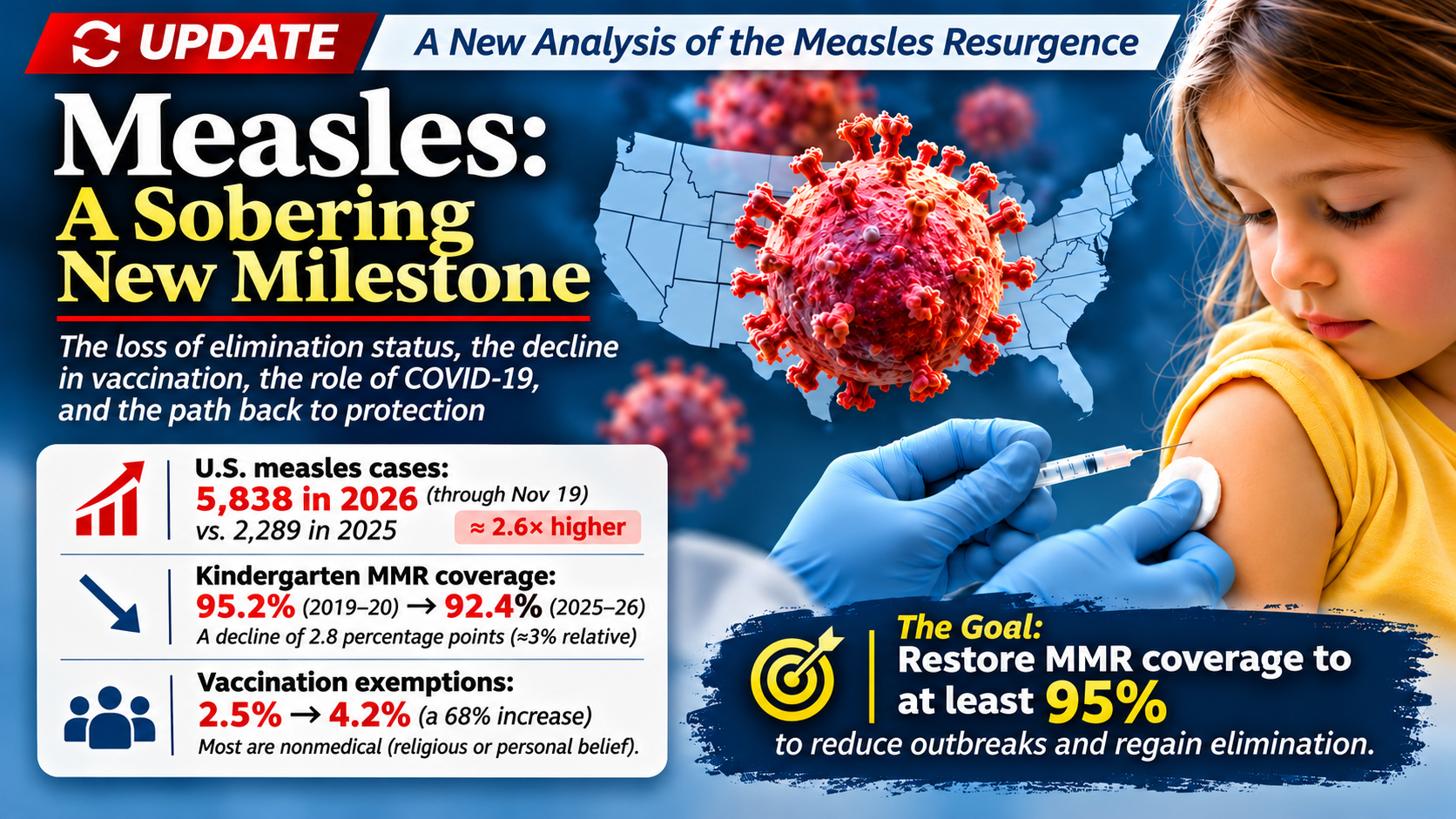
The United States has lost its measles-elimination status for the first time since 2000 after a continuous chain of domestic transmission persisted for more than 12 months. By November 19, 2026, the CDC had reported 5,838 confirmed cases, compared with 2,289 during all of 2025. The warning signs were evident long before the current administration. National kindergarten MMR vaccination coverage fell from 95.2% in 2019–20 to 92.4% in 2025–26, while exemptions from school-required vaccinations rose from 2.5% to 4.2%. COVID-era disruptions contributed to the initial decline, but coverage never fully recovered. As a result, communities with concentrated immunity gaps are increasingly vulnerable to outbreaks.
The scientific priorities are clear, even if implementation is challenging: restore MMR vaccination coverage to at least 95% across communities, close local immunity gaps, strengthen outbreak surveillance, and rebuild public trust. Federal funding and outbreak assistance have been documented, but their measurable effectiveness remains uncertain. Although the resurgence predates Secretary Kennedy's tenure, the current administration shares responsibility with state and local authorities for reversing it. The relevant measure of leadership is not who receives the blame, but whether sustained transmission can be interrupted and elimination status restored.
Opening Thoughts
When I examined the resurgence of measles earlier this year (Read the essay here), the evidence pointed to declining vaccination coverage, concentrated pockets of low community immunity, and outbreaks frequently initiated through international travel. New data have made the consequences of that pattern much clearer.
As of November 19, 2026, the CDC reported 5,838 confirmed measles cases in the United States this year, compared with 2,289 during all of 2025. That represents more than a 2.5-fold increase, with several weeks remaining in the year. Approximately 96% of 2026 cases (5,629 of 5,838) have been associated with outbreaks, including transmission chains that began in 2025. Both annual totals remain preliminary and subject to revision.
The consequences extend beyond case counts. The CDC reports 646 hospitalizations, approximately 11% of confirmed cases, and six deaths currently included in its national surveillance figures. State health departments have reported additional measles-associated deaths, underscoring the importance of distinguishing provisional national mortality statistics from state-level reporting.
On November 17, the Pan American Health Organization formally determined that the United States had lost its measles-elimination status after a continuous transmission chain persisted for at least 12 months. This designation reflects sustained transmission, not simply an increase in annual cases.
Meanwhile, national kindergarten MMR vaccination coverage has declined from 95.2% in 2019–20 to 92.4% in 2025–26, a 2.8 percentage-point decrease. Although the national average is informative, it can obscure communities where vaccination rates fall substantially below the approximately 95% threshold commonly associated with effective community protection.
Even more concerning is the increase in vaccination exemptions. These allow children to attend school without receiving one or more normally required vaccinations. Depending on state law, exemptions may be granted for medical reasons or for religious or personal beliefs. National exemption rates rose from 2.5% in 2019–20 to 4.2% in 2025–26, an increase of 1.7 percentage points, or 68% relative to the original rate. Nonmedical exemptions account for most exemptions, although an exemption from any required vaccine does not necessarily indicate exemption from MMR.
The CDC estimates that approximately 280,000 kindergartners lacked documentation of completing the MMR vaccination series during the 2025–26 school year. Importantly, not all these children have exemptions; some are behind schedule or have incomplete records. Likewise, an exemption from one required vaccine does not necessarily mean a child is unvaccinated against measles.
Together, these trends suggest that the initial disruption of vaccination during COVID-19 has evolved into a more persistent problem involving delayed immunization, increasing exemptions, and declining community protection. The resurgence is not explained by imported infections alone. International travel can introduce the virus, but sustained outbreaks depend heavily on the susceptibility of the communities it reaches.
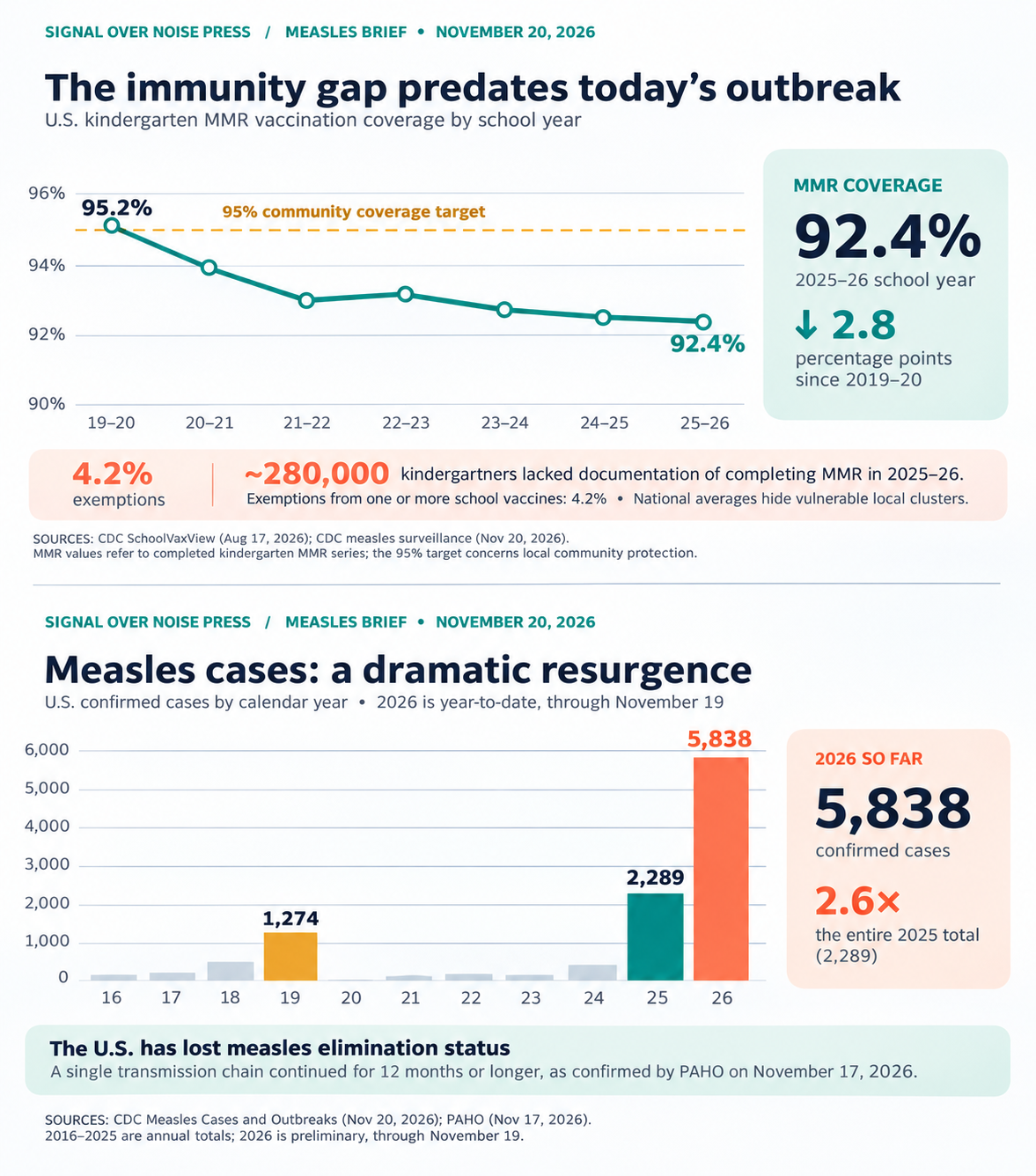
Figure 1. U.S. confirmed measles cases, 2016–2026, and national kindergarten MMR vaccination coverage, 2019–20 through 2025–26. The 2026 case count includes reports through November 20. Cases are reported by calendar/epidemiologic year; vaccination coverage is reported by school year. Sources: CDC Measles Cases and Outbreaks, November 13, 2026; CDC SchoolVaxView, August 17, 2026.
How Did We Get Here? The Role of COVID-19
The timing of declining vaccination coverage deserves closer examination. National kindergarten MMR coverage was approximately 95% immediately before the COVID-19 pandemic. It fell to 93.9% during the 2020–21 school year and to approximately 93% in 2021–22. The steepest decline occurred during the pandemic and its immediate aftermath.
This was not simply a statistical coincidence. CDC investigations documented substantial reductions in routine pediatric vaccination during the early pandemic. Across ten U.S. jurisdictions studied, MMR administration during June–September 2020 remained 8.8% below pre-pandemic levels among children aged 12–23 months and 11.3% below baseline among children aged 2–8 years. Although vaccination activity recovered after restrictions eased, the rebound was insufficient to compensate fully for missed doses.
Disrupted medical visits, parental concerns about infection, school closures, and changes in enrollment and vaccination verification all plausibly contributed. The available evidence does not establish precisely how much of the decline was attributable to any single factor.
More troubling, vaccination coverage never returned to its previous level. Even after schools reopened and routine healthcare resumed, MMR coverage remained below 95% and continued to drift downward. Increasing vaccine exemptions suggest that the problem evolved beyond temporary disruptions in healthcare delivery.
A 2026 study in JAMA Network Open, involving 321,743 children with regular access to healthcare, found that timely first-dose MMR vaccination declined from 79.9% in 2021 to 76.9% in 2024. Over the study period, the proportion without a recorded MMR vaccination by age two increased from 5.3% in 2020 to 7.7% in 2024. Delays in earlier childhood immunizations were strongly associated with subsequent nonvaccination.
These observational findings may not represent every American child and cannot independently establish the causes of changing vaccination behavior. Nevertheless, they reinforce concern that under-vaccination persists even among children who regularly receive medical care.
It is also important to distinguish temporal association from causal attribution. The decline in vaccination coverage began before the current federal administration, and substantial immunity gaps were already present when it took office. Federal, state, and local public-health decisions can influence vaccination access, messaging, surveillance, and outbreak control, but the available evidence does not establish how many infections can be attributed to any particular administration's policies.
COVID-19 therefore helps explain how the decline accelerated. It does not fully explain why the decline persisted. The immediate challenge is no longer simply recovering from a disruption in healthcare delivery; it is restoring sustained confidence, access, and vaccination coverage in communities where immunity is no longer sufficient to prevent transmission.Why Did the United States Lose Its Measles-Elimination Status?
On November 17, the Pan American Health Organization (PAHO) announced that the United States had lost the measles-elimination status it had maintained since 2000. Importantly, elimination does not mean zero measles cases. Countries can experience imported infections and even substantial outbreaks while retaining elimination status, as long as transmission chains are interrupted before they become established. The decisive criterion is whether epidemiologic and laboratory evidence establishes that a continuous chain of domestic measles transmission has persisted for at least 12 months.
PAHO's independent Regional Monitoring and Re-Verification Commission reviewed the evidence and concluded that a transmission chain beginning January 20, 2025, had persisted for at least 12 months. The threshold was reached in January 2026 and formally confirmed in November. The distinction is important. The United States did not lose elimination status simply because of its case count. It lost that status because sustained domestic transmission had been reestablished. Indeed, countries can experience considerably higher measles case rates per capita while retaining elimination status if they have not experienced a continuous transmission chain lasting 12 months. The designation therefore measures the persistence of endemic transmission, not the total burden of disease or an overall ranking of national public-health performance.
The Importance of 95% Vaccination Coverage
Fortunately, the measures necessary to prevent measles are well established. Two doses of MMR vaccine are approximately 97% effective at preventing measles infection. Because the virus is extraordinarily contagious, CDC, WHO, and PAHO generally identify at least 95% two-dose vaccination coverage in every community as an important target for preventing sustained transmission.
National kindergarten MMR coverage currently stands at 92.4%, approximately 2.6 percentage points below that target. Restoring coverage to at least 95% would substantially reduce susceptibility and make sustained transmission less likely. It would be a meaningful, measurable public-health achievement. But a national average alone is insufficient. A state with high vaccination coverage may contain individual counties, schools, or closely connected communities with coverage substantially below 90%. Those vulnerable clusters can sustain outbreaks even when statewide vaccination rates appear reassuring. The distribution of immunity matters as much as the national average.
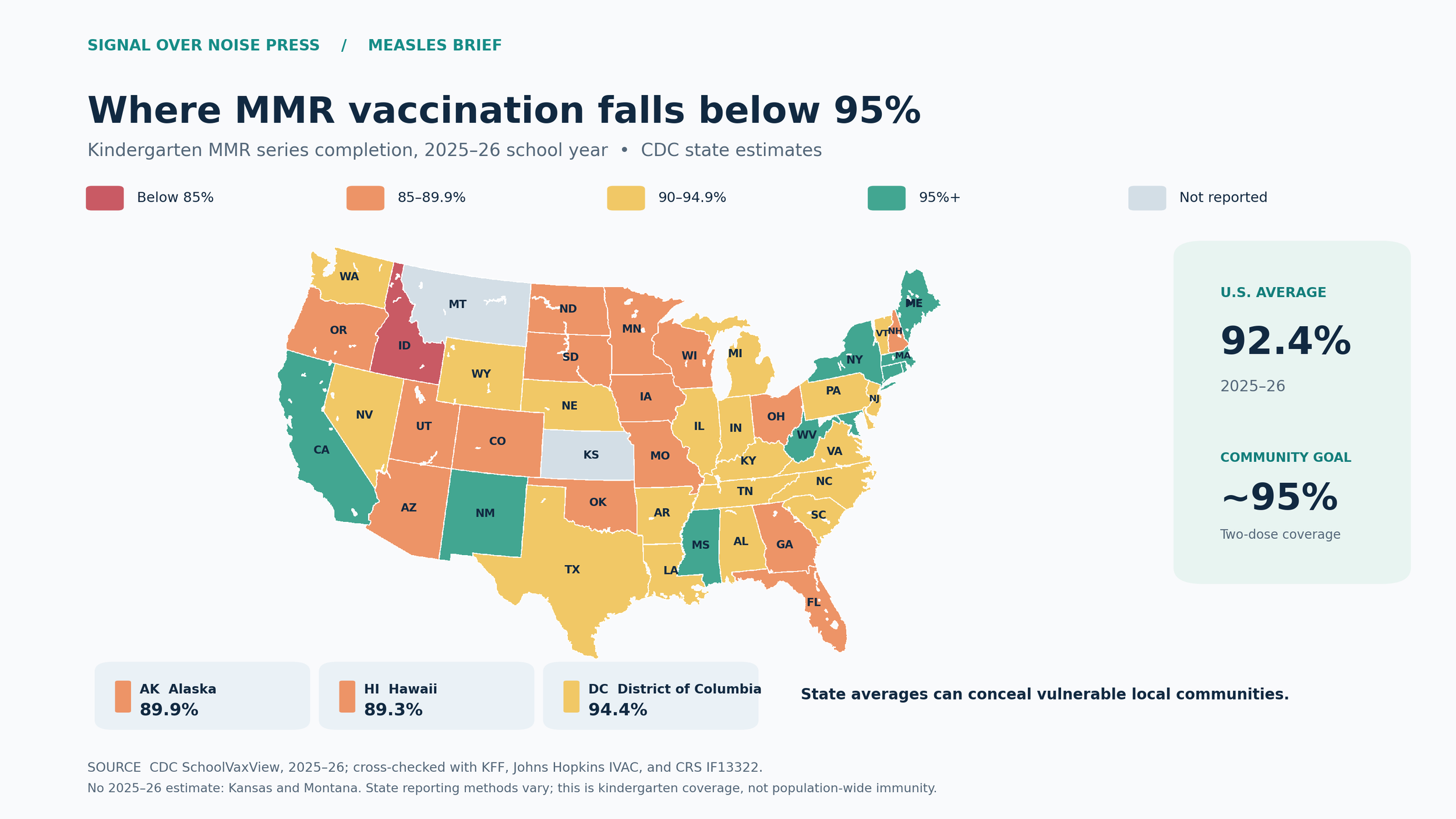
Figure 2. Kindergarten MMR vaccination coverage by state, 2025–26 school year. States are color-coded relative to the approximate 95% community-protection target. Kansas and Montana lack reported coverage estimates. State averages may conceal much lower coverage in individual communities. Source: CDC SchoolVaxView, August 17, 2026.
The practical implication is straightforward. National vaccination coverage should return to at least 95%, but targeted vaccination efforts must also identify and address communities where protection remains substantially lower. That will require catch-up immunization programs, effective school-entry policies, cooperation with local health authorities, and engagement with trusted community and medical professionals. The goal is not simply to improve a national statistic. It is to reduce the number and concentration of susceptible individuals sufficiently to interrupt transmission. Improving kindergarten coverage alone will not immediately close immunity gaps among older children and adults.
Responsibility: What Does the Evidence Actually Show?
The loss of elimination status has understandably generated considerable media attention, much of it focused on Secretary Robert F. Kennedy Jr. and the current administration. Leadership carries responsibility, particularly during a public-health crisis. But responsibility for managing a problem should not be confused with responsibility for creating it.
Epidemiologic evidence shows that the conditions underlying this resurgence developed well before the current administration. National vaccination coverage had been declining for years, with the most pronounced initial decline occurring during the COVID-19 pandemic. Community immunity gaps were already documented. The transmission chain ultimately responsible for the loss of elimination status began before Kennedy's appointment on February 13, 2025.
Those facts significantly limit claims that the current administration caused the resurgence. Recent reporting by the Associated Press, Reuters, The Wall Street Journal, The Washington Post, and The New York Times has emphasized the seriousness of the setback. Some reports have examined federal staffing reductions, changes in vaccination guidance, and concerns about public-health messaging. These are legitimate subjects for investigation. But documenting policy changes or institutional reductions does not prove their independent contribution to additional measles infections, prolonged outbreaks, or deaths.
Conversely, the longstanding decline in vaccination does not establish that subsequent federal decisions were inconsequential. A complete assessment must also consider state vaccination requirements, school exemptions, local public-health capacity, parental decisions, and the concentration of susceptible individuals within particular communities.
What Has the Federal Response Actually Been?
Public discussion has focused heavily on assigning responsibility, with relatively little attention to the federal response itself. That record deserves examination.
Secretary Kennedy publicly recommended MMR vaccination during the initial Texas outbreak in March 2025. Following the November 17 loss of elimination status, the CDC again confirmed that Kennedy and CDC Director Erica Schwartz recommend MMR vaccination as the most effective way to prevent measles.
Federal assistance has also been documented. According to the CDC's November 17 statement, approximately $100 million in additional funding has been provided since August 2026 to strengthen prevention and response to measles and other vaccine-preventable diseases through much of 2027. This includes $50.2 million for vaccination programs, community partnerships, and outbreak response, and $49.8 million for epidemiologic and laboratory capacity. These are funding commitments and allocations, not measures of expenditures completed or outcomes achieved.
CDC reports that it has provided requested epidemiologic assistance to Texas, South Carolina, Virginia, Kansas, New Mexico, and Wisconsin. Pennsylvania and New York have also requested federal assistance. The agency continues national surveillance, outbreak investigations, clinical guidance, and laboratory and epidemiologic support for state and local health departments.
One particularly instructive CDC investigation examined the initial response in West Texas. During January–February 2025, state and local officials organized 33 MMR vaccination clinics and 16 measles testing clinics. Yet those vaccination clinics administered approximately 275 doses. Investigators documented substantial community reluctance toward vaccination and cooperation with contact tracing. This finding illustrates an important limitation of public-health interventions: making vaccines and services available does not guarantee their acceptance. Community trust and engagement remain essential.
Pennsylvania provides a more recent example of an extensive response. According to its November 18 report, about 300 state health personnel participated in outbreak activities. The state conducted 269 pop-up vaccination clinics, administering more than 7,200 MMR doses through them. Statewide MMR administration reached nearly 62,000 doses in October, compared with approximately 25,000 during a typical month. Pennsylvania also documented continuing coordination between its outbreak response team and CDC personnel.
These numbers establish substantial vaccination and public-health activity. They do not, by themselves, demonstrate how much transmission was prevented or how quickly community immunity improved.
The relationship between federal and state surveillance also warrants attention. Pennsylvania has documented disagreements with the CDC over the information required to classify and report measles-associated deaths. The resulting differences in published mortality figures underscore the importance of transparent reporting standards and timely reconciliation. They do not establish that either agency has deliberately misrepresented mortality.
PAHO Director Jarbas Barbosa acknowledged U.S. surveillance, case detection, targeted vaccination, and coordinated public-health efforts in the November 17 CDC statement. Separately, PAHO emphasized that regaining elimination status will require sustained vaccination coverage of at least 95% with two doses in every community, accompanied by effective surveillance and outbreak response.
Also on November 17, a coalition of medical and public-health organizations, including the American Academy of Pediatrics, called for a comprehensive national strategy to regain measles-elimination status. Its recommendations included stronger federal support for state and local outbreak investigations, consistent evidence-based clinical guidance, and implementation of PAHO recommendations. The coalition also expressed concerns about the consistency of federal vaccination messaging. These criticisms deserve consideration alongside the documented federal assistance already underway.
These are established response activities and identifiable concerns. They do not establish that the response was insufficient, but it is also inaccurate to describe the response as an absence of action.
Important questions remain unanswered. How effectively have federal resources reached vulnerable communities? Have vaccination-policy or staffing changes affected outbreak duration, public confidence, or vaccine uptake? What measurable reductions in susceptibility and transmission have resulted from these interventions?
The CDC's November 17 statement outlines priorities for vaccination, surveillance, and community engagement. However, it does not provide a detailed national recovery plan with specific vaccination targets, implementation milestones, and publicly defined measures of success.
The existence of a federal response is established. Its adequacy and measurable effectiveness remain questions requiring further evaluation.
Looking Forward: A Measurable Path Back to Elimination
The current administration inherited a deteriorating situation. It now bears responsibility for helping reverse it. A meaningful national recovery strategy should establish measurable objectives: restoring national kindergarten MMR coverage to at least 95%; identifying and closing local immunity gaps through targeted and catch-up vaccination; strengthening surveillance and rapid outbreak response; and documenting sustained interruption of endemic transmission.
The 95% objective provides a practical benchmark for evaluating progress. Yet a national average alone cannot guarantee elimination if substantial pockets of susceptibility remain. Vaccination coverage must be sufficiently high across individual communities to prevent sustained transmission following imported infections.
Regaining elimination status also requires more than reaching a vaccination target. Under the Pan American Health Organization's re-verification framework, the United States must demonstrate interruption of endemic transmission for at least 12 consecutive months, submit a corrective action plan, and document strengthened vaccination, surveillance, and outbreak-response systems. The evidence must then undergo independent review before elimination status can be formally restored.
Secretary Kennedy and HHS should be expected to present a coordinated strategy developed with state and local health authorities, accompanied by regular public reporting on vaccination coverage, community immunity gaps, outbreak duration, and progress toward re-verification. These measures would permit an assessment of whether the response is producing meaningful improvements rather than simply generating activity.
Accountability should be measured by results—not announcements, funding commitments, or political arguments.
Closing Thoughts
Measles remains a highly contagious but preventable disease. Its resurgence represents a significant public-health failure, and the loss of elimination status is a sobering milestone. Vaccination coverage declined during the COVID-19 pandemic, remained depressed after routine services resumed, and created vulnerabilities long before the present administration assumed responsibility.
That history should neither be ignored when assigning responsibility nor used to excuse inadequate action today.
The scientific priorities are clear: restore vaccination coverage, identify and protect vulnerable communities, strengthen public-health surveillance, and interrupt sustained transmission. The practical challenge is translating those priorities into an effective national strategy, with measurable objectives and transparent reporting of results.
As physicians and citizens, we should insist on distinguishing what the evidence establishes from what we suspect or infer. That standard applies equally to public officials, scientific institutions, and news organizations. Accountability does not require proving that today's leaders created yesterday's problems. It requires evaluating what they do about those problems now.
The measles resurgence predates this administration. Its response—and the results of that response—will become part of its public-health record.
References
Primary epidemiologic, scientific, and public-health sources
CDC. Measles Cases and Outbreaks. Updated November 20, 2026; data through November 19.
PAHO. Measles and Rubella Elimination: Regional Monitoring and Re-Verification Commission.
CDC. Joint Statement: Loss of U.S. Measles Elimination Status. November 17, 2026.
Contemporary reporting and analysis
Reuters. US Loses Measles Elimination Status After Nearly Three Decades. November 17, 2026.
Reuters Investigates. How Kennedy Let Measles Run Wild in America. November 17, 2026.
Investigative reporting examining federal leadership, CDC staffing, vaccination trends, and outbreak response. Its conclusions concerning responsibility should be distinguished from independently demonstrated causal effects.
The Wall Street Journal. Vaccination Is Down. Measles Is Up. November 18, 2026.
The Washington Post. U.S. Loses Measles-Elimination Status. November 13, 2026.
