
In Brief
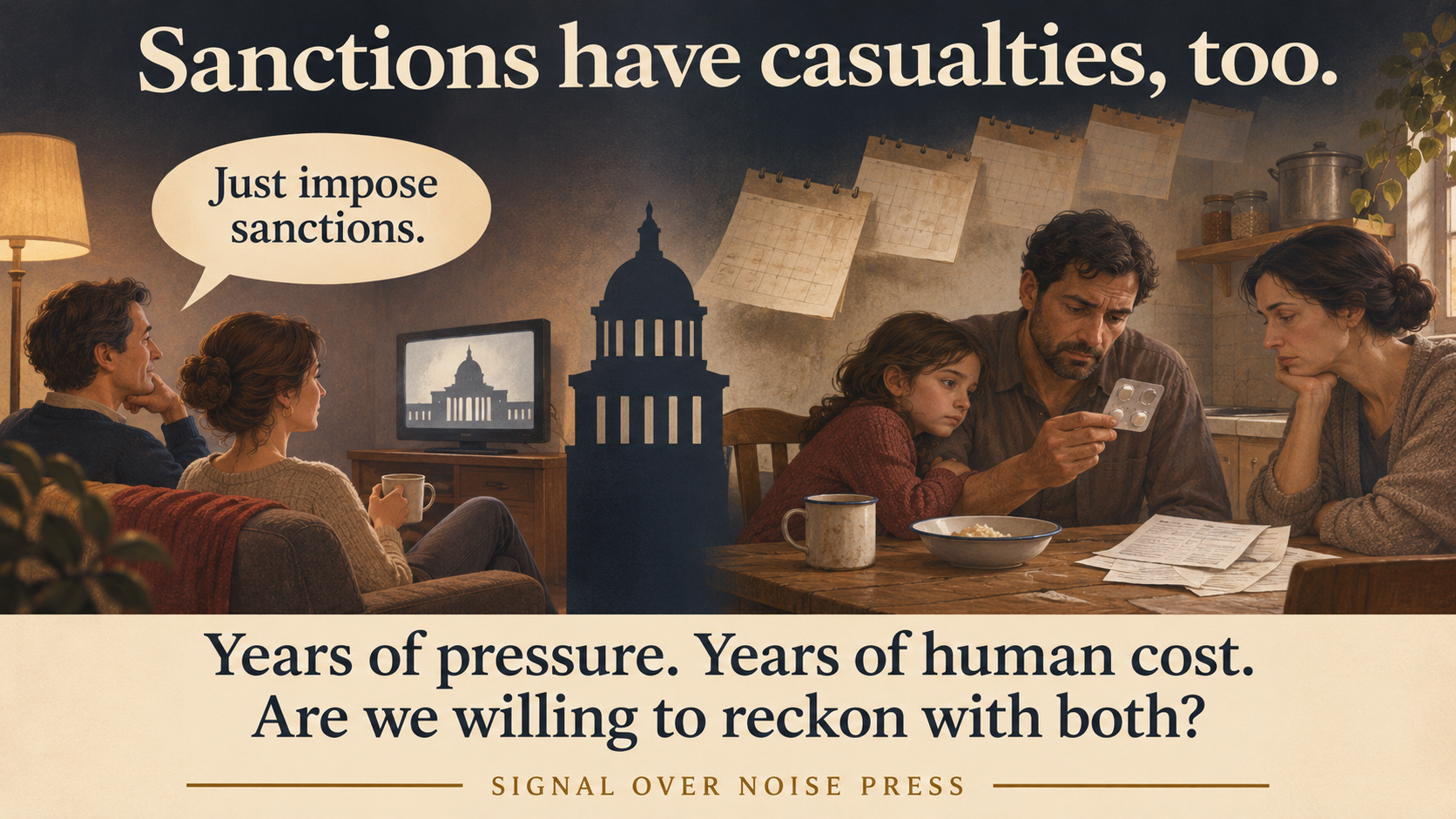
Economic sanctions are a familiar response to aggression, repression, and threats to international security. Their appeal is understandable. They offer a way to exert pressure without resorting to military strikes. However, their record of securing political concessions is mixed, and their costs can reach far beyond the government they target. In Iran, physicians documented interruptions in treatment for patients with serious blood disorders. Broader studies associate sanctions with higher mortality, although the size of the effect and how much can be attributed to sanctions remain uncertain. Even when sanctions help achieve a political objective, we still have to ask whether the result justified the suffering along the way.
Author’s Reflection
For years, I regarded economic sanctions as one of the more useful instruments of foreign policy. When a government engaged in aggression, violated human rights, or threatened international security, sanctions seemed to offer a restrained response. We could restrict trade and financing and press for negotiations without sending soldiers into battle.
I understood that sanctions caused economic hardship. But I had not adequately connected that hardship to the people who would bear it. I thought more about the government we hoped to influence than about the family trying to buy food, the worker losing a job, or the patient unable to obtain essential medicine. Somewhere along the way, I allowed nonmilitary to become something close to benign. I regret my naïveté.
Sanctions can constrain weapons programs, disrupt financial networks, and contribute to negotiated settlements. Yet some last for decades without achieving their stated political objectives, while citizens with little influence over their leaders endure the consequences. The costs can reach allies and push governments into closer relationships with rival powers. I began by asking whether sanctions work. I found myself asking something harder. Even when sanctions secure a political concession, how do we weigh that gain against the hardship they may impose on people living in the country under sanctions? Americans may feel some of the economic fallout indirectly. For families in the targeted country, a lost paycheck or a medicine they can no longer get can upend a life that was already precarious. These are people doing what most of us do, trying to earn a living and care for their families, often with little say in the decisions that brought on sanctions. It’s hard to know how many went without food or missed treatment because of sanctions. That hardship is easy to overlook when we ask whether the policy worked.
How Sanctions Evolved and Who Bears the Cost
Governments have long used trade to put pressure on one another. For centuries, one of the bluntest tools was the naval blockade. During the First World War, Britain and its allies restricted shipments to Germany to deprive it of supplies needed to fight. The blockade also deepened food shortages among German civilians. After the war, the architects of the League of Nations adapted that wartime instrument for peacetime. They hoped that the threat of losing access to foreign trade and credit would deter aggression.
The League tested that idea in 1935, after Mussolini’s Italy invaded Ethiopia. Members restricted trade and lending but stopped short of an oil embargo. Italy went on to occupy Ethiopia. A decade later, the United Nations Charter gave the Security Council authority to restrict economic relations without using armed force. The means of applying pressure would grow more varied in the decades that followed, but the old question remained. How do you put enough pressure on a government to change its course without upending the lives of people who had little say in its decisions?
Modern sanctions range from freezing a targeted individual’s assets to restricting an entire country’s access to banking, trade, and technology. The reach of those measures grew as trade and finance became more interconnected. A government can disrupt a transaction far beyond its borders if the transaction depends on banks, services, or technology under its jurisdiction. By 2021, the U.S. Treasury described sanctions as a first-resort tool.
To judge the political effects of sanctions, we first have to know what they were designed to achieve. Were they meant to slow military procurement or to persuade a government to change a policy? We ask less often about the people living under those sanctions. Who could no longer afford food or get the medicine they needed? Those consequences are harder to measure and uncomfortable to confront, even when sanctions achieve their stated goal.
The Outcome of Sanctions
In the 2007 third edition of Economic Sanctions Reconsidered, Gary Hufbauer and colleagues at the Peterson Institute for International Economics rated 70 of 204 observations, or 34%, as at least partially successful. Those observations came from 174 case studies, some with multiple targets, objectives, or phases. Robert Pape’s 1997 analysis used an earlier sample drawn from the 1990 second edition. He found five successes among 115 cases, fewer than 5%. Hufbauer and colleagues, Table 6.1, Pape’s reanalysis. The two studies differ, but neither inspires much confidence that sanctions will achieve their political aims. Given that uncertainty, how much hardship can we justify imposing on the people who live under them?
Hufbauer and colleagues scored both how much of the objective was achieved and how much sanctions contributed. A meaningful contribution to a partially achieved goal could count as a success. Pape required a substantial concession after sanctions were threatened or imposed and judged whether another explanation, such as military force, better accounted for the change. Neither study tells us whether the gains justified the costs.
South Africa is often cited as a sanctions success. Nevertheless, questions remain as to how much sanctions alone contributed to the end of apartheid. Economic pressure intensified in the 1980s as South Africans organized strikes and protests. The principal U.S. sanctions were in force from 1986 to 1991, and negotiations to end apartheid had already begun when those measures were lifted. Nelson Mandela and the African National Congress supported sanctions during the struggle. Mandela called for them to end in 1993, as the transition advanced. Domestic resistance helped build support for sanctions abroad, and sanctions may in turn have strengthened the opposition’s hand at the negotiating table. Because those pressures reinforced one another, the timing alone cannot tell us how the transition would have unfolded without sanctions. It is also hard to separate the hardship sanctions added from the hardship apartheid itself had long imposed.
Iran has lived under successive waves of U.S. sanctions since 1979. The first measures came during the hostage crisis, when the Carter administration froze Iranian government assets. After the United States designated Iran a state sponsor of terrorism in 1984, restrictions expanded to address Iran’s support for armed groups and, over time, its military capabilities. In 1995, Washington broadly barred U.S. trade and investment with Iran. The following year, Congress authorized sanctions against foreign companies making certain investments in Iran’s petroleum sector. By then, U.S. policy was reaching beyond American companies to influence who else would do business with Iran.
Iran’s nuclear program brought a new wave of restrictions. Beginning in 2006, the UN Security Council imposed measures aimed at Iran’s nuclear and missile activities. In the early 2010s, the United States tightened restrictions on banks doing business with Iran, and the European Union imposed an oil embargo. The pressure on oil revenue and access to banking helped give Iran a reason to negotiate. Under the 2015 nuclear agreement, Iran accepted verifiable limits on its nuclear program in exchange for relief from specified sanctions. International inspectors verified that Iran had taken the initial steps required for that relief in January 2016.
Decades of sanctions and diplomacy had helped produce a verifiable nuclear agreement, although several key restrictions were scheduled to expire over time. The Trump administration regarded those expiration dates as a serious weakness, arguing that the agreement would leave Iran able to expand its nuclear activities later. It also objected that the deal failed to address Iran’s ballistic missile program and its support for terrorism and armed groups threatening Americans and U.S. allies. In 2018, the United States withdrew and restored sanctions under its “maximum pressure” campaign.
Beginning in 2019, Iran progressively stepped back from its nuclear commitments. Washington renewed maximum pressure in February 2025. Later that year, France, Germany, and the United Kingdom invoked the agreement’s “snapback” process, citing Iran’s failure to meet its commitments. Earlier UN sanctions returned in September. The agreement had secured measurable nuclear limits for a time, but its durability depended on continued cooperation among governments with sharply different views of what it should accomplish.
Behind this history are the people who live in Iran—an estimated 92.4 million in 2025, according to the United Nations Population Fund. They include parents trying to provide for their children, workers trying to earn a living, and older people who depend on regular medical care. Many have little influence over their government’s nuclear policy or its support for armed groups abroad. Yet restrictions on trade and banking can reach deeply into their lives, making imports harder to obtain, threatening livelihoods, and adding pressure to household budgets already strained by inflation. For families with little financial cushion, a lost income or an unavailable medicine can undo what little stability they have managed to build.
Some of those consequences were visible well before the nuclear agreement. Between 2009 and 2012, physicians in southern Iran documented worsening access to essential medicines and deteriorating health measures among patients with specific blood disorders. Sanctions operate alongside domestic policy failures and other economic pressures, making their separate contribution difficult to measure. We cannot reliably count every missed treatment, depleted savings account, or disrupted childhood attributable to sanctions. Those losses are easy to overlook when we judge the diplomatic outcome. A government can spend years under economic pressure while a patient who needs treatment may have only days to wait.
Russia shows how restrictions can hinder procurement while leaving room for circumvention. After Russia’s full-scale invasion of Ukraine in 2022, the United States and its allies expanded sanctions and export controls. A September 2025 Government Accountability Office report found that export controls hindered Russia’s access to U.S. military technology and documented ways Russia circumvented some restrictions. GAO also found that U.S. agencies lacked objectives tied to measurable targets, limiting their ability to assess the overall effort.
Russia’s oil trade shows how much can shift to other markets. Between 2020 and 2024, Europe’s share of Russian crude oil and condensate exports fell from 51% to 12%. Asia and Oceania’s share rose from 41% to 81%, with China and India receiving most of those exports in 2024. Russia found buyers and grew more dependent on them. Countries imposing restrictions have to account for how trading partners and competitors will respond.
Libya illustrates how sanctions can help secure a specific, achievable concession. The UN imposed sanctions in 1992 to press Libya to cooperate with terrorism investigations, including the Lockerbie bombing. In 1999, Libya handed over two suspects for trial and met the conditions for suspending the measures. Further commitments led the Security Council to lift the sanctions formally in 2003. Sanctions and diplomacy worked together toward demands Libya could meet in exchange for identifiable relief.
This may be one of sanctions’ strongest uses. A government knows what it must do, compliance can be verified, and meeting the demands brings relief. The years required, and the costs to civilians, still belong in the assessment, but Libya shows how a defined objective can produce a result that can be evaluated.
The Humanitarian Cost We Too Often Overlook
We have already seen how sanctions can reach ordinary families. The harder task is determining how many people are harmed and how severely. Independent researchers may have limited access to affected communities, reliable records, or information governments are willing to release. That makes the human consequences easier to overlook. When broad restrictions disrupt trade and banking, it is reasonable to expect that some people—and potentially many—will struggle to obtain necessities, even when safeguards are intended to protect them. The available research gives us an incomplete but troubling view of that hardship.
Consider what it takes to get an exempt medicine to a patient. A hospital places an order. A bank declines to process the payment because it fears running afoul of sanctions. The supplier holds the shipment until it is paid. The distributor runs out of stock, and the hospital has no readily available substitute. The exemption is still in force when the patient misses treatment. This is one way overcompliance can cause harm. An intermediary avoids a lawful transaction because it considers the compliance burden or the risk of error too high.
A small study from southern Iran clearly highlights the healthcare stakes. Physicians Mehran Karimi and Sezaneh Haghpanah examined access to treatment in 2009 and 2012, surveying 69 patients with thalassemia, 40 patients with congenital coagulation disorders, and 20 physicians. They also compared clinical and laboratory measures. Patients with transfusion-dependent thalassemia receive repeated blood transfusions. Over time, iron accumulates and can damage the heart, liver, and endocrine system. Medicines called iron chelators help remove the excess. In the Iranian study, reported access to deferoxamine (an iron chelator) fell by nearly 70%, and access to deferasirox, sold as Exjade, fell by about half. Iron levels rose, consistent with a worsening iron burden. For patients with hemophilia A, replacement factor VIII helps prevent or treat bleeding. Reported access to one form of factor VIII concentrate fell from 96.7% in 2009 to 3.3% in 2012. The researchers also documented worsening joint disease, a consequence consistent with repeated bleeding into joints. This study was small and observational. It documented deteriorating access and worsening clinical measures. It did not measure deaths or establish how much of the shortage was due to sanctions, domestic procurement problems, or other decisions. What it gives us is a view of what disrupted access can mean for people who depend on regular treatment.
The broader evidence is concerning. A 2023 systematic review identified 185 publications on sanctions and health. Of 27 quantitative studies without identified data-integrity problems, 21 consistently reported adverse effects across the outcomes they examined. The reviewers also found important methodological limitations. War, domestic policy, and other economic shocks can affect health at the same time as sanctions, making it difficult to separate their effects.
Francisco Rodríguez and colleagues examined mortality data and sanctions across 152 countries from 1971 through 2021. They used statistical models to estimate how mortality changed under sanctions, adjusting for measured differences between countries and other conditions that could affect survival. Their estimate of approximately 564,000 excess deaths per year associated with unilateral sanctions applies to 2012–2021, as labeled in Table 5 of their study. “Excess deaths” means deaths above the number their model estimated would have occurred without those sanctions. The reported 95% confidence interval ranged from approximately 368,000 to 761,000 deaths annually, indicating substantial statistical uncertainty even within the model.
In their report, Unilateral sanctions refers to restrictions imposed outside the UN framework, including measures imposed by the United States or the European Union. Such restrictions can affect trade and access to finance well beyond the sanctioning country’s borders. The researchers found some of their strongest mortality associations in this category. For UN sanctions, the results were too uncertain to establish a statistically significant effect. That finding leaves open the possibility of substantial harm from UN sanctions as well.
The scale of the estimate warrants attention, but its meaning still depends on the study’s methods and assumptions. Researchers cannot observe what would have happened to the same population during the same years without sanctions. They must estimate that comparison. War, government decisions, economic instability, and weaknesses in healthcare systems can influence both the results. Statistical methods help account for those factors, but uncertainty about causation remains beyond the reported confidence interval. The study provides evidence of potentially extensive human harm, while the precise number of deaths attributable to sanctions remains open to scrutiny.
A separate 2025 study by Gibson and colleagues examined restrictions on foreign aid between 1990 and 2019. The researchers estimated about 129 additional infant deaths and 11 additional maternal deaths per 100,000 live births per year, corresponding to increases of about 3.1% and 6.4% relative to the study averages. These estimates concern aid sanctions specifically. They show why duration belongs in the accounting. When additional risks persist, the harm can accumulate year after year.
Iraq offers a reason to be careful with large numbers. Estimates of hundreds of thousands of additional child deaths during the sanctions era were widely circulated. Later demographic research found serious problems with the survey data behind those estimates. The hardship warrants investigation, but claims about the number of deaths require credible evidence.
The burden can also be uneven. Officials and people with political connections may retain access to imports or profit from smuggling. Families with little savings have less room to absorb higher prices or shortages. A patient who needs factor VIII has little room to wait. The people who bear those costs may have almost no influence over the policy their government is being pressed to change.
Success at What Cost
In medicine, we ask what an intervention does for the patient, what adverse effects it causes, and how its benefits and risks compare with the available choices. A better laboratory result is one piece of that judgment. Sanctions deserve comparable scrutiny. The assessment should include the political result, how much the restrictions contributed, how long they took, and what happened to civilians in the meantime.
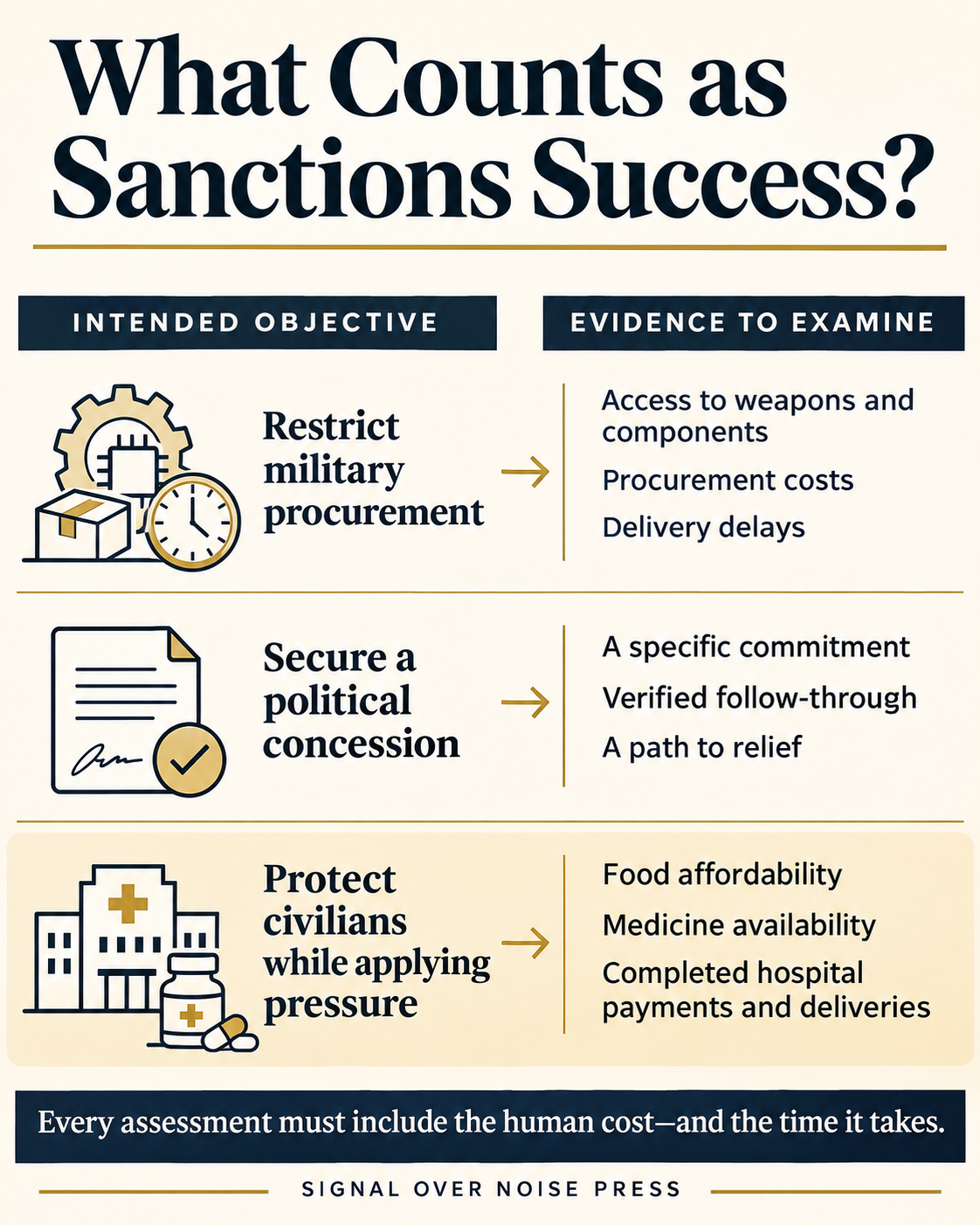
Judge sanctions by what they achieve—and what ordinary people in the sanctioned country endure along the way.
The alternatives also carry risks. Restrictions can disrupt the financing of aggression, slow weapons procurement, and help protect people outside the sanctioned country. Diplomacy can fail, and military intervention can exact an even greater cost. Those possibilities belong in the same assessment as the hardship people living under sanctions experience.
The accounting should begin when sanctions are designed and continue while they are in force. Was imposing them reasonable given what we knew at the time? Is continuing them justified when the anticipated concession remains elusive, and the costs accumulate? In 2019, GAO reported that U.S. agencies had assessed economic effects but had not determined how effective sanctions were in achieving broader foreign-policy objectives. Its 2025 Russia report found a related gap in measurable targets.
A serious sanctions policy should state what it aims to achieve, how progress will be measured, when the measures will be reviewed, and what will qualify the targeted government for relief. The humanitarian safeguards should be just as concrete. Each month, agencies could track the share of exempt essential-medicine orders that participating hospitals successfully paid for and received by the date they were needed. A rejected payment or missed delivery would trigger a review to identify where the order stalled and arrange a working payment or shipping route. A patient’s treatment depends on the order making it all the way through.
I still believe diplomacy deserves every reasonable opportunity before military force. I also know how easily I once assumed that an economic measure must be the more humane choice. Whether sanctions are warranted depends on what they are likely to achieve and who will bear the consequences.
We readily count frozen assets, reduced exports, and lost government revenue. We are less practiced at asking who went without treatment, who lost a livelihood, and whether years of hardship produced an improvement proportionate to their cost.
I began by asking whether sanctions work.
I now realize that even a “yes” leaves the hardest question unanswered.
Was it worth it—and for whom?
Selected References
U.S. Department of the Treasury. The Treasury 2021 Sanctions Review. 2021. Report
Hufbauer GC, Schott JJ, Elliott KA, Oegg B. Economic Sanctions Reconsidered. 3rd ed. Peterson Institute for International Economics, 2007. Chapter 6 and Table 6.1
Pape RA. Why economic sanctions do not work. International Security. 1997, 22(2), 90–136. Article
U.S. Department of the Treasury. South African Transactions Regulations. Federal Register, July 12, 1991. Final rule
United Nations Special Committee against Apartheid. A/AC.115/L.696. 1993. Record of Mandela’s appeal
Levy PI. Sanctions on South Africa: What did they do? American Economic Review. 1999, 89(2), 415–420. Article
United Nations Security Council. Resolution 2231 (2015) and the Joint Comprehensive Plan of Action. Implementation timeline
International Atomic Energy Agency. Verification and monitoring in the Islamic Republic of Iran in light of United Nations Security Council resolution 2231 (2015). GOV/2025/8. Report
U.S. Government Accountability Office. Russia Sanctions and Export Controls: U.S. Agencies Should Establish Targets to Better Assess Effectiveness. GAO-25-107079, 2025. Report
U.S. Energy Information Administration. Russia’s oil exports have decreased modestly since 2022, shifting toward Asia. August 7, 2025. Analysis
United Nations Security Council. Libya sanctions. 1999 report on suspension, Resolution 1506 (2003) lifting the measures
Karimi M, Haghpanah S. The effects of economic sanctions on disease specific clinical outcomes of patients with thalassemia and hemophilia in Iran. Health Policy. 2015, 119(2), 239–243. Article
Pinna Pintor M, Suhrcke M, Hamelmann C. The impact of economic sanctions on health and health systems in low-income and middle-income countries: a systematic review and narrative synthesis. BMJ Global Health. 2023, 8(2), e010968. Article
Rodríguez F, Rendón S, Weisbrot M. Effects of international sanctions on age-specific mortality: a cross-national panel data analysis. The Lancet Global Health. 2025, 13(8), e1358–e1366. Article, Full text and Table 5
Gibson RM, et al. The impact of aid sanctions on maternal and child mortality, 1990–2019: a panel analysis. The Lancet Global Health. 2025, 13(5), e820–e830. Article
Dyson T, Cetorelli V. Changing views on child mortality and economic sanctions in Iraq: a history of lies, damned lies and statistics. BMJ Global Health. 2017, 2, e000311. Article
U.S. Government Accountability Office. Economic Sanctions: Agencies Assess Impacts on Targets, and Studies Suggest Several Factors Contribute to Sanctions’ Effectiveness. GAO-20-145, 2019. Report
