
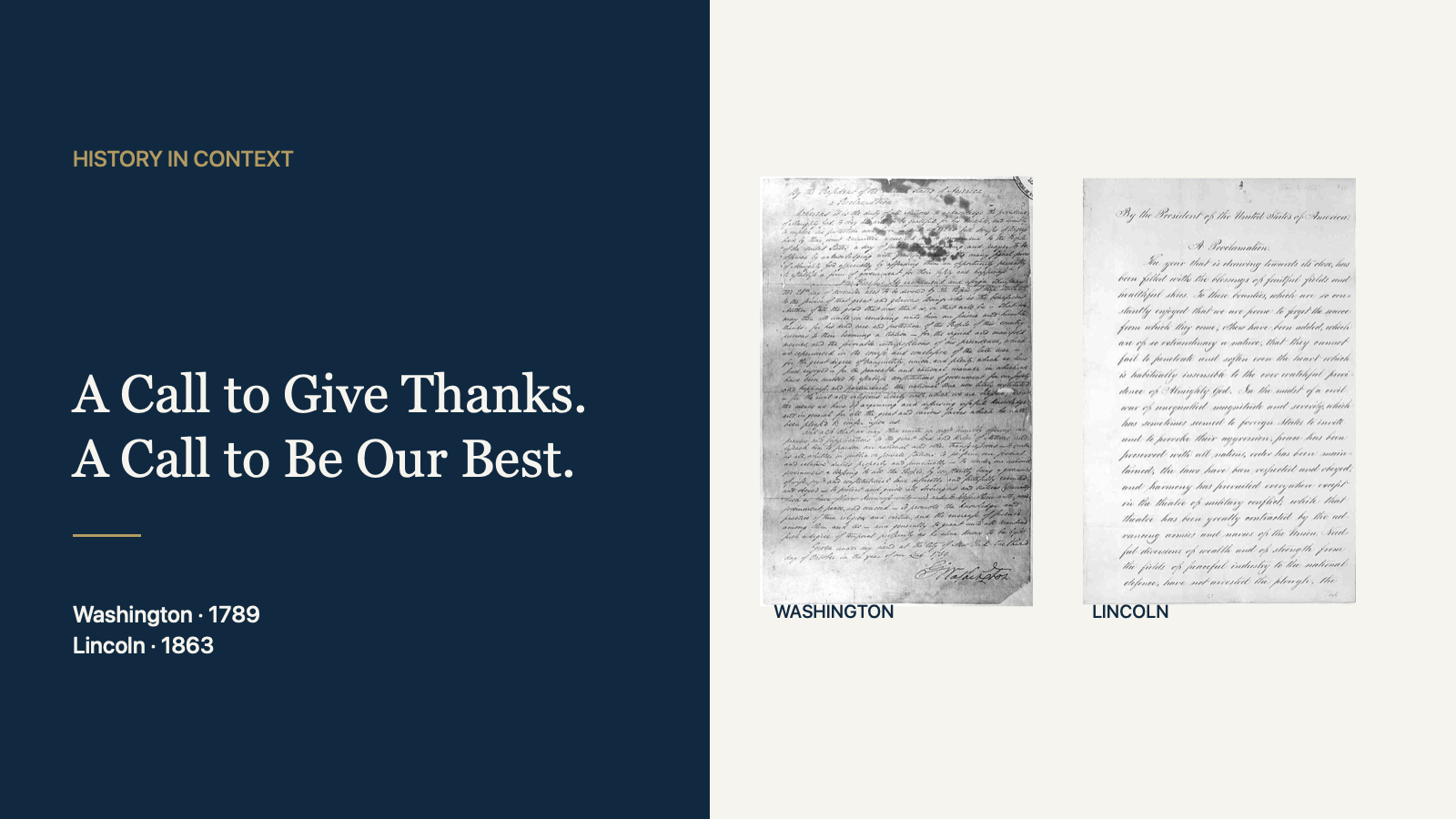
Thanksgiving proclamations of George Washington (1789) and Abraham Lincoln (1863). Document images: National Archives.
HISTORY IN CONTEXT · November 26, 2026
Like many Americans, I grew up associating Thanksgiving with the Pilgrims, Native Americans, and a successful harvest at Plymouth in 1621. I had given surprisingly little thought to how Thanksgiving actually became a national holiday or what its origins might teach us.
In revisiting its history, I found something far more meaningful than I had anticipated.
In 1789, at the request of Congress, George Washington issued a national Thanksgiving proclamation. Our Constitution was new, and the American experiment in self-government was largely untested.
What struck me about Washington's words was that, alongside his expression of gratitude, he asked for forgiveness:
“to pardon our national and other transgressions”
He also called upon Americans to fulfill their individual responsibilities and promote:
“wise, just, and constitutional laws, discreetly and faithfully executed and obeyed”
Seventy-four years later, with the nation engulfed in civil war, magazine editor Sarah Josepha Hale appealed to Abraham Lincoln to establish Thanksgiving as:
“a National and fixed Union Festival.”
Five days later, on October 3, 1863, Lincoln issued his proclamation. Despite the recent victories at Gettysburg and Vicksburg, his words were not ones of triumph. He asked Americans to remember those who had suffered and appealed to the Almighty:
“to heal the wounds of the nation”
And to restore the country to:
“the full enjoyment of peace, harmony, tranquillity and Union.”
Washington was attempting to establish a republic. Lincoln was attempting to preserve it. Neither regarded gratitude as incompatible with acknowledging our national shortcomings.
Perhaps that is what I had missed all these years. Thanksgiving was not simply a call to give thanks. It was also a plea for unity and a reminder of our collective and individual responsibility to get better.
Nearly two and a half centuries into the American experiment, those words still resonate.
The enduring question
Can we be grateful for what we have, recognize where we have fallen short, and commit ourselves to becoming better—as individuals and as a nation?
Happy Thanksgiving.
Primary sources
George Washington — Thanksgiving Proclamation, October 3, 1789. Smithsonian Institution.
Sarah Josepha Hale — Letter to Abraham Lincoln, September 28, 1863. Library of Congress.
Abraham Lincoln — Thanksgiving Proclamation, October 3, 1863. National Archives.
History in Context · Signal Over Noise Press
