
The Tool Is New. The Responsibility Is Not.
How augmented intelligence can help physicians use medical information
without surrendering clinical judgment
Companion reading: This essay focuses on how physicians can use artificial intelligence responsibly in patient care. My recent Signal Brief, “AI Doomsday: What Can We Really Know?”, examines a very different part of the AI debate: increasingly autonomous systems, loss of human control, and catastrophic predictions about where advanced AI may eventually lead. The two pieces are intended to be read together. One asks what advanced AI might become; this one focuses on how physicians should use the tools already entering clinical medicine.
Not All AI Is the Same
Artificial intelligence has acquired a frightening reputation. Patients hear about systems that “hallucinate,” computers becoming autonomous, jobs disappearing, machines behaving unpredictably, and even predictions that advanced AI may someday escape human control. Against that backdrop, learning that your physician is using AI could understandably sound unsettling.
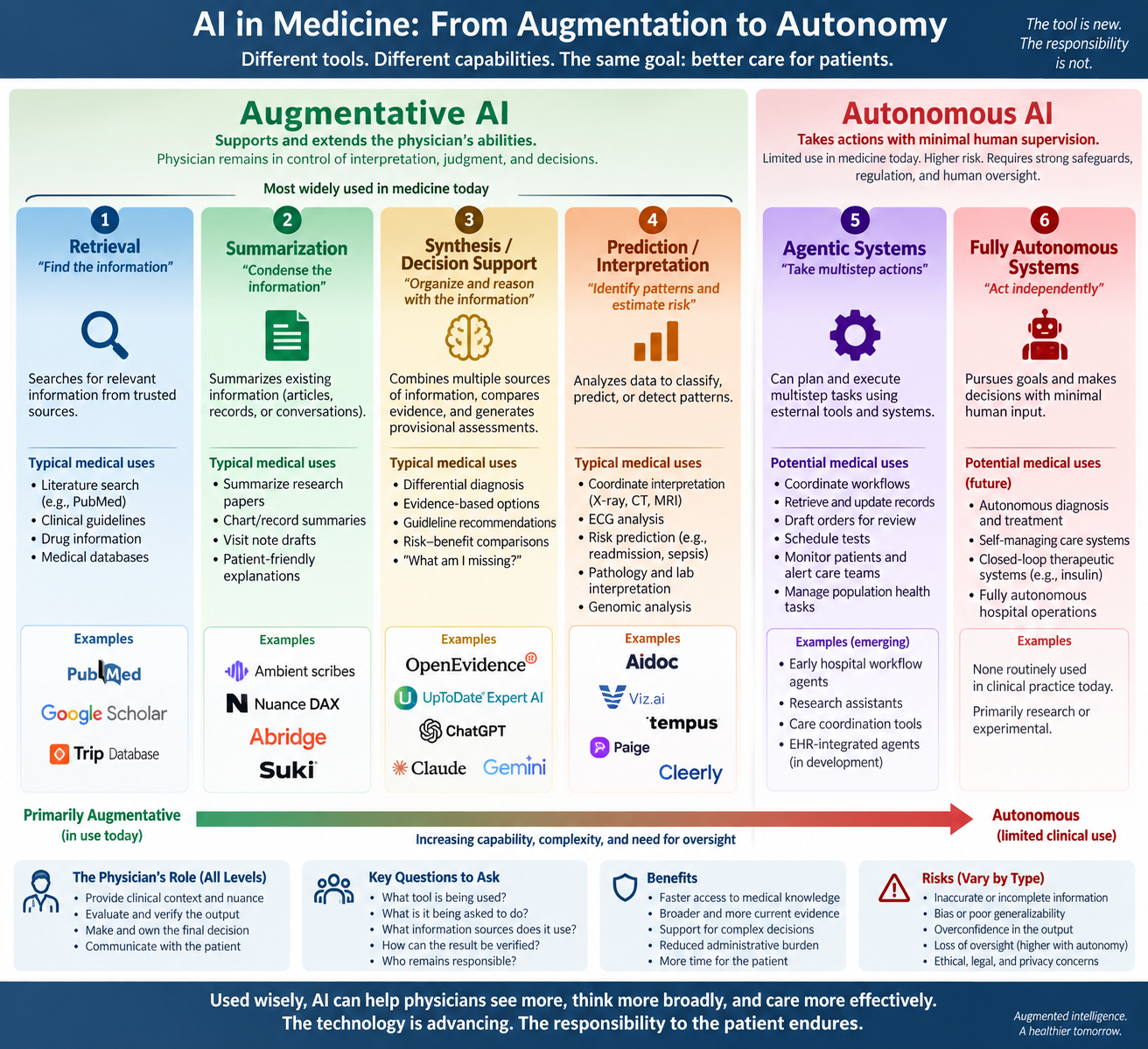
But the phrase artificial intelligence may itself create confusion because it is an umbrella term covering very different technologies. Physicians do not really use “AI” in the abstract. They use specific tools for specific jobs. One program may search medical literature, another may summarize a medical record, another may listen during an office visit and draft the note, and another may help organize clinical findings into a list of possible diagnoses. These tools differ enormously in capability and risk.
Much of what physicians are using today is probably better described as augmented intelligence. The technology extends what the physician can do while leaving interpretation, judgment, and responsibility with the physician. That distinction is important because it separates the AI currently entering most clinical practice from the far more autonomous systems driving much of today’s public anxiety.
We Have Been Using Better Information Tools for a Long Time
I practiced medicine through several revolutions in medical information. Early in my career, finding an answer to a clinical question often meant going to the medical library in person.
One of our main tools was called Index Medicus. For a modern reader, the easiest way to think of it is as a giant printed search engine for medical journals. Articles were organized under subject headings. If I wanted information about a kidney disease, I would open the appropriate volume, identify relevant citations, locate the actual journals somewhere in the library stacks, pull down the bound volumes, and read the articles.
The print was often small, the process was slow, and the number of papers one could realistically retrieve and read before making a clinical decision was limited. Index Medicus began in 1879, when the medical literature was already becoming difficult to navigate. For generations, however, time itself capped how much evidence a physician could reasonably review.[1]
Computers began changing that process in the 1960s. Systems called MEDLARS and later MEDLINE allowed electronic searches of medical journal citations rather than leafing through printed indexes.[2] At one point, physicians in our medical library did not simply sit down at a terminal and search MEDLINE themselves. Trained librarians performed the searches because the systems required specialized commands, an understanding of how medical information was indexed, and access to limited computing resources.
Today that arrangement seems almost unimaginable. PubMed (the free online descendant of those earlier databases) lets a medical student walking in a hallway search millions of medical articles on a phone.
The technology changed dramatically, but the physician’s responsibility did not. A search produced information. The physician still had to decide whether the information mattered.
When Medical Information Moved Into the Physician’s Pocket
The next important transition was portability. Before smartphones, Apple introduced a handheld computer called the Newton MessagePad. I used one with a medical program called Pocket Doc to generate a year's worth of patient notes. It was cumbersome and limited, but something important was happening: medical information and documentation were beginning to move from the library and nurse’s station into the physician’s hand.
Then came the PalmPilot and similar handheld computers. Suddenly a physician could carry drug dosing, drug interactions, medical calculators, and selected reference material in a coat pocket. Some residency programs, including ours, expected trainees to have one. This sounds quaint now, but at the time it was transformative.
Steve Jobs once described the personal computer as a “bicycle for the mind.” The analogy remains useful. A bicycle does not decide where the rider should go; it allows the rider to travel farther and faster. That is a good way to think about responsible medical AI.
From Finding Information to Organizing It
Eventually electronic tools stopped merely helping physicians find information and began helping them organize and summarize it. UpToDate became one of the most influential examples. Its founder, nephrologist Burton “Bud” Rose, initially developed the program around kidney disease and related areas of medicine. I remember Dr. Rose giving me an early Apple HyperCard version of what would eventually become UpToDate. I did not appreciate at the time how consequential it would become. That memory is humbling.
UpToDate allowed physicians to search expert-written summaries that pulled together findings from many studies and translated them into practical clinical guidance. Instead of finding ten articles and assembling the meaning entirely from scratch, the physician could begin with a carefully edited summary of what the evidence showed.
This became increasingly important because medical knowledge was expanding much faster than any individual could absorb. PubMed now contains more than 40 million biomedical citations and abstracts, with well over a million new citations added annually in recent years.[3] No physician can read everything. Modern medicine therefore depends less on memorizing all available information and more on knowing how to find, evaluate, combine, and apply it.
AI moves that process another step forward.
“AI” Is Not Really One Tool
It helps to separate the broad category from the actual applications. Think of artificial intelligence like “computer technology” or “the internet”: a broad label covering many different systems.
Physicians actually use applications built for particular purposes. ChatGPT is a general-purpose conversational tool. OpenEvidence is designed around medical questions and medical literature. UpToDate Expert AI adds generative AI capabilities to an established expert-curated clinical reference. Other systems analyze medical images, summarize charts, create notes, or help predict clinical risk.
Underneath these applications may be large language models, specialized search engines, ranking systems, databases, and other software components. For a patient, the important point is not whether the label says “AI.” It is what the tool is being asked to do, what information it relies on, how its answer can be checked, and who remains responsible for the result.
AI can gather and organize far more information, far faster, than a physician could through conventional searching, and structure it into a logical clinical reasoning pathway. It can inform the decision; it should not make the decision. Some tools primarily search for relevant information. Others summarize existing information. More advanced systems synthesize multiple pieces of evidence and suggest possible interpretations. Still others can predict, classify, or identify patterns in images or laboratory data. Beyond that are increasingly autonomous systems that can carry out multistep tasks and interact with outside software or systems.
For most clinical care today, the greatest immediate value lies in the first several categories: searching, summarizing, synthesizing, and supporting interpretation. The closer a system moves toward acting independently, the greater the need for oversight.
“Google Search on Steroids” Is Not a Bad Analogy
For a lay reader, one way to think about medical AI is as Google Search on steroids. A traditional search engine is primarily a retrieval tool. You ask a question and receive links. Professional medical databases do much the same thing at a higher level: physicians search a topic and receive studies, reviews, guidelines, and other sources. The information may be excellent, but it often arrives disconnected. One article discusses a medication. Another describes a diagnostic test. Another examines a disease. Another reviews a treatment guideline. The physician still has to decide which pieces matter and assemble them into something useful.
AI can move the process one step further. It can potentially retrieve relevant information, compare it, organize it, and produce a provisional synthesis.
What Would That Look Like in a Real Patient?
Suppose an older patient suddenly develops worsening kidney function. Physicians call this acute kidney injury, meaning the kidneys are not working as well as they were previously. There are many possible explanations. The patient may be dehydrated. The heart may not be pumping effectively enough to maintain healthy blood flow to the kidneys. A medication may be contributing. A blockage may be preventing urine from draining normally. The kidney tissue itself may have been injured. More than one problem may even be occurring at the same time.
A conventional internet or medical-database search could provide excellent information about all of these possibilities, but the physician would receive a collection of articles. AI can help arrange those articles into a detailed summary. A medically focused AI tool might take the patient’s age, medical history, medications, laboratory results, blood pressure, recent procedures, and urine tests and produce what physicians call a differential diagnosis: a ranked list of possible explanations for what is happening. The important word is possible. The appropriate AI answer is not, “This patient definitely has diagnosis X.” It should be closer to: “Based on the information provided, these are the most likely explanations, and these particular findings make some possibilities more likely than others.” That is synthesis. It is not certainty.
The Real Power May Be the Conversation That Follows
Suppose examining the urine does not show microscopic debris that can sometimes accompany damage to the kidney’s tiny filtering structures. That does not prove such damage is absent, but it may make that explanation somewhat less likely. Perhaps an ultrasound shows that urine is draining normally, making blockage less likely. Perhaps the blood pressure has fallen substantially, or severe heart failure is interfering with kidney function. Each new piece of information changes the clinical picture. The physician can provide those additional findings and ask the AI system to reconsider the possibilities. The ranking will then change.
That is how clinical reasoning has always worked. A physician begins with the available information, develops a preliminary list of possibilities, gathers additional evidence, revises that list, orders further tests or begins treatment, and then reassesses.
AI can make that process extraordinarily fast. Instead of waiting until tomorrow’s rounds, consulting several colleagues separately, or performing multiple independent literature searches, the physician can test an initial idea, add new information, challenge assumptions, and refine the differential diagnosis while the patient is still being evaluated.
This is why I increasingly think of responsible medical AI as something resembling an immediate second opinion.
That phrase requires an important qualification: AI is not another physician. It does not physically examine the patient, know the patient in a human sense, or accept responsibility for the decision's consequences. But it can help the physician ask useful questions: What am I missing? What else could explain this? Does this new information change the ranking? What evidence supports this possibility? What additional test could distinguish among these diagnoses?
The physician supplies the clinical context and nuance. AI helps organize the possibilities. The physician decides what they mean.
Think About the Contrast With Index Medicus
The difference is remarkable. In the library era, a physician might realistically retrieve only a few relevant papers before deciding. Time itself limited the breadth of the evidence review.
Today, an AI system can potentially help draw on a much larger body of information in seconds and organize it around the particular question being asked. That does not guarantee correctness. AI can misunderstand evidence, overemphasize weak research, omit an important possibility, or occasionally generate something that sounds convincing but is false or unsupported—a problem commonly called an AI “hallucination.”
The term sounds more mysterious than the phenomenon. It simply means the computer produced an answer that sounded plausible but was not reliable. That is precisely why the physician remains necessary. AI's benefit is not that the machine suddenly knows the truth. The benefit is that the physician can begin the decision-making process with a broader, better-organized body of information than was previously possible.
Why Patients May Eventually Welcome This
Patients should reasonably expect physicians to use the best available tools to arrive at an accurate diagnosis and appropriate treatment. In that sense, responsible AI use should not be viewed as a departure from good medicine. It is part of medicine’s continuing evolution.
Earlier generations adopted computerized medical searches, online databases, drug-interaction programs, handheld references, imaging software, and expert-written point-of-care resources because those technologies improved access to useful information. AI can extend that progression.
Fear is understandable because the term AI is currently being used to describe everything from a program that summarizes a medical article to experimental systems capable of increasingly autonomous behavior. Those are clearly not the same thing. Fearing a physician’s responsible use of AI may eventually seem as misplaced as fearing that a physician searched MEDLINE or PubMed. The more useful question is not simply, “Did my doctor use AI?” It is: What tool did my physician use, what was it asked to do, and who remained responsible for the result?
Medicine Is Already Using These Tools
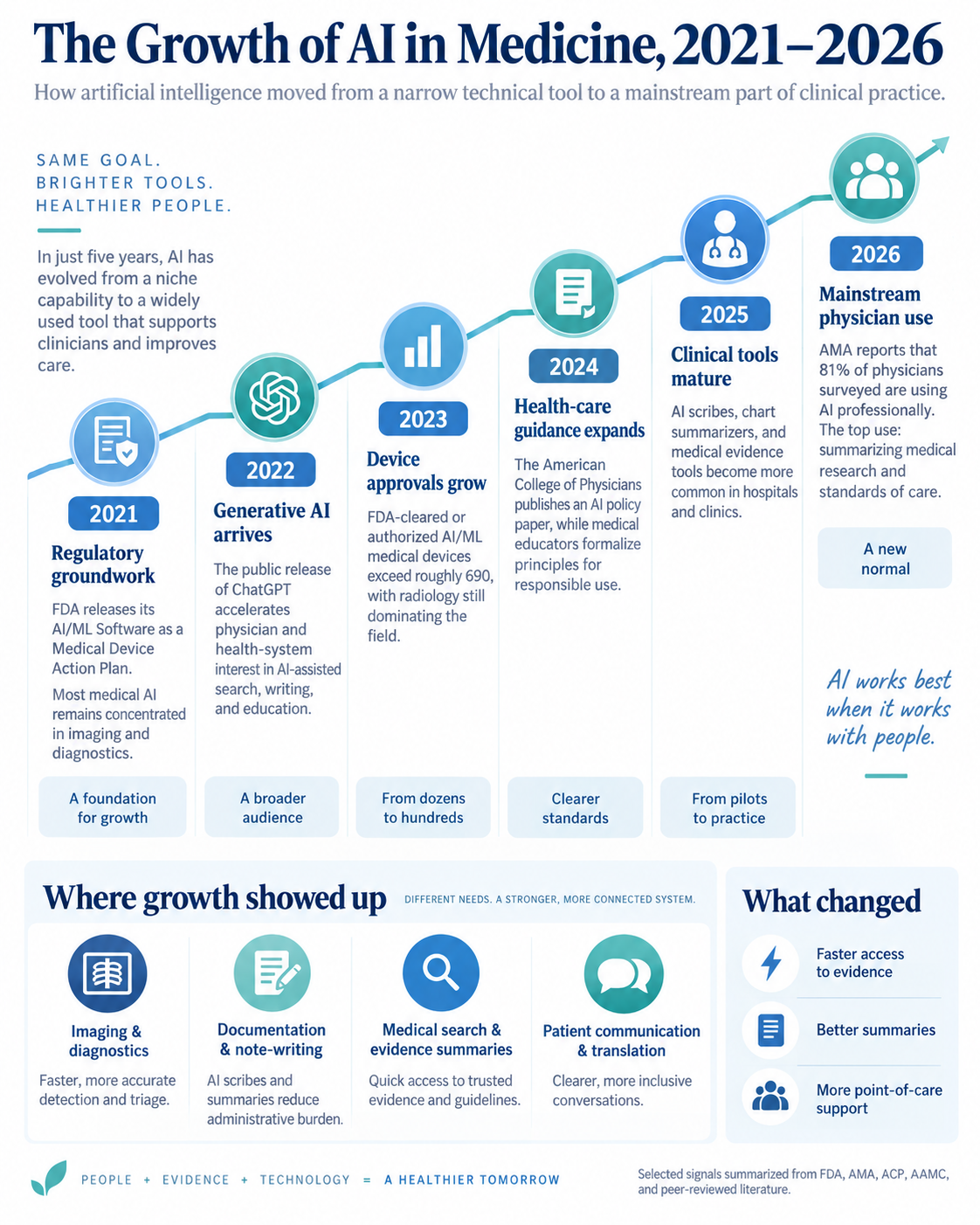
This is not speculation about some distant future. The American Medical Association reported in 2026 that 81% of surveyed physicians were aware of or used AI in professional practice. The most common reported use was summarizing medical research and standards of care. Other uses included documentation, chart summaries, patient communications, translation, and diagnostic assistance.[4]
The American College of Physicians has suggested that augmented intelligence may better describe AI used in medicine. Its guidance emphasizes that these tools should support clinical decision-making while preserving physician judgment, professional responsibility, competence, and the patient-physician relationship.[5] The Association of American Medical Colleges likewise emphasizes that human judgment should remain central and that AI should complement, not replace, human decision-making.[6]
These organizations are not telling physicians to avoid AI. They are trying to define how it should be used.
Augmentation Is Different From Autonomy
This distinction is particularly important given the broader public debate about AI. Systems that help physicians search evidence, summarize records, or organize a differential diagnosis are primarily augmentative. The human asks the question, provides the patient information, evaluates the answer, and decides what happens next. That is fundamentally different from an autonomous system that can independently pursue complicated goals, use outside tools, interact with other systems, and take consequential actions with limited human supervision.
The broader debate about increasingly autonomous AI deserves serious attention, but patients should not assume that every use of artificial intelligence carries the same risks. Medical AI should be designed to make physicians better informed—not irrelevant.
The Patient Still Changes Everything
Another reason physicians remain central is that medical evidence usually comes from groups of people, while the patient sitting in front of the physician is one person. A study may show that a treatment generally works. A guideline may recommend it. An AI system may summarize the evidence beautifully. The physician still has to ask: Does this apply to this patient?
Age can matter. Kidney and liver function can matter. Other illnesses matter. Medications matter. Frailty matters. Cost matters. Prognosis matters. Personal preferences matter. Tolerance for side effects and risk matters. Family circumstances can matter. So can fear, trust, and what the patient actually wants. These considerations are not inefficiencies waiting for software to eliminate them. They are clinical medicine. We now use the phrase personalized medicine frequently, but in reality, good medicine has always been personal.
How AI Could Actually Strengthen Trust
Patients understandably worry that technology could create distance between themselves and their physicians. Used poorly, it could. Used well, it may do the opposite by giving the physician a faster way to test assumptions, review evidence, and explain the reasoning behind a recommendation.
Imagine a physician saying: “There are several possible explanations for what is happening. I used a medical AI tool to review the evidence and challenge my initial thinking. Based on your examination and test results, I think these two possibilities are most likely. Here is why. That sounds less like surrendering a decision to a machine than like a physician seeking another source of information before deciding.
Patients may become more comfortable with medical AI once they understand that it should not issue a final verdict. Its value is in an iterative process: organizing possibilities, incorporating new information, identifying potential blind spots, and helping the physician refine a differential diagnosis as the clinical picture becomes clearer. In some respects, this is similar to having several knowledgeable colleagues available for an immediate second opinion. The major difference is speed.
The physician still decides which information matters, whether the evidence fits the patient, and what to do next. The ultimate responsibility remains where it has always belonged: with the physician. If AI helps the physician reach a sound diagnosis more efficiently, one of its greatest benefits may be giving something back that medicine has steadily lost: more time for the physician to spend with the patient.
What Patients Should Expect
Patients do not need a list of every textbook, journal article, colleague, database, search engine, or computer program their physician consulted. They rarely have. But they should reasonably expect their physician to understand the information being used.
Important evidence should be traceable to trustworthy sources. New clinical information should cause the physician (an AI) to reconsider earlier assumptions when appropriate. Uncertainty should remain uncertainty rather than being converted into false confidence simply because an answer sounds polished.
The physician should also be able to explain how AI materially influenced an important decision if the patient asks. Most importantly, responsibility should never become ambiguous. The physician should remain prepared to explain and defend the diagnosis and treatment plan as their own clinical judgment.
The Tool Is New. The Responsibility Is Not.
Working through Index Medicus had real value. It taught patience, skepticism, and respect for the complexity of medical evidence. But no one is going back to it, nor should we. Physicians did not abandon judgment when computerized databases arrived. They did not abandon it when medical information moved into their pockets. They did not abandon it when expert-written programs gave physicians access to enormous amounts of synthesized evidence at the bedside.
AI belongs in that same professional tradition. Its greatest contribution may be its ability to bring far more information into clinical reasoning, far more quickly, while allowing the physician to repeatedly refine the question as the patient’s story becomes clearer. That is not replacing clinical judgment. It is another bicycle for the clinical mind.
Use the technology. Verify the evidence. Refine the possibilities. Understand the patient. Own the decision.
The tools have changed. The obligation to the patient has not.
References
National Library of Medicine. MEDLINE History. National Library of Medicine.
National Library of Medicine. Index Medicus to Cease as Print Publication. NLM Technical Bulletin. 2004.
National Library of Medicine. About PubMed; MEDLINE/PubMed Production Statistics.
American Medical Association. 2026 Physician Survey on Augmented Intelligence. March 2026.
DeCamp M, Snyder Sulmasy L, Karches KE, et al. Ethics and professionalism in artificial intelligence and medical practice: a position paper from the American College of Physicians. Ann Intern Med. 2026.
Association of American Medical Colleges. Principles for the Responsible Use of Artificial Intelligence in and for Medical Education. Version 2.0. 2025.
Ebell MH, Hale W, Buchanan JE, Dake P. Hand-held computers for family physicians. J Fam Pract.1995;41(4):385-392.
Wolters Kluwer. Wolters Kluwer Celebrates 30 Years of UpToDate. 2022.
Wu V, Casauay J. OpenEvidence. Fam Med. 2025;57(3):232-233.
Yang F, Graetz I. Ambient AI tool adoption in US hospitals and associated factors. Am J Manag Care.2026;32(1).
Sielaff ML, Platt J, Tan S, et al. Building trust: public priorities for health care AI labeling. Am J Manag Care.2026;32(1).
