
Extracting Truth in a Noisy Media Environment
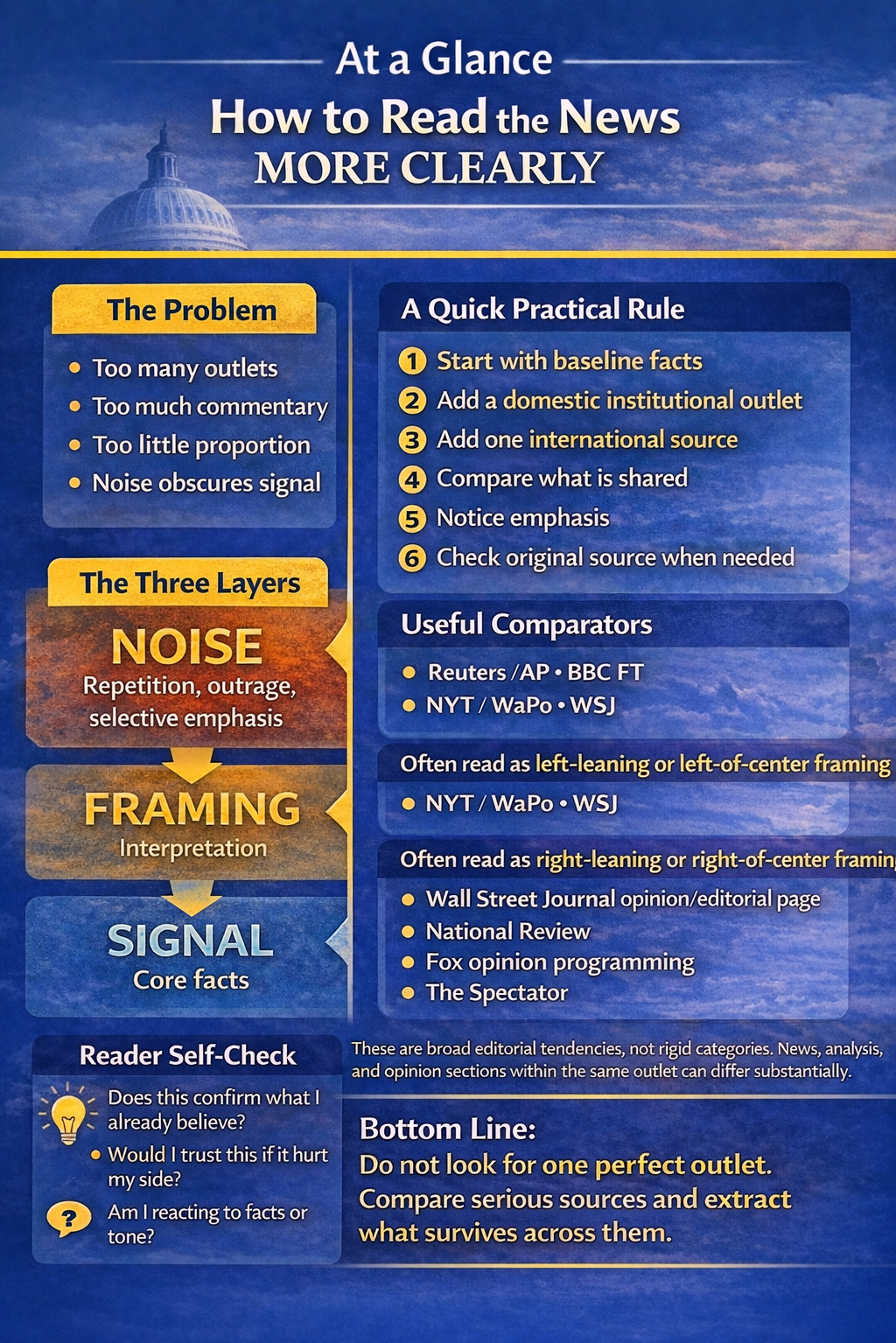
AP, Associated Press; BBC, British Broadcasting Corporation; FT, Financial Times; NYT, New York Times; WaPo, Washington Post; WSJ, Wall Street Journal.
Trust in the news is fragile, and not without reason. Pew reported in February 2026 that 57% of U.S. adults have either little confidence or no confidence in journalists to act in the public’s best interests.
The usual argument is about bias: one outlet leans left, another leans right, one host favors one party, another favors the other. But for most readers, the deeper problem is not bias alone. It is noise.
Today’s media environment is saturated with cable channels, digital outlets, newsletters, podcasts, Substacks, aggregators, clips, and commentary layered on top of commentary. Much of it is designed to provoke, retain attention, and reinforce audience identity. In that kind of environment, even accurate information can become misleading when it is incomplete, repeated selectively, or stripped of context. That is why so many people feel informed and confused at the same time!
The Fundamental Problem Is Noise
Bias matters, but noise is often worse. Bias can at least be recognized and adjusted for. Noise is more corrosive because it blurs the line between fact, interpretation, outrage, and entertainment.
A story breaks, and within minutes, it is no longer just a story. It becomes a contest of headlines, clips, instant analysis, moral declarations, partisan framing, and recycled talking points. By the time readers encounter it, they are often consuming not the event itself, but several layers of interpretation wrapped around it.
That is the central challenge: readers are not simply learning what happened. They are being told what the event should mean.
Why Readers Struggle
Most people do not have time to compare multiple outlets, inspect the primary source, and sort reporting from analysis, commentary, and advocacy. They watch a familiar show, follow a trusted host, or read a handful of preferred writers. Over time, those habits become more than routines. They become loyalties.
That is a common reason it is so difficult to persuade readers that a favorite show or preferred source may be heavily one-sided. A challenge to the source is often experienced as a challenge to the individual or group.
And inconsistency makes the problem worse. Public narratives can later be revised to expose earlier blind spots or institutional incentives. Jake Tapper and Alex Thompson’s 2025 book Original Sin is explicitly presented by its publisher as an account of President Biden’s decline and of efforts to hide the extent of that deterioration. Whether one agrees with every argument in the book is not the point here. The point is that media narratives can shift dramatically, sometimes in ways that force readers to ask why certain questions were minimized, postponed, or treated differently earlier on.
That pattern is not confined to a single network or political faction. It is a recurring feature of a system driven by incentives, speed, access, and audience expectations.
A Better Framework
Instead of asking whether a source leans left or right, it is often more useful to frame it based on three questions:
What are the core facts? What happened, who acted, when, where, and on what evidence?
How is it being framed? Which facts are being emphasized, minimized, moralized, or repeated?
What is noise? What in this presentation is mainly designed to provoke, flatter, alarm, or confirm the audience?
This is the key distinction. Facts are usually fewer and more stable than the commentary that accumulates around them.
The Three Layers Of Information
One useful way to think about modern news is as three stacked layers:
Signal is the shared factual core.
Framing is the interpretation of those facts.
Noise is the repetition, selective emphasis, emotional tone, and endless commentary that distort proportion.
The task of a serious reader is not to find one perfectly neutral institution. It is to work downward through those layers until the underlying signal becomes visible.
A Practical Method
A workable routine is simple.
Start with a baseline reporting source that primarily aims to establish what exactly happened (possibly Reuters, the Associated Press, or the BBC). Then read 1-2 major institutional outlets (possibly the Wall Street Journal and New York Times) for depth and context. After that, if needed, read one analysis piece to understand how the story is being interpreted. Only then read advocacy or opinion to understand how the issue is being argued politically.
If you reverse that order and begin with the argument, you will often mistake interpretation for fact.
The Reader Can Be Biased Too
This may be the hardest point to accept.
A story that confirms what you already believe will often feel more persuasive than one that complicates your worldview. A host who uses your moral vocabulary will feel more trustworthy than one who does not. A narrative that vindicates your side will feel more complete than one that leaves room for uncertainty.
That reaction is human. But it is also one of the main ways readers get trapped.
The right question is not only, “Is this source biased?” It is also, “Why does this version feel convincing to me?”
What Honesty Requires
An honest post on this subject cannot promise readers a short list of saints and villains. It cannot rank every outlet neatly and call the problem solved. That would simply create another simplified narrative.
A more honest conclusion is this: readers cannot eliminate bias, noise, or institutional incentives entirely. But they can become more disciplined. They can slow down. They can distinguish reporting from persuasion. They can compare serious outlets with different tendencies. They can look for the shared factual core. And they can become more suspicious of stories that seem perfectly tailored to confirm what they already wanted to believe.
That is not a perfect solution. It is, however, a useful one.
How To Use International Sources
International outlets can be extremely useful, especially when covering wars, foreign policy, migration, trade, or global crises. They often highlight aspects of a story that American outlets underemphasize, particularly the effects on civilians, regional history, or non-Western political interests.
That does not make them more objective. It makes them differently situated.
This is the key point: international sources should usually be used comparatively, not devotionally. A serious reader does not replace one national bias with another. Instead, he or she uses international coverage to identify what domestic reporting may be missing.
A practical method is simple. Start with a baseline factual source such as Reuters or the Associated Press. Then read one major American institutional outlet. After that, add one international source—such as the BBC, the Financial Times, or Al Jazeera—to see what changes in emphasis, tone, and framing occur. The goal is not to decide which source is “right” in every respect. It is to identify which facts remain stable across them and which interpretations begin to diverge.
That comparison is often revealing. Western outlets may focus more heavily on official U.S. or European perspectives, military strategy, or domestic political implications. International outlets may give more space to regional actors, civilian disruption, historical grievances, or views from outside the Western alliance system. Both can add value. Both can also reflect institutional and national assumptions.
A good rule is this: use international sources to widen the frame, not to escape the need for judgment.
Bottom line
The biggest obstacle to understanding the news is not simply that some outlets lean left and others lean right. It is because the modern information environment is saturated with noise.
In a noisy environment, clarity belongs to the reader who learns to strip away performance, recover proportion, and hold on to the facts that survive across competing narratives.
That is how truth is extracted from noise.
This Is A Starting Point, Not A Complete Solution
In an upcoming post—An Evidence-Based Guide to the News—we will take a deeper, more systematic look at how to evaluate reporting, identify distortion, and build a reliable information workflow.
Looking Ahead
Having outlined a framework for evaluating information, we will next turn to a concrete example: a series examining the Affordable Care Act—how it works, how it is financed, and where the challenges lie.
References
Pew Research Center. Americans’ trust in journalists and news organizations remains low. Published February 11, 2026. Accessed March 28, 2026. https://www.pewresearch.org/short-reads/2026/02/11/majority-of-americans-express-low-confidence-in-journalists-to-act-in-publics-best-interests/
Reuters Institute for the Study of Journalism. Digital News Report 2024: United States. Published 2024. Accessed March 28, 2026. https://reutersinstitute.politics.ox.ac.uk/digital-news-report/2024/united-states
Reuters. Trust Principles. Thomson Reuters. Accessed March 28, 2026. https://www.thomsonreuters.com/en/about-us/trust-principles.html
Associated Press. News values and principles. Accessed March 28, 2026. https://www.ap.org/about/news-values-and-principles/
BBC. Editorial Guidelines: Section 4—Impartiality. Accessed March 28, 2026. https://www.bbc.co.uk/editorialguidelines/guidelines/impartiality
The Washington Post. Policies and Standards. Accessed March 28, 2026. https://www.washingtonpost.com/policies-and-standards/
Gentzkow M, Shapiro JM. Media bias and reputation. J Polit Econ. 2010;118(4):718-775. doi:10.1086/655456
https://www.journals.uchicago.edu/doi/10.1086/655456Lazer DMJ, Baum MA, Benkler Y, et al. The science of fake news. Science. 2018;359(6380):1094-1096. doi:10.1126/science.aao2998
https://www.science.org/doi/10.1126/science.aao2998
