
Signal to Noise Ratio
Why I Write
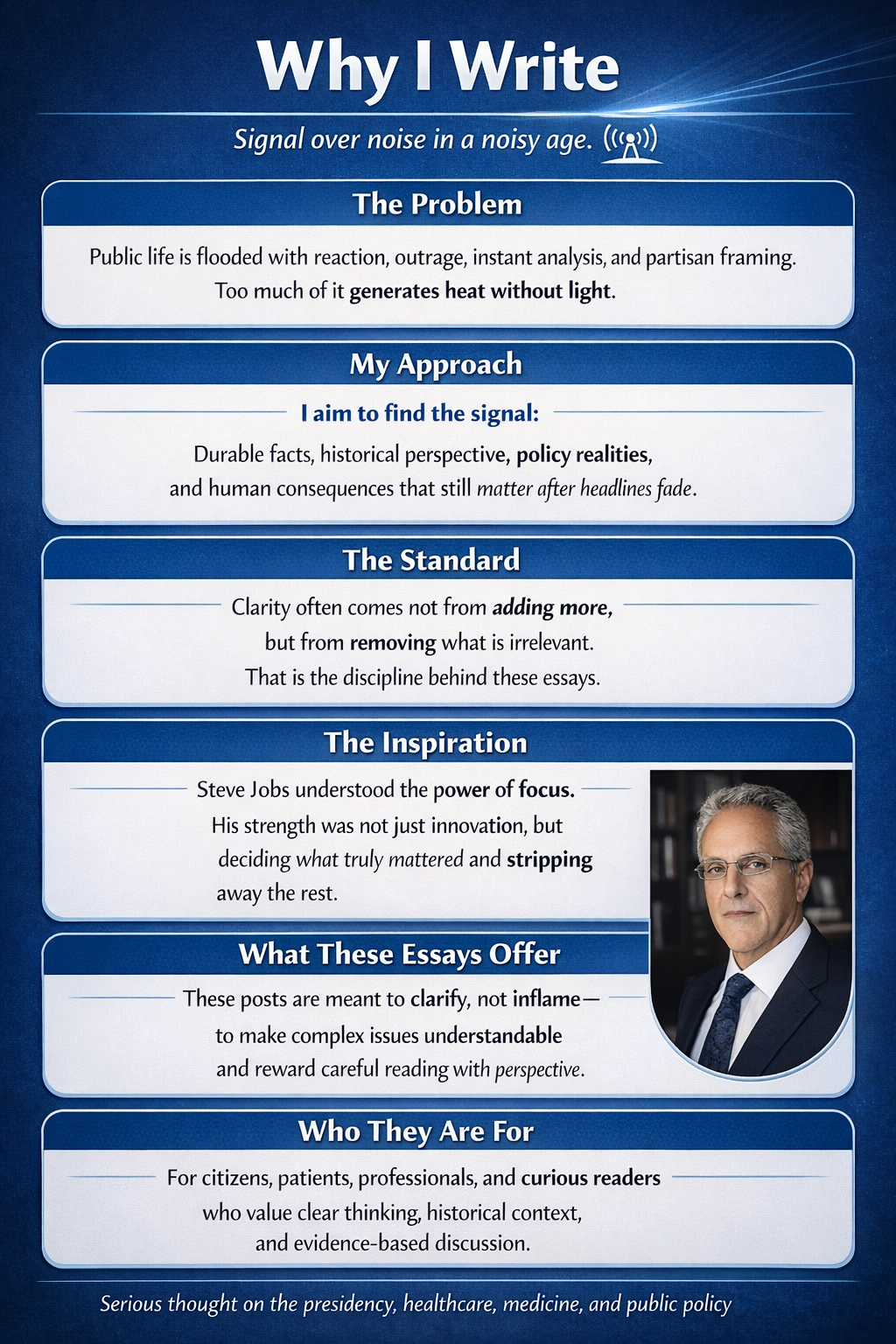
In an age of constant reaction, my essays are guided by a simple principle: the signal-to-noise ratio matters. Public life is saturated with commentary, outrage, instant analysis, and partisan framing, much of it designed to provoke rather than clarify. The result is noise—volume without depth, heat without light. My goal is different. I try to identify the signal: the durable facts, historical patterns, policy realities, and human consequences that remain meaningful after the headlines fade. Whether the subject is the presidency, healthcare, medicine, or public policy, I want these posts to reward careful readers with perspective rather than distraction.
This approach reflects both habit and conviction. As a physician, educator, and writer, I have spent much of my professional life trying to make complex subjects more understandable without oversimplifying them. Good explanation requires more than information; it requires judgment, context, and a willingness to separate what matters from what merely attracts attention. That is the standard I hope to bring here as well.
Steve Jobs understood this principle well. One of his great strengths was not merely innovation, but disciplined focus—the ability to decide what truly mattered and to strip away what did not. He had a knack for choosing the signal over the noise, for recognizing that clarity often comes not from adding more, but from removing the irrelevant. Public writing should aspire to something similar. Not every controversy deserves equal weight. Not every loud claim deserves serious attention. And not every popular narrative survives careful examination.
That same discipline shapes the structure of these essays. I aim to write clearly, ground arguments in history and evidence, and resist the temptation to chase the emotional tempo of the moment. I am less interested in winning a news cycle than in helping readers better understand the deeper forces beneath it. If a piece is worth reading, it should still be worth thinking about after the immediate outrage has passed.
As part of that commitment, these posts will include references whenever appropriate. In an era of noise, assertion is easy; documentation is harder. When I discuss history, medicine, healthcare policy, or public affairs, I want readers to know that the goal is not simply to offer opinion, but to ground the discussion in sources they can review for themselves. Including references is one small but important way of reinforcing clarity, accuracy, and intellectual honesty.
I write, ultimately, for readers who value seriousness over spectacle and understanding over reaction. The intended audience is broad by design. Issues such as the presidency, healthcare, medicine, and public policy do not belong only to specialists, academics, or political insiders; they shape the lives of ordinary citizens, patients, professionals, and voters alike. If these essays help illuminate a complex subject, sharpen an important distinction, or restore a measure of perspective in a noisy age, then they will have served their purpose.
–Paul G. Schmitz, M.D.
Readers with thoughtful comments or questions are welcome to contact the author through the contact page.
Looking Ahead
In the next post, we turn to a different but equally important challenge: how to make sense of the modern information environment. With so many competing narratives, sources, and interpretations, understanding the news itself has become part of the problem.
