
Americans broadly embrace the principle of fairness. Agreeing on what fairness actually requires is considerably more difficult. In a 2024 AP-NORC survey, 91% of Americans considered equal protection under the law extremely or very important to the nation's identity. Yet in a separate 2023 Pew Research Center survey, 50% opposed considering race and ethnicity in selective college admissions to increase diversity, while 33% supported the practice. The surveys asked different questions, but together they illustrate a fundamental disagreement: Americans largely agree on the importance of equal rights, but differ on whether characteristics such as race or ethnicity should influence decisions about who receives an opportunity.
The disagreement extends well beyond college admissions. Should everyone be evaluated according to identical standards, or should institutions account for differences in educational preparation, economic circumstances, and historical disadvantage? How should demonstrated achievement be weighed against the opportunities that helped produce it? And when several qualified individuals compete for a single position, what makes the selection fair? These questions are difficult because different approaches can be defended as fair, yet each carries consequences for the individuals involved.
Having lived through the civil rights era and spent much of my professional life in academic medicine, I have witnessed a profound transformation in American society. Opportunities once restricted by discriminatory laws and institutional practices have expanded substantially. Women and racial minorities have entered universities, professions, and leadership positions in numbers that would have been difficult to imagine sixty years ago. Social attitudes have changed, educational opportunities have expanded, and barriers once widely accepted have been challenged or dismantled. The progress is real, substantial, and well documented. Determining precisely what produced it is more complicated. Civil rights legislation, affirmative action, changing cultural expectations, educational expansion, economic development, and individual achievement have all contributed.
Over these same decades, the American pursuit of fairness has evolved. The original emphasis on prohibiting discrimination expanded to include efforts to address unequal opportunities, improve demographic representation, and influence institutional culture. These developments eventually became associated with the framework known as diversity, equity, and inclusion (DEI). Yet the three concepts represent fundamentally different goals. Diversity describes differences among people and can be measured. Equity requires judgments about what constitutes fair treatment. Inclusion concerns participation, relationships, and the more subjective experience of belonging. Each has legitimate objectives, but they are not interchangeable, and success in one does not guarantee success in another.
Americans have increasingly looked to legislation, government agencies, universities, corporations, and other institutions to advance these objectives. Their efforts have contributed to substantial changes, yet disagreements over fairness remain unresolved. Perhaps that should encourage us to examine not only what institutions have accomplished, but also what they can realistically be expected to achieve. How do we distinguish meaningful progress from an ideal that may never be fully attainable? How much responsibility for creating a fairer society ultimately rests with the individuals who make decisions, exercise influence, and shape others' opportunities every day?
From Civil Rights to DEI: How the American Approach to Opportunity Evolved
The modern American civil rights movement did not begin with affirmative action or diversity programs. It emerged from generations of legal challenges, political organizing, public protest, and demands that the United States fulfill constitutional promises it had repeatedly failed to honor.
The Supreme Court's 1954 decision in Brown v. Board of Education rejected racial segregation in public schools. The Montgomery bus boycott, Freedom Rides, sit-ins, and Birmingham demonstrations brought discrimination into the national spotlight. Citizens and civil rights organizations led these efforts, often at considerable personal risk. Presidential action followed helping translate those demands into national policy.
President John F. Kennedy took a pivotal step in March 1961 when he signed Executive Order 10925. It required federal contractors to ensure that applicants and employees were treated without discrimination based on race, color, creed, or national origin. Kennedy established the President's Committee on Equal Employment Opportunity, chaired by Vice President Lyndon Johnson, with authority to investigate complaints, review compliance, and recommend sanctions against businesses. The federal government was using its substantial purchasing authority to influence private-sector employment practices. Contractors receiving federal business were expected to demonstrate compliance in their hiring practices.
Kennedy also appointed Black Americans to prominent federal positions, acted against discrimination in federally supported housing, and used federal authority to enforce university desegregation. In June 1963, he proposed comprehensive civil rights legislation that became the foundation for the landmark law enacted after his death. Kennedy's initiatives established important mechanisms for actively enforcing equal opportunity.
Johnson expanded those efforts. As vice president, he had worked with major employers through the Plans for Progress initiative, encouraging companies to change recruitment and employment practices. By 1963, 115 participating companies, employing more than 5.5 million people, had joined the initiative. The program reflected a growing emphasis on changing employment practices rather than simply making antidiscrimination declarations.
As president, Johnson signed the Civil Rights Act of 1964 and the Voting Rights Act of 1965. In September 1965, Executive Order 11246 strengthened federal-contractor equal employment requirements and assigned enforcement responsibility to the Department of Labor. In 1967, those requirements were expanded to include discrimination based on sex. Johnson also appointed Robert C. Weaver as the first Black cabinet secretary and Thurgood Marshall as the first Black Supreme Court justice.
Title VII of the Civil Rights Act of 1964 prohibited employment discrimination based on race, color, religion, sex, or national origin. Its central purpose was to protect individuals from discriminatory treatment, not to ensure that every workforce reflected the demographic composition of the city or state where it operated. Section 703(j) specifically stated that differences in workforce representation did not, by themselves, require preferential hiring or racial quotas. In other words, the law established a fundamental commitment to nondiscrimination without requiring demographic proportionality.
Johnson recognized, however, that the new law would not automatically overcome disadvantages accumulated through generations of unequal treatment and opportunity. In June 1965, speaking at Howard University, he delivered his landmark address, To Fulfill These Rights. Johnson argued that individuals long denied educational and economic opportunities could not immediately compete on equal terms simply because the law had changed. Opening the gates of opportunity was not enough; people needed the preparation and resources to walk through them.
This marked an important cultural expansion. The nation increasingly considered not only whether individuals were protected from discriminatory treatment, but also whether they had the education, resources, and opportunities to exercise those rights.
Johnson's Great Society programs, including Head Start, reflected this broader ambition. Head Start sought to improve educational preparation among children from low-income families, recognizing that differences in opportunity begin early and can influence achievement throughout life. This approach also illustrates a distinction that would become central to later debates: helping individuals develop the skills and qualifications needed to compete is fundamentally different from granting preferential consideration when selecting among qualified applicants.
Although both approaches would eventually become associated with affirmative action, the controversy intensified as employers and universities began incorporating numerical goals and racial preferences into their programs. In 1969, President Richard Nixon's administration implemented the Philadelphia Plan, establishing numerical employment goals for minority workers on federally funded construction projects. These were formally distinguished from rigid quotas because contractors were required to demonstrate good-faith efforts rather than guarantee particular outcomes. Nevertheless, they generated substantial controversy over numerical objectives as a proxy for civil rights.
The debate over racial preferences reached a defining moment in 1978, when the Supreme Court considered the admissions program at the University of California, Davis, School of Medicine. The school reserved 16 of its 100 entering positions for designated minority applicants. Allan Bakke, a White applicant, had been rejected despite having higher admissions test scores than some candidates admitted through the separate process. The case exposed a fundamental problem with demographic quotas: reserving positions for one group necessarily prevents applicants outside that group from competing for those positions, regardless of their individual qualifications. The Court invalidated the quota while permitting more limited consideration of race as one admissions factor. The underlying controversy has persisted to the present.
The federal government's role in this evolution extended well beyond legislation and executive orders. Under Johnson's Executive Order 11246, the Department of Labor acquired substantial authority to enforce affirmative action requirements among federal contractors. Through its Office of Federal Contract Compliance Programs (OFCCP), the Department reviewed employment practices, examined workforce demographics, and required covered companies to demonstrate compliance. Employers faced potential financial settlements, contract cancellation, or exclusion from future federal business. In fiscal year 1979 alone, OFCCP conducted more than 2,400 compliance reviews and obtained approximately $9.3 million in financial commitments across its equal employment opportunity and affirmative action enforcement programs. The federal government had created both an expectation of institutional change and meaningful consequences for noncompliance.
These requirements encouraged corporations to establish equal employment opportunity offices, employ compliance specialists, and formalize recruitment, hiring, and promotion practices. When Ronald Reagan took office in 1981, his administration reduced the emphasis on numerical hiring targets and punitive enforcement, favoring voluntary compliance and less burdensome regulation. Yet the corporate structures established during the preceding two decades remained largely intact. Companies had invested in personnel, procedures, and administrative systems that had become established parts of their operations.
During the 1980s and 1990s, another transformation followed. Corporate affirmative action programs increasingly evolved into what became known as diversity management. Employers began emphasizing the potential organizational benefits of workforces comprised of people with different backgrounds, experiences, and perspectives. Sociologists Erin Kelly and Frank Dobbin documented this evolution in their 1998 study, How Affirmative Action Became Diversity Management. Diversity was increasingly promoted as a business objective rather than exclusively a matter of legal compliance, justified through claims about recruitment, innovation, organizational performance, and workplace culture. What began partly as a response to government enforcement evolved into a broader institutional philosophy that would eventually encompass equity and inclusion as well.
The resulting framework spread throughout corporations, universities, healthcare organizations, professional associations, and government agencies. Modern DEI did not emerge fully formed from the Civil Rights Act. It developed through successive legal decisions, administrative practices, social movements, and changing institutional objectives.
The legal and political approach has since shifted. In 2023, the Supreme Court rejected the race-conscious admissions systems used by Harvard University and the University of North Carolina. In January 2025, President Donald Trump revoked Johnson's Executive Order 11246, ending its affirmative action requirements for federal contractors. His administration argued that DEI programs had increasingly substituted demographic preferences for individual merit and that opportunities should be based on qualifications, achievement, and equal treatment. The decision became a political lightning rod. Supporters viewed it as a return to merit-based opportunity and individual fairness, while critics saw it as a retreat from efforts to address persistent discrimination and unequal opportunity. The underlying civil rights statutes remained in force. After six decades of pursuing fairness, Americans still disagree about what fairness requires.
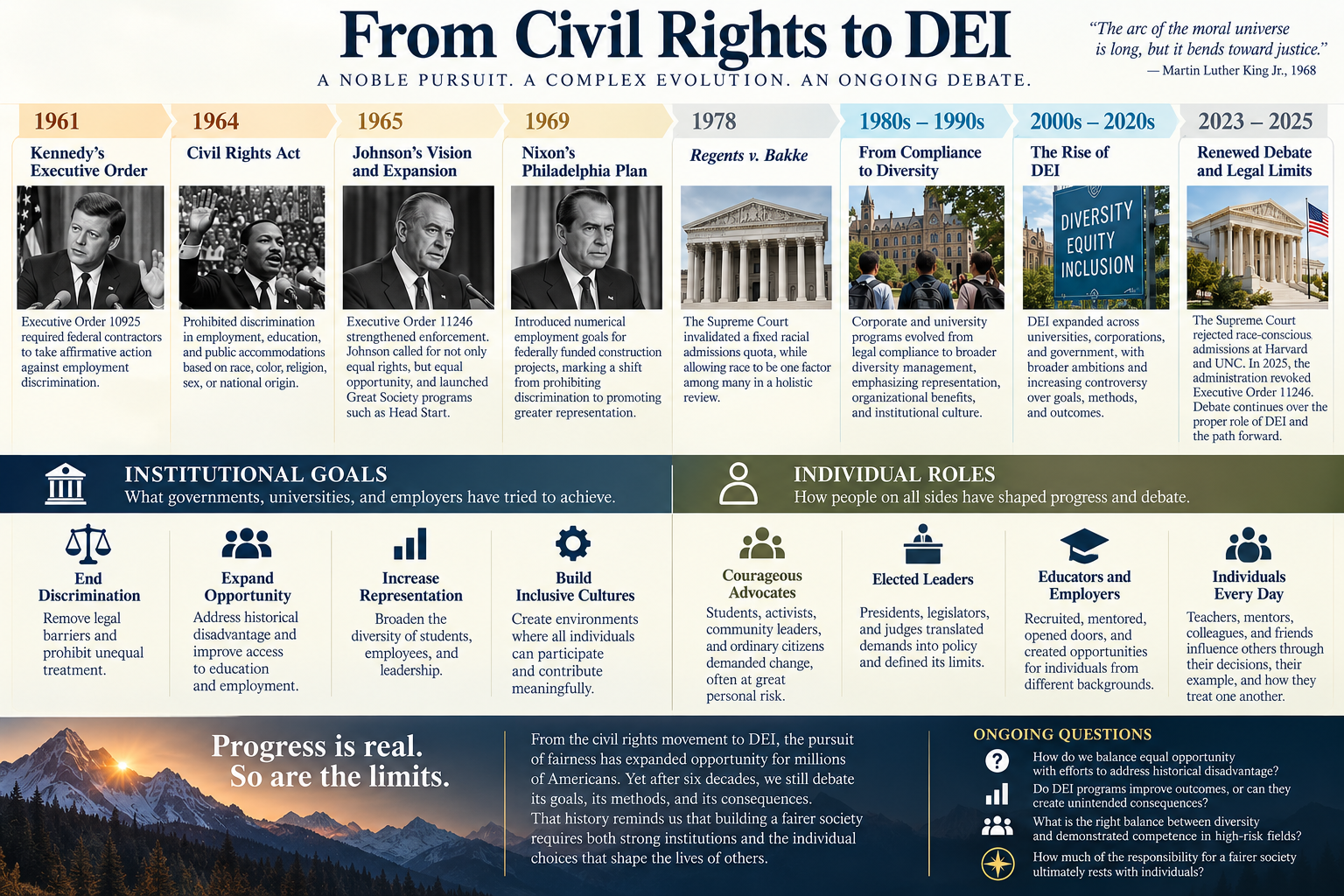
The history explains how a commitment to prohibiting discrimination evolved into a much broader institutional mission. But diversity, equity, and inclusion are not interchangeable objectives. Each raises different questions about fairness, and pursuing one does not necessarily advance the others.
Three Letters, Three Very Different Promises
Diversity, equity, and inclusion are often presented as complementary objectives under a single institutional mission. Yet they represent fundamentally different ambitions. Diversity concerns who is represented. Equity requires judgments about what constitutes fairness. Inclusion concerns whether individuals can participate meaningfully and feel that they belong. Understanding their differences is essential to evaluating what each can reasonably accomplish.
Diversity: Representation, Education, and Competence
Diversity describes differences among individuals within a population or institution. These may include race, ethnicity, sex, age, socioeconomic circumstances, educational background, professional experience, religion, and geographic origin. Many of these characteristics can be measured. A university can examine the composition of its student body, a corporation can evaluate workforce demographics, and a medical school can determine whether its recruitment efforts reach applicants from a broader range of backgrounds.
Diversity can serve important educational and professional purposes. Students with different experiences may contribute perspectives that enrich classroom discussions. Businesses may benefit from employees who understand different communities, markets, and cultures. Healthcare organizations may gain valuable insights from professionals whose experiences reflect those of the populations they serve.
Although diversity creates the possibility of learning from differences. It does not guarantee that such learning occurs. In an earlier essay on higher education, I described the gradual disappearance of the traditional classroom. At one time, virtually all of our 110 medical students attended lectures in person. Questions were spontaneous. Students challenged professors, professors learned from students, and discussions sometimes took unexpected turns. The classroom was more than a place where information was delivered. It was an environment where ideas could be examined, questioned, defended, and reconsidered.
As education increasingly migrated toward recorded lectures and computer-based instruction, students gained considerable advantages. Educational materials became more accessible, lectures could be reviewed repeatedly, and students enjoyed greater flexibility. But something was also lost. Much of university life unfolds outside the classroom—in spontaneous hallway conversations, unexpected exchanges in the library, discussions over lunch in the cafeteria, or friendships with people whose backgrounds and experiences differ from our own. These encounters seldom appear in a curriculum, and their influence is nearly impossible to measure. Yet a chance conversation can challenge a deeply held assumption, introduce an unfamiliar perspective, inspire a new interest, or even change the direction of someone's career. Thousands of these small interactions occur throughout a university every day, often without anyone recognizing their significance. As students spend less time together, opportunities for these encounters diminish.
Research also supports the importance of these interactions. In a 2002 study published in the Harvard Educational Review, Patricia Gurin and colleagues examined longitudinal data from more than 11,000 students attending 184 American colleges and universities. Students who reported greater interaction across racial and ethnic lines generally showed stronger intellectual engagement, self-reported academic skills, and civic awareness. Informal interactions among students were particularly important. Although observational, the findings reinforced a distinction between demographic representation and the educational experiences that make diversity valuable.
Consider a university that devotes considerable attention to assembling a demographically diverse class, only to have much of its instruction delivered to students working independently at computer screens. What educational benefit is being realized if those students rarely engage with one another? The question is not whether technology belongs in education, but whether institutions are providing meaningful opportunities for students to learn from the diversity they have worked to create.
And here the responsibility shifts, at least in part, from the institution to the individual. Professors must encourage discussion, challenge assumptions, and invite different perspectives into the classroom. Students must be willing to listen, question, disagree respectfully, and engage with people whose experiences or opinions differ from their own. Simply bringing people together accomplishes relatively little if they make no effort to learn from one another. A diverse student body is an institutional goal. What students learn from that diversity is the educational accomplishment.
Another consideration becomes particularly important in professional education: competence. A medical school's responsibility extends well beyond the demographic composition of its entering class. It must graduate physicians who possess the knowledge, skills, judgment, and professional abilities necessary to care for patients safely and effectively. A diverse entering class may represent meaningful progress in educational opportunity, but its composition tells us little about whether its graduates are prepared to practice medicine.
Determining who has the potential to become an excellent physician is not as straightforward as we might wish. Academic performance and standardized examinations provide valuable evidence of preparation and predict aspects of future achievement, but neither captures every quality necessary for clinical excellence. Judgment, communication, perseverance, adaptability, and the capacity to learn from experience also matter. Differences in educational opportunity further complicate our assessment of individual potential. Nevertheless, our responsibility is to identify the candidates most likely to develop into capable, accomplished physicians, using the best available evidence and professional judgment. That obligation cannot be subordinated to demographic objectives or assumptions based on race, sex, or other personal characteristics. Medical schools should continually improve how they evaluate applicants, recognize potential that conventional measures may overlook, and expand opportunities for capable students whose circumstances have limited their preparation.
Selecting students inevitably involves judgments about future potential; graduating them requires evidence of demonstrated competence. Students may enter medical school with different levels of preparation and follow different educational pathways. Teachers and mentors can help them develop their abilities, but each student must ultimately acquire the knowledge, skills, and judgment necessary to care for patients safely and effectively. As I argued in an earlier essay on higher education, compassion should shape the path to competence; it should not alter the definition of competence.
Equity: The Promise and Limits of Fairness
Unlike diversity, which can be described and measured, equity requires judgments about what constitutes fairness. Does fairness mean evaluating everyone according to identical standards, accounting for differences in preparation and opportunity, or providing additional assistance to those facing disadvantage? Should institutions seek equal access to opportunities, or comparable outcomes across demographic groups? These objectives are not necessarily interchangeable.
Consider two applicants competing for a single position. One possesses stronger conventional qualifications but has enjoyed substantial educational advantages. The other has overcome considerable adversity but presents a less impressive academic record. Which selection is equitable? The question is whether fairness should be judged primarily by what applicants have achieved or also by the circumstances under which they achieved it. There is no universally accepted answer.
Some inequities can be identified and corrected. An employer can ensure equal pay for equal work. A school can provide additional resources to students. A supervisor can recognize the potential of an overlooked employee and provide an opportunity to develop it. Institutions and individuals can remove unnecessary barriers, expand access to education, and help others acquire the qualifications needed to succeed. These are tangible improvements that are entirely consistent with our innate sense of fairness.
But equity as a universal condition of human life is an entirely different proposition. Throughout recorded history, societies have struggled with differences in wealth, status, power, and opportunity. Individuals enter life with different family circumstances, resources, abilities, and social connections. They encounter different opportunities and develop different ambitions, interests, and priorities. These differences accumulate throughout life, often in ways that are difficult to recognize, much less measure.
Even if we could identify every advantage and disadvantage, how would we compensate for them fairly? What weight should we assign to family wealth, parental encouragement, educational preparation, mentorship, personal effort, or circumstances beyond an individual's control? No universally accepted formula balances these considerations, nor is there a reliable way to apply one consistently across an entire society.
Equity is a worthy aspiration and a useful guide for correcting identifiable injustices. It is not a condition that any society can reasonably promise to achieve.
Inclusion: The Promise and Limits of Belonging
Inclusion asks that we treat individuals with respect and provide meaningful opportunities to participate and contribute. A university must create an environment in which everyone feels comfortable expressing their ideas. A company can promote inclusion by giving all qualified employees a fair opportunity to contribute, grow, and advance. But inclusion cannot reasonably mean universal admission, acceptance, membership, or belonging. Universities must make admissions decisions, businesses must select employees for promotion, and professional organizations may establish legitimate membership requirements. An inclusive society cannot promise that everyone will be accepted into every group or receive every opportunity they seek. Opportunities are limited; individuals and organizations must make choices, and disappointment is an unavoidable part of life. We should expect to be treated fairly, but we must also learn to accept rejection, recognize that others may be better qualified or simply better suited to a particular opportunity, and move forward without assuming that every unfavorable outcome represents an injustice.
Consider fraternities and sororities, which present an interesting paradox within American universities. Institutions that emphasize diversity and inclusion frequently recognize social organizations built around selective membership, shared traditions, and a strong sense of belonging. These organizations can provide lifelong friendships, mentoring, leadership experience, community service, and valuable professional connections. Yet membership is not guaranteed, and selection may depend upon personal relationships, shared interests, and judgments about compatibility. Financial requirements may create additional barriers. An organization can be remarkably inclusive toward its members while remaining highly selective about whom it admits. Does this make such organizations inherently inequitable? Not necessarily. The freedom to associate with others around shared interests and values is itself an important individual liberty.
American law recognizes this distinction. The First Amendment protects freedom of association, though the extent of that protection depends on the organization's nature and purpose. Congress also explicitly exempted qualifying social fraternities and sororities from Title IX's restrictions on sex-based membership practices, allowing traditional single-sex membership. This exemption does not authorize racial discrimination. The Supreme Court has also recognized that public universities may impose reasonable, viewpoint-neutral membership requirements as a condition of official recognition and access to university resources. In Christian Legal Society v. Martinez (2010), the Court upheld a public law school's requirement that officially recognized student organizations accept all students wishing to join. The law recognizes both the value of voluntary association and the legitimate limits institutions may place upon it.
Inclusion extends beyond membership in organizations like fraternities to the broader university community, where students must learn to live together with mutual respect rather than merely tolerate one another. Students share classrooms, libraries, cafeterias, residence halls, athletic facilities, and social spaces. They will encounter people whose backgrounds, beliefs, habits, and personalities differ substantially from their own. Some of these encounters will be rewarding; others will be uncomfortable. Like family members, individuals within a university community should aspire to treat one another with consideration and respect, particularly when disagreements arise. Respect does not require affection, agreement, or friendship with everyone. It requires recognizing others' dignity and accepting some responsibility for the community they share.
Much of the responsibility for creating an inclusive community ultimately rests with its members. Professors can encourage respectful debate, students can listen to classmates with whom they disagree, and university leaders can demonstrate how differences should be addressed without personal hostility. These ordinary interactions are how people learn to live and work together. An institution can establish expectations for inclusion, but individuals determine how those expectations are practiced.
The Limits of Policy, the Power of People
Institutions can establish rules against discrimination, promote fair treatment, and create opportunities for people from different backgrounds. But genuine inclusion depends on something more personal: how individuals choose to treat one another. A university can require respectful conduct, but it cannot mandate friendship, eliminate prejudice, or guarantee a sense of belonging. Those relationships develop over time, through shared experiences, everyday conversations, disagreements, acts of kindness, and countless small interactions that no administrative program can fully anticipate or measure.
Nor should we imagine that every member of a community will eventually embrace these ideals. Some people will remain prejudiced, and some will be openly racist. Discriminatory behavior must be confronted, but changing attitudes and building mutual respect is a slower and more personal undertaking. An institution can establish the conditions for inclusion; the people within it ultimately determine whether a genuine community develops.
This distinction exposes a fundamental difficulty with treating diversity, equity, and inclusion as a single institutional mission. Representation can be measured, but demographic composition alone tells us little about fairness or the quality of human relationships. Equity requires judgments about competing interests and circumstances. Inclusion depends on individual behavior, mutual respect, and the willingness to engage with people whose backgrounds and beliefs differ from our own. These objectives are related, but we cannot achieve or evaluate them in the same way.
Diversity can be counted. Equity must be evaluated. Inclusion must be cultivated.
From Affirmative Action to DEI: What Have We Accomplished?
American society has undergone a remarkable transformation over the past sixty years, particularly in education, professional opportunities, and social attitudes. The changes are substantial and well documented, even if determining precisely what produced them is more complicated.
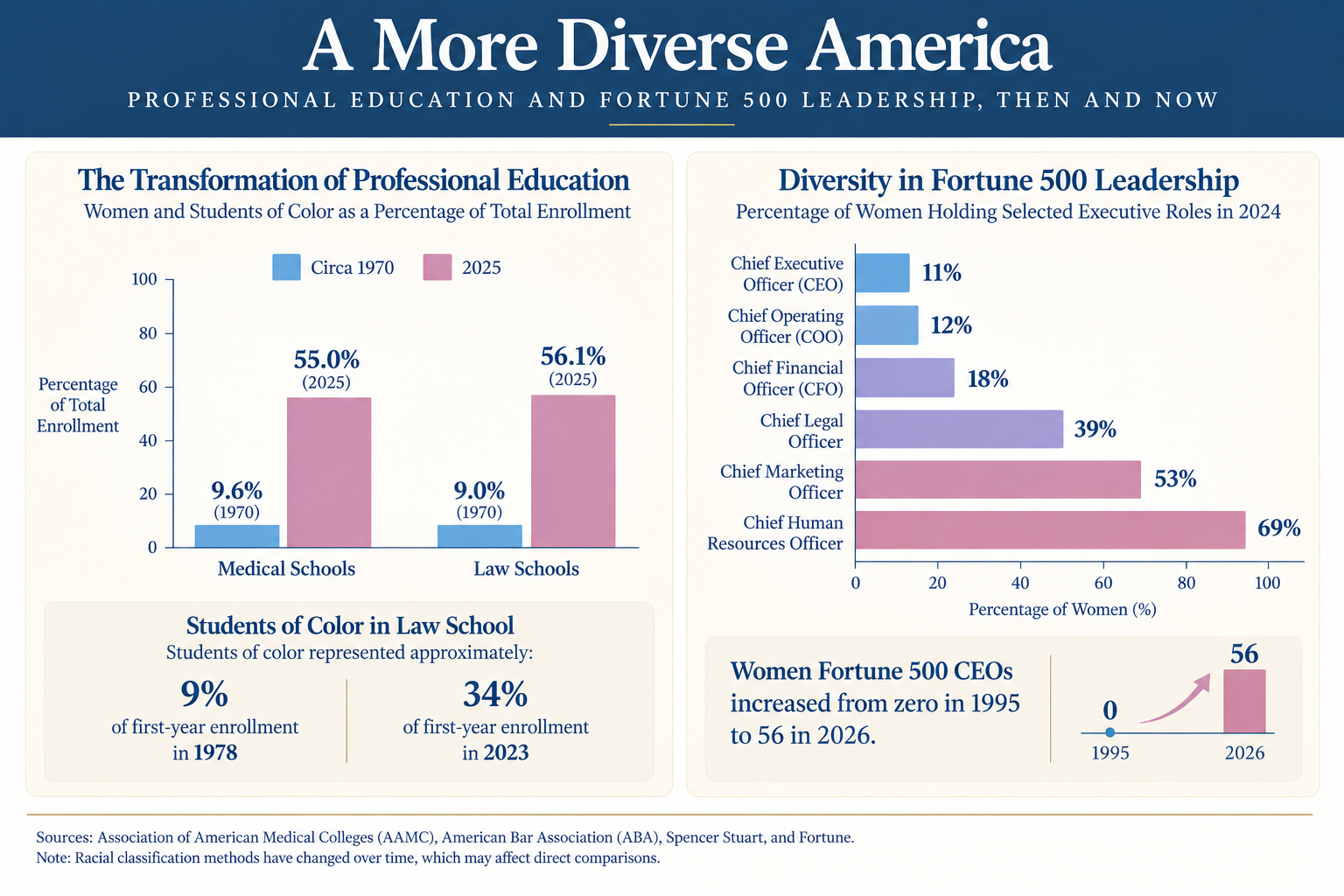
In 1970, women represented approximately 9.6% of students enrolled in American medical schools and 9% of law students. Today, they account for approximately 55% and 56%, respectively. Two professions historically dominated by men have undergone a profound demographic transformation in little more than half a century. Racial and ethnic representation has also expanded. According to the American Bar Association, students of color accounted for approximately 9% of first-year law school enrollment in 1978, compared with 34% in 2023.
Corporate America provides another perspective. In 1995, no woman headed a Fortune 500 company. By 2026, women led 56 companies, representing 11.2% of the total. Progress has been substantial, although representation varies considerably across leadership positions. A 2024 Spencer Stuart analysis found that women held approximately 18% of chief financial officer positions, compared with 53% of chief marketing officer positions and 69% of chief human resources officer positions. Such differences raise interesting questions about career choices, professional preparation, advancement opportunities, and the factors that influence leadership selection.
Perhaps equally remarkable is the transformation in public attitudes. In 1958, Gallup found that only 4% of Americans approved of marriage between Black and White people. By 2021, approval had reached 94%.
Having witnessed much of this, I find it difficult to look at American society today and conclude that little has improved. Opportunities once restricted by law or custom have expanded to millions. Women and minorities now participate in educational, professional, and leadership roles that were far less accessible to earlier generations. These accomplishments deserve recognition and celebration.
Yet substantial challenges remain. Children continue to enter school with vastly different levels of preparation and resources. Discrimination in hiring has not disappeared. Access to influential professional networks and opportunities for advancement remains uneven, while economic mobility remains constrained by family circumstances and geography. Decades of civil rights protections, affirmative action, and DEI initiatives have not resolved these problems. They remind us that changing institutional policies and demographic representation is only part of the challenge of creating a fairer and more balanced society.
Affirmative Action: The Debate Over Fairness
Affirmative action has generated decades of controversy over whether efforts to correct historical disadvantage can expand opportunity without creating new forms of unequal treatment. Critics question whether racial preferences are fair to individual applicants and whether the programs consistently benefit their intended recipients. Supporters argue that removing discriminatory rules does not necessarily overcome disadvantages accumulated through generations of unequal opportunity. Both perspectives raise questions about how fairness should be accomplished.
Economist Thomas Sowell, in Affirmative Action Around the World, questioned whether preferential policies consistently delivered their promised benefits, citing unintended consequences such as resentment and advantages flowing disproportionately to relatively privileged members of the intended groups. Supreme Court Justice Clarence Thomas has emphasized another concern: the stigma of preferential treatment. When race influences selection, minority students and professionals may find their qualifications questioned, even when their accomplishments were achieved entirely on merit. A policy intended to expand opportunity may inadvertently diminish recognition of individual achievement.
Other research presents a different picture. In The Shape of the River, William Bowen and Derek Bok examined more than 45,000 students entering selective universities and documented substantial educational and professional achievements among Black graduates. More recently, economist Zachary Bleemer studied California's elimination of race-conscious university admissions under Proposition 209. He found that minority applicants shifted to less selective institutions and ultimately earned less. These findings challenge the argument that students necessarily benefit from attending institutions more closely matched to their initial academic preparation.
Some of the most promising research, however, examines how we might expand opportunity more directly. In the federal Moving to Opportunity experiment, families living in high-poverty housing projects were offered help relocating to lower-poverty neighborhoods. Children who moved before age 13 later had higher college attendance and higher earnings as adults, demonstrating the potentially lasting influence of childhood circumstances.
These studies illustrate different approaches to improving opportunity. Some seek to compensate for disadvantage during selection, while others attempt to remove barriers that prevent individuals from developing their abilities or accessing better resources.
The Trump administration has moved decisively to dismantle federal DEI programs and restore an emphasis on individual merit and equal treatment. But the pursuit of greater opportunity should not end with a policy change. Researchers continue to investigate the effects of educational disadvantage, housing, economic mobility, and discrimination, including promising approaches that do not depend on demographic preferences. We should welcome this work, learn from its findings, and remain willing to reconsider methods that have failed to deliver meaningful results. The objective is not to preserve any particular program or philosophy, but to continue finding better ways to expand opportunity and improve people's lives.
The Power of Everyday Decisions: Where Fairness Becomes Personal
For more than sixty years, America's pursuit of fairness has concentrated heavily on what governments, universities, corporations, and other institutions should accomplish. We have enacted civil rights legislation, established affirmative action programs, developed diversity initiatives, and created elaborate administrative systems intended to improve opportunity and prevent discrimination. These efforts have helped transform American society, although their results have varied considerably. Yet amid this emphasis on institutional responsibility, we may have overlooked something fundamental: institutions establish policies, but individuals make the countless decisions through which fairness is experienced in everyday life.
Listen carefully when successful people reflect on their accomplishments. Whether accepting an Academy Award, celebrating an athletic championship, receiving a Nobel Prize, or being recognized as an outstanding employee, they frequently acknowledge the people who helped them along the way. A teacher who inspired them. A coach who demanded more than they thought possible. A mentor who recognized potential. A colleague who offered guidance at a critical moment. They seldom speak about an institutional program. They remember the people who believed in them, challenged them, and helped them succeed. Their achievements may be individual, but the journeys toward them rarely are.
These contributions occur at every level of society. A corporate executive may direct substantial resources toward education and professional development. A hospital director may recognize promise in a young physician and provide an opportunity for further training. A college professor may encourage a capable student to pursue graduate education. A Costco manager may offer additional responsibilities to an employee who has demonstrated initiative. A McDonald's manager may give a teenager a first job, teach responsibility, and provide encouragement that shapes a lifetime of employment. A coach may recognize ability in a child who lacks confidence, while a parent may help another family's child get to soccer practice. The resources and authority available to these individuals differ enormously, yet each can influence another person's future.
Research demonstrates that these relationships can have measurable consequences. In a study involving more than one million children, economists Raj Chetty and colleagues found that effective teachers influenced college attendance and earnings well into adulthood. Randomized studies of mentoring programs have demonstrated improvements in educational and professional achievement. In another landmark investigation, Chetty and colleagues examined approximately 21 billion Facebook friendship connections and found that communities with stronger relationships across socioeconomic lines tended to experience greater upward economic mobility. Their work also highlighted the importance of opportunities for people from different backgrounds to meet and form relationships. Taken together, these findings suggest that the people we encounter, the relationships we develop, and the opportunities others create for us can profoundly influence the course of our lives.
Some of these relationships develop through formal programs, but many arise from ordinary interactions that no institution could reasonably plan. A conversation in a university hallway may introduce a student to an entirely new field of study. A recommendation may open the door to a professional career. An unexpected assignment may reveal abilities that neither an employee nor a supervisor previously recognized. An encouraging word may persuade someone to continue when giving up seems easier. We rarely know which encounters will prove consequential, and most will never appear in a survey, institutional report, or measure of demographic progress.
Individual influence, however, can work in either direction. A manager who promotes friends rather than qualified employees may close doors to deserving candidates. A professor who recognizes potential only in students with familiar backgrounds may overlook exceptional talent. A coach who concentrates exclusively on the most accomplished players may miss a child capable of extraordinary improvement. Fairness requires us to examine our assumptions, evaluate people thoughtfully, apply reasonable standards, and remain open to potential that might otherwise go unrecognized. Sometimes the most important contribution is not giving someone an advantage, but ensuring that an unnecessary disadvantage does not prevent them from receiving a fair opportunity.
Responsibility also belongs to those receiving these opportunities. A teacher can provide instruction, but the student must learn. A mentor can offer guidance, but the trainee must develop the necessary skills. An employer can provide an opportunity for advancement, but the employee must demonstrate the qualifications and performance the position requires. Opportunity does not guarantee achievement, nor should it. Talent, preparation, perseverance, personal choices, and individual effort remain essential. The people who help us succeed deserve our gratitude, but we must ultimately accept responsibility for our growth.
Perhaps the most extraordinary aspect of individual influence is its cumulative potential. We tend to measure social progress through landmark legislation, judicial decisions, government programs, institutional policies, and demographic statistics. Yet millions of decisions occur every day that are almost impossible to measure. People choose whom to encourage, whom to mentor, whose ideas to consider, whose achievements to recognize, and whether to make an additional effort on someone else's behalf. Most of these decisions seem unremarkable. Some may have little lasting effect, while others can change the course of a life. Multiplied across millions of individuals and successive generations, their potential influence is enormous.
And this is where our discussion of fairness ultimately leads. We have devoted decades to developing increasingly ambitious institutional approaches to discrimination, opportunity, diversity, equity, and inclusion. We have accomplished a great deal, but we continue to confront disadvantages that no institution can completely eliminate. Perhaps we have placed too much emphasis on what systems can accomplish and too little on individuals' responsibility to practice fairness in their everyday relationships. Governments can establish rights, universities can provide education, and corporations can create opportunities. But people recognize potential, offer encouragement, share knowledge, open doors, and help others develop the abilities necessary to succeed.
The opportunity to make a difference is available to nearly everyone. It does not require extraordinary wealth, political authority, or professional distinction. Sometimes it requires nothing more than a little time, attention, encouragement, or a willingness to help someone whose circumstances differ from our own. We cannot know how many lives these ordinary decisions might change, but we have good reason to believe their collective influence is substantial.
We may never create a society in which everyone begins with the same advantages, encounters identical opportunities, or achieves comparable success. Five thousand years of human history suggest that we should be modest about such ambitions. Yet the progress of the past sixty years demonstrates that societies can change, barriers can fall, and opportunities can expand. Much remains to be accomplished, and all of us share responsibility for further progress.
We cannot legislate every act of fairness. But we can practice fairness every day.
We may never achieve a perfectly fair society. But each day offers another opportunity to make it fairer.
Fairness is not a destination we will someday reach. It is a responsibility we must continually fulfill.
Selected References and Further Reading
The following sources provide the historical foundation, demographic evidence, competing interpretations of fairness, and empirical research discussed in this essay. Particular attention is given to the distinction between institutional efforts to expand opportunity and the influence of education, mentoring, and individual relationships.
AP-NORC Center for Public Affairs Research. Most Say Democracy Is Important for the U.S. Identity, but Few Think It Is Functioning Well. April 3, 2024. Read
Pew Research Center. More Americans Disapprove Than Approve of Colleges Considering Race, Ethnicity in Admissions Decisions. June 8, 2023. Read
Supreme Court of the United States. Brown v. Board of Education, 347 U.S. 483 (1954). National Archives. Read
Kennedy JF. Executive Order 10925, Establishing the President's Committee on Equal Employment Opportunity. March 6, 1961. Read
President's Committee on Equal Employment Opportunity. Report to the President. November 1963. Federal Reserve Bank of St. Louis, FRASER historical collection. Read
Civil Rights Act of 1964. Title VII, including Section 703(j). U.S. Equal Employment Opportunity Commission. Read
Johnson LB. To Fulfill These Rights. Commencement address, Howard University, June 4, 1965. LBJ Presidential Library. Read
Johnson LB. Executive Order 11246, Equal Employment Opportunity. September 24, 1965. National Archives. Read
U.S. Department of Labor. Chapter 7: Nixon and Ford Administrations, 1969–1977. Historical account of federal equal-employment enforcement and the Philadelphia Plan. Read
U.S. Department of Labor. Sixty-Seventh Annual Report, Fiscal Year 1979. Office of Federal Contract Compliance Programs enforcement and compliance statistics. Read
Supreme Court of the United States. Regents of the University of California v. Bakke, 438 U.S. 265 (1978). Read
Kelly E, Dobbin F. How Affirmative Action Became Diversity Management: Employer Response to Antidiscrimination Law, 1961–1996. American Behavioral Scientist. 1998;41(7):960–984. Read
Supreme Court of the United States. Students for Fair Admissions, Inc. v. President and Fellows of Harvard College, 600 U.S. 181 (2023). Consolidated consideration of Harvard and University of North Carolina admissions practices. Read
Trump DJ. Executive Order 14173, Ending Illegal Discrimination and Restoring Merit-Based Opportunity.January 21, 2025. Federal Register. Read
Gurin P, Dey EL, Hurtado S, Gurin G. Diversity and Higher Education: Theory and Impact on Educational Outcomes. Harvard Educational Review. 2002;72(3):330–367. Read
United States Code. Title IX of the Education Amendments of 1972, 20 U.S.C. §1681(a)(6). Provisions exempting qualifying social fraternities and sororities from certain sex-based membership restrictions. Read
Supreme Court of the United States. Christian Legal Society Chapter of the University of California, Hastings College of the Law v. Martinez, 561 U.S. 661 (2010). Freedom of association and university recognition of student organizations. Read
Brady WJ, McLoughlin K, Doan TN, Crockett MJ. How Social Learning Amplifies Moral Outrage Expression in Online Social Networks. Science Advances. 2021;7(33):eabe5641. Read
Association of American Medical Colleges. Historical medical school enrollment statistics, 1965–2015, and 2025–26 medical school enrollment data. Historical data | 2025–26 enrollment
American Bar Association. Profile of the Legal Profession: Legal Education. Historical enrollment trends by sex, race, and ethnicity. Read
Pew Research Center. The Data on Women Leaders. Historical Fortune 500 female CEO representation, 1995–2023. Read
Fortune. Two Health Insurers Just Overtook GM as the Highest-Ranking Women-Led Companies on the Fortune 500. June 3, 2026. Reports 56 female Fortune 500 CEOs, representing 11.2% of companies. Read
Spencer Stuart. Fortune 500 C-Suite Snapshot 2024: Profiles in Functional Leadership. Analysis of demographic representation across senior corporate positions. Read
Gallup. U.S. Approval of Interracial Marriage at New High of 94%. September 2021. Read
Sowell T. Affirmative Action Around the World: An Empirical Study. Yale University Press; 2004.
Bowen WG, Bok D. The Shape of the River: Long-Term Consequences of Considering Race in College and University Admissions. Princeton University Press; 1998.
Bleemer Z. Affirmative Action, Mismatch, and Economic Mobility after California's Proposition 209. Quarterly Journal of Economics. 2022;137(1):115–160. Read
Kline PM, Rose EK, Walters CR. A Discrimination Report Card. American Economic Review.2024;114(8):2472–2525. Read
Chetty R, Hendren N, Katz LF. The Effects of Exposure to Better Neighborhoods on Children: New Evidence from the Moving to Opportunity Experiment. American Economic Review. 2016;106(4):855–902. Read
Bergman P, Chetty R, DeLuca S, Hendren N, Katz LF, Palmer C. Creating Moves to Opportunity: Experimental Evidence on Barriers to Neighborhood Choice. American Economic Review. 2024;114(5):1281–1337. Read
Chetty R, Diamond R, Foster TB, et al. Creating High-Opportunity Neighborhoods: Evidence from the HOPE VI Program. U.S. Census Bureau, Center for Economic Studies Working Paper CES-26-02. January 2026. Read
Chetty R, Friedman JN, Rockoff JE. Measuring the Impacts of Teachers II: Teacher Value-Added and Student Outcomes in Adulthood. American Economic Review. 2014;104(9):2633–2679. Read
Bell A. The Long-Term Impacts of Mentors: Evidence from Experimental and Administrative Data. Working paper. March 2026. Long-term follow-up of a randomized youth mentoring experiment. Read
Chetty R, Jackson MO, Kuchler T, et al. Social Capital I: Measurement and Associations with Economic Mobility. Nature. 2022;608:108–121. Read
Chetty R, Jackson MO, Kuchler T, et al. Social Capital II: Determinants of Economic Connectedness. Nature.2022;608:122–134. Read
