
The history behind the movies—and what our favorite outlaw reveals about us.
Most of what I write for Signal Over Noise covers subjects that tend to raise blood pressure: politics, public policy, healthcare, and the arguments that stick with us. This time, I thought we might escape to Sherwood Forest.
I enjoy historical movies, especially those set in medieval England. Give me a castle, a disputed throne, and a sufficiently disagreeable sheriff, and I am usually willing to settle in. They also leave me wondering how much of what I just watched actually happened. That seemed like a good excuse for an occasional new feature: history after the credits. Start with an entertaining movie, look into its history, and see what survives after the credits.
Robin Hood seemed a promising place to begin. I have watched Douglass Fairbanks, Kevin Costner, Russell Crowe, Taron Egerton, and others take their turns with the bow. Recently, Paul Greengrass’s The Uprising, starring Andrew Garfield, sent me back to the subject. I thought I knew the essentials: Sherwood Forest, Little John, Maid Marian, Friar Tuck, an absent king, and a sheriff who could use a serious attitude adjustment. What I learned was that the players reflect a collection of stories assembled over several centuries. The characters were assembled over a rather extended period of time. The king changed. Even the forest was debatable.
I have learned to accept historical inaccuracies and enjoy the movie for what it is. My working assumption is about 90 percent entertainment and 10 percent history. Sometimes less history. That is a personal rule of thumb, not a calculation, and I am happy to go along for the ride. The danger comes when the filmmaker’s version becomes the history I think I know.
Historical movies deserve to be enjoyed—and their version of history deserves to be examined, too. A real rebellion, an actual king, and convincing costumes can lend authority to events that never happened. The emotions may ring true. The message may be compelling. Neither guarantees historical accuracy. And Robin Hood is hardly alone. Filmmakers often treat history as a trigger for a movie and something to manipulate once the screenwriter arrives.
A Real Revolt, An Invented Origin
The first thing to consider in our Robin Hood analysis is which Richard has the throne. Richard I, the Lionheart, belongs to the late twelfth century. Richard II, the young king in The Uprising, ruled nearly two centuries later. He was fourteen during the Peasants’ Revolt of 1381. Same first name; very different England.
The revolt was real and makes more sense once we understand that the plague preceded The Uprising. The Black Death reached England in 1348 and devastated the country in 1348–49, killing perhaps a third to a half of its population. With fewer workers available, survivors could demand better wages or seek better terms. Landowners and the government tried to contain the labor class. Labor legislation, including the Statute of Labourers of 1351, sought to hold wages down and restrict workers’ freedom to leave service.
People had experienced a catastrophe, seen the value of their labor rise, but then faced efforts to keep old obligations in place. Taxes to support the Crown added another grievance. Attempts to collect an unpopular poll tax, a levy on people rather than simply on property, helped turn resentment into rebellion in 1381.
Wat Tyler, a leader of the revolt, was real. So was John Ball, the radical priest who challenged the social order. Richard II met the rebels, Tyler was killed, and promises of relief gave way to repression. Garfield’s Ploughman, however, is an invented central character. His personal journey and the film’s proposed connection to Robin Hood belong to the screenplay.
Then there is the ominously named Domesday Book—sometimes spelled Domesdei and pronounced “Doomsday.” I knew very little about it before this film. William the Conqueror ordered a great survey in 1085, and the information was gathered in 1086. The survey recorded landholdings, resources, values, and obligations across much of England, helping the crown understand what it possessed and what it believed it could tax and collect. Think of an enormous government inventory, with rather more sheep and mills than we would expect today.
Its later nickname referred to the finality of its judgments, like the biblical Day of Judgment. It was not a prediction of the apocalypse, but its records could be used in disputes over what people owed the crown. A parliamentary petition from 1377 complained that tenants were obtaining extracts from Domesday and using them to resist customary services. Some claimed protections connected to land that had belonged to the crown.
That gives the film’s use of Domesday a historical foothold. The larger suggestion that an ancient record could establish sweeping reform for the oppressed is a dramatic expansion of a narrower argument about status, land, and obligations. A real dispute lies beneath the story; the screenplay makes it do considerably more work.
The film also treats the revolt as Robin Hood’s birth certificate. William Langland’s Piers Plowman, around 1377, already mentions Robin Hood rhymes. The name and stories were circulating well before the rebellion. The film can imagine an outlaw’s origin in 1381, but it cannot establish the Robin Hood legend as originating in that period.
How Robin Acquired His Familiar Company
The earliest surviving stories of Robin Hood give us a rougher and less complete character than the movies depict. Robin is generally believed to be a yeoman: a commoner below the rank of a knight. Depending on the setting, the word could describe a small landholder, a skilled attendant, or someone serving in a household. It does not establish Robin’s exact occupation. It does indicate that the dispossessed earl familiar from later cinematic versions was an embellishment at best.
Much of the Robin Hood origin survives in ballads—stories told in verse, often sung or recited. One especially influential work is A Gest of Robyn Hode. “Gest” means a tale or adventure. This long anonymous poem, surviving in early printed editions from around the beginning of the sixteenth century, gathers older stories into an extended sequence: Robin assists a financially desperate knight, tangles with the sheriff, and encounters a disguised king. It became a major foundation for later retellings. It is a collection of adventures, not a recovered biography. Its king is named Edward, another reason to be cautious about assuming that Richard the Lionheart was there from the beginning.
Little John, Much the Miller’s Son, and Will Scarlet already appear among Robin’s companions in the early ballads. Their names are old; many familiar details about their lives are not. Little John’s celebrated first encounter with Robin on a narrow bridge comes from later storytelling. Will’s status as Robin’s half-brother in Prince of Thieves is a modern invention. The sheriff is an early adversary, but a real office does not establish a villain's identity.
Marian is absent from the principal early ballads, including the Gest. Records of Robin Hood festivities at Kingston in 1509–10 include her, and later drama helps establish her place beside Robin. Anthony Munday’s late-1590s plays turn her into the noble Matilda. Over time, writers make her a sweetheart to be rescued, a political ally, or a fighter who can manage perfectly well without waiting for Robin.
Friar Tuck also appears in the principal early ballads and becomes attached to Robin through later performance traditions. An outlaw priest used “Friar Tuck” as an alias in the fifteenth century, but that does not prove he belonged to Robin’s band. Alan-a-Dale arrives in a later ballad about rescuing his beloved from an unwanted marriage; his familiar role as the company’s musician develops afterward.
Sherwood has a legitimate early claim: it appears in Robin Hood and the Monk. But Barnsdale in Yorkshire is central to the Gest and other early stories or poems. In stories about Robin Hood’s death, he is betrayed and dies at Kirklees Priory. Later local traditions identify Loxley as his birthplace and Hathersage as Little John’s burial place. These locations belong on a map of the legend, but their appearance in stories does not establish that Robin Hood or his companions actually lived—or died—in these locations.
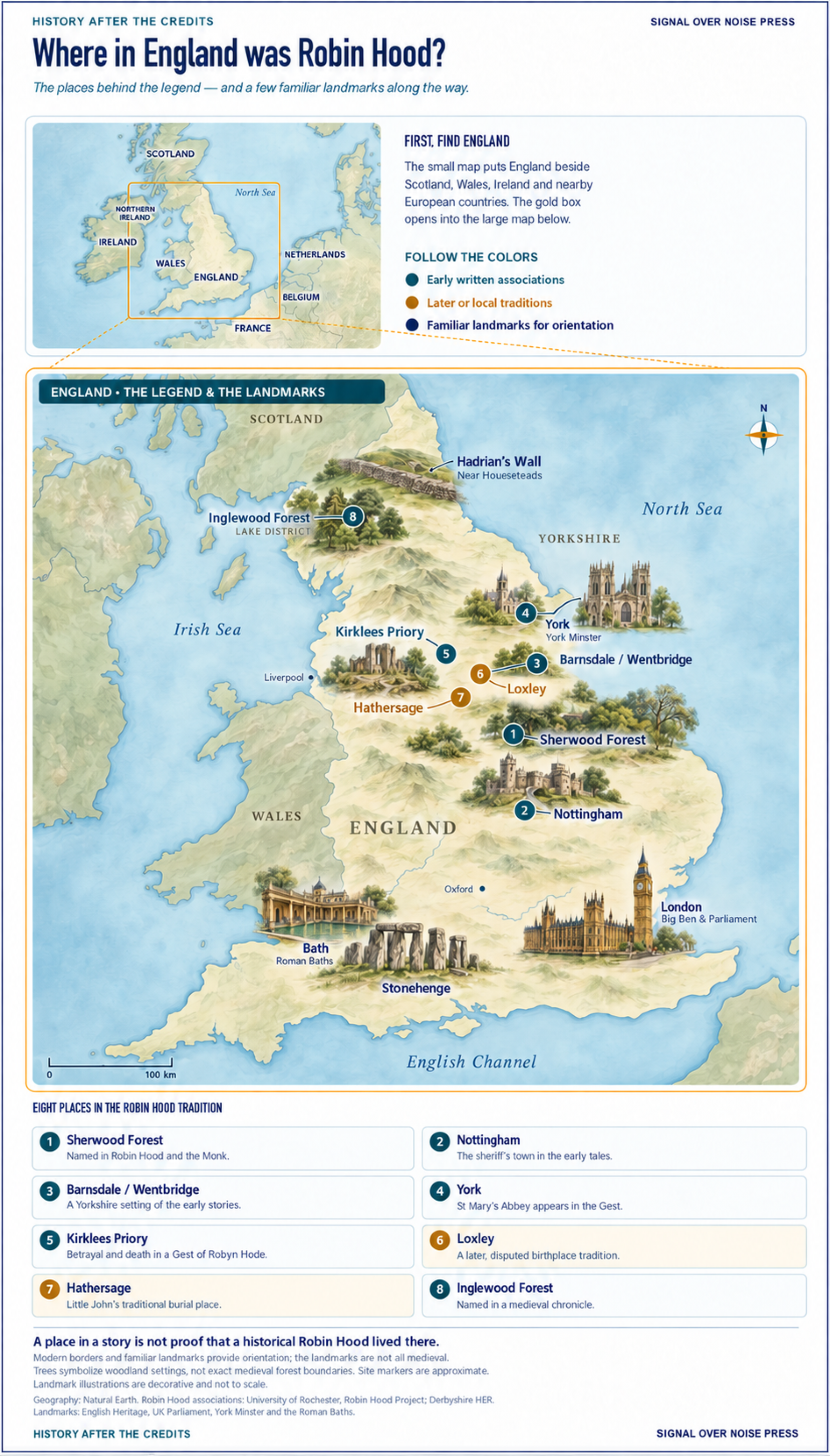
The geography of the legend. Early settings and later traditions overlap; the illustrations and modern landmarks provide orientation, not a reconstruction of medieval England.
Books and plays gradually supplied the backgrounds, romances, and political loyalties that made Robin and his companions feel like people with complete lives. In a history published in 1521, the Scottish historian John Major placed Robin in the time of Richard the Lionheart and his brother John—roughly three centuries before Major’s literary works. This helped establish the royal setting familiar from so many movies, although it did not prove that Robin had lived then.
In plays written in the late 1590s, Anthony Munday gave Robin a considerable social promotion: the commoner became Robert, Earl of Huntingdon, a nobleman driven into outlawry. Marian became Lady Matilda Fitzwater, his aristocratic love interest. These changes gave later storytellers a ready-made plot involving lost status, powerful enemies, and romance. Robin was acquiring quite a résumé.
Joseph Ritson’s influential 1795 collection brought older Robin Hood poems, songs, and ballads together with extensive notes, helping preserve the material and renew interest in it. Walter Scott then brought Robin, called Locksley, into Ivanhoe, published in late 1819 with an 1820 title-page date. Robin is a supporting character, but Scott’s dramatic struggle between Saxons and Normans helped shape the world that later audiences would associate with him. Howard Pyle’s illustrated The Merry Adventures of Robin Hood (1883) gathered familiar adventures into an engaging narrative, especially appealing to younger readers, and gave the outlaws a memorable visual identity.
By the time Hollywood arrived, Robin already had centuries of revisions behind him. The filmmakers inherited a collection of stories that generations of writers had rearranged, expanded, and made their own.
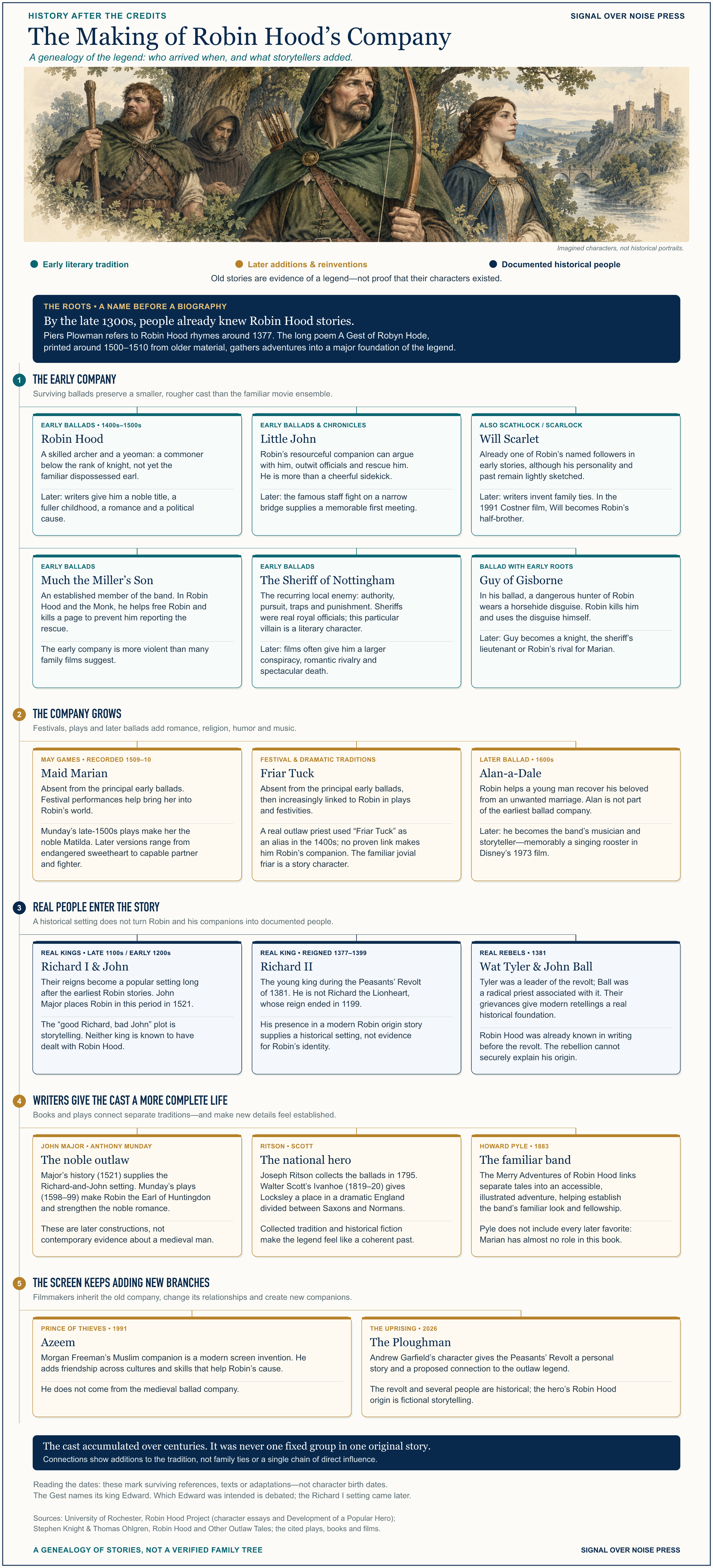
The making of Robin Hood’s company. The connections trace additions to a storytelling tradition, not a verified family tree.
Was There A Man Behind The Name?
Possibly. What we lack is a securely identified man whose documented life matches the familiar story. Medieval records contain people with names resembling Robin or Robert Hood, and researchers have proposed several candidates. A matching name, a brush with the law, and a plausible location make for an intriguing possibility. However, they do not establish a single character as the Robin Hood portrayed in the movies.
Historian David Crook offers one possible starting point: Robert of Wetherby, a real outlaw hunted down in Yorkshire in 1225. Surviving records describe an officially funded pursuit that ended in his death. Other records from around the same time identify a Yorkshire fugitive called Robert Hod, whose confiscated property appears in the royal accounts. Crook has suggested that these could have been two names for the same man—and that stories about his exploits and violent end might have helped launch the Robin Hood legend.
That is an intriguing possibility, but it requires two connections we cannot establish: that Robert of Wetherby was Robert Hod, and that this particular Robert inspired the stories. A similar name, the right general location, and trouble with the sheriff make someone worth investigating. They do not establish that he was a generous outlaw who defended the poor. Crook himself acknowledges that the two recorded men cannot confidently be identified as one person.
However, his research shows why the search is worth taking seriously. Real people and contemporary records remain to be examined. What remains missing is the trail of evidence connecting a particular fugitive to the hero we recognize. We may have found someone who could have inspired Robin Hood; we have not found Robin Hood’s biography.
Other scholars ask a different question. A. J. Pollard examines the early stories in the social and political world of the fifteenth century: what would their audiences have recognized in this yeoman hero? Stephen Knight traces how later societies reshape Robin to express their own ideas about justice, authority, and heroism. Those approaches can tell us a great deal even when they cannot give us a birth date. One outlaw may have sparked it. Several lives may have contributed. Invention may account for much of the rest. The most defensible origin story is therefore the history of how Robin was created, rather than a confident reconstruction of a man we have not found.
How Good Is the Good Outlaw?
We may never know whether one particular outlaw inspired the legend. What we can see more clearly is why Robin Hood endured: he became a symbol of resistance to people accustomed to getting their own way. That is an appealing role, and it earns him considerable forgiveness before he has even drawn his bow.
We extend much the same courtesy today. A politician, protest movement, or public figure who gives voice to our frustrations can win more than our support; they can win the benefit of the doubt we rarely grant their opponents. We notice their courage, understand their anger, and make allowances for their methods. The difficulty comes when what they represent matters so much to us that we stop looking closely at what they do. Robin Hood has generations of storytellers to keep us on his side. Our modern champions can often count on us to do that work ourselves.
Robin steals, threatens, and kills. His companions sometimes do worse. Give those same actions to the sheriff, and our enthusiasm would probably fade. Of course, the usual defense is that Robin fights injustice—and that distinction matters. When officials abuse their authority, obedience is not automatically a virtue. Recovering food taken from a hungry family is different from robbing that family. Rescuing someone from an unjust execution is different from killing a witness to protect yourself. “Lawbreaking” is too broad a label to explain these differences. So is “resistance.”
The times matter too. People facing a powerful landlord or an abusive official often lacked protections many of us expect today. Still, medieval England was not one uninterrupted episode of Game of Thrones. Courts, legal customs, and petitions offered ways to challenge authority, however imperfectly. The Domesday disputes show people using old records to make their case. Sometimes resistance involved paperwork, which helps explain why filmmakers tend to reach for the sword.
Nor should we assume that everyone listening to these stories thought alike. Medieval audiences could admire an outlaw’s courage, laugh at an official’s humiliation, and still recognize that murder was wrong. We manage much the same thing at the movies, admiring a hero’s loyalty and generosity even as he lies, steals, or kills his way through the story.
The early Robin also differs from the figure described by “steal from the rich, give to the poor.” In the Gest, one of his most important acts of generosity is helping a knight who risks losing his land over a debt. His help is personal and selective, rather than part of a general plan to redistribute wealth. He is also more religious than I had realized. In Robin Hood and the Monk, he risks entering Nottingham to attend Mass; the Gest emphasizes his devotion to the Virgin Mary. Faith and anger at corrupt clergy could sit comfortably together. A greedy abbot did not discredit God. Robin’s devotion, however, did not keep his adventures free of bloodshed.
One episode makes that harder to overlook. In Robin Hood and the Monk, Little John kills the monk who helped bring about Robin’s capture. Much then kills the monk’s page to prevent him from reporting what happened. Robin is rescued, but a witness has been killed to make the rescue possible. The page’s precise age is uncertain; the reason for his death is troubling enough.
We know Robin and want him free. We admire Little John’s loyalty. The page barely gets our attention. That is how easily a story can direct our sympathies: someone outside the familiar circle becomes a problem to remove rather than a person whose life matters.
Real history gives us the same difficulty. The rebels of 1381 had serious grievances, but violence in London included killings of officials and attacks on Flemish residents. We can recognize their oppression without approving everything they did. We can also condemn those killings without pretending their grievances were imaginary.
And then there is revenge. We want the bully embarrassed, the corrupt official frightened, and the man who has made everyone else suffer to discover that his position will not protect him forever. I cheer along with everyone else. Watching the sheriff get his comeuppance is part of the fun, and I doubt many of us pause to consider Robin’s economic philosophy before enjoying it.
Still, there is a difference between stopping someone from doing harm and making him suffer because we enjoy seeing it. Motives matter, but so do methods—and the people caught in the middle. A just cause does not make every act committed in its name just.
None of this requires us to watch an adventure film with a clipboard. I can enjoy a sword fight without proposing it as the preferred way to resolve a tax dispute. But it is worth occasionally asking whether Robin has earned our approval or simply inherited it by being Robin. Would we accept the same conduct from the sheriff? Sometimes there is a good reason to judge them differently. Sometimes we just like the fellow with the bow.
Why We Keep Going Back
Rich against poor and rulers against the oppressed certainly help explain the story’s endurance. But the wish underneath is broader: we want power to answer to someone. We want someone who can walk into an unfair situation and do what everyone else is afraid or unable to do.
Robin offers justice with a visible result. The prisoner escapes. The stolen money comes back. The official loses his dignity. Real life offers investigations, conflicting accounts, and decisions that arrive long after the damage. A well-aimed arrow moves the plot along considerably faster. Pleasure exists beyond the politics, too. The forest offers escape from a tightly ordered world. The band offers belonging. There are jokes, friendships, improbable rescues, romance, and the satisfaction of watching someone do something difficult extremely well. Sometimes I want an examination of authority. Sometimes I want to see whether he can make the shot.
Robin also travels well because he is so adaptable. A traditional version can restore a rightful king while punishing bad officials. Another can challenge the social order itself. One makes him a cheerful protector; another asks what years of violence have done to him. Knight’s work helps explain this flexibility: Robin’s changing forms reveal the values and needs of the people retelling the story. That is a symbol's advantage over a person. A person brings awkward details, mixed motives, failures, and consequences. A symbol can be stripped down to the qualities we need: courage, loyalty, generosity, defiance. Each generation can imagine its own sheriff and send Robin after him. It is also the danger. Once we decide that someone embodies justice, we may stop judging how that person behaves. We become generous with our hero’s motives and severe with everyone else’s. The old outlaw still has something to say to the modern world: liking a cause, or the person carrying its banner, does not relieve us of the responsibility to judge the conduct.
Pass The Popcorn And Check The Dates
The movies become more enjoyable for me when I understand what each one is borrowing. Costner’s Prince of Thieves opens in 1194 against a crusading background; Azeem, the family drama, and the sheriff’s conspiracy are storytelling. Crowe’s 2010 film begins around Richard I’s death in 1199, then draws on conflicts associated with Magna Carta in 1215 and the French invasion of 1216. Its calendar is remarkably accommodating. Prince Louis was indeed French, the son of France’s king. But rebellious English barons invited him to take the English crown while fighting King John. That is more complicated, and in its own way more interesting, than a simple story of England uniting against an outside invader. Egerton’s 2018 version uses crusading warfare as a backdrop for a heavily invented rebellion. A period setting and a historical trigger are not quite the same thing.
The films about Robin’s later life ask a different question. Robin and Marian, with Sean Connery and Audrey Hepburn, imagines the aging hero and the love he left behind. Michael Sarnoski’s The Death of Robin Hood, starring Hugh Jackman, turns toward guilt and the burden of past violence. These are interpretations of a literary figure’s ending, not reconstructions of a documented death. The man who was so useful as a symbol eventually has to live with being a man.
I have put the films together in the viewing guide below, with their themes, historical connections, and principal liberties. Historical accuracy and enjoyment deserve separate columns. Otherwise, Alan Rickman’s sheriff may never receive the recognition he deserves!
I began with movies and found a character built by centuries of songs, plays, books, and performances. I still cannot tell you exactly who Robin Hood was. I have a better understanding of how he became the man I thought I knew, and why I am so willing to take his side.
That is the spirit of History After the Credits. Enjoy the adventure. Let it make you curious. Then see what the evidence can support, including the parts that complicate a satisfying story.
When the next Robin Hood appears, I will probably watch. I will check which Richard is on the throne, wonder where this particular Marian came from, and notice what the story asks me to forgive. I will also be hoping for a really good sheriff.
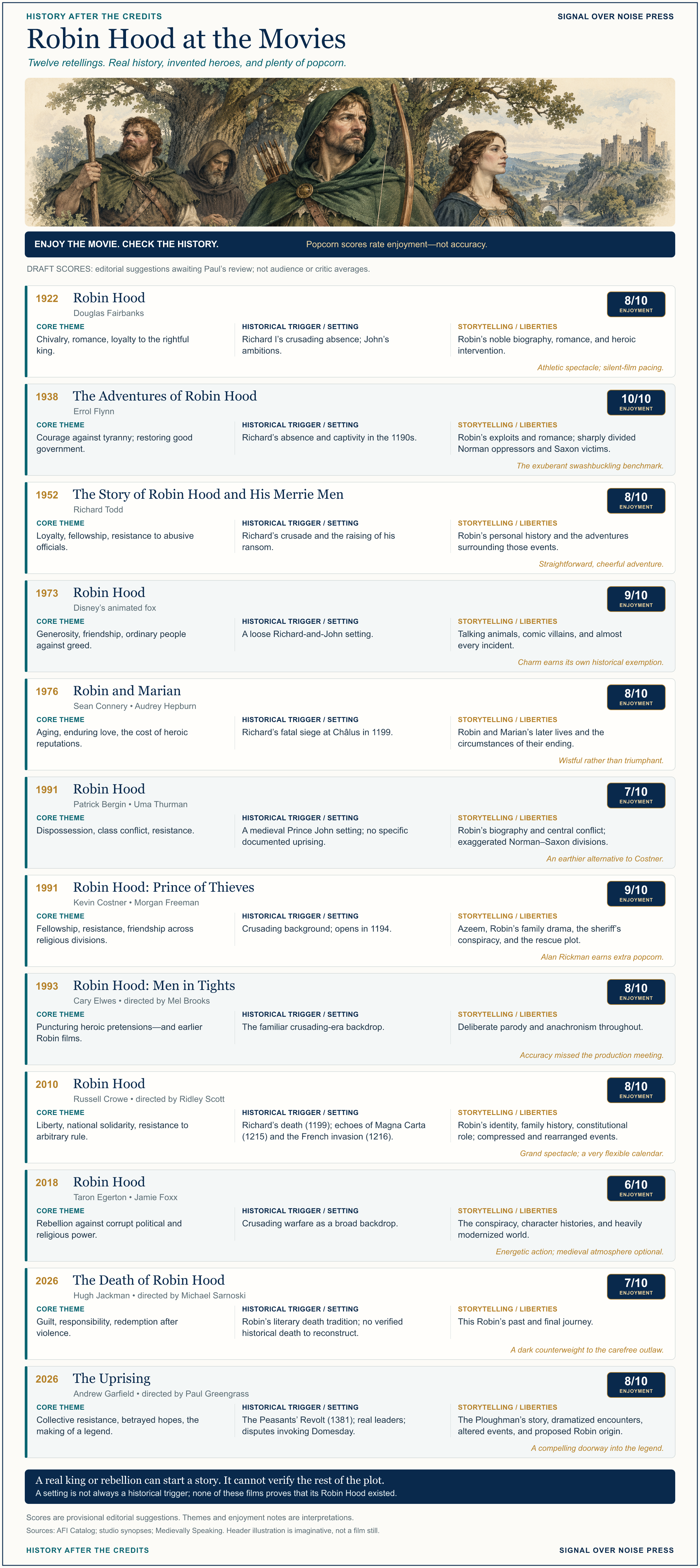
Robin Hood at the movies: the historical ingredients, the inventions, and the entertainment. Enjoyment scores are distinct from historical accuracy.
References
John H. Chandler, Robin Hood: Development of a Popular Hero, University of Rochester.
Stephen Knight and Thomas H. Ohlgren, introduction to A Gest of Robyn Hode, Middle English Texts Series.
University of Rochester, The Robin Hood Project, including its character essays.
David Crook, Robin Hood: Legend and Reality, especially the discussion of Yorkshire in 1215–1225.
A. J. Pollard, Imagining Robin Hood: The Late-Medieval Stories in Historical Context.
Stephen Knight, Robin Hood: A Mythic Biography and Reading Robin Hood.
The National Archives, Domesday Book; Hull Domesday Project, “Domesday, or Doomsday.”
Commons’ Petition Against Rebellious Villeins, 1377, reproduced with historical notes on Frank Grady’s University of Missouri–St. Louis teaching site.
English Heritage, Introduction to Medieval England; Yale Avalon Project, post-plague labor legislation.
London Museum, “How the Peasants’ Revolt rocked medieval London.”
English Heritage, “How Dover Castle became the Key of England—the Great Siege of 1216.”
Kevin J. Harty, review of The Uprising, Medievally Speaking; official film materials from Focus Features, A24, and the AFI Catalog.
