

In Brief
Patients place extraordinary trust in physicians, expecting sound clinical judgment, technical competence, compassion, and the ability to make difficult decisions independently. But how confidently can we establish that medical education has prepared physicians to meet those expectations?
Over the past several decades, medical knowledge and clinical complexity have expanded dramatically, while clinical productivity demands, documentation requirements, and administrative responsibilities have increasingly competed with the time available for teaching.
We have become remarkably sophisticated at administering examinations, completing evaluations, and documenting compliance with accreditation requirements. Yet we have far less evidence establishing how effectively these processes prepare physicians for independent practice or translate into better patient outcomes.
Despite extraordinary advances in medical knowledge, technology, and clinical complexity, the fundamental approach remains largely familiar: complete the required training, pass the examinations, satisfy the accreditation standards, and assume the system is working. We have become exceptionally good at demonstrating that educational requirements have been met, but considerably less successful at demonstrating what those requirements actually accomplish.
Meanwhile, Medicare directs billions of dollars annually to teaching hospitals through financing arrangements largely disconnected from demonstrated educational effectiveness.
Drawing on decades of experience as a physician and educator, together with published research and federal oversight reports, this essay examines what we know, what remains uncertain, and whether academic medicine is adequately fulfilling its educational responsibilities.
The central argument is straightforward: We cannot keep expanding what physicians must know while reducing opportunities to teach and assess them, then assume educational excellence will follow. The public deserves evidence, not just assurances.
What You'll Learn
Most patients see the result of medical education: the physician who examines them, recommends treatment, performs a procedure, or makes a difficult decision. Far fewer understand the years of training, institutional decisions, financial incentives, and educational assessments that precede those encounters.
This essay examines six questions that matter to physicians, educators, patients, and anyone concerned about the quality and cost of American healthcare.
How has medical training changed? Explore the evolution of residency education, including key improvements in supervision and patient safety, alongside concerns that increased attending involvement and competing clinical demands may limit residents' opportunities to develop independent judgment.
How do we know a physician is competent? Understand what medical examinations, board certification, faculty evaluations, and accreditation establish—and what they may fail to reveal about clinical reasoning, recognizing urgency, making decisions under uncertainty, and readiness for independent practice.
What is happening to the physicians who teach? Examine how expanding medical knowledge, clinical workloads, productivity expectations, electronic documentation, and administrative requirements compete with teaching and mentorship. Consider what happens when educators retain responsibility for preparing physicians but increasingly lack the time to do so effectively.
Where does the money go, and who is accountable? Follow the billions in public funding that Medicare directs to teaching hospitals through Direct and Indirect Graduate Medical Education payments. Learn how these arrangements developed, why hospitals have vigorously defended them, and why financial reimbursement remains poorly connected to demonstrated educational quality.
Why does this matter to patients and healthcare costs? Consider how training may shape clinical judgment, professional values, communication, patient safety, unnecessary testing, and healthcare expenditures throughout a physician's career. Explore why unrecognized educational shortcomings may also influence future generations of physicians.
How can we improve medical education? Examine practical approaches to strengthening foundational knowledge, bedside teaching, independent reasoning, meaningful assessment, simulation, mentorship, and the thoughtful use of artificial intelligence. Most importantly, consider how we might determine whether these approaches actually produce better-prepared physicians.
The purpose is not to argue that an earlier generation of physicians was better trained or that today's educational programs are failing. It asks whether our methods of teaching, assessment, financing, and institutional oversight have kept pace with the increasingly demanding responsibilities of medical practice.
Ultimately, the question is not simply how many physicians we train, but how well we prepare them for the patients who will depend on their knowledge, judgment, and humanity.
Opening Thoughts
Medical education was my passion.
For nearly three decades, I devoted much of my professional life to teaching physicians. I led an internal medicine training program with over 180 residents and fellows, directed a nephrology fellowship that trained more than 100 nephrologists, contributed extensively to medical school curriculum development, and wrote textbooks to help students understand the science and practice of medicine. Along the way, I received numerous teaching awards. But the greatest satisfaction came from watching young physicians develop the knowledge, judgment, confidence, and professional responsibility necessary to care for patients independently.
I believed deeply in that responsibility. As a program director, I advocated for educational resources, better assessment tools, and greater attention to the quality of clinical training. I was persistent, sometimes to the frustration of colleagues and administrators confronting competing demands. I understood those pressures, particularly the financial realities of sustaining an academic medical institution. But I often struggled to reconcile our stated educational mission with the priorities that dominated institutional decision-making.
"No margin, no mission" was the familiar refrain. I came to despise it. Not because I failed to appreciate the importance of financial stability, but because it too often ended a discussion that remained unresolved. We could explain why additional educational resources were difficult to provide without establishing whether existing resources were sufficient to accomplish what we expected of our faculty and trainees.
I was not always an easy participant in these discussions. I had trained in an era that emphasized independence, personal responsibility, and getting the job done. When confronted with an obstacle, my instinct was to find a way around it and keep moving. That approach served me well in many circumstances, but I also recognize its limitations. Passion can make it difficult to appreciate competing priorities or acknowledge that a preferred solution may not be the best one. By repeatedly finding ways to fulfill educational responsibilities despite inadequate support, I may sometimes have helped perpetuate the very system I wanted to change.
A few years ago, I thought I had put these concerns behind me. Yet I continue to encounter publications raising remarkably familiar questions about clinical training, faculty responsibilities, educational assessment, accreditation, and the relationship between institutional finances and professional purpose. The Summer 2026 issue of The Pharos, published by Alpha Omega Alpha, led with an editorial titled "Mission, margin, and mindset." Paul Haidet and Frederic Hafferty examined the consequences of letting financial considerations occupy the center of institutional decision-making rather than supporting the institution's underlying purpose. Their conclusion reversed the familiar refrain: "No mission, no margin." [1] I recognized the argument immediately. These were questions I had struggled with throughout my career.
I am also mindful that medicine has changed enormously since my own training. Today's students and residents confront a far more extensive and complex body of medical knowledge, increasingly sophisticated technology, and substantial educational and administrative demands. We continue to graduate many excellent physicians, and dedicated educators work extraordinarily hard to prepare them. This is not an argument that my generation worked harder, possessed greater professional virtue, or was necessarily better trained. But neither should we assume that every change in medical education has represented progress.
There exists a historical contradiction worth examining. The basic architecture of physician education remains recognizable: selection into medical school, foundational science, clinical rotations, examinations, residency or fellowship, and eventual certification. Educational frameworks have evolved, simulation has expanded, and assessment methods have become more elaborate. Yet the institutional environment surrounding that educational paradigm has changed dramatically in financing, reimbursement, documentation, clinical productivity, and administrative accountability.
Have our educational methods and resources kept pace with those changes? More importantly, can we demonstrate that the process continues to prepare physicians for the responsibilities patients will eventually entrust to them?
I often challenged trainees with a simple choice: “Get by—or get better.” A resident can complete required rotations and pass examinations without necessarily demonstrating the full range of abilities needed for independent practice. Similarly, an attending physician can complete evaluation forms without adequately observing the clinical judgment those evaluations are meant to assess. Institutions can also satisfy accreditation requirements without necessarily showing how effectively their programs prepare physicians for independent patient care.
Ultimately, this is not simply a disagreement among physicians, educators, and administrators. Medical education is a public responsibility. Patients are entitled to expect that their physicians have been adequately prepared and that the institutions entrusted with that preparation can provide meaningful evidence of its success.
Patients entrust us with their lives. We owe them more than assurances that our training system works. We owe them evidence that it deserves their trust.
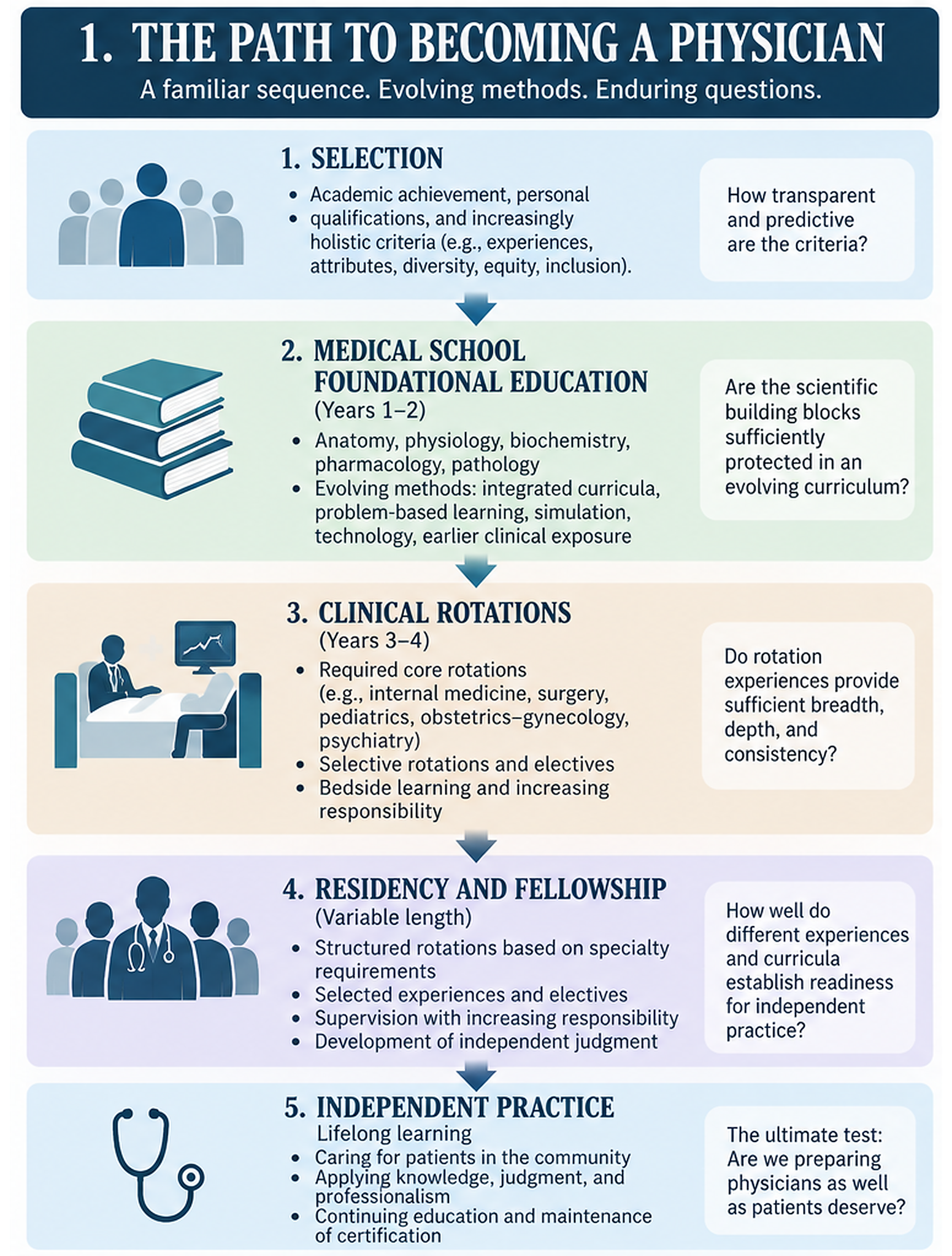
The traditional pathway remains recognizable even as medical curricula, teaching methods, supervision, and assessment continue to evolve.
Assessing Competence: What Have We Actually Established?
The pathway to becoming a physician is familiar. Students are selected for medical school, acquire foundational knowledge, complete clinical rotations, enter residency and sometimes fellowship training, pass examinations, receive faculty evaluations, and eventually are certified for independent practice. Over the decades, educational methods have evolved, competency frameworks have expanded, and the requirements for documenting progress have become increasingly elaborate.
The accompanying illustration summarizes this progression. At every stage, institutions judge who should advance and, ultimately, who is ready to assume responsibility for patients. Those judgments rely on a combination of examinations, evaluations, documented experiences, faculty assessments, and accreditation requirements.
But what do these measures actually establish? And how reliably do they tell us whether someone will become a competent, independent physician?
Selecting Future Physicians: What Predicts Success?
Medical education begins with selection. Admissions committees evaluate academic achievement, standardized examination scores, recommendations, interviews, personal experiences, and other applicant characteristics. These measures provide useful information, but selecting candidates with the greatest potential to become excellent physicians is not simple.
Academic performance may predict success in mastering medical knowledge. Interviews and personal statements may reveal important qualities, although their reliability and predictive value depend heavily on how they are conducted and interpreted. Qualities such as integrity, empathy, resilience, curiosity, and sound judgment are particularly difficult to establish during a brief admissions interview.
The question is whether institutions adequately examine which selection criteria predict subsequent educational achievement, clinical performance, and professional conduct—and whether some criteria receive more weight than the evidence justifies. Selection identifies potential. Selection identifies potential. Education must transform that potential into the knowledge, judgment, and professional responsibility required for independent practice.
Examinations: Measuring Knowledge and Reasoning
Throughout medical school and postgraduate training, examinations provide the principal means of assessing educational progress. They are standardized, relatively efficient, and can test a substantial body of knowledge. Their value should not be dismissed. But examinations are not all designed to measure the same abilities, and passing an examination does not establish every dimension of clinical competence.
Consider the distinction between knowledge, competence, performance, and outcomes. Knowledge concerns what the physician knows. Competence describes the ability to apply that knowledge appropriately. Performance is what the physician actually does in practice. Outcomes reflect what ultimately happens to patients. These concepts overlap, but they are not interchangeable.
A physician may understand the diagnosis and treatment of a life-threatening infection yet fail to recognize its urgency in an actual patient. Conversely, a physician may recognize the emergency immediately, make appropriate decisions, and provide excellent care, yet the patient may still die because the illness is overwhelming. Patient outcomes therefore cannot be interpreted without considering clinical circumstances. Two equally capable surgeons may have very different complication rates because their patients have substantially different underlying risks.
As one colleague observed with a mixture of amusement and humility, “The patient got better despite us.” The reverse is equally true: patients sometimes do poorly despite excellent care. Clinical outcomes are essential measures of healthcare quality, but interpreting them requires considerable caution. A favorable outcome does not necessarily validate the decisions that preceded it, just as an unfavorable outcome does not establish that the care was inadequate. Disease severity, patient characteristics, circumstances, and chance all influence what happens. This creates a considerable challenge when measuring and documenting the quality of care, particularly when attributing outcomes to an individual physician's competence. We must evaluate not only what happened to the patient, but whether the physician's decisions were sound given what was known at the time.
These difficulties illustrate why assessing physician competence requires more than examinations or patient outcomes. We need to understand not only what physicians know, but how they apply that knowledge, make decisions, and perform in actual clinical settings. Each represents a different dimension of competence and requires different assessment approaches.
In 1990, George Miller described a progression from knowing, to knowing how, to showing how, and ultimately to doing. His framework remains useful because it distinguishes acquiring medical knowledge from applying it, demonstrating clinical skills, and performing in practice. [6] Success at one level does not automatically establish competence at the next. A physician may perform exceptionally well on a written examination yet struggle to recognize or manage an evolving clinical problem independently.
Examinations provide evidence of medical knowledge and selected aspects of clinical reasoning, but how reliably that performance predicts sound clinical judgment and independent practice remains an important question. A 2026 systematic review of 44 studies involving more than one million physicians found associations between licensing or certification examination performance and subsequent measures of clinical quality, patient outcomes, and professional conduct. [7] These findings are important and support the value of well-designed examinations, but they do not establish that examinations adequately capture every capability required for independent practice.
Among the American Board of Internal Medicine questions I have reviewed recently, too many seemed to reward factual recall rather than meaningful clinical reasoning. That is my impression of those questions, not a formal analysis of the entire examination. Consider two approaches to assessing knowledge about hyperkalemia, an excessively elevated potassium concentration in the blood. The first asks which electrolyte abnormality produces a sine-wave pattern on an electrocardiogram. The answer requires recognizing an important association, but little more than rote memorization. Another approach, adapted from a question in my book The Renal System, presents a dialysis patient arriving in the emergency department with lightheadedness, hypotension, a potassium concentration of 7.8 mEq/L, and a dangerous electrocardiographic abnormality. The learner must determine which treatment is immediately necessary while urgent potassium removal is organized. [12] The answer requires recognizing that intravenous calcium is needed to stabilize the cardiac membrane, even though calcium does not remove potassium. Additional treatment, including urgent dialysis when appropriate, remains necessary. [13] The second question demands more than rote memorization of a single association. It requires the learner to identify the immediate priority, understand the underlying physiology, and distinguish stabilization from definitive treatment. Yet even this improved question has limitations. The problem has already been recognized and presented to the candidate. The examination does not necessarily reveal whether the physician would have identified the emergency independently, appreciated its urgency, or responded appropriately as the patient's condition evolved.
Knowing the correct answer is important. Recognizing when that answer is needed—and acting appropriately—is another matter.
Beyond Written Examinations: Observing Clinical Reasoning
A well-structured oral examination can explore abilities that conventional multiple-choice questions may not adequately assess. Returning to the patient with severe hyperkalemia, an examiner could ask: Why does calcium help? What does it fail to accomplish? What if the electrocardiogram improves but potassium remains dangerously elevated? What additional information might change your management? The purpose is not simply to identify the correct answer, but to examine the reasoning behind it and determine whether the candidate can adapt to changing circumstances.
Oral examinations have a long history in medical specialty certification and remain part of the assessment process in neurosurgery and anesthesiology. [14] They require trained examiners, carefully developed clinical scenarios, consistent scoring standards, and substantial faculty time. Without these safeguards, they can become subjective exercises in determining what a particular examiner wants to hear.
Written examinations require comparable attention to quality. I learned how carefully students scrutinize question wording when their grades are at stake. Sometimes they identify genuine errors or ambiguity, and those concerns deserve correction. But the desire to avoid disputes can also encourage simpler questions that are easier to score while revealing less about a learner's ability to reason through a complex clinical problem.
Ambiguity is not rigor, but difficulty is not unfairness. We should design assessments that reward sound, defensible clinical reasoning rather than merely produce an uncontested grade.
Neither written nor oral examinations, however, can fully substitute for observing physicians making decisions during actual patient care.
Residency and Fellowship: Measuring Performance or Documenting Progress?
Postgraduate training is where the distinction between competence and performance becomes especially important. Residents and fellows progress through required rotations, clinical experiences, procedures, examinations, and faculty evaluations. Programs maintain extensive records that document these activities and demonstrate compliance with accreditation standards.
The Accreditation Council for Graduate Medical Education (ACGME) has developed a detailed competency framework to assess physicians across six broad domains, including patient care, medical knowledge, communication, professionalism, and systems-based practice. Individual specialties define more specific abilities through developmental Milestones.
Twice each year, Clinical Competency Committees review available evidence and assign developmental ratings describing each resident's progress. [9]
This is a thoughtful and ambitious framework. It reflects a genuine effort to move beyond simply counting rotations and examinations toward evaluating the capabilities physicians must develop.
But the framework has a fundamental vulnerability: the quality of its conclusions depends on the quality of the observations underlying them. A faculty member may be asked to rate a resident's ability to recognize clinical deterioration, make independent decisions, communicate with patients, or manage complex clinical problems. Yet how often has that faculty member directly observed those behaviors? How much of the assessment reflects firsthand observation, and how much rests on general impressions, secondhand reports, or the assumption that satisfactory performance on a busy clinical service demonstrates competence? Assigning a numerical level to clinical judgment does not necessarily make that judgment objectively measurable.
Research illustrates both the possibilities and limitations of these assessments.
A 2024 JAMA study examined assessments of 6,898 newly trained hospitalists and more than 455,000 Medicare hospitalizations. Higher certification-examination scores were associated with better selected patient outcomes, while the end-of-residency Milestone ratings examined were not. [10] Another 2024 study of 327 vascular surgeons performing more than 4,200 procedures found associations between Milestone ratings and selected surgical outcomes, although those relationships varied with program rating patterns. [11]
These findings suggest that workplace assessments can contain meaningful information, but their predictive value is neither uniform nor assured. The problem becomes more evident when we examine the evaluations from which many of these judgments are constructed.
A 2023 study reviewed 4,869 end-of-rotation evaluations from three residency programs. Among more than 77,000 numerical ratings, fewer than 1% indicated performance below expectations. More than 70% of written comments lacked the specificity or actionable information necessary to guide improvement. [15] These results raise an obvious question: If almost everyone receives favorable ratings, how effectively do the evaluations distinguish among levels of performance or identify opportunities for improvement?
I generally prefer thoughtful narrative evaluations to numerical scores, but writing “excellent resident” in a comment box accomplishes little. Compare that with: “Recognized deterioration without prompting, appropriately sought senior assistance, and established sound immediate priorities; needed help refining the differential diagnosis.” The latter identifies observed performance, explains what the resident accomplished independently, and describes something that can be improved.
Candor is another concern. Students and residents evaluate attending physicians, who in turn evaluate them. Both perspectives matter, but professional relationships, concerns about retaliation, and the administrative consequences of unfavorable assessments can discourage honest judgments. A 2026 survey of family medicine program directors found that 56% perceived faculty reluctance to provide critical feedback. Almost one-quarter reported graduating at least one resident during the preceding three years whom they believed should have undergone remediation or another reportable action but did not. These were reported judgments, not independently established deficiencies, but the findings deserve attention. [16]
We have created increasingly detailed systems for recording educational progress. Yet much of what we record still depends on observations that may be limited, evaluations that lack specificity, and judgments influenced by pressures unrelated to competence. We also face a practical problem we will examine later: attending physicians are expected to make these assessments while clinical productivity demands, documentation requirements, and administrative responsibilities increasingly compete for their time. How reliably can we evaluate clinical judgment when the opportunities to observe it are themselves being squeezed?
From Completing Requirements to Demonstrating Readiness
This brings us back to the pathway illustrated at the beginning of this section. At every stage, physicians must satisfy requirements intended to prepare them for greater responsibility. Most requirements serve legitimate purposes. Examinations assess important knowledge. Clinical rotations provide essential experience. Supervision protects patients. Competency frameworks establish expectations. Accreditation requires programs to meet defined standards. But meeting these requirements is not the same as independently demonstrating the full breadth of capabilities future patients will depend on.
A deeper accountability problem also exists. Physicians largely determine what future physicians must know, develop the examinations used to assess that knowledge, evaluate trainees' performance, and help determine who is prepared for independent practice. We then point to successful completion of those requirements as evidence that the system is working. Who, then, is evaluating the evaluators?
The issue is not whether physicians should establish professional standards. Their expertise is indispensable. The issue is whether the standards and assessments themselves are sufficiently examined to determine how well they predict actual clinical performance and patient outcomes. In 2018, the National Academies identified the lack of broadly established graduate medical education outcome measures as a significant obstacle to evaluating physicians, training programs, and the institutions responsible for preparing them. [8]
The challenge is to obtain credible evidence of what trainees can recognize, explain, decide, and accomplish independently—not simply what they know or which requirements they have completed. We need to establish how consistently they demonstrate these abilities, when they require assistance, and whether identified deficiencies have been corrected. That demands sustained, meaningful observation by qualified faculty, candid and specific feedback, and repeated opportunities to demonstrate improvement. Ultimately, we must also examine how physicians perform after entering independent practice. Only then can we begin to determine whether our educational assessments predict the clinical capabilities they claim to measure.
We cannot improve the reliability of clinical assessment simply by collecting more evaluations. We must improve the quality of the evidence those evaluations depend upon. And we should not confuse the successful completion of an educational program with proof that the process has accomplished everything we intended. Patients have every right to expect that a physician declared ready for independent practice has demonstrated the knowledge, judgment, and professional responsibility necessary for that role. They should not have to investigate the reliability of a residency program's evaluations or whether an attending had adequate opportunities to observe a trainee.
Those are responsibilities the profession and its institutions have accepted on the public's behalf.
We know how to document that physicians have completed their training. We must become equally determined to demonstrate what that training has prepared them to do.
The Mission, the Margin, and the Missing Time
What We Pay For—and What We Neglect
We have built a healthcare system that meticulously accounts for the cost of delivering care while failing to account adequately for the cost of preparing the physicians who will deliver it. A procedure appears on the revenue report. A teaching encounter may appear nowhere. An attending physician who performs additional billable procedures can generate measurable revenue and receive productivity credit. An attending who devotes that same time to developing a resident’s clinical judgment may receive no comparable recognition—and may sacrifice clinical productivity in the process. Medicare supports hospitals that train physicians, but reimbursement is not directly tied to teaching quality. We have created a system in which the immediate financial value of clinical services is carefully measured while the long-term value of physician education remains largely invisible.
This creates a predictable institutional imbalance. Academic medical centers have developed sophisticated systems to capture clinical charges, monitor productivity, ensure billing compliance, and protect reimbursement. Clinical productivity is frequently measured through relative value units, or RVUs, which assign standardized values to medical services and typically influence physician compensation. We have no comparable standardized system to determine whether an attending physician has enough time to observe a resident’s clinical judgment, examine the reasoning behind a treatment decision, or provide meaningful feedback. The first activities have identifiable financial consequences. The latter are too easily treated as responsibilities that dedicated physicians will somehow fulfill.
The conflict becomes unavoidable when clinical productivity expectations and administrative obligations increase. Time is finite. Unless institutions eliminate other responsibilities, add personnel, or genuinely improve efficiency, additional work must displace something, or extend the physician's workday. Activities without immediate financial consequences are particularly vulnerable.
This is not simply a logical deduction. A 2012 survey found that 75% of responding academic physicians reported spending less time teaching after productivity targets were introduced. Another 86% reported being less inclined to undertake activities that did not count toward those targets. The findings came from one institution and reflected faculty perceptions, but they identified an unmistakable conflict between what the institution measured and what its faculty were expected to accomplish. [26]
More than a decade later, a 2023 qualitative study involving hospital medicine leaders at seventeen academic medical centers documented continuing tensions between clinical expansion and education. Participants described heavy clinical workloads, competing priorities, and a mismatch between growing clinical responsibilities and available teaching opportunities. [27]
In 2025, Pellegrini and Babbott again highlighted the vulnerability of academic medicine's educational and research missions when clinical revenue dominates institutional decision-making. They argued that institutions must support those missions, not treat them as discretionary activities undertaken when finances permit. [28]
The recurring theme is difficult to ignore. These problems have been recognized for years, yet institutional accountability structures continue to favor clinical productivity over less readily measured educational work.
I experienced this firsthand. As program director, I regularly advocated for resources necessary to improve training. One effort became legendary at our institution: obtaining handheld devices for thirty residents to support their work at the point of care. The expenditure was modest, and the purpose was straightforward. Yet I pursued the request for nearly five years before we succeeded. I was pleased that we eventually obtained the devices. But I was also troubled that something so tangible and relatively inexpensive required such extraordinary persistence. What chance did we have when the request involved protected time for thoughtful teaching, direct observation, or individualized assessment—activities whose value was considerably harder to quantify?
There is an important distinction here. Medical education receives substantial funding, and many institutions invest seriously in teaching. The problem is not the literal absence of educational dollars. It is the failure to consistently connect educational responsibilities with the time, resources, and accountability needed to fulfill them.
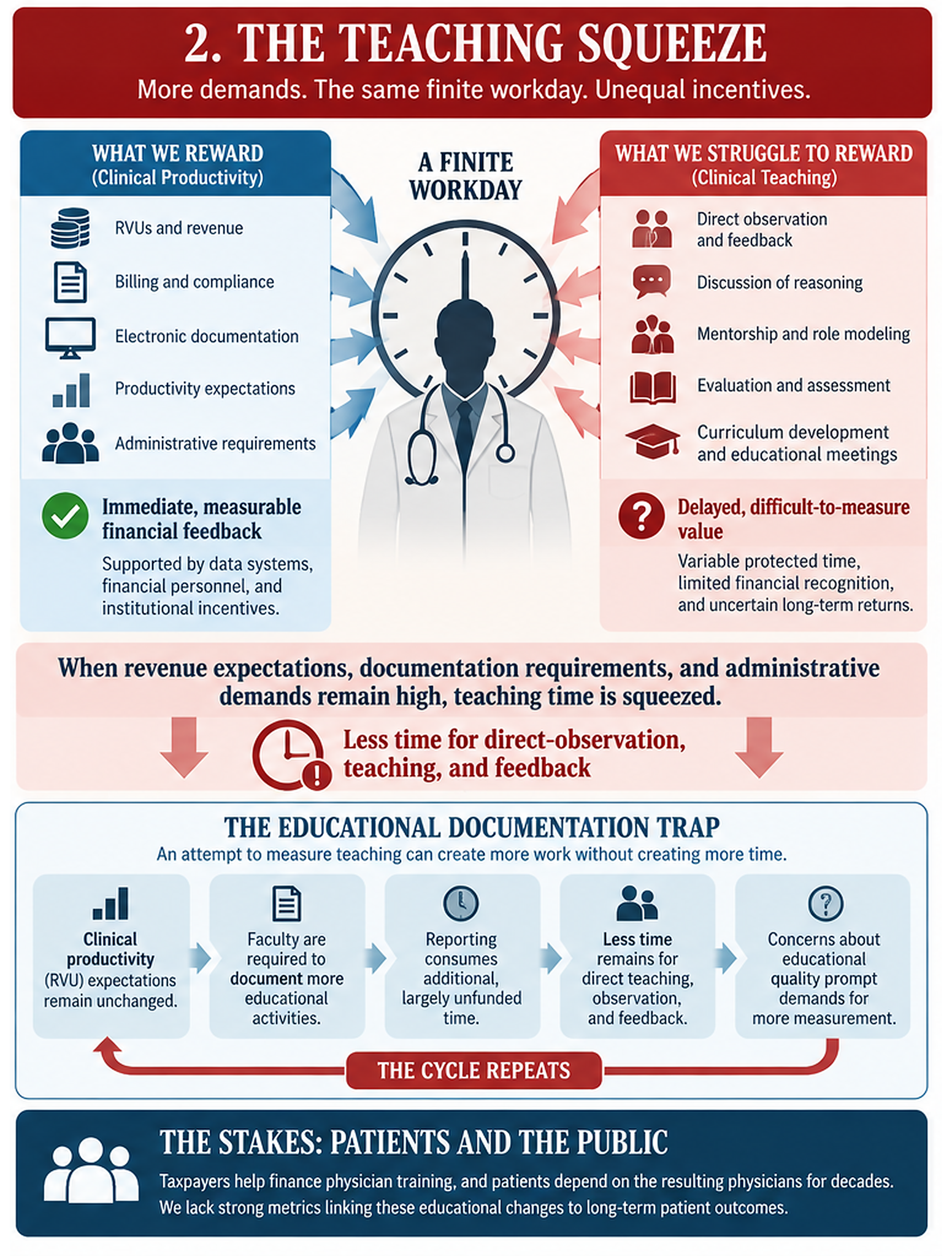
Immediate clinical productivity incentives compete with the less visible work of teaching. Adding unfunded educational reporting can consume still more of the limited time available.
The Cost of an Hour
The consequences of this imbalance extend beyond budgets. They affect how physicians work and how future physicians learn. Meanwhile, the medical literature, therapeutic options, and complexity of care continue to expand. Faster search tools and artificial intelligence can help retrieve information, but developing the judgment to use it appropriately still requires experience and feedback. Medical education has always required trainees to balance service and learning. Caring for patients is itself an essential educational experience. But the demands placed on attending physicians and trainees have changed considerably, particularly in the areas of supervision, documentation, and administrative accountability.
Some changes were necessary. The death of eighteen-year-old Libby Zion in 1984 brought national attention to resident fatigue and inadequate supervision. The Bell Commission's recommendations helped shape New York's 1989 regulations, and the Accreditation Council for Graduate Medical Education (ACGME) followed with national duty-hour limits in 2003. [17] These reforms addressed genuine risks. A landmark 2004 trial found that interns working traditional schedules with frequent extended shifts made substantially more serious medical errors than those working redesigned schedules. Exhaustion was not an educational virtue. [18]
Reducing fatigue and improving supervision were important advances in patient safety. But greater attending involvement can inadvertently limit residents' opportunities to reason through problems and make clinical decisions independently. In a 2018 randomized trial, increasing attending participation in resident work rounds did not significantly reduce medical errors. Interns spoke less, and residents reported less autonomy. Both groups already received attending supervision; the study examined the effects of a more intensive approach. [19]
The question, then, is not simply how much supervision residents receive, but whether that supervision protects patients while allowing residents to develop and demonstrate their own clinical judgment.
Another transformation occurred through financial accountability. Medicare teaching-physician requirements, revised in July 1996, and subsequent billing audits increased scrutiny of attending participation and documentation. These were primarily reimbursement requirements, not educational reforms, and they did not require attendings to make every clinical decision. Nevertheless, their implementation changed the environment in which many residents learned.
A particularly revealing study published by Fihn and colleagues in 2000 examined the effects of Medicare's revised teaching-physician documentation requirements. Following their implementation in 1996, attending physicians reported substantial increases in administrative workload and reductions in scheduled teaching. The proportion reporting scheduled teaching on at least twenty days per month declined from 80% to 50%, while those documenting clinical activities every day increased from 27% to 94%. The proportion reporting workweeks exceeding seventy hours also rose dramatically, from 18% to 57%. These were retrospective faculty reports from a limited number of institutions, but the magnitude of the changes is difficult to ignore. [20]
Although the study could not determine whether residents developed better or worse clinical judgment, or whether their preparation for independent practice had changed, it demonstrated how dramatically institutional requirements could alter the work of clinical educators without providing corresponding evidence about the educational consequences.
That is precisely the uncertainty we should be investigating.
More than a quarter-century later, we still struggle to establish the educational consequences of these administrative changes. I witnessed this transformation. Earlier in my career, residents had considerable opportunity to develop assessments, formulate treatment plans, and defend their reasoning before experienced attendings. The system certainly had weaknesses, but it offered meaningful opportunities to take on progressively greater responsibility.
As attending responsibilities expanded, I watched something else happen. A busy clinical service, a difficult patient, competing obligations, and unfinished documentation made it expedient for the attending to establish the diagnosis, formulate the plan, issue instructions, and move on. I was part of that shift. I regret it.
But the consequences extended well beyond the residents. Most physicians who choose academic medicine do so, at least in part, because they want to teach. They take satisfaction in challenging young physicians, sharing their experience, watching confidence develop, and helping shape the next generation of clinicians. Teaching and mentoring are not incidental responsibilities. For many, they are among the most rewarding aspects of their professional lives.
Yet these responsibilities have been steadily crowded out by demands for clinical productivity, documentation requirements, billing compliance, and institutional performance expectations. Attending physicians cannot simply disregard these obligations. In some compensation systems, incomplete documentation can affect salary. Discrepancies between documented services and Medicare billing can invite audits, financial penalties, and potentially legal liability. The consequences are tangible and immediate. The consequences of spending less time teaching are neither as easily measured nor as readily enforced.
This creates a deeply frustrating professional dilemma. Attendings remain responsible for residents' education and evaluation, but the time and attention required to fulfill that responsibility are increasingly consumed by other demands. What once made academic medicine particularly fulfilling—the opportunity to teach, mentor, question, and witness the development of clinical judgment—can become another obligation squeezed into an already overcrowded day. Over time, that diminishes not only educational quality but also the professional satisfaction of the physicians expected to provide it.
The patient might receive appropriate care, but I had not necessarily learned what the resident would have recognized, how the alternatives would have been weighed, or whether the correct urgency would have been assigned. I had demonstrated my clinical judgment and asked the resident to implement it. Later, I was expected to evaluate the resident's judgment.
These competing demands are reflected in how physicians spend their working days.
A 2019 study that directly observed eighty internal medicine interns across six residency programs found that 43% of their time was spent interacting with medical records or documentation, compared with 13% in direct patient care and 7% in educational activities. Some activities overlapped, and much of the medical-records work was necessary. These findings illustrate how profoundly the structure of the workday determines opportunities for learning. [21]
A separate study of ambulatory physicians found that nearly half their office time was devoted to electronic records and desk work, compared with 27% in direct face-to-face patient care. Additional clerical work frequently extended beyond scheduled office hours. [22]
The consequences for teaching are particularly revealing. A 2020 observational study of attending emergency physicians found that each additional minute spent documenting was associated with approximately half a minute less teaching. The investigators found no similarly strong association with reduced direct patient care. The study was small, involving ten attending physicians, and could not establish causation. Nevertheless, it raises an important concern: when competing obligations consume an attending's time, teaching may be among the first responsibilities to suffer. [23]
These findings point to a fundamental problem in academic medicine. Clinical productivity, documentation, billing compliance, and institutional performance are measured, monitored, and enforced. The quality of teaching and the development of independent clinical judgment are far more difficult to measure, and missed educational opportunities rarely produce an immediate institutional consequence.
We cannot continue adding responsibilities without recognizing what is being displaced. Physicians may compensate by working longer hours, but time and attention are finite. When teaching becomes something accomplished between other obligations, both educators and trainees lose something special and essential.
This is not principally a failure of attending physicians to value education. It is an institutional failure to protect it.
When Documentation Replaces Thought
A frequent comment I heard from attending physicians was, “I just don't have time to think anymore.” Yet thinking is not time away from clinical work. It is clinical work. Increasingly, I felt we were documenting primarily to establish that a reimbursable service had been performed, rather than explaining what we believed was happening to the patient and why a particular course of treatment made sense.
A thoughtfully written clinical note can provide an extraordinary window into a physician's reasoning. It reveals which findings matter, why one diagnosis is favored, which alternatives remain plausible, and what developments should prompt reconsideration. For students and residents, that reasoning is itself an educational resource. A note crowded with copied laboratory results, templated statements, and completed fields may be lengthy without being particularly informative.
A 2025 AMA Journal of Ethics article addressed this problem directly, advocating documentation that makes relevant clinical information and reasoning readily apparent rather than burying them beneath repetitive data and templated text. [24] The objective is not a longer note, but a more informative one. “Acute kidney injury—follow laboratory results” identifies a problem and assigns a task. A brief explanation of the suspected cause, the alternatives being considered, and the findings that would prompt a change in management accomplishes something far more valuable. It communicates not simply what the physician intends to do, but why. For the next clinician, that reasoning provides continuity of care. For the student or resident, it offers a window into how sound clinical judgment develops and is applied.
Medicare has taken steps to simplify documentation requirements. Beginning in 2021 for office visits, and extending to most other evaluation-and-management settings in 2023, the level of service became largely dependent on medical decision-making or time rather than the volume of documented history and examination findings. [25] Yet I recall the institutional response to these changes. Our billing and coding personnel, supported by administration, encouraged us to continue documenting much as we always had, simply “to be safe.” The concern about audits, repayment demands, and regulatory scrutiny was genuine. But the practical consequence was that even reforms intended to reduce administrative burden could leave established practices largely untouched. Institutional templates, billing incentives, and a culture of defensive documentation continued to shape our work, sometimes well beyond what the regulations themselves required.
When documentation dominates, the educational consequences are twofold. Time is diverted from direct observation and teaching, while the medical record itself may fail to model the reasoning young physicians need to develop. Patients also bear the consequences when physicians have less time to listen, interpret information, reconsider decisions, and explain their recommendations.
An institution cannot reasonably demand thoughtful clinical judgment while treating the time necessary to exercise it as expendable.
These pressures have emerged at precisely the moment when medicine demands more sophisticated clinical judgment. The volume of published medical literature has more than doubled in less than three decades, while diagnostic capabilities, treatment options, and the complexity of clinical decisions have continued to expand. Yet the time available to teach young physicians how to interpret and apply this information remains constrained by competing clinical, administrative, and financial obligations. The following illustration captures this growing tension between what physicians must learn, what educators are expected to deliver, and the time institutions make available to accomplish either.
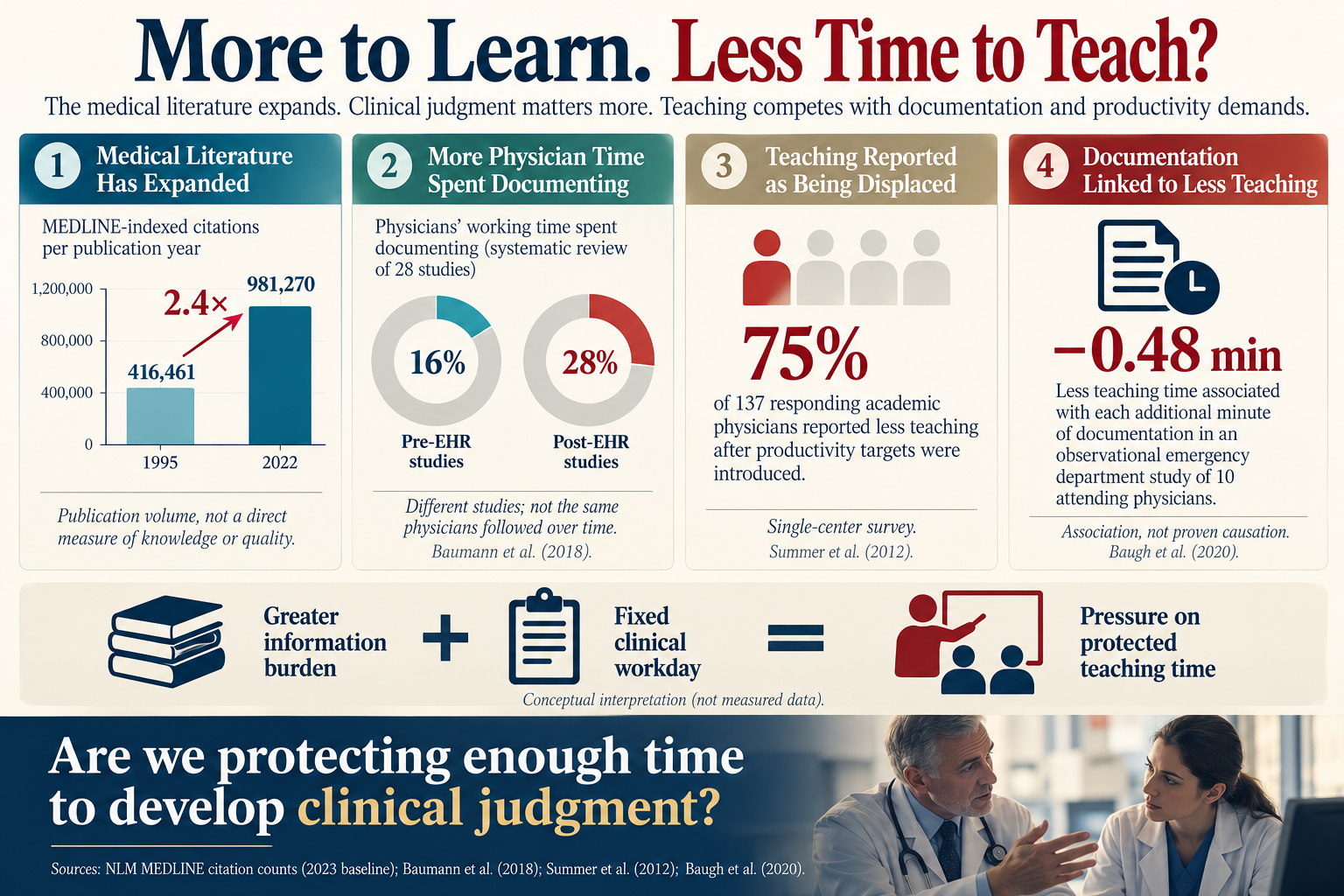
The expanding volume of medical literature has increased the information physicians must navigate, while documentation and productivity demands compete with teaching responsibilities. Annual MEDLINE-indexed citations increased approximately 2.4-fold between 1995 and 2022. A systematic review of 28 studies reported that physicians spent 16% of working time documenting in studies conducted before electronic health records, compared with 28% in studies conducted afterward. In a single-center survey, 75% of academic physicians reported less teaching time following the introduction of productivity targets. A small observational study found an inverse association between documentation and teaching time.
Sources: National Library of Medicine; Baumann et al., 2018; Summer et al., 2012; Baugh et al., 2020.
Show Me the Data
One of the most frustrating obstacles I encountered as a program director was demonstrating that an educational problem existed. Students completed their courses. Residents fulfilled their rotations. Trainees passed examinations, received satisfactory evaluations, and graduated. From an administrative perspective, the system appeared to be functioning as intended. When I questioned whether we had sufficient opportunity to evaluate clinical judgment meaningfully, the response was predictable: Where is the evidence that our training is inadequate? Show me the data. But that was precisely the problem.
We could document examinations, attendance, procedural experience, and progression through training. We were less successful at establishing whether residents could consistently recognize clinical deterioration, determine urgency, make independent decisions, or respond appropriately when their initial approach proved incorrect. The inability to demonstrate inadequate training could therefore be interpreted as reassurance that training was adequate. Yet my concern was that our assessments might not reliably detect important deficiencies.
We were being asked to prove a problem using a measurement system whose adequacy was itself in question. This was compounded by the difference between financial and educational accountability. The consequences of inadequate billing documentation were immediate and measurable. An insufficiently supported claim, missing attestation, or compliance failure could result in denied reimbursement, audits, repayment demands, or penalties.
The consequences of inadequate education were much harder to quantify. What was the cost of an attending who lacked time to assess a resident's reasoning? How could we measure the clinical judgment that failed to develop because the attending routinely made the decisions? What was the cost of an educational deficiency that remained undetected until a physician entered independent practice years later? We had no comparable accounting for those losses.
The response sometimes amounted to an expectation that faculty should manage. We were well compensated, after all. Surely we could fulfill our clinical, administrative, educational, and scholarly responsibilities. But compensation does not create additional hours, and professional dedication does not eliminate competing demands.
Over time, I became something of an educational activist within my institution. I repeatedly challenged resource decisions and argued for greater attention to teaching and assessment. My persistence occasionally frustrated colleagues who wanted to end the discussion and attend to other responsibilities.
I also tried a less confrontational approach. Rather than argue that our educational programs were inadequate, I returned to a principle I emphasized with trainees: “Get by—or get better.” We were graduating residents, and they were passing examinations. These were reassuring indicators of success, but they hardly established that our educational system was functioning as well as it could. Indeed, some compromise in teaching seemed almost inevitable. Attending physicians had finite time and attention. As clinical productivity expectations, billing requirements, and administrative responsibilities expanded, opportunities to observe residents, question their reasoning, provide feedback, and mentor them were increasingly squeezed.
Meanwhile, medicine itself was becoming more complex. The body of knowledge was expanding, diagnostic and therapeutic options were multiplying, and expectations for young physicians were growing. It strains credulity to believe that we could continually expand what physicians needed to learn while reducing the time and attention devoted to teaching them, yet somehow achieve the same—or better—educational outcomes. Perhaps residents were adapting in ways we had not adequately measured. But relying on competence to emerge despite these competing pressures, without seriously examining the consequences, was an extraordinary act of institutional faith.
Why, then, wouldn't we want to improve even successful programs? Why shouldn't residents have greater opportunities to exercise independent clinical judgment, faculty have more time to teach, and evaluations provide more meaningful evidence of competence? Yet even this argument often failed to produce change. When I questioned the reliability of our assessments, I was asked to demonstrate that they were deficient. When I advocated improvement without alleging failure, the program's existing success became a reason to preserve the status quo. We seemed to demand proof of educational inadequacy before committing additional resources, while accepting expanding clinical and administrative obligations without adequately examining what they displaced.
We required evidence that education was suffering before acting to protect it, even as demands on medical education expanded and the conditions necessary to deliver it steadily eroded.
The contradiction vexed me. We do not require physicians to demonstrate that their practice is failing before encouraging them to improve. Why should institutions responsible for educating those physicians demand proof of failure before pursuing comparable improvements? I can accept that my proposed solutions were not necessarily the best ones. Administrators faced legitimate financial and operational constraints, and additional resources do not automatically produce better education. But the questions deserved serious examination.
There was another complication. Educators were held responsible for educational outcomes while having limited influence over the institutional priorities that shaped them. Accreditation offered no simple remedy. Reporting concerns to an accrediting organization could invite scrutiny of the entire program, potentially affecting trainees and colleagues. Even confidentiality did not necessarily eliminate professional risk. In 2004, the ACGME acknowledged that individuals raising concerns could sometimes be identified because the same issues had previously been discussed within their programs. [33]
The public should not have to depend on an educator's willingness to risk a career before an educational weakness receives serious attention.
Accreditation itself deserves scrutiny. Advocacy organizations, including Do No Harm, have challenged aspects of the existing system and called for clearer connections among educational standards, professional competence, institutional accountability, and public participation. Its 2026 submission addressed proposed federal reforms to accrediting-agency oversight rather than providing empirical evidence about physician outcomes. [34] I welcome this renewed attention to accountability.
The larger question is whether accreditation and internal oversight adequately examine what educational programs actually accomplish, rather than simply whether they demonstrate compliance with prescribed processes.
Eventually, I recognized that individual persistence was no substitute for institutional accountability. Educational quality should not depend on an unusually determined program director fighting to protect fundamental responsibilities. When an administrator asks, “Show me the data,” the appropriate response may be, “That is precisely what I have been asking you to help us obtain.”
Following the Money
Graduate medical education (GME) encompasses the supervised residency and fellowship training that follows medical school. It also receives an enormous public investment. According to a Congressional Research Service analysis of hospital cost reports, Medicare paid teaching hospitals an estimated $21.2 billion through graduate medical education payments in fiscal year 2023. [47] How that money is distributed, and what the public receives in return, deserves considerably more scrutiny than it has received.
Medicare supports graduate medical education through two principal mechanisms. Direct Graduate Medical Education (DGME) payments help cover resident salaries and benefits, faculty teaching costs, and educational overhead. The calculation depends largely on historically determined per-resident amounts, the number of eligible residents, and the hospital's Medicare patient population. [29,30] But DGME represents less than one-third of Medicare's GME expenditures. In fiscal year 2023, DGME distributed approximately $6.1 billion, while the remaining $15.0 billion was paid through Indirect Medical Education (IME). [47]
IME is intended to compensate teaching hospitals for higher inpatient care costs associated with their training responsibilities. These may include the additional costs of supervising trainees, more extensive diagnostic testing, and clinical services associated with complex patient populations. Unlike DGME, IME does not directly reimburse educational expenses. It adjusts Medicare's hospital inpatient payments, calculated using the number of residents relative to hospital beds and the hospital's qualifying Medicare inpatient reimbursement. [30]
Here is the fundamental disconnect: the presence of residents helps determine how much IME a hospital receives, but the effectiveness of their education plays no role in the calculation.
The formula does not ask whether residents receive adequate supervision, develop sound clinical judgment, learn to avoid unnecessary testing, or demonstrate readiness for independent practice. It does not recognize whether attending physicians have sufficient time to teach, observe, and evaluate them. Nor does it reward institutions whose graduates show better clinical outcomes or use healthcare resources more efficiently. We count residents to calculate reimbursement. We do not comparably assess what those residents are learning to determine the payment.
Residents also provide valuable clinical services. Their work contributes to patient care and hospital operations, often substantially. Yet the financial contribution of their clinical work and the educational value of their training are different matters. A hospital may benefit from employing residents without necessarily providing the educational environment those residents deserve.
The history of these payments is instructive. IME emerged from the 1983 hospital payment reforms, when Congress sought to protect teaching hospitals from financial disruption under Medicare's new prospective payment system. Its original payment adjustment was set above the amount estimated from hospital cost analyses. Congress subsequently reduced the adjustment, but the underlying structure survived.
Independent federal advisers have repeatedly questioned whether the payments accurately reflect additional hospital costs. In 2010, the Medicare Payment Advisory Commission (MedPAC) recommended redirecting IME funding above empirically justified costs into a performance-based GME program, with payments tied to educational standards and institutional performance. [48] In 2021, MedPAC again identified shortcomings, finding that IME payments exceeded estimated additional inpatient costs while inadequately recognizing teaching-related costs in outpatient settings.
These were not proposals to abandon graduate medical education. They were attempts to better align public spending with legitimate costs and educational objectives. But reform has encountered formidable resistance. Teaching hospitals and their national associations have vigorously defended these payments. The record is explicit. After Medicare cuts in the Balanced Budget Act of 1997, lobbying by the Association of American Medical Colleges (AAMC) and the American Hospital Association (AHA) helped secure congressional legislation restoring billions in hospital payments. [49]
In 2014, the Institute of Medicine proposed a fundamental restructuring of Medicare GME financing, including greater transparency, educational accountability, and performance-based funding. Importantly, it recommended maintaining aggregate Medicare GME support, adjusted for inflation, while changing how funds were distributed. Hospital organizations nevertheless strongly opposed major elements of the proposal, warning of serious financial consequences for teaching institutions. [51]
In 2015, the AHA organized a congressional briefing specifically to defend GME and IME funding. It emphasized the essential services teaching hospitals provide and warned that reductions or reallocations would threaten patient care and medical education. [50] These organizations are entitled to advocate for their members. Teaching hospitals provide essential and often expensive services, including care for patients with complex illnesses and substantial needs. But defending hospital revenue should not be mistaken for evidence that the existing financing system is appropriately designed or accountable.
Hospitals have been vigorous advocates for preserving the money. Where has the comparable urgency been in demonstrating the educational value of public investment?
The contrast is difficult to ignore. When Medicare payments are threatened, hospital organizations mobilize, commission analyses, engage lawmakers, and describe the consequences for patients and communities. Yet recommendations for greater transparency and educational accountability have remained largely unrealized for years. If hospitals invoke their educational mission to justify substantial public payments, they should be expected to demonstrate how they fulfill that mission. That is not an unreasonable burden. It is a basic obligation accompanying public support.
My experience as a program director illustrates another problem: the remarkable opacity of GME financing within teaching hospitals.
Both DGME and IME payments flow to hospitals rather than directly to residency programs. IME is particularly difficult to trace because it is incorporated into Medicare's inpatient reimbursement rather than designated for specific educational activities. I had little understanding of how much IME revenue our hospital received, where that money went, or how much of it, if any, translated into additional faculty teaching time, educational resources, or improved resident supervision.
Even the more explicitly educational DGME funding was difficult to follow. I may have seen a GME budget, but I had limited visibility into the complete financial picture and little meaningful participation in decisions about how resources were allocated. I repeatedly sought greater involvement. I understood that institutional budgets were complex and that educational programs competed with other legitimate priorities. But I also knew what was required to supervise residents, provide meaningful assessments, maintain educational programs, and support faculty teaching. I did not need to be an accountant to ask how those needs were being weighed against competing institutional priorities.
My experience was hardly unique. In a 2012 survey of 268 internal medicine program directors, 159 had attempted to determine how much direct GME funding their programs received. Only 84 succeeded. [31] The survey addressed DGME, the smaller and more explicitly educational component of Medicare funding. It did not examine the much larger IME payments. These physicians were held responsible for educating and evaluating residents, yet many could not readily determine how much direct public financial support their programs received, much less how broader institutional funding arrangements supported their educational mission.
There is something fundamentally wrong with holding educational leaders accountable for the quality of physician training while giving them so little visibility into, or influence over, the financial decisions that determine their ability to deliver it.
The problem extended well beyond individual institutions.
In 2018, the Government Accountability Office (GAO) found that federal agencies lacked sufficient standardized information to comprehensively evaluate the costs and effectiveness of their GME investments. Even basic questions about faculty teaching time, training expenditures, and physician workforce outcomes could be difficult to answer. As of January 2026, GAO still listed its principal recommendations for improving the federal government's evaluation of GME funding as unresolved. [43]
Consider what this means. For decades, we have maintained elaborate mechanisms for calculating and distributing billions of dollars in Medicare payments, yet have failed to establish a sufficiently comprehensive system for determining what that investment accomplishes.
Financial oversight certainly exists. A 2018 federal Inspector General report identified nearly $4 million in excess GME reimbursement because residents were counted by more than one hospital beyond allowable limits. The findings revealed weaknesses in reimbursement oversight, not proof of intentional misuse. [32]
But the contrast is revealing. We can audit how residents are counted for payment purposes. We have been far less systematic about establishing whether those residents receive the supervision, clinical experience, and rigorous assessments necessary to become capable independent physicians.
Accreditation provides educational standards and program oversight. Yet accreditation is not the same as financial accountability, and successful accreditation does not establish that the educational investment is producing the best possible outcomes. Neither DGME nor IME payments are directly determined by demonstrated educational effectiveness.
The public deserves better.
Teaching hospitals should provide understandable accounting of the Medicare GME payments they receive, the educational resources they support, and the institutional decisions governing their allocation. Educational leaders should have meaningful participation in those decisions. Institutions should show that attending physicians have sufficient time to teach, that residents receive meaningful supervision and assessment, and that training programs prepare graduates to provide safe, effective, and financially responsible care.
This does not require turning every teaching encounter into another billable transaction. It requires clear institutional commitments and evaluation of whether they are fulfilled. It also requires greater candor about financial priorities. When an educator requests additional resources and is told there is “no money,” that explanation deserves examination. Does the institution lack sufficient revenue? Are existing funds committed elsewhere? Are resources restricted? Or has the institution simply chosen to prioritize other activities over education?
Complex financing should not shield institutions from accountability. The public has invested billions in the training of physicians, and teaching hospitals have successfully defended the importance of that investment before Congress. They should now be expected to demonstrate, with comparable determination, that the educational mission is being fulfilled.
Hospitals have been remarkably effective at explaining why they need the money. It is time they became equally accountable for explaining what the public receives in return.
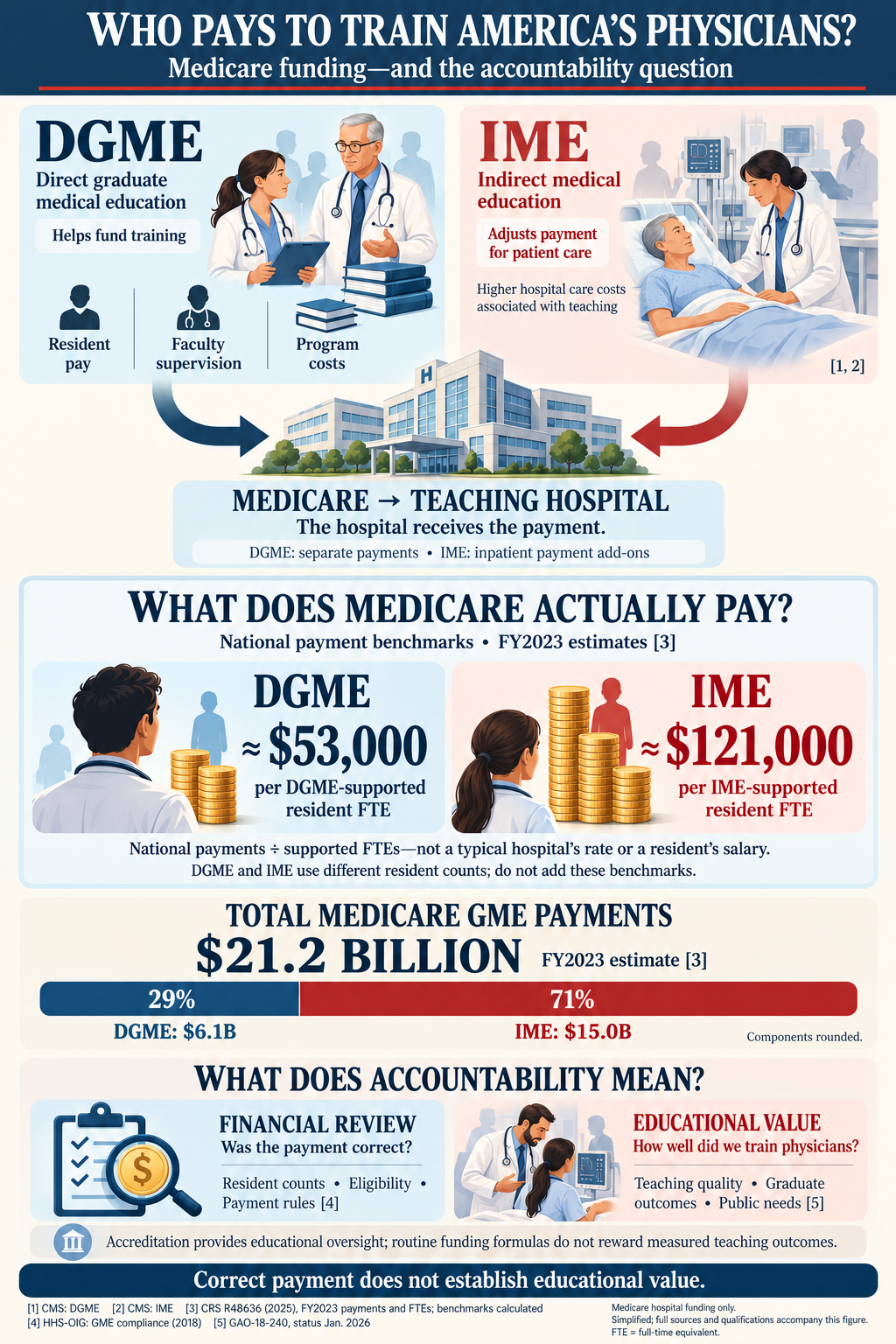
Medicare’s FY2023 GME reimbursement consisted of approximately $6.1 billion in DGME and $15.0 billion in IME. Payment audits verify eligibility and amounts; neither formula measures the quality of teaching.
The Educational Work We Have Neglected to Measure
One response to the imbalance between clinical and educational accountability has been to develop more explicit measures of faculty teaching. Educational Value Units, or EVUs, attempt to make teaching visible in a manner somewhat analogous to the Relative Value Units (RVUs) used to measure clinical productivity.
The idea has merit. In 2016, investigators at Johns Hopkins described a system in which approximately one educational unit represented an hour of direct teaching contact. During one academic year, nearly 5,900 units were distributed among fifty-four faculty members, allowing the department to define and allocate scheduled educational responsibilities more explicitly. [35]
More recently, Ohio State University described an EVU system supported by a dedicated data analytics team and monthly faculty reports. The approach provided greater visibility into educational activities but also required considerable administrative infrastructure. [36]
My own experience with efforts to account for educational work revealed both their promise and their limitations. As we began documenting faculty teaching activities, the accumulated effort became so substantial that administrators seemed almost incredulous. I wondered whether the institution could realistically provide adequate financial support for everything being reported. Questions soon arose about the accuracy of the accounting itself. How reliably could these activities be documented, valued, and verified?
Consider the familiar drive-by consultation. I might spend thirty minutes in a hallway discussing a difficult patient with another clinical team, reviewing diagnostic possibilities, explaining a physiological mechanism, or helping a younger physician think through a treatment decision. Was that clinical consultation, education, or both? Who should record the time? How could it be verified? And would thirty minutes spent in that conversation necessarily have the same educational value as thirty minutes spent in a scheduled conference?
Some of the most valuable teaching I did during my career was never scheduled, assigned, or documented. It might have been a telephone call from a medical student, an impromptu discussion with a clinical team, an extended conversation with a struggling resident, or a meeting with another program director to address an educational problem.
These encounters were part of the daily fabric of academic medicine. A brief conversation could clarify a misunderstanding, prevent an error, or fundamentally change how a developing physician approached a clinical problem. An hour spent helping a resident overcome a particular difficult situation might accomplish more than several scheduled lectures. Yet capturing every such encounter would require precisely the kind of additional documentation we were already struggling to manage.
These difficulties are not unique to my experience. A 2024 qualitative study examined EVU initiatives at ten academic health centers. Only four were still actively using their systems when investigators conducted interviews. Others had paused or abandoned them because of logistical barriers, insufficient resources, faculty dissatisfaction, and workload burdens. Institutions also differed considerably in what they counted as educational activity and how they valued it. [37]
There is considerable irony here. We have spent years examining how documentation displaces teaching, and now we risk imposing additional documentation to establish that teaching occurred.
An educational equivalent of the clinical productivity contest could reward faculty for accumulating easily documented activities while overlooking less measurable but equally important contributions. Worse, physicians already struggling to find time to teach could be required to spend even more time proving they did so.
Yet abandoning measurement is not the answer. EVUs have helped demonstrate the substantial educational effort required to sustain academic medicine. Another difficulty arises when we confuse measuring effort with determining educational value and providing adequate institutional support.
I increasingly believe that educational accounting should begin with institutional commitments rather than attempting to capture every educational transaction. We can measure scheduled teaching, protected faculty time, assigned supervision, curriculum development, mentorship responsibilities, and other substantial educational commitments. Much of this information should be available through existing schedules and administrative systems without requiring constant faculty data entry. We can compare what an institution promises to support with the resources it actually provides.
But the objective should not be another individual productivity ranking. Nor should we pretend that an hour of excellent teaching and an hour of mediocre teaching have equivalent educational value simply because both lasted sixty minutes. We must evaluate educational effectiveness through meaningful observation, feedback, and evidence of trainee development, not merely by accumulating teaching hours.
Perhaps the more important question is not how to account for every hour of teaching, but whether institutions have committed sufficient time, personnel, and financial resources to make excellent teaching possible.
Attendings expected to teach, observe, evaluate, and mentor must have realistic clinical workloads and sufficient flexibility to respond when meaningful educational opportunities arise. Most academic institutions would undoubtedly insist that they already provide such support. They can point to educational mission statements, faculty appointments, scheduled teaching activities, and designated protected time.
But those assurances are difficult to reconcile with the evidence. Studies cited throughout this essay have documented the extraordinary time consumed by clinical documentation, the extension of administrative work beyond scheduled hours, and the displacement of teaching by competing responsibilities. These findings are not isolated complaints from overburdened physicians. They reflect measurable pressures on the educational environment that institutions claim to protect.
My experience matched these findings. When patient volume increased, documentation accumulated, or competing obligations demanded attention, teaching was often the responsibility that gave way. Faculty were still expected to fulfill their educational duties, but the time and flexibility necessary to do so were increasingly constrained. Protected time means little if clinical workloads remain unchanged or unfinished responsibilities simply follow physicians home.
Institutions should therefore be expected to demonstrate, rather than merely assert, their commitment to education. How much teaching time is actually protected? What happens to that time when clinical demands increase? Do faculty have meaningful opportunities to observe residents, evaluate their reasoning, and provide individualized feedback?
The question is no longer simply whether institutions value education. It is whether they are willing to demonstrate that their staffing, schedules, budgets, and clinical expectations provide the conditions necessary to deliver it.
Some of the most important contributions an educator makes will never appear on a productivity report. Their absence from that report does not diminish their value. Academic medicine's responsibility is not simply to count educational work, but to create the conditions for excellent teaching—and to assess whether that teaching is achieving its purpose.
The Financial Return We Cannot See
Another dimension of this problem deserves attention: the logical possibility that better-trained physicians ultimately deliver better, more cost-effective care. Hospitals derive immediate operational value from residents’ clinical services, while the potential long-term return on the education those residents receive is much harder to measure. We have only limited information connecting educational expenditures to physicians’ later practice and patient outcomes.
A physician who recognizes a problem early, selects appropriate tests, avoids unnecessary interventions, and understands when treatment is unlikely to benefit the patient can influence healthcare expenditures over an entire career. Conversely, deficiencies in clinical judgment may contribute to unnecessary testing, inappropriate treatment, delayed diagnoses, and avoidable complications. These are logical conclusions, but it is difficult to determine how much they reflect training.
Nevertheless, evidence indicates that the programs in which physicians train influence their subsequent use of healthcare resources. A 2014 JAMA study examined spending patterns among 2,851 primary care physicians caring for nearly 492,000 Medicare beneficiaries. Physicians trained in higher-spending regions subsequently generated higher expenditures than those trained in lower-spending regions, even after adjustment for patient, physician, and geographic characteristics. [38] The overall adjusted difference was approximately 7%. Among physicians in their first seven years of practice, however, the difference was 29%. The association diminished with additional years in practice.
These findings suggest that physicians may carry practice patterns acquired during residency into their subsequent careers. The study did not establish that physicians who spent more time in patient care were less competent or that physicians who spent less provided better care. But it raises an important possibility: the training environment can influence clinical decisions long after formal education ends.
Another study examined nearly 30,000 patients assigned to physician teams affiliated with two different academic institutions at the same Veterans Affairs hospital. The teams shared the same facilities and supporting services. Patients assigned to teams affiliated with the higher-ranked medical school had shorter, less expensive hospital stays by about 10%–25%, with no significant differences in measured health outcomes. Differences in diagnostic testing contributed to the spending variation. [39] The investigators could not separate differences in physician selection from differences in training. Nor does an institution's ranking necessarily establish the clinical competence of every physician associated with it. Nevertheless, the findings show that physicians working in the same healthcare environment can use resources differently without producing corresponding differences in patient outcomes.
We generally regard medical education as an expense that must be supported by the clinical enterprise. But what if some educational investments ultimately produce physicians who deliver more appropriate, effective, and efficient care throughout their careers? The financial return might never appear on the training institution's balance sheet. Instead, it might accrue to patients, insurers, Medicare, and the broader healthcare system over decades of subsequent practice.
A potential conflict of interest also exists between the institution's immediate financial interests and the public's longer-term interests. In a fee-for-service environment, providing additional billable services can increase institutional revenue. A physician who appropriately avoids unnecessary tests or procedures may reduce overall healthcare spending without generating a comparable financial reward for the employer. Granted, sometimes excellent medicine is expensive. The objective is better value: appropriate decisions, improved outcomes, fewer avoidable harms, and responsible resource use.
The costs of improving medical education are often immediate. The benefits may emerge years later, may be difficult to attribute to a particular educational intervention, and may accrue to patients and institutions far removed from the one that made the investment.
That imbalance gives the status quo an enormous practical advantage. An administrator can explain precisely what additional teaching time will cost. The educator may be unable to demonstrate what failing to provide that time will eventually cost patients. Yet difficulty in measuring a benefit does not establish that the benefit is absent. It creates an obligation to investigate. We should be studying which educational activities improve clinical judgment, how reliably those improvements translate into patient outcomes, and whether their benefits justify their costs.
Indeed, we have a system that financially supports physicians in training without adequately measuring the long-term value of the education they receive. In addition, we have become extraordinarily proficient at counting educational activities, such as residents, rotations, examinations, clinical encounters, and completed evaluation forms. Medicare reimburses teaching hospitals through formulas that recognize resident numbers and hospital activity, while institutional financial systems meticulously track clinical services, revenue, and productivity.
But counting educational activity is not the same as establishing educational quality. A completed rotation does not necessarily demonstrate clinical competence. A favorable evaluation is meaningful only when supported by credible evidence of the abilities being assessed. And a hospital receiving substantial GME reimbursement has not, by that fact alone, demonstrated that its graduates are well prepared.
The question is not simply how many physicians we train, but how well we train them. We need more physicians to meet society's healthcare needs, and expanding access to care is an important goal. But increasing the number of trainees, programs, and completed requirements without comparable attention to educational quality risks confusing institutional productivity with professional preparation. Ultimately, patients benefit not merely from access to a physician, but from care provided by someone with the knowledge, judgment, and professional responsibility to care for them well.
We have learned to count the physicians we train. We must become equally proficient at demonstrating how well we have prepared them.
From Getting By to Getting Better
A Framework for Learning Medicine
Recognizing shortcomings is generally easier than correcting them. Simply adding more supervision can prevent an immediate error while limiting opportunities to develop independence. Less supervision creates those opportunities but also exposes patients to risk. Narrative assessments can be illuminating or superficial. Mentorship can develop judgment or perpetuate dependency.
The answer is not simply another attractive educational framework. It is a dependable connection between what physicians are taught, what they are permitted to do, what their teachers actually observe, and what institutions support.
When I wrote The Renal System, I organized the material into five sections: The Building Blocks (ABCs), The Diseases, Renal Medicine as an Art, Self-Reflection, and The Core References. I compared memorizing diseases without understanding their foundations to memorizing a word without learning the alphabet. [12] The intent was not simply to organize renal physiology more conveniently. It was to create a progression from fundamental understanding to clinical application, thoughtful patient care, critical self-assessment, and continued learning.
The Building Blocks establish the scientific concepts necessary to explain findings and anticipate consequences. In physician training, this means rigorous instruction and examinations that require independent understanding, not merely recognition of familiar terminology.
The Diseases bring those foundations into clinical problems. The learner must interpret information, distinguish competing explanations, recognize urgency, act, and reassess. Written and oral cases, simulation, and actual patient care provide different opportunities to develop and observe these abilities.
Renal Medicine as an Art addresses the person receiving care. Listening, honesty, cultural understanding, communication, and attention to patient priorities belong within clinical education, not outside it as optional enrichment.
Self-Reflection asks learners to examine decisions, recognize limitations, learn from mistakes, and demonstrate improvement. Feedback should not end with acknowledgment. The trainee should have an opportunity to demonstrate that an identified weakness has been addressed.
The Core References support lifelong learning. Physicians must be able to evaluate new evidence, seek consultation, and incorporate new information intelligently. The objective is not simply to retrieve an answer, but to determine whether it is credible and applicable to the patient.
These components should interact repeatedly rather than function as five requirements completed once. A difficult patient should send the learner back to physiology. An unexpected outcome should prompt reconsideration of the original reasoning. New evidence should change practice when appropriate. I believe this provides an effective foundation when carried out well. Its individual ideas are not wholly novel, and several are already explicit in modern competency-based education. The challenge is implementation. A beautifully designed framework is of little value without capable teachers, meaningful clinical responsibility, honest observation, and adequate institutional support.
The Human Dimension of Medical Education
When I interviewed at Massachusetts General Hospital, one question stayed with me. As I remember it, the interviewer asked, “What have you learned about death?” Not merely what I knew about its physiology. What had my experiences with death taught me? Looking back, I suspect the interviewer was trying to understand something more fundamental about me. Could I empathize with patients and families confronting illness, suffering, and loss? Could I connect with people at their most vulnerable moments, recognizing that medicine requires more than scientific knowledge and technical competence? I believe the question was intended to explore not simply what I knew, but the kind of physician I might become.
Books such as Elisabeth Kübler-Ross's On Death and Dying, Atul Gawande's Being Mortal, Siddhartha Mukherjee's The Emperor of All Maladies, and Rebecca Skloot's The Immortal Life of Henrietta Lacks shaped my understanding of medicine.
I also intentionally placed artwork, historical images, and quotations throughout one of my own published books. I did so deliberately to introduce the humanities into medical education and encourage the reader's growth as a person. These were invitations to reflection, not additional professional virtues to memorize for an examination.
A chasm exists between reciting a professionalism checklist and practicing its principles. Honesty matters when acknowledging an error is embarrassing. Respect matters when a patient needs another explanation or a nurse challenges a treatment plan. An attending who teaches courtesy while humiliating residents provides contradictory lessons. "Do no harm" cannot mean avoiding every risk. It requires judging which risks are justified and whose goals the intervention serves. Medical expertise does not confer complete understanding of the patient's experience. The physician must listen and learn as well as explain.
The same responsibility extends to trainees. I recall less open discussion of emotional distress during my own training, but that does not establish that earlier generations suffered less. A major 2016 systematic review estimated depression or depressive symptoms in approximately 27% of medical students, with substantial variation across studies. Importantly, its analysis did not establish a consistent increase in prevalence over the decades examined. [40]
We should distinguish the difficulty necessary to prepare for demanding work from avoidable burdens that contribute little to learning. Confidential support, realistic workloads, meaningful mentorship, and an environment that does not treat seeking assistance as weakness belong within the educational mission. Supporting students and maintaining rigorous standards are complementary obligations.
Learning Through Responsibility
Clinical judgment develops through responsibility, experience, feedback, and the opportunity to examine mistakes. For consequential decisions, I would ask trainees to commit to an assessment and plan before receiving the attending's answer, whenever patient safety permits. The attending should identify what was recognized independently, what help was required, and what should improve. Feedback should be followed by another opportunity to demonstrate the ability. Recognizing a weakness without revisiting it is not a completed educational intervention. This requires substantial time and effort from experienced physicians. It cannot be reduced to checking another box on a rotation evaluation.
Simulation can provide controlled practice with dangerous or uncommon situations. Structured oral cases can examine the rationale behind a decision. Actual patient care must establish how the developing physician performs amid competing demands.
Readiness standards should apply consistently to every trainee, regardless of background. Expanding opportunity and supporting a diverse profession must be compatible with rigorous clinical expectations. No demographic quota, representation target, legacy preference, staffing need, or desire to preserve graduation rates should override demonstrated readiness. It is an obligation to assess individuals fairly, provide preparation and remediation, and avoid transferring known deficiencies to patients.
We must also recognize that teaching and assessment require expertise. Being a capable physician does not automatically make someone an effective teacher or a reliable evaluator of clinical competence. Faculty should receive appropriate development, and institutions should examine whether their assessments identify deficiencies and lead to meaningful improvement. An educator who lacks preparation in a particular area should not be expected to evaluate that ability without qualified assistance.
A further consequence deserves serious consideration. The physicians we educate today will eventually become the attendings, mentors, and educators responsible for training the next generation. If their own preparation has been inadequate, particularly in clinical reasoning, judgment, or professional responsibility, those deficiencies may influence not only their patients but also the physicians they subsequently train. Unrecognized weaknesses can be perpetuated, gradually becoming accepted practice rather than deficiencies requiring correction.
The consequences of inadequate medical education may therefore extend far beyond a single graduating class. We are not simply preparing physicians to care for today's patients. We are preparing the physicians who will teach those responsible for tomorrow's patients—and the generations that follow.
At some point, every physician confronts what a colleague once called the “day of reckoning.” The resident or fellow becomes the physician others turn to for answers, making decisions without the reassurance of an attending reviewing every judgment. A 2025 scoping review of 116 publications identified 192 reported gaps in the transition from graduate medical education to independent practice, including procedural independence, patient care, and practice management. These reported educational gaps underscore the challenges of this transition. [41] I have often wondered whether newly independent physicians would benefit from a structured mentorship period during their first year of practice. They would assume full clinical responsibility while having ready access to experienced colleagues for case discussions, feedback, and assistance with unfamiliar situations. The American College of Surgeons' Transition to Practice initiative provides a precedent, although the optimal duration and effectiveness across specialties remain uncertain. [42] Such an arrangement should neither become another year of residency nor substitute for demonstrating competence before graduation. Mentors must also be open to challenge, and physicians must remain free to seek other perspectives. Independence does not mean isolation. Recognizing when to seek assistance is itself an essential element of clinical competence.
Investing in the Opportunities to Learn
If medical knowledge and clinical complexity have expanded, logic demands that we increase opportunities for meaningful educational engagement. That does not necessarily mean adding more lectures or extending training. It means providing high-quality, high-level contact between developing physicians, experienced educators, and the clinical problems they must learn to solve.
Direct observation of patient encounters, bedside teaching, structured clinical discussions, simulation, standardized patients, deliberate procedural practice, and longitudinal mentorship all offer opportunities to develop and assess abilities that written examinations cannot adequately capture. The essential elements are active participation, meaningful feedback, and opportunities to demonstrate improvement.
Another opportunity is remarkably straightforward: keeping clinical teaching teams together. In many hospitals, patients assigned to a particular physician team are scattered across multiple floors, requiring attending physicians, residents, and students to travel repeatedly between clinical locations. This geographic separation consumes time and reduces opportunities for spontaneous discussion, direct observation, and meaningful interaction among team members. Geographically localized teaching units offer an alternative. By assigning patients and their physicians to the same clinical area and providing shared workspace for attending physicians, residents, medical students, and other healthcare professionals, institutions can create more opportunities for bedside teaching, collaborative decision-making, and timely feedback.
This approach has been studied. A 2010 New England Journal of Medicine investigation of an integrated teaching unit found substantial increases in time devoted to learning and teaching, along with improved trainee satisfaction. The intervention included greater attending availability and reduced resident workloads. Importantly, the results demonstrate that redesigning clinical work can create meaningful additional educational opportunities.
The objective should not be greater operational efficiency alone. If time saved through better team organization is converted immediately into additional clinical assignments, the educational advantage may disappear. Time recovered through more efficient work should be deliberately protected for teaching, observation, and patient care. Sometimes improving medical education does not require an entirely new curriculum or assessment system. It requires organizing clinical care so that meaningful education can actually occur.
Simulation deserves particular attention because it allows trainees to encounter dangerous or uncommon clinical situations without placing patients at risk. A resident can practice recognizing respiratory failure, managing a cardiac emergency, or performing a procedure repeatedly until a defined level of competence is demonstrated. Structured debriefing allows faculty to examine not simply what the trainee did, but why.
Evidence suggests these investments can benefit patients. In one study, simulation-based training in central venous catheter insertion was associated with substantially fewer bloodstream infections. A subsequent economic analysis estimated that an annual educational expenditure of approximately $112,000 produced more than $700,000 in net savings from avoided infections. These observational findings cannot establish that all simulation programs will deliver comparable benefits, but they demonstrate that educational investment can have measurable clinical and financial value. [44,45]
Artificial intelligence offers additional possibilities. AI-supported case simulations, virtual patients, individualized learning exercises, and structured feedback may expand access to practice opportunities. They could allow residents to rehearse diagnostic reasoning or communication skills before working directly with patients. A 2025 randomized surgical simulation trial found that AI-informed personalized feedback from human instructors improved selected trainee performance measures compared with AI tutoring alone. [46]
These tools offer extraordinary opportunities to improve clinical care and education, but they cannot substitute for the foundational knowledge and independent judgment physicians must develop. Students and residents need to demonstrate that they can formulate assessments, recognize clinical uncertainty, and make reasoned decisions without relying on AI to supply the answers. They must also learn to use these tools critically, recognize their limitations, challenge their recommendations, and determine when the information genuinely improves a clinical decision. A physician cannot meaningfully supervise an AI recommendation without the expertise to evaluate it. The same principle applies to AI-assisted documentation: technology may organize information, but it should not create the appearance of human reasoning that never occurred. And perhaps most importantly, if AI reduces the administrative burden on physicians, institutions should use some of that recovered time to restore what has been progressively lost—meaningful patient interaction, thoughtful clinical deliberation, teaching, and assessment—rather than simply demanding greater clinical productivity.
This is an appealing direction: use technology to expand practice opportunities, identify learning needs, and make the educator's time more effective. But none of these approaches is free. Simulation requires facilities, equipment, instructors, program development, and assessment. AI requires reliable systems, oversight, evaluation, and safeguards. Meaningful bedside observation and clinical coaching require experienced physicians with enough time to teach.
We can improve educational efficiency, and we should. But efficiency does not eliminate the need for resources. Even a brief educational encounter has an opportunity cost when the attending is expected to meet clinical productivity requirements at the same time.
What We Should Measure Next
We cannot reconstruct the educational environment of forty years ago and fairly compare its graduates with physicians trained today. Too much has changed: patient populations, medical knowledge, diagnostic and therapeutic technologies, supervision, clinical responsibilities, and the organization of healthcare itself. Nor should we assume that simply spending more time with trainees necessarily produces better physicians. An hour of thoughtful clinical discussion and feedback may be extraordinarily valuable. An additional hour of an attending directing every decision provides relatively little educational benefit.
What matters is the nature of the experience and whether it develops abilities that can subsequently be demonstrated.
I would favor a prospective, multicenter study comparing conventional residency training with an approach providing deliberately protected opportunities for direct observation, clinical discussion, and meaningful feedback. Both groups would retain appropriate patient safeguards. The intervention would focus on allowing trainees to exercise judgment before the attending intervenes, when clinically safe, followed by examination of the reasoning and reassessment of identified weaknesses. The outcomes should extend beyond examination scores and trainee satisfaction. We should assess recognition of clinical deterioration, determination of urgency, appropriate consultation, decision-making under uncertainty, and follow-through. Independent assessors should examine performance across multiple scenarios and clinical settings.
Most importantly, those evaluations should extend into the first years of independent practice, when physicians must demonstrate these abilities without the routine safeguards of residency training. Do they demonstrate more reliable independent judgment? Are important deficiencies less common? Are their decisions associated with differences in patient safety, appropriate resource use, or risk-adjusted expenditures? Do the benefits justify the educational investment?
Such studies would be difficult, expensive, and imperfect. But those limitations are reasons to design thoughtful investigations, not abandon the effort. We have spent decades asking physicians to practice evidence-based medicine. We should demand a comparable commitment to evidence-based medical education.
Institutions must therefore make deliberate choices. Faculty cannot be expected to accommodate an expanding body of medical knowledge, increasing clinical demands, growing administrative obligations, and more rigorous educational expectations without corresponding changes in how their time and responsibilities are organized.
Teaching and patient care are complementary, but they are not interchangeable. A clinical encounter may provide an excellent educational opportunity, but realizing that opportunity requires time to observe a resident, question an assessment, examine alternative diagnoses, provide feedback, and evaluate whether learning has occurred. These activities do not happen simply because an attending and a resident are caring for the same patient. They require deliberate attention, and that attention cannot be devoted to every competing obligation at once.
Most academic medical centers would insist that they already protect teaching time, support faculty development, and evaluate resident competence. But the studies reviewed throughout this essay raise serious questions about the adequacy of those commitments. Documentation and administrative demands consume substantial portions of the workday, often at the expense of teaching opportunities. Meanwhile, the knowledge and complexity of medicine continue to expand.
The appropriate response to institutional assurances is straightforward: Show us the evidence. How much protected teaching time is actually delivered, not merely scheduled? Have clinical workloads been adjusted to accommodate educational responsibilities? How often are residents directly observed, their reasoning challenged, and meaningful feedback provided? Do our assessments reliably identify weaknesses, and does remediation produce demonstrable improvement?
These are not unreasonable questions. We routinely ask them when evaluating clinical interventions. Educational programs responsible for preparing the next generation of physicians deserve no less scrutiny.
Answering them will require resources and difficult choices. Some improvements will require additional funding. Others will require reallocating existing expenditures, modifying clinical assignments, or eliminating administrative work that contributes little to patient care or education. Financial constraints are real, but they cannot become a permanent justification for expecting ever more from faculty without examining what is being sacrificed.
And then there is the public's investment. Medicare provided an estimated $21.2 billion in graduate medical education payments in fiscal year 2023, mostly through IME payments to teaching hospitals. The public has every right to ask what it receives for that substantial commitment. Are we producing physicians who demonstrate sound clinical judgment, recognize their limitations, communicate effectively, and deliver safe, evidence-based, cost-conscious care? Are we preparing them adequately for independent practice? And perhaps most importantly, what evidence do we have that the institutions receiving this funding are accomplishing these objectives?
Teaching hospitals have successfully defended the importance of this public investment. They should be equally prepared to demonstrate that the educational mission it helps sustain is being fulfilled. Counting residents to calculate reimbursement is not the same as establishing the quality of the education those residents receive.
We should also remember where the benefits of excellent medical education ultimately appear. Not necessarily in a teaching hospital's immediate operating margin, productivity reports, or annual financial statements, but in the thousands of clinical decisions a physician makes throughout a career—and in the physicians that person may one day help train.
For much of my professional life, I approached medical education as a physician and educator responsible for preparing the next generation. Today, I increasingly approach it as someone who will depend on the physicians that system produces. I know how much dedication goes into training excellent doctors. I also know how difficult it can be to establish that every graduate has developed the knowledge, judgment, compassion, and professional responsibility necessary for independent practice. I do not expect perfection, nor do I expect a guarantee against medical errors. But I do expect the institutions entrusted with that responsibility to show they have done everything reasonably possible to prepare physicians for the patients who will depend on them.
That is ultimately what this discussion has been about. Not preserving the educational practices of an earlier generation, defending professional reputations, or satisfying another set of accreditation requirements. We should be willing to examine our assumptions, acknowledge what we do not know, and determine whether the education we provide is accomplishing what we promise. The profession asks patients to trust its judgment. It should be equally willing to demonstrate that the physicians earning that trust have been adequately prepared.
We cannot continue expanding what physicians must know while diminishing the time available to teach them, then assume that educational excellence will somehow take care of itself.
The public deserves more than assurances that institutions value education. It deserves evidence that they have provided the conditions necessary to deliver it, and that the physicians emerging from their programs are prepared for the responsibilities entrusted to them.
Annotated References
The annotations identify what each source contributes and, where important, what its findings do not establish.
[1] Haidet P, Hafferty FW. "Mission, margin, and mindset." The Pharos. Summer 2026:2–4. Read the editorial.
Editorial examining how financial priorities influence professional and institutional values. Central to the mission-and-margin argument; not an empirical study of trainee competence.
[2] Gallup. Honesty and Ethics in Professions and Confidence in Institutions. Historical survey series, 2005–2026. Physician ethics. Medical-system confidence.
Provides long-term public-opinion trends. Physician honesty ratings and confidence in the medical system are different measures and should not be interpreted as one continuous scale of trust.
[3] Annenberg Public Policy Center, University of Pennsylvania. "Public Confidence in One's Own Healthcare Provider Remains High." August 31, 2026. Survey report.
Nationally representative survey showing high, relatively stable confidence in one's personal healthcare provider as a source of trustworthy public-health information. Does not directly assess residency quality.
[4] Gaffney A, Himmelstein DU, Dickman S, et al. "Trends and Disparities in the Distribution of Outpatient Physicians’ Annual Face Time with Patients, 1979–2018." Journal of General Internal Medicine. 2023;38(2):434–441 (published online 2022). Full text.
National observational analysis showing increased total physician face time over the long term, but declining annual primary-care face time after 2005. Visit duration was reported rather than directly observed.
[5] Agency for Healthcare Research and Quality. 2019 National Healthcare Quality and Disparities Report: Quality Trends. AHRQ report.
Documents trends in patients' reports of adequate time and communication. Important counterweight to a simplistic claim that perceived time with physicians has steadily deteriorated.
[6] Miller GE. "The Assessment of Clinical Skills/Competence/Performance." Academic Medicine. 1990;65(9 Suppl):S63–S67. PubMed.
Foundational conceptual framework distinguishing knowledge, application, demonstration, and actual performance. A framework for assessment rather than an empirical comparison of training systems.
[7] Pugh D, et al. "Association Between Physician Licensing and Certification Examination Performance and Quality of Patient Care: A Systematic Review." Academic Medicine. 2026;101(8):1012–1026. PubMed.
Review of 44 studies involving more than one million physicians. Supports the predictive value of licensing and certification examinations, while not establishing that they capture every dimension of clinical competence.
[8] National Academies of Sciences, Engineering, and Medicine. Graduate Medical Education Outcomes and Metrics: Proceedings of a Workshop. National Academies Press; 2018. Report.
Examines the absence of established, broadly useful GME outcome measures and challenges in collecting and interpreting them. Workshop proceedings, not a controlled study.
[9] Accreditation Council for Graduate Medical Education. The Milestones Guidebook for Residents and Fellows; Institutional Requirements, effective July 1, 2026. Milestones guidebook. Institutional requirements.
Primary sources describing competency assessment, institutional educational responsibilities, and expectations for program support. Establish what programs are required to do, not how consistently they accomplish it.
[10] Gray BM, et al. "Associations of Internal Medicine Residency Milestone Ratings and Certification Examination Scores With Patient Outcomes." JAMA. 2024;332(4):300–309. Full text.
Observational study linking examination scores, Milestone ratings, and selected hospital outcomes. Uses an earlier version of internal medicine Milestones; should not be generalized to all specialties or assessment systems.
[11] Smith BK, et al. "Accreditation Council for Graduate Medical Education Milestone Training Ratings and Surgeons' Early Outcomes." JAMA Surgery. 2024;159(5):546–552. Full text.
Finds associations between Milestone ratings and selected vascular-surgery outcomes under certain program conditions. Demonstrates that workplace assessment can contain useful information, with important limitations.
[12] Schmitz PG. The Renal System. Learning Innovations; 2020. "Using this Book," pp. ii–iii; clinical questions and explanations, pp. 264–306.
Primary source for the foundations-first educational framework and the clinical reasoning example. The framework's organization is observable; comparative educational effectiveness has not been established.
[13] Alfonzo A, et al. UK Kidney Association Clinical Practice Guideline: Management of Hyperkalaemia in Adults. 2023. Clinical guideline.
Supports the immediate management distinction in the hyperkalemia example. Included to validate the clinical illustration, not as a comprehensive treatment protocol.
[14] American Board of Neurological Surgery; American Board of Anesthesiology. Official oral and applied examination descriptions. Neurosurgery. Anesthesiology.
Documents contemporary use of oral examinations to assess clinical judgment. Does not establish that oral examinations are uniformly superior to written examinations.
[15] Anderson LM, et al. "An Analysis of Written and Numeric Scores in End-of-Rotation Forms from Three Residency Programs." Perspectives on Medical Education. 2023;12:497–506. Full text.
Empirical evidence of overwhelmingly favorable numerical ratings and limited actionable narrative feedback. Does not independently establish how many trainees had actual deficiencies.
[16] Wilson JL, et al. "FEAR: Faculty Evaluation and Retaliation—A Survey of Family Medicine Program Directors." Family Medicine. 2026;58(3):178–184. Full text.
Survey of program directors identifying perceived barriers to candid assessment, including reciprocal evaluations, complaints, and insufficient documentation for remediation. Findings reflect reported perceptions and experiences.
[17] Philibert I, Taradejna C. "A Brief History of Duty Hours and Resident Education." In: The ACGME 2011 Duty Hour Standards. ACGME; 2011. Historical review.
Provides historical context for Libby Zion, the Bell Commission, and national duty-hour reforms.
[18] Landrigan CP, et al. "Effect of Reducing Interns' Work Hours on Serious Medical Errors in Intensive Care Units." New England Journal of Medicine. 2004;351:1838–1848. PubMed.
Controlled study demonstrating safety concerns associated with traditional extended shifts. Supports the need for fatigue-related reform, not every subsequent supervision policy.
[19] Finn KM, et al. "Effect of Increased Inpatient Attending Physician Supervision on Medical Errors, Patient Safety, and Resident Education: A Randomized Clinical Trial." JAMA Internal Medicine. 2018;178:952–959. PubMed.
Randomized study showing reduced reported autonomy under increased attending participation without a statistically significant reduction in errors. Did not measure graduates' later independent performance.
[20] Fihn SD, et al. "Effects of the Revised HCFA Evaluation and Management Guidelines on Inpatient Teaching." Journal of General Internal Medicine. 2000;15:451–456. PubMed.
Historical comparison surrounding the 1996 teaching-physician documentation changes. Faculty reported reduced scheduled teaching while trainee evaluations remained favorable. Does not establish a decline in subsequent competence.
[21] Chaiyachati KH, et al. "Assessment of Inpatient Time Allocation Among First-Year Internal Medicine Residents Using Time-Motion Observations." JAMA Internal Medicine. 2019;179:760–767. Full text.
Direct-observation study of intern time allocation across six programs. Describes how work time was spent; does not establish that all electronic-record activity was educationally unnecessary.
[22] Sinsky C, et al. "Allocation of Physician Time in Ambulatory Practice: A Time and Motion Study in 4 Specialties." Annals of Internal Medicine. 2016;165:753–760. PubMed.
Directly measured ambulatory physicians' clinical and electronic-record activities, supplemented by after-hours diaries. Small sample, but useful evidence of competing demands.
[23] Baugh JJ, et al. "Documentation Displaces Teaching in an Academic Emergency Department." Western Journal of Emergency Medicine. 2020;21:974–977. Full text.
Small observational study finding documentation time associated with reduced teaching time. Does not prove that the association caused inferior trainee performance.
[24] Frayha N. "How to Teach Good EHR Documentation and Deflate Bloated Chart Notes." AMA Journal of Ethics. 2025;27(11):E808–E814. Article.
Educational and ethical analysis of excessively long electronic notes, loss of visible clinical reasoning, and consequences for teaching. Includes discussion of practical improvements.
[25] Centers for Medicare & Medicaid Services. Evaluation and Management Services. MLN006764; May 2026. CMS publication.
Official guidance on documenting and billing clinical services. Useful for distinguishing regulatory requirements from institutional documentation habits.
[26] Summer R, et al. "Physician Perception of the Impact of Productivity Measures on Academic Practice." Archives of Internal Medicine. 2012;172:967–969. Full text.
Single-center survey linking productivity expectations with reported reductions in teaching and nonbillable academic activity. Self-reported perceptions, not independently measured teaching quality.
[27] Patel V, et al. "Impact of Clinical Demands on the Educational Mission in Hospital Medicine at 17 Academic Medical Centers: A Qualitative Analysis." Annals of Internal Medicine. 2023;176:1526–1535. PubMed.
Multicenter qualitative study documenting tensions between clinical expansion and education, alongside institutional adaptation efforts. Does not measure graduates' competence.
[28] Pellegrini VD Jr, Babbott S. "Keepers of the Academic Mission: Calling All Faculty." Academic Medicine. 2025;100:661–665. PubMed.
Commentary examining governance, clinical revenue, and support for academic work. Important institutional analysis, not a controlled educational intervention.
[29] U.S. Government Accountability Office. Graduate Medical Education: Information on Initial Distributions of New Medicare-Funded Physician Residency Positions. GAO-26-107686; December 2025. GAO report.
Describes federal support for GME, statutory residency caps, and the initial distribution of additional Medicare-funded positions. Its approximate $22 billion FY2023 figure is rounded; reference [47] provides the precise DGME/IME split.
[30] Centers for Medicare & Medicaid Services. Direct Graduate Medical Education and Indirect Medical Education payment guidance. DGME. IME.
Explains the distinct purposes and calculations of Medicare's principal GME payments. Necessary for avoiding the mistaken assumption that each program receives a simple per-trainee allowance.
[31] Chaudhry SI, et al. "Accountability and Transparency in Graduate Medical Education Expenditures." American Journal of Medicine. 2012;125:517–522. PubMed.
Survey demonstrating limited financial transparency reported by internal medicine program directors. Does not establish misuse of funds.
[32] U.S. Department of Health and Human Services, Office of Inspector General. CMS Did Not Always Ensure Hospitals Complied With Medicare Reimbursement Requirements for Graduate Medical Education. 2018. Audit summary.
Documents overpayments resulting from overlapping resident counts. Supports financial oversight without establishing intentional fraud or educational consequences.
[33] ACGME. "Getting Beyond Whistle-blowing: Protecting Individuals Who Report Non-compliance with the Accreditation Standards." ACGME e-Bulletin. April 2004. Bulletin.
Historical acknowledgment that confidentiality does not necessarily prevent identification of people reporting concerns in small training programs.
[34] Do No Harm. Comment on proposed federal accreditation regulations. September 21, 2026. Organizational statement.
Advocacy position supporting accreditation reforms, educational quality, and accreditor independence. Should not be treated as empirical evidence that a replacement accreditation model would improve patient care.
[35] Regan L, Jung J, Kelen GD. "Educational Value Units: A Mission-Based Approach to Assigning and Monitoring Faculty Teaching Activities in an Academic Medical Department." Academic Medicine. 2016;91:1642–1646. PubMed.
Describes a structured system for measuring faculty educational effort. Demonstrates implementation and workload allocation, not improved graduate competence.
[36] Hunold KM, et al. "Implementation Strategy for an Education Value Unit System in Emergency Medicine at The Ohio State University." JACEP Open. 2025;6:100251. PubMed.
Describes an EVU system with dedicated analytic support and monthly reporting. Illustrates the infrastructure necessary to implement educational accounting.
[37] Maggio LA, et al. "In Search of a 'Metric System' for Measuring Faculty Effort: A Qualitative Study on Educational Value Units at U.S. Medical Schools." Academic Medicine. 2024;99:445–451. Article.
Interviews involving EVU initiatives at ten academic health centers. Documents operational difficulties, variable approaches, and incomplete sustainability.
[38] Chen C, Petterson S, Phillips R, Bazemore A, Mullan F. "Spending Patterns in Region of Residency Training and Subsequent Expenditures for Care Provided by Practicing Physicians for Medicare Beneficiaries." JAMA. 2014;312:2385–2393. Study.
Observational association between residency-region spending patterns and later physician-associated expenditures. Consistent with training-related practice habits, but does not prove better training causes lower costs.
[39] Doyle JJ Jr, Ewer SM, Wagner TH. "Returns to Physician Human Capital: Evidence From Patients Randomized to Physician Teams." Journal of Health Economics. 2010;29:866–882. PubMed.
Natural experiment comparing care delivered by teams affiliated with different academic institutions in one VA hospital. Demonstrates cost differences without corresponding measured outcome differences; cannot separate physician selection from training effects.
[40] Rotenstein LS, et al. "Prevalence of Depression, Depressive Symptoms, and Suicidal Ideation Among Medical Students: A Systematic Review and Meta-Analysis." JAMA. 2016;316:2214–2236. PubMed.
Large review documenting substantial emotional distress among medical students. Does not establish that today's trainees have consistently higher distress than earlier generations.
[41] Zavodnick J, et al. "Transition From Graduate Medical Education to Independent Practice: A Scoping Review." Academic Medicine. 2025;100:239–247. PubMed.
Review of 116 publications reporting 192 gaps in transition to practice. Supports further investigation of readiness, not a national estimate of incompetent graduates.
[42] Cogbill TH, Shapiro SB. "Transition from Training to Surgical Practice." Surgical Clinics of North America. 2016;96:25–33. PubMed.
Describes a mentored transition-to-practice approach. Establishes a practical precedent rather than proof of improved patient outcomes across specialties.
[43] U.S. Government Accountability Office. Physician Workforce: HHS Needs Better Information to Comprehensively Evaluate Graduate Medical Education Funding. GAO-18-240; March 2018. GAO report.
Found significant gaps in standardized information on federal GME funding, costs, and outcomes. As of January 2026, its two recommendations on improving federal evaluation remained open.
[44] Calhoun AW, Cook DA, et al. "Educational and Patient Care Impacts of In Situ Simulation in Healthcare: A Systematic Review." Simulation in Healthcare. 2024;19(1S):S23–S31. Systematic review.
Review of 62 studies, 24 pooled quantitatively, suggesting potential improvements in some patient-care outcomes from in situ simulation. The varied designs limit causal generalization.
[45] Cohen ER, et al. "Cost Savings From Reduced Catheter-Related Bloodstream Infection After Simulation-Based Education for Residents in a Medical Intensive Care Unit." Simulation in Healthcare. 2010;5(2):98–102. Economic evaluation.
Observational economic evaluation estimating approximately ten avoided bloodstream infections and more than $700,000 in net annual savings after simulation-based training. Findings do not establish a universal financial return.
[46] Giglio B, et al. "Artificial Intelligence–Augmented Human Instruction and Surgical Simulation Performance: A Randomized Clinical Trial." JAMA Surgery. 2025;160(9):993–1003. Randomized trial.
Trial in 87 medical students finding better performance on selected simulated surgical tasks with AI-informed personalized human feedback than AI tutoring alone. Clinical patient outcomes were not studied.
[47] Congressional Research Service. Medicare Graduate Medical Education, 2025. IF13088; August 20, 2025. CRS analysis.
CRS analysis of FY2023 Medicare hospital cost reports estimated $21.17 billion total GME payments: $6.12 billion DGME and $15.05 billion IME. These are payment totals, not evidence of hospitals’ final educational spending.
[48] Medicare Payment Advisory Commission. “Graduate Medical Education Financing: Focusing on Educational Priorities,” Recommendation 4-1. June 2010. MedPAC recommendation.
Recommended redirecting IME funds above empirically justified patient-care costs toward a performance-based GME program. A federal advisory recommendation, not a finding that hospitals fraudulently spent IME payments.
[49] Institute of Medicine (now National Academy of Medicine). Graduate Medical Education That Meets the Nation’s Health Needs. National Academies Press; 2014. Consensus report.
Recommended modernization of GME financing and governance, greater transparency, and stronger accountability for public investment and educational outcomes.
[50] McMahon GT, Katz JT, Thorndike ME, Levy BD, Loscalzo J. "Evaluation of a Redesign Initiative in an Internal-Medicine Residency." New England Journal of Medicine. 2010;362:1304–1311. Full article.
Evaluation of an integrated teaching unit combining geographic localization of patients, reduced resident workload, increased attending availability, faculty development, and bedside teaching. Learning activities occupied 20% versus 10% of intern time, and teaching activities 8% versus 2%, compared with conventional teams. Trainee satisfaction was also higher. Because several interventions were implemented together, the study cannot establish how much improvement was attributable to geographic localization alone.
[51] Beller GA. "President's Page: Academic Health Centers: The Making of a Crisis and Potential Remedies." Journal of the American College of Cardiology. 2000;36(4):1428–1431. Full article.
Contemporaneous account of the financial pressures created by the Balanced Budget Act of 1997. Explicitly documents AAMC and AHA lobbying preceding the 1999 congressional hospital-payment relief legislation and subsequent AAMC efforts to prevent additional IME reductions. Supports the claim of organized political advocacy, but does not establish that lobbying was the sole cause of congressional action or that all resulting hospital relief represented IME funding.
[52] American Hospital Association. "Hospital Leaders Urge Congress to Adequately Fund Graduate Medical Education." June 16, 2015. AHA statement.
Primary-source documentation of hospital advocacy to preserve and expand Medicare GME and IME funding. Describes the AHA's congressional briefing, its opposition to proposed reductions and reallocations, and its concerns about the 2014 Institute of Medicine reform recommendations. Establishes the association's stated position and lobbying activity, not whether existing payments were appropriately allocated or educationally effective.
[53] Medicare Payment Advisory Commission. "Revising Medicare's Indirect Medical Education Payments to Better Reflect Teaching Hospitals' Costs." In: Report to the Congress: Medicare and the Health Care Delivery System. Chapter 6; June 2021. MedPAC report.
Reexamines the empirical justification for Medicare IME adjustments. Finds that inpatient IME payments exceed estimated additional teaching-related inpatient costs while outpatient teaching-related costs are inadequately recognized. Recommends transitioning to empirically justified adjustments for both inpatient and outpatient Medicare payments. Distinguishes excess payments relative to modeled costs from evidence of inappropriate hospital expenditures.
