
Affective Polarization: What it is and Why it Matters
“If destruction be our lot, we must ourselves be its author and finisher.”
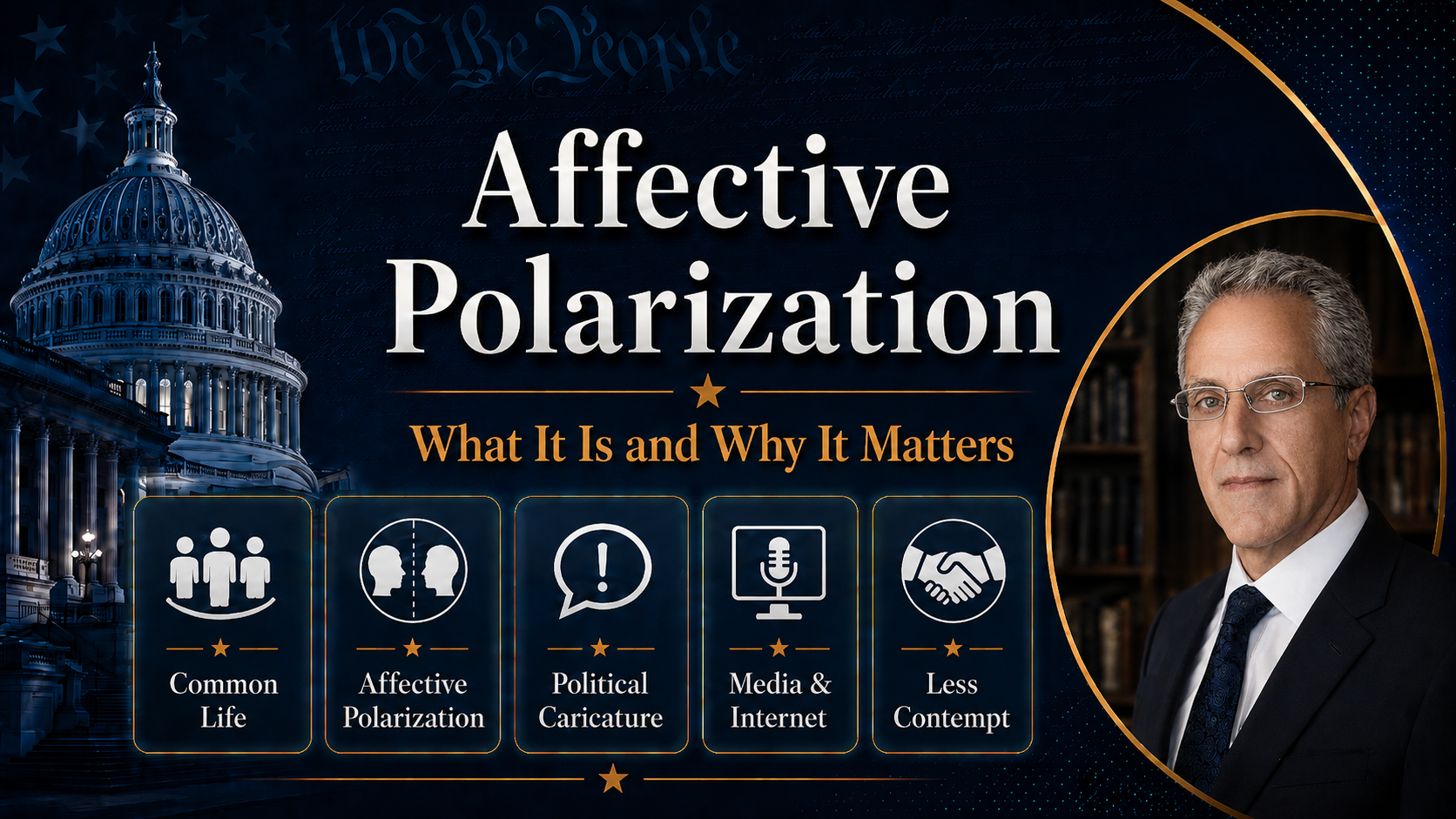
One of the tragedies of modern politics is that we are increasingly dividing ourselves along partisan lines rather than our deeper commonalities. Families still care for one another. Friends still share meals, hobbies, recreation, and routines. Neighbors still help each other. At a football game, in a church pew, on a golf course, or at a school event, people who vote differently may still cheer together, laugh together, and feel part of something shared. Yet when political topics arise, many of the same people become guarded or silent. That contrast is a true tragedy. It suggests that politics is no longer merely reflecting ordinary differences but increasingly displacing other parts of our common life that ought to matter more. (5-7)
Political scientists have a term for this problem: affective polarization. It does not simply mean disagreement over policy. It refers to the growing tendency to see the other side as selfish, dishonest, dangerous, or morally suspect. Recent work suggests that this phenomenon is more complex than simple partisan dislike. It may involve othering, aversion, and moralization—seeing opponents as fundamentally different, wanting greater social distance from them, and viewing one’s own political identity in deeply moral terms. In plain English, politics stops being mainly an argument about policy and becomes a judgment about what sort of people “they” are. (1)
Americans have always argued about politics. That is part of a healthy democracy. A free people will disagree about immigration, taxation, education, healthcare, public demonstrations, foreign policy, and the reach of government. The deeper problem today is not disagreement itself, but the way disagreement has become more emotional, more moralized, and far more personal. A republic can survive policy conflict. It struggles when citizens begin to see political opponents as morally compromised, socially threatening, or fundamentally unfit to govern. Pew’s data show how far this has gone: in 1994, only 17% of Republicans and 16% of Democrats held a very unfavorable view of the other party. By 2022, those figures had risen to 62% and 54%, respectively. Majorities in both parties also described the opposing side as more immoral and more dishonest than other Americans. (2-4)
A Familiar Phrase, but Not a Diagnosis
My original inspiration for this essay was the familiar phrase “Trump Derangement Syndrome.” It is obviously partisan and not a medical diagnosis. Still, the phrase has endured because it points, however crudely, to something many people think they see: a style of political reaction in which hostility toward Donald Trump becomes so reflexive that it begins to look less like measured criticism and more like reactive political theatre.
The phrase itself is useful only in a limited sense. Its value lies in framing what happens when intense political dislike hardens into contempt. The better analytic term is affective polarization, because the underlying pattern is not unique to Trump and not confined to one political camp. It reflects the growing tendency to see political opponents not simply as wrong, but as morally compromised. (1-4)
When Politics Becomes More Than Disagreement
What makes this trend especially dangerous is that it alters not only what citizens think, but how they think. Once public life is framed as a contest between the righteous and the corrupt, ordinary democratic habits weaken. Compromise looks like surrender. Fair-mindedness looks weak. Losing an election feels less like a setback than a moral catastrophe.
Campos and Federico suggest that affective polarization is not one simple emotion. Some forms of it appear more dangerous than others. Their work points especially to the risks of personal hostility, social avoidance, and the sense that the other side is alien or beyond reach. That matters because it reminds us that the central problem is not strong conviction by itself. It is when political disagreement hardens into contempt. (1)
One Sign of the Problem: Political Caricature
One of the clearest signs of affective polarization is the loss of proportion. A politician says one thing; opponents hear the most extreme possible version of it. Calls for stronger border enforcement become “he wants to deport every immigrant.” Calls for looser enforcement or asylum reform become “they want open borders.” Concerns about media bias lead to hostility toward a free press. Concerns about election integrity become authoritarianism. On the other side, calls for reform are often recast as lawlessness or national self-destruction.
Caricature does not merely make people angrier; it makes them less accurate. Once politics is filtered through a lens of moral suspicion, citizens stop responding to what was actually proposed and start responding to a threatening caricature of it. That is believed to reflect one of the main ways disagreement hardens into contempt. (1-4)
When Criticism Becomes Moral Escalation
Caricature is not only about policy distortion. It also appears in the way public figures are morally described. A disliked political figure is no longer merely mistaken, reckless, or offensive. He must also be monstrous. Association becomes guilt. Suspicion becomes certainty. Dislike becomes a license for exaggeration.
This kind of moral escalation is one reason affective polarization is so corrosive. Once hatred becomes intense enough, the ordinary standards of evidence begin to feel optional. The question quietly shifts from “What can we show?” to “What is the harshest accusation that feels emotionally satisfying?” That is a dangerous road to travel. It weakens the discipline of proportion and turns public life into a contest in moral maximalism. That is fundamentally tragic because hatred and division do not foster serious problem-solving. They intensify the very conditions they claim to resist.
Disproportion in Public Language: A Few Telling Examples
Disproportionate language is an unfortunate consequence of affective polarization. Politicians stop describing the other side’s arguments and start caricaturing the other side. A policy disagreement becomes proof of moral failure. A coalition becomes a cartoon. A rival becomes a civic threat. The point is not that every example below is equally bad. It is that each moves too quickly from criticism to condemnation, and that is exactly how disagreement hardens into contempt.
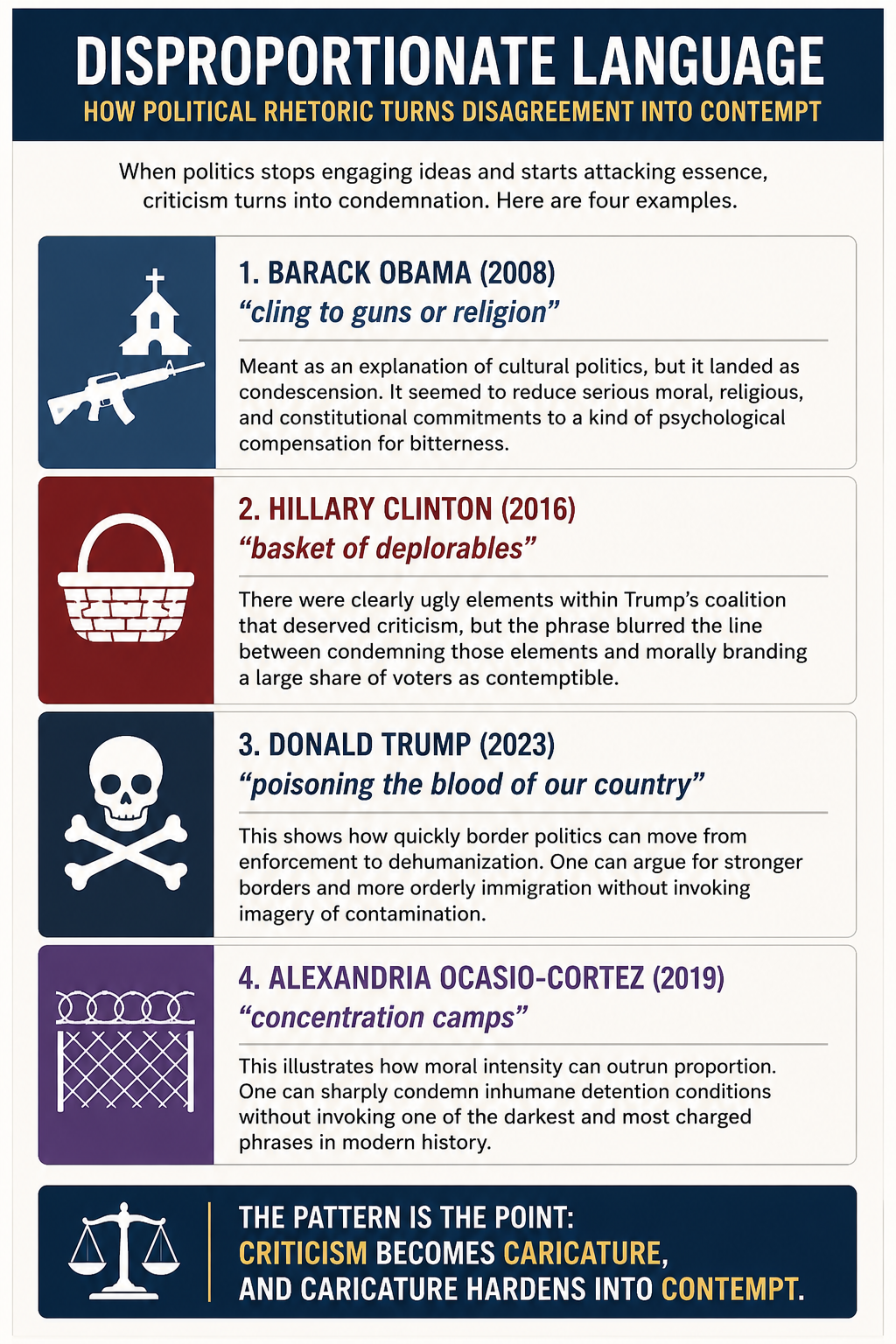
These examples are not identical, nor are they the only ones. They are representative of a larger pattern in modern political life: disagreement is compressed into moral caricature, and political rivals are recast as threats rather than fellow citizens. That pattern matters even more when it comes from elected officials and other public figures, because their language does not merely reflect polarization—it can legitimize it, amplify it, and teach citizens how to speak and think about one another. A democracy can survive disagreement. It has a much harder time surviving a culture in which disagreement is habitually translated into contempt.
Sources: Obama “cling to guns or religion” (reuters.com) · Clinton “basket of deplorables” (reuters.com) · Trump “poisoning the blood” (reuters.com) · Ocasio-Cortez “concentration camps” (pbs.org).
The Trend Is Measurable
This problem is not merely anecdotal. It shows up in hard numbers. As noted earlier, the share of partisans with very unfavorable views of the other party has climbed sharply over the last three decades, and majorities in both parties now describe the opposing side as more immoral and more dishonest than other Americans. (2-4)
The emotional toll is visible as well. Pew found in 2023 that 65% of Americans say thinking about politics makes them feel exhausted, while 55% say it makes them feel angry. About eight in ten Americans described politics using a negative word or phrase. (4) There is also a behavioral dimension. One widely cited Science study found that Thanksgiving dinners involving residents from opposing-party precincts were 30 to 50 minutes shorter than same-party dinners after the 2016 election. That finding is not a complete theory of democratic decline, but it is a vivid sign that partisan hostility is confined to television or the internet. It enters the home. (5)
Campos and Federico add an important methodological caution. They argue that older “warmth bias” measures may miss important psychological distinctions and that affective polarization is better measured as a more complex mix of othering, aversion, and moralization. That does not negate the broader trend. It makes the study of the trend more serious. (1)
Less Time Together, More Room for Distortion
At the same time, politics has become more moralized, and Americans appear to be spending less time together in ordinary social life. According to the U.S. Bureau of Labor Statistics, Americans spent 35 minutes a day socializing and communicating in 2024, down from 43 minutes in 2014. The share of people who engaged in any socializing and communicating on a given day also fell from 38% to 30%. (6) The change appears especially striking among younger Americans. Using the same federal time-use data, Our World in Data reported that Americans ages 15 to 29 spent about 45% more time alone in 2023 than in 2010. (7)
That does not prove that reduced face-to-face contact causes affective polarization. But it does support a plausible hypothesis: a country that spends less time together may also become less capable at being together. Fewer ordinary encounters should suggest fewer opportunities to build the habits that facilitate healthy disagreement—patience, nuance, conversational restraint, and the ability to see another person as more than a political label. (5-7)
The Internet May Matter More Indirectly Than Directly
The internet is an obvious suspect in this story, but the evidence warrants caution. A well-known PNAS paper found that polarization increased the most among demographic groups least likely to use the internet and social media. That finding undercuts the simplest claim that more internet use directly causes more polarization. (9)
But that does not let digital life off the hook. It points instead toward a subtler mechanism: the internet may operate as an amplifier more than a simple cause. Online systems reward outrage, speed, identity conflict, and moral accusation. A relatively small number of highly active users can shape the broader information climate, which then influences others who absorb their information through headlines, snippets, commentary, and secondhand political talk.
That interpretation fits later work showing that online political discussions are generally perceived as more hostile than offline ones. The point is not that the internet magically turns ordinary people into monsters. It is that hostile people and hostile behavior become more visible there, and that visibility changes the emotional tenor of politics for everyone else. (10)
The Media Do Not Just Report Polarization. They Often Intensify It
The media deserve direct scrutiny here. The problem is not simply that some outlets get facts wrong. It is that the broader media economy often rewards misproportion—emotionally activating framing, moral urgency, and dramatic contrast over patient clarification.
There is now strong evidence that negativity is structurally rewarded. A 2023 Nature Human Behaviour study that analyzed roughly 105,000 headline experiments found that each additional negative word in a headline increased click-through rates by about 2.3%, while positive words reduced clicks. (11) Audience behavior fits this pattern. The Reuters Institute’s 2024 Digital News Report documented continued news avoidance and described a public increasingly put off by news that feels repetitive, depressing, or emotionally draining. (12)
The press undermines its best role when it teaches citizens not merely what happened, but how angry to be. Serious reporting still exists, and it remains indispensable. But an ecosystem built around urgency, conflict, and dark framing can erode trust even in institutions that still do important reporting.
How Public Language Teaches Citizens to Think
We are not in a civil war in the literal military sense. But we may be living through a kind of cold civic war, in which rhetoric, media, and digital networks are increasingly used as weapons against fellow citizens rather than as tools of persuasion and self-government. The struggle is not over territory but rather over legitimacy, moral status, and cultural control. In that environment, the pen, the post, the headline, and the viral clip can all become instruments of humiliation, caricature, and delegitimization. Politics begins to feel less like an argument within a shared country and more like combat inside a fraying one.
Citizens learn not only from facts, but from tone. When leaders and media figures describe opponents as deplorable, fascist, lawless, poisonous, or traitorous, they are not merely expressing passion. They are teaching us to think in moral extremes. A democracy cannot remain healthy if disagreement is constantly framed as contamination, civic emergency, or menace.
This is one reason the language of “saving democracy” can be so deceptive. One of the saddest ironies of modern politics is that many people who sincerely believe they are protecting democracy may be weakening it in the process. Once opponents are treated as existential threats rather than citizens, exaggeration begins to feel righteous, restraint begins to break down, and losing through normal election results becomes intolerable.
Why Face-to-Face Life Still Matters
If digital experiences amplify caricature, face-to-face encounters can sometimes soften it. That does not mean in-person encounters are automatically wise or that online experiences are automatically corrupt. It means that human beings are usually harder to caricature in person than on a computer screen. The neighbor, coworker, church member, cousin, or golf partner does not fit neatly into the moral cartoons supplied by political media.
McMurtrie and colleagues found that higher levels of affective polarization were cross-sectionally associated with lower social support, greater stress, and worse self-rated health, but their six-wave longitudinal study did not find clear evidence that changes in affective polarization caused changes in those outcomes over time. They also found some evidence that stress may increase affective polarization, not just the other way around. (13) That nuance strengthens rather than weakens the argument. We can say that the relationship between polarization and well-being appears real, but we should avoid claiming a causal relationship, as the evidence does not clearly support it.
Remote Work and the Social Drift Problem
Remote work is probably partly to blame for some Americans, though not the whole story. In 2024, 32.5% of employed people did some work at home on days worked, and among workers with a bachelor’s degree or higher, about 50% did so. (6) Remote work has obvious benefits: flexibility, autonomy, less commuting, and often better control over one’s time. But it may also remove one of the last routine settings for casual, low-stakes, face-to-face interaction.
Gallup reported in 2024 that fully remote workers were more likely than fully on-site workers to report loneliness, with hybrid workers in between. (14) The problem is not remote work itself. The problem is what happens if those lost interactions are not replaced elsewhere. A society can become both more technologically connected and less socially connected.
Avoidance Is Understandable, but Not Enough
In many families and friend groups, politics is now simply avoided. Some people want to avoid conflict. Others feel too poorly prepared to debate. Some worry that one bad exchange will spoil an entire gathering. But complete avoidance is not a durable civic solution. If reasonable people retreat from political discussion altogether, the field is left to the loudest and least restrained voices.
The better answer is not more argument for its own sake. It is a better discussion: narrower questions, lower stakes, more curiosity, less performance, and more willingness to say, “I may be wrong,” “I haven’t looked at that carefully,” or “let’s check that.” A fruitful political conversation does not require encyclopedic knowledge. It requires enough honesty and humility to distinguish what one knows, what one suspects, and what one still needs to learn.
How to Make Politics Discussable Again
A healthier civic culture likely requires two things at once: more human contact and better information habits. Face-to-face life matters because it humanizes. Better information habits matter because family talk, friend talk, and online talk can all become echo chambers.
That means several practical disciplines: narrowing political questions instead of totalizing them; stating opponents’ views in their strongest form before criticizing them; permitting uncertainty; resisting emotional escalation; and spending less time passively absorbing outrage and more time reading directly from higher-quality sources.
In practical terms, it means finding signal over noise. That phrase is more than branding here. It is the real civic task.
What Proportion Sounds Like
A healthy society is not one in which everyone thinks alike. It is one in which people can think differently without learning to despise one another. As the often-quoted line commonly attributed to George Patton characterizes it, “If everybody is thinking alike, then somebody isn’t thinking.” The point is sound even if the attribution is fuzzy: real disagreement is not a defect in democratic life. It is part of how free citizens test assumptions, challenge excesses, and correct errors. The task is not to eliminate differences, but to keep differences from collapsing into contempt.
A healthier public culture would still allow forceful criticism, but it would sound different. Instead of saying that immigrants are “poisoning the blood of our country,” a serious critic of illegal immigration could argue that unlawful entry strains public resources, weakens the rule of law, and requires firmer enforcement. Instead of calling millions of voters “deplorable,” a serious critic could say that some ugly or extremist tendencies have attached themselves to a coalition without condemning all supporters wholesale. Instead of calling a political movement “fascist,” a defender of democratic norms could say that certain rhetoric and conduct show a troubling disregard for constitutional restraint and electoral legitimacy.
Proportion does not require weakness. It requires disciplined rhetoric and avoids stereotypes.
When Defeat Feels Like Exile
One sign of a troubled political culture is that some citizens now experience ordinary election defeat as something close to exile. Every election matters, and some outcomes carry real consequences. But losing an election is not the same thing as losing a country. A self-governing people must retain the ability to lose, regroup, argue again, and continue living together. If every defeat is experienced as proof that the nation is no longer livable, then democratic citizenship has weakened.
A related problem is that some people become so hardened in their political identities that contrary evidence no longer feels persuasive, only threatening. At that point, politics is no longer just a set of beliefs. It has become an identity, a habit, and an emotional reward. That makes the argument much harder. You cannot always reason people out of a position that is serving deep psychological and social needs.
That does not mean the effort is pointless. It means the goal must become more modest. Instead of trying to win every argument, one tries to lower the temperature, separate one claim from the whole worldview, ask what evidence would actually matter, and remind people of the shared life that still exists outside politics. Some people will not be reachable in the moment. But a healthy civic culture still depends on enough citizens refusing to treat democratic loss as personal exile and political disagreement as a form of moral annihilation.
The Saddest Irony
One of the saddest ironies of modern politics is that many of the people most convinced they are saving democracy may be undermining it in the process. When opponents are treated as existential threats, exaggeration begins to feel justified, restraint begins to erode, and democratic norms become easier to bend in the name of a “higher cause”.
One of the clearest warning signs is dehumanizing language. Once political opponents are described as poison, vermin, traitors, fascists, or monsters, civic decency collapses. We are no longer arguing with fellow citizens; we are preparing ourselves to see them as less deserving of sympathy, fairness, or restraint. That is a dangerous moral threshold to cross. Whatever our political differences, we remain human beings with far more in common than partisan rhetoric often allows.
Democracy is not protected when every disagreement is recast as a battle against evil. It is protected when citizens retain enough proportion to oppose one another without denying one another’s legitimacy.
A Final Thought
We do not need less passion in American politics. We need less contempt.
Too many Americans now encounter politics mainly as noise: algorithmic, emotional, repetitive, negative, and moralized. At the same time, many lack the everyday face-to-face experiences that help restore perspective, restraint, and proportion. That combination is dangerous—not because disagreement itself is dangerous, but because democracy depends on citizens who can disagree without deciding that the other side is morally beyond the pale.
A healthy country does not require us to think alike. It requires us to act like decent human beings toward one another, to tolerate friction without panic, and to develop enough civic maturity to live with real differences. The goal is not unanimity. It is enough restraint, humility, and shared humanity to keep disagreement from hardening into contempt.
There are moments when public life feels so exaggerated that one wants to call people back to reality. We are still families, neighbors, coworkers, and fellow citizens. We may not think alike, and we should not have to. But we live better, govern better, and endure better when we remember that shared life depends more on cooperation and restraint than on constant political escalation.
Politics should matter. It should not erode the ties of family, friendship, and common life.
References
Campos N, Federico C. A New Measure of Affective Polarization. American Political Science Review. 2025.
Pew Research Center. Republicans and Democrats increasingly critical of people in the opposing party. 2022.
Pew Research Center. As partisan hostility grows, signs of frustration with the two-party system. 2022.
Pew Research Center. Americans’ dismal views of the nation’s politics. 2023.
Chen MK, Rohla R. The effect of partisanship and political advertising on close family ties. Science. 2018.
U.S. Bureau of Labor Statistics. American Time Use Survey—2024 results. 2025.
Our World in Data. Young Americans spend much more time alone than they did fifteen years ago. 2025.
Iyengar S, Sood G, Lelkes Y. Affect, not ideology: A social identity perspective on polarization. Public Opin Q. 2012.
Boxell L, Gentzkow M, Shapiro JM. Greater internet use is not associated with faster growth in political polarization among U.S. demographic groups. PNAS. 2017.
Bor A, Petersen MB, et al. The psychology of online political hostility. American Political Science Review. 2022.
Robertson CE, et al. Negativity drives online news consumption. Nature Human Behaviour. 2023.
Reuters Institute for the Study of Journalism. Digital News Report 2024.
McMurtrie B, Roemer A, Philipp M, Hebden R, Williams M. Political Polarization and Wellbeing: Investigating Potential Intrapersonal Harm From Affective Polarization. International Review of Social Psychology. 2025.
Gallup. 1 in 5 employees worldwide feel lonely. 2024.
Looking Ahead
Affective polarization makes it harder to listen to people clearly. Polling creates a different but related challenge: it often claims to tell us what people think, yet the way polls are conducted, reported, and interpreted can add another layer of political noise.
Next week, I’ll look at polling itself — why polls fail, why they still matter, and how citizens can use public opinion data without being managed by it.
