
Why Polls Fail – and Why We Still Need Them
When Donald Trump won the presidency in 2016, my first reaction was incredulity.
Either the polling was incompetent, or we had been misled.
That may sound blunt, but I suspect many citizens felt something similar. For months, the public had absorbed a broad message: Hillary Clinton was likely to win. Polls, forecasts, pundit panels, headlines, and expert commentary all seemed to point in the same direction. Then Election Night happened.
The technical explanation was more complicated. The national polls were not wildly wrong about the popular vote. Clinton did win the national popular vote. The larger failures were concentrated in state polling, Electoral College interpretation, turnout assumptions, forecasting, and media narrative (which is a lot). On Election Night, ordinary citizens did not experience a careful distinction between national polling, state polling, likely-voter screens, turnout models, and probabilistic forecasting. They experienced a dramatic mismatch between what they thought had been forecast gold and what voters actually did. Pew Research Center made a similar distinction after the election, noting that national polling told only part of the story and that errors in state-level polling helped distort expectations in the Electoral College. (1)
Since then, I have been deeply skeptical of polling. Part of that skepticism is personal. I almost never answer calls from unknown numbers, and I certainly do not stop my day to talk to a pollster. That does not make me politically disengaged. I vote. I read. I think carefully about public issues. But from the standpoint of traditional polling, I am largely invisible unless a pollster reaches me some other way and I choose to participate.
That is the modern polling problem in human form. Pollsters are not only trying to construct a representative sample. They are trying to persuade real people to participate in a process many now avoid or distrust. The people most skeptical of polling are precisely the people polling has the hardest time analyzing.
Polls Are Not Worthless (Entirely)
Good polling can provide useful information. They can help citizens see beyond their own circle. They can show broad public concerns. They can reveal whether people are more worried about inflation, immigration, crime, climate, health care, foreign policy, or democratic stability. They can test sweeping claims from politicians who insist that “the American people” overwhelmingly support whatever position they already hold.
Without polls, we would not get more truth. We would likely get more anecdotes, more rallies, more cable panels, more social media noise, and more self-serving claims from people with power, money, or a microphone.
The serious question is whether they help average citizens think more clearly.
Often, I am not sure they do.
Polls are far more valuable to campaigns, donors, consultants, journalists, advocacy groups, and political parties than they are to ordinary voters. Campaigns use them to allocate money, test messages, decide where candidates travel, and judge whether an issue is moving voters. Journalists use them to create daily political weather reports. Donors use them to decide where financial donations might make a difference. Activists use them to generate momentum or alarm.
A citizen does not need a poll to decide whether inflation is affecting his/her family, whether he/she trusts a candidate, whether border policy concerns them, whether a war seems justified, or whether a proposed law seems wise. Those judgments come from experience, evidence, values, consequences, and leadership.
For the ordinary citizen, the value of polling is more modest. Polls are useful when they broaden perspective, reveal a real trend, challenge a false claim, or show that the country is more divided than our own social circle suggests.
A Word About My Own Use of Polling
I should be clear about one thing. I have used polling data in prior essays, and I expect I will use it again.
That is not because I think polls are perfect. It is because, for many questions of public opinion, polling is often the best imperfect evidence we have.
If we want to know whether Americans are worried about health care costs, how they view the Affordable Care Act, whether they trust institutions, or what issues they consider most urgent, personal anecdotes are not enough. Social media is not enough. Cable panels are not enough. We need some structured way to generate public data.
This is why I have relied at times on organizations such as Pew Research Center, KFF, Gallup, AP-NORC, and other established survey groups. Their work is not beyond criticism, but it is usually more useful than guesswork. Pew describes its American Trends Panel as a probability-based panel of randomly selected U.S. adults. KFF describes itself as an independent source for health policy research, polling, and journalism. NORC’s AmeriSpeak panel is designed as a probability-based panel representative of the U.S. population, and Gallup describes its panel as representative of U.S. adults. (2-5)
When used carefully, polling can help describe the public mood. It can show that health care affordability is not just an abstract budget issue, but a lived public concern. It can show that citizens may support a policy goal while remaining divided over the means. It can reveal public confusion, frustration, fear, or consensus that might otherwise be hidden behind partisan slogans.
But polling should be used modestly. A poll can tell us what a group of respondents said under the conditions of a particular survey. It cannot prove that the public is correct. It cannot settle a policy debate. It cannot replace fiscal analysis, constitutional judgment, historical context, clinical evidence, moral reasoning, or practical experience.
So this essay is not a rejection of polling. It is a clarification of how I believe polling should be used: as another layer of evidence, not authority; as context, not prophecy; as signal, not noise.
If I cite polling in a future essay, it should be because the poll helps illuminate a real question of public opinion — not because it conveniently supports a preferred narrative.
The Old Warning: “Dewey Defeats Truman”
The most famous polling failure in American history remains the 1948 presidential election.
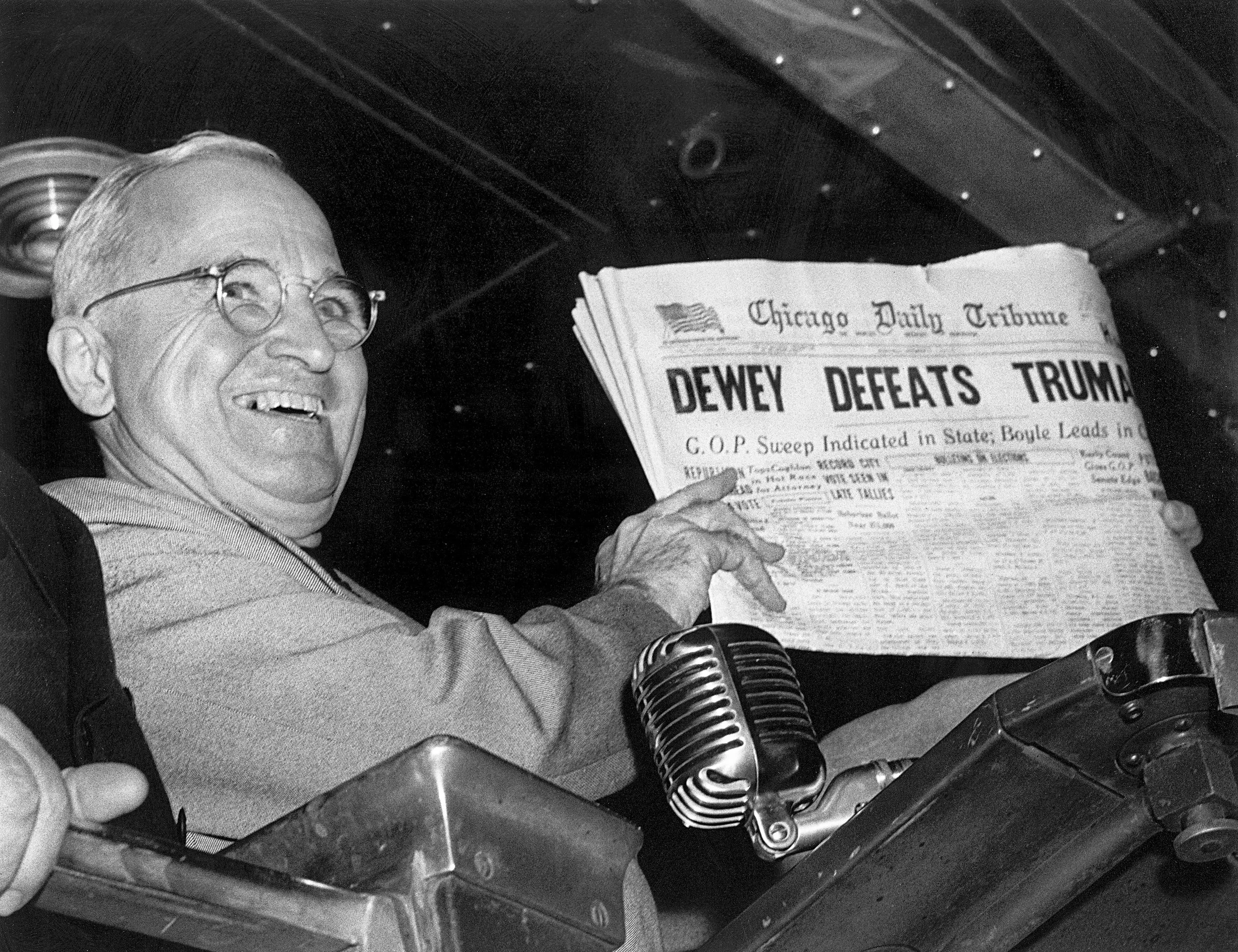
Harry S. Truman holding the Chicago Daily Tribune with the erroneous headline, "Dewey Defeats Truman", at Union Station in St. Louis, Missouri, on November 4, 1948, after winning the 1948 United States presidential election. He was so widely expected to lose that the Tribune printed the erroneous headline, boldly anticipating victory for his opponent, Thomas E. Dewey.
Thomas Dewey was widely expected to defeat Harry Truman. The expectation was so strong that the Chicago Daily Tribune printed its now-famous headline: “Dewey Defeats Truman.” Truman won instead, and the photograph of the victorious president holding up the mistaken newspaper became one of the great images in American political history. The Roper Center has described the 1948 failure as serious enough that the Social Science Research Council formed a committee to evaluate the errors and manage the backlash against polling. (6)
The photograph is funny. It is also instructive.
The details of 1948 were different from today. Polling methods were less sophisticated, several pollsters stopped polling too early, and the media environment moved far more slowly. But the larger lesson remains current: the danger is not merely that polls can be wrong. The danger is that provisional measurements can be converted into settled expectations.
Polling Has Always Had a Reach Problem
The history of polling is really a history of reachability.
Early American polling was informal and unscientific. Newspapers and magazines conducted straw polls. Readers sent in ballots or postcards. These polls could generate huge numbers, but they did not necessarily represent the electorate.
Perhaps the earliest example of failed polling came in 1936, when The Literary Digest predicted that Alf Landon would defeat Franklin Roosevelt. The magazine received millions of responses. The problem was not sample size. The problem was sample bias. Its lists overrepresented people with telephones, automobiles, and magazine subscriptions during the Great Depression — a more affluent and more Republican-leaning group than the electorate as a whole. Roosevelt won in a landslide. (7)
That failure helped launch the modern era of scientific polling. George Gallup and others argued that a smaller but more carefully constructed sample could outperform a massive but biased one.
Then came decades of face-to-face interviews, landline telephone polling, random-digit dialing, cell phone polling, online panels, voter files, text-to-web surveys, address-based sampling, and various mixed methods.
An important question was, are we hearing the public, or only the portion of the public willing and able to answer?
That is why a large poll is not automatically a good poll. A large sample can make a bad poll look more precise. It cannot make a biased poll representative.
The 2016 Failure
For many Americans, 2016 permanently changed how they hear the word “poll.”
The common perception is that the polls were wrong, and that is clearly true, but incomplete. Nationally, the final polls were closer than public memory suggests because Clinton did win the popular vote. The bigger failure was in the state polling that mattered most for the Electoral College, especially in the industrial Midwest. The even larger failure was the conversion of a probabilistic advantage into a public narrative of inevitability. Pew noted that forecasters relying heavily on polls gave Clinton a wide range of victory probabilities, while many state-level expectations proved wrong. (1) That distinction matters, but it does not absolve the broader political-media system.
The average citizen was not studying polling data every morning. He or she was absorbing a public atmosphere. Clinton was favored. Trump was behind. The experts had spoken. Then the voters spoke differently.
In that moment, the citizen’s reaction was understandable: either the people who reported polling data did not understand the country, or the people explaining the measurements overstated what they knew. And once citizens conclude that polling is either incompetent or manipulative, every future poll arrives with heavy suspicion. Even good polling has to climb out of a hole dug by past errors.
Are Some Voters Harder to Poll?
There is a common conservative complaint that polls undercount Republican voters. In recent presidential elections, that complaint has had more merit than many commentators initially acknowledged.
The more precise point is not that conservatives are always under-polled. It is that certain voters — including some Republican-leaning, rural, non-college, populist, or low-institution-trust voters — may be harder for pollsters to reach, persuade, model, and weight correctly.
That does not necessarily mean they are lying to pollsters. The “shy Trump voter” explanation is probably too simple. The harder problem may be that some voters never enter the survey in the first place.
This matters because polling can correct only for what it can see. If a pollster has too few voters from a particular group, weighting can help — but only up to a point. Demographic weighting may adjust for age, sex, race, education, and geography. It may not fully account for distrust, alienation, willingness to respond to surveys, or unexpected turnout.
AAPOR’s 2024 pre-election polling report found that public polls were more accurate than in 2016 or 2020, but still underestimated Republican vote share relative to Democratic vote share for the third straight presidential cycle. (8) Modern polling can still measure public opinion, but some parts of the electorate are easier to hear than others.
The Problem Is Not Just Who Answers
Modern polling skepticism often focuses on who answers the phone. That matters. I almost never do. Many others do not either. But the problem goes deeper than response rates. The question itself can shape the answer.
Consider foreign policy. One poll might ask: “Do you support bombing Iran?” Another might ask: “Do you support preventing Iran from obtaining a nuclear weapon?” Those are not the same question. The first emphasizes a violent act. The second emphasizes a desirable strategic goal. Many citizens might support the goal while opposing the method. Others might support military action only after diplomacy, sanctions, inspections, congressional authorization, or evidence of imminent threat.
A fair poll would separate those issues. Do you believe Iran is trying to obtain a nuclear weapon? Would that pose a serious threat? Do you support diplomacy? Sanctions? Cyber operations? Targeted strikes? Broader war? Congressional authorization? What costs or risks would change your view?
Only then do we begin to know what the public actually thinks.
AAPOR’s best-practices guidance emphasizes disclosure of core survey details, including sample size, margin of sampling error, weighting, full question wording, survey mode, population under study, and how the sample was constructed. (9) A poll can be accurate for the question asked and still misleading for the conclusion drawn from it. The public usually sees the headline, not the full wording. That is why polling questions are not a technical footnote. It is, in essence, the poll before the poll.
Polling Averages Help — But Only So Much
Polling averages, such as RealClearPolitics, can be useful because they reduce the temptation to cherry-pick a single poll. One poll may be an outlier. A polling average gives a rough center of gravity. But an average is not a cure for polling error. If several pollsters share the same blind spot, the average simply averages the blind spot. If the underlying polls miss certain voters, misjudge turnout, use loaded questions, or rely on weak methods, the average may appear stable even when it is wrong.
The decimal points can also create false precision. A candidate leading by 0.7 points on average does not mean that they are meaningfully “ahead.” The race is functionally tied. A two-point advantage may be real, or it may disappear in light of typical polling error ranges.
Polls as Evidence — or Manipulation?
If a poll confirms what I already suspect, I am more likely to treat it as evidence. If it contradicts my instincts, I become skeptical. Who paid for this? Who did they call? How was the question worded? Were they trying to shape the story?
That reaction is entirely rational. Polls can be sponsored, framed, selectively released, or amplified strategically. But it also reveals how polls can generate and amplify a low-trust political culture.
Polls are no longer received as neutral measurements by many citizens. They are messages. And like all political messages, they are filtered through experience, identity, prior belief, and distrust.
That means polls may not directly change many minds. They may instead change the atmosphere in which minds operate. They shape headlines, fundraising, candidate coverage, donor confidence, turnout expectations, and the public sense of momentum. In that sense, polls do not merely report political reality. They become part of it.
They can create a bandwagon effect. They can create an underdog effect. They can make one side complacent and the other side angry. They can influence strategic voting. In 2016, for example, if a voter believed Clinton was likely to win, he or she might reasonably vote Republican down ballot to preserve some balance in Congress. That is not irrational. It is an attempt to anticipate power and create restraint.
But it also shows how polling can shape behavior before the vote is cast.
Which Polls Deserve More Weight?
The informed citizen should not ask, “Which poll do I trust?” The better question is: “What claim can this poll reasonably support?”
A poll may be sufficient to show a broad trend, but not sufficient to declare a winner. It may reveal public concern but not policy sophistication. It may measure the answer to a badly worded question. It may be useful as one data point, but misleading as a headline.
Some polls deserve more weight than others. A transparent poll from a known university, nonprofit research center, or established polling organization deserves more attention than a mystery poll with a hidden sponsor and no methodology. A poll that releases exact question wording deserves more attention than one summarized only by a headline. A poll of likely voters shortly before an election deserves different treatment than a poll of adults months before voting begins.
National issue polls and election polls should also be analyzed differently. A poll asking whether Americans are worried about health care costs is not trying to predict who will vote on a specific Tuesday. A presidential poll is. That extra step — predicting the electorate — makes election polling especially vulnerable to assumptions about turnout and modeling errors.
Even reputable polls should be demoted from the status our political culture often gives them. A poll from a distrusted institution can still be methodologically strong. A poll from a politically friendly source can still be junk. The disciplined citizen does not trust the brand first. They examine the poll first.
A Citizen’s Polling Filter
If a poll helps me see beyond my own circle, understand a broad public concern, or challenge a sweeping claim from a politician or commentator, it may be useful. If it simply tells me that Candidate A is up 1.2 points this week, it is probably noise. If it converts a close race into a confident narrative, it is worse than noise. It is a distortion.
Polls should not be accepted or dismissed by instinct alone. This filter gives citizens a practical way to judge whether a poll deserves attention: examine the source, sample, wording, context, and uncertainty before absorbing the headline. The goal is disciplined skepticism.
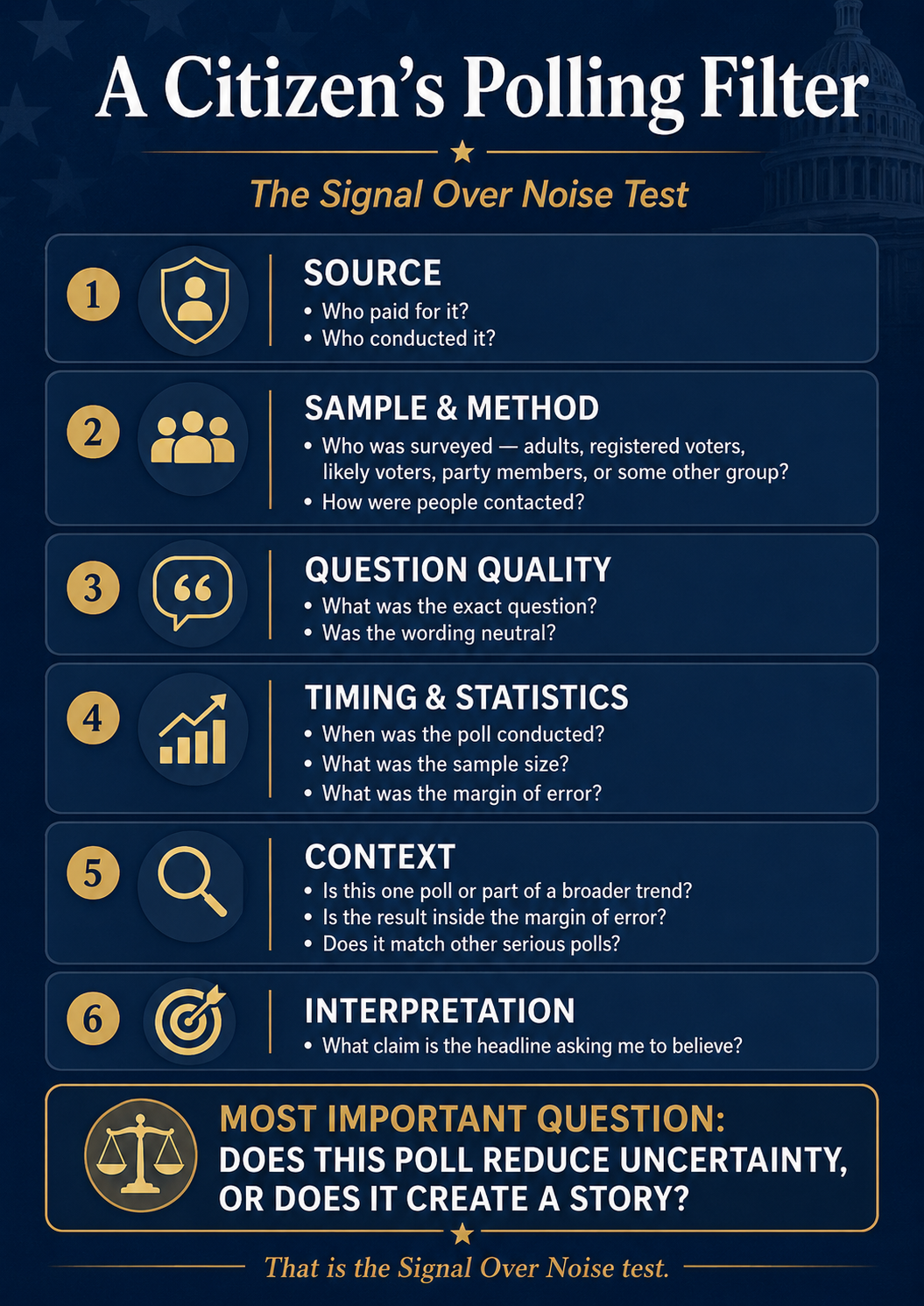
Not every poll deserves equal weight. However, before accepting a headline or dismissing it outright, citizens should examine who paid for the poll, who conducted it, who was surveyed, how respondents were contacted, what question was asked, and whether the result fits a broader trend. A poll should clarify public opinion, not simply manufacture a story. That is the essence of the Signal Over Noise test.
The Real Value for Citizens
So, do polls help citizens think more clearly? Sometimes. But not nearly as often as their prominence suggests.
Polls can provide perspective. They can remind us that our own friends, family, neighborhood, golf group, social media feed, or preferred news source may not reflect the country at large. They can reveal that public opinion is more complex than partisan slogans suggest. They can show that a policy goal is popular while the means are not. They can expose false claims about what “everyone” believes.
Unfortunately, polling coverage often does the opposite. It turns uncertainty into drama, small movements into narratives, and imperfect measurements into political weather reports. It encourages citizens to watch democracy like a scoreboard rather than understand it as a civic responsibility.
For the average citizen, the answer is not to ignore every poll. It is to lower their status.
A poll is not a command.
It is not a prediction.
It is not a moral verdict.
It is not a substitute for judgment.
It is one piece of evidence — sometimes useful, often noisy, and always worth interrogating.
Polling is often the best imperfect evidence we have for public opinion. But imperfect evidence is still imperfect. It should inform judgment, not replace it.
The point is not to trust polls or dismiss polls. The point is to refuse to be managed by them.
References
Mercer A, Deane C, McGeeney K. Why 2016 election polls missed their mark. Pew Research Center. November 9, 2016.
Pew Research Center. The American Trends Panel. Pew Research Center.
KFF. Health Tracking Poll. KFF.
NORC at the University of Chicago. About AmeriSpeak. NORC.
Gallup. How Does the Gallup Panel Work? Gallup.
Roper Center for Public Opinion Research. Dewey Defeats Truman: 75th Anniversary. Cornell University. November 3, 2023.
Squire P. President Landon and the 1936 Literary Digest Poll. Social Science History. Cambridge University Press.
American Association for Public Opinion Research. Task Force on 2024 Pre-Election Polling. AAPOR. 2025.
American Association for Public Opinion Research. Best Practices for Survey Research. AAPOR.
American Association for Public Opinion Research. Margin of Sampling Error/Credibility Interval. AAPOR.
