
The Electoral College and the Federal Bargain
Why This Still Feels So Confusing
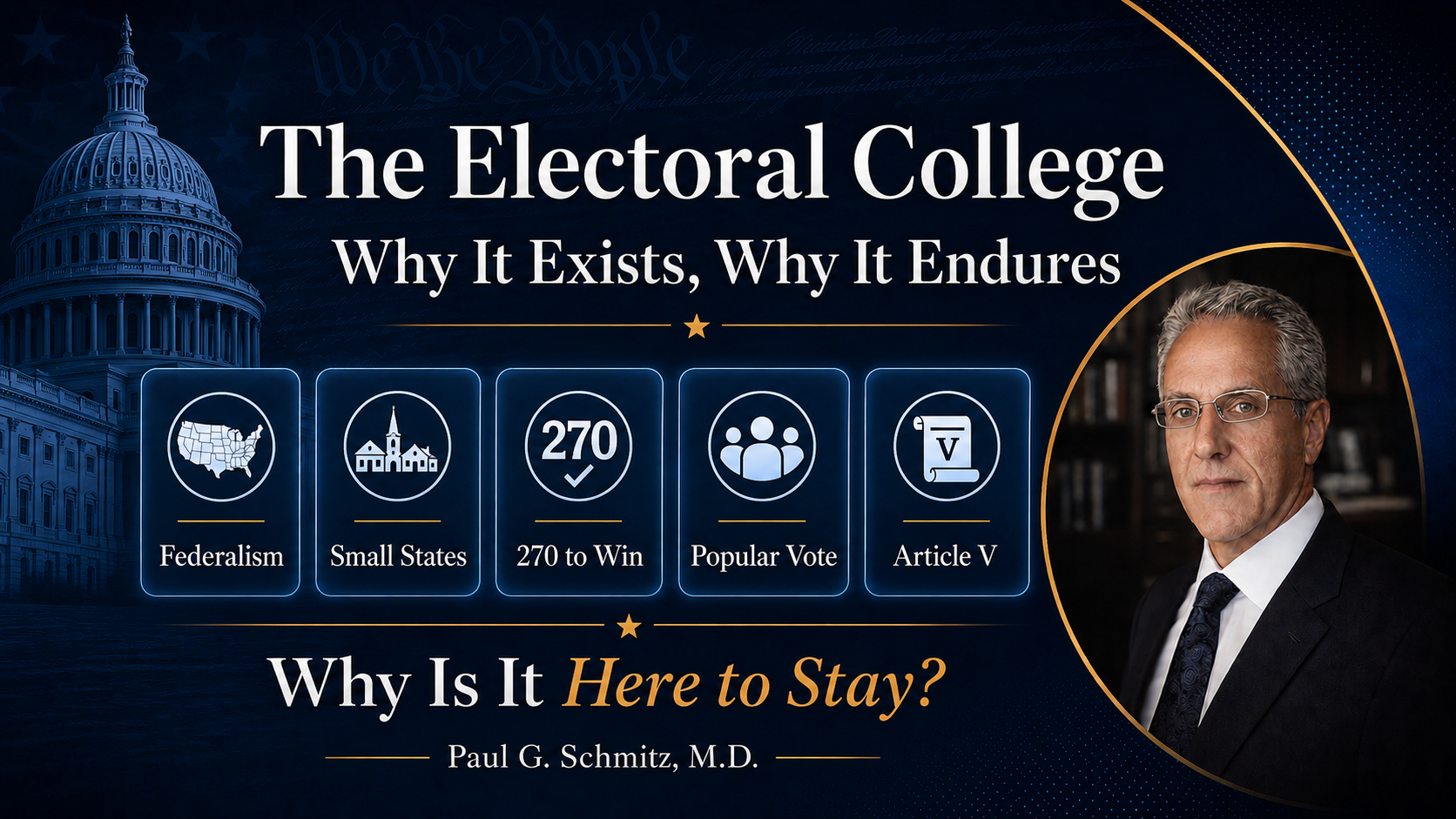
For many Americans, the Electoral College feels like an artifact from another age. People often say they do not really understand it, cannot see why it still exists, and find it hard to accept that a presidential candidate can win the White House without winning the national popular vote. Those reactions are understandable. The Electoral College is not intuitive, and in a modern democracy it can seem like a strange and indirect way to choose a president. Yet it did not survive by accident. It survives because it reflects a deeper constitutional bargain that has never fully disappeared. (1,6,7)
How It Actually Works
The Electoral College is the system used to choose the president. There are 538 electoral votes in all, and a candidate needs 270 to win. Each state receives electoral votes equal to its total representation in Congress: its House members plus two senators. In most states, the candidate who wins the statewide popular vote receives all of that state’s electoral votes. Maine and Nebraska are the exceptions, using a district-based method that can split electoral votes. In other words, Americans do not vote directly for the president in one national tally; they vote within states, and those state results determine the electoral outcome. (6,7)
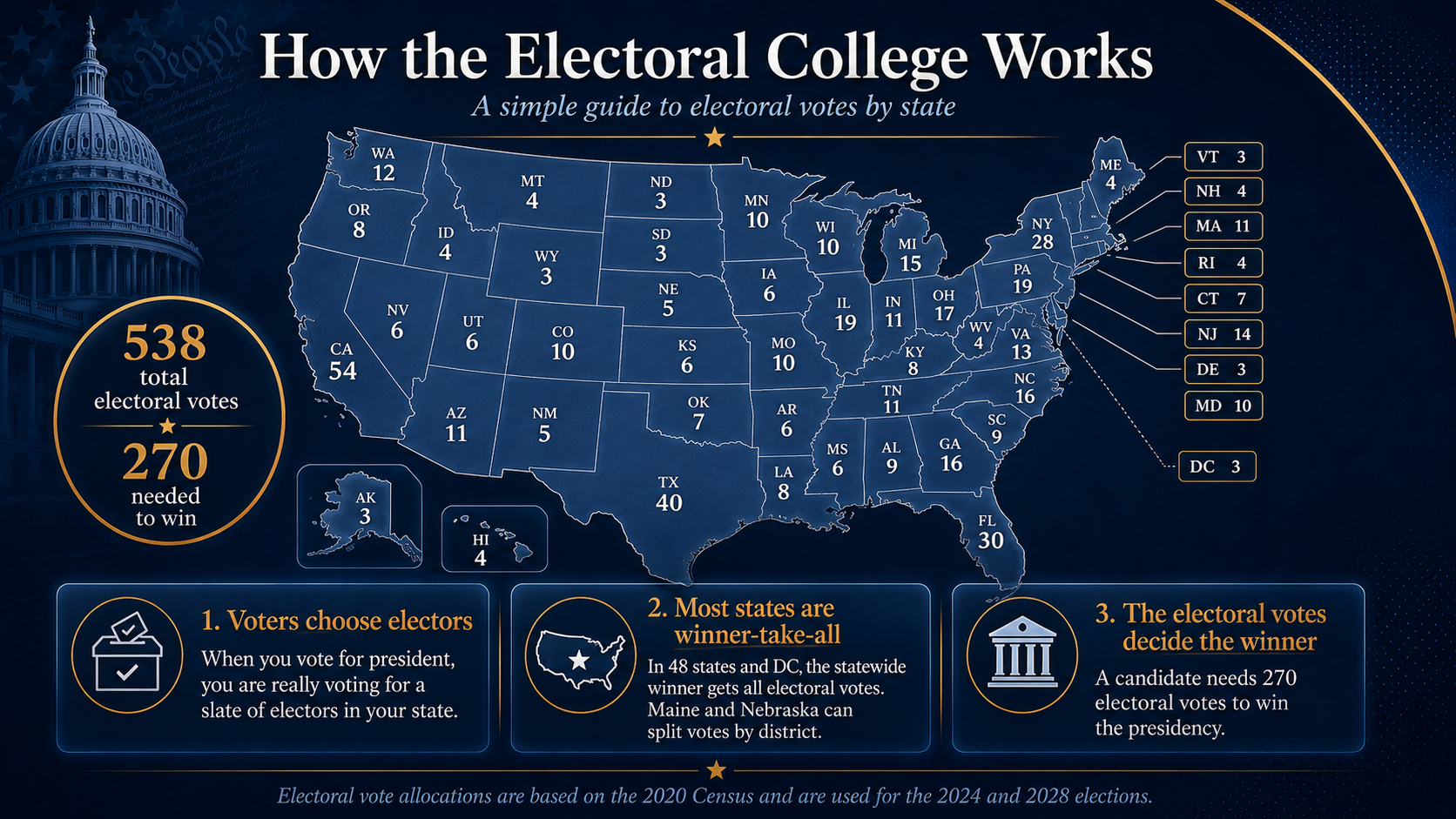
Electoral votes are allocated by state based on each state’s total representation in Congress—its House members plus two senators—with the District of Columbia receiving three electors. The map shows the current allocation based on the 2020 Census, which applies to the 2024 and 2028 presidential elections. There are 538 total electoral votes, and a candidate needs 270 to win. In most states, the statewide winner receives all electoral votes, while Maine and Nebraska may split votes by congressional district.
The States Entered the Union Guarding Their Independence
To understand why this system exists, one must begin with the political world in which the Constitution was written. After independence, the states did not regard themselves as mere administrative subdivisions of one consolidated nation. Under the Articles of Confederation, each state retained its “sovereignty, freedom and independence,” and the union itself was described as a “league of friendship.” The Constitution was therefore not written for provinces already accustomed to subordination. It was proposed to political communities that still thought of themselves as possessing a meaningful share of sovereignty and that were wary of surrendering too much of it to a distant central authority. (2,3)
Why the Electoral College Exists
The standard explanation is that the framers created the Electoral College as a compromise between election of the president by Congress and direct election by the people. That is correct as far as it goes. But the deeper issue was federalism. A purely national vote would have pushed the new republic toward a more consolidated order, one in which the states mattered less as constitutional actors. The Electoral College preserved a role for them in choosing the executive, just as the broader Constitution preserved a role for them throughout the new federal system. The institution was part of the architecture of union, not merely a procedural curiosity. (1,3)
The Small-State Fear Was Not Symbolic
Nowhere was that concern more intense than among the smaller states. For them, the issue was not etiquette or wounded pride. It was political survival inside the new union. If national institutions were based strictly on population, large states such as Virginia and Pennsylvania could dominate, while smaller states such as Delaware and New Jersey would become permanently diminished partners. The Senate’s own constitutional history clearly preserves the logic. William Paterson argued that a confederacy “supposes sovereignty in the members composing it & sovereignty supposes equality,” and Roger Sherman made the stakes unmistakable: “Everything depended on this.” The smaller states, he argued, would not agree to the plan without equality of suffrage in at least one chamber. (4)
The Great Compromise Made Union Possible
The Great Compromise answered that fear with real constitutional ingenuity. The House would represent the people by population. The Senate would represent the states as states, each with equal suffrage. That was not a decorative concession. It was the price of union. Article V later underscored how fundamental that principle was by declaring that no state, without its consent, may be deprived of its equal suffrage in the Senate. That is one of the clearest signs in the Constitution that the states were meant to remain constitutional actors, not merely geographic units. (4,5)
How the Electoral College Fits the Same Logic
The Electoral College reflects that same federal instinct. It does not give small states equal power in presidential elections, but it does ensure that the presidency is not awarded solely by one undifferentiated national vote. Because each state’s electoral vote total includes its Senate and House representation, the system blends population and statehood in a single mechanism. In that sense, the Electoral College belongs to the same constitutional family as the bicameral legislature: partly national, partly federal, and deliberately so. (6,7)
What the Electoral College Gets Right
The strongest argument for the Electoral College is that it preserves the federal character of the American republic. Its defenders argue that it requires candidates to build support through the states rather than simply accumulate votes in a single national aggregate. It can also contribute to a sense of political finality. State-by-state allocation may magnify a narrow margin into a clearer electoral result, and disputes can often be contained within particular states rather than becoming a single nationwide recount. Whether one finds those arguments persuasive or not, they are not frivolous. They reflect the constitutional reality that the United States was designed as a federal republic, not a simple national democracy. (1,7,8)
What the Electoral College Gets Wrong
The criticisms, however, are serious. The most obvious is the democratic one: the Electoral College can elect a president who did not win the national popular vote. That has happened in 1824, 1876, 1888, 2000, and 2016. A second problem is that the modern system is shaped not only by the Constitution but by winner-take-all rules adopted by most states. In practice, campaigns spend disproportionate time and money in a small number of battleground states, while voters in safely Republican or safely Democratic states often receive far less attention. There is also the problem of unequal weighting. Because every state receives two electoral votes corresponding to its Senate seats, smaller states receive somewhat greater electoral weight per capita than larger ones, even though in practice, swing-state status often matters more politically than state size alone. The result is a system that reflects federalism, but not simple political equality. (1,6,7)
Why It Is Not Going Anywhere
For all practical purposes, the Electoral College is not going away. Abolishing it outright would require a constitutional amendment under Article V: proposal by two-thirds of both houses of Congress and ratification by three-fourths of the states, or a convention called by two-thirds of the states, with ratification still requiring approval from three-fourths of the states. That is an extraordinarily high bar in any era. It is an even higher bar here because many of the states whose consent would be needed are precisely those least inclined to surrender the leverage the present system gives them. The institution endures not only because it is old, but because the Constitution makes it exceptionally difficult to remove. (5,7)
The National Popular Vote Interstate Compact: A Workaround, Not an Amendment
One reform proposal deserves special attention because many readers have heard of it but do not really understand how it works: the National Popular Vote Interstate Compact. The compact is not a constitutional amendment, and it does not abolish the Electoral College. Instead, it is a formal agreement among participating states to use their existing electoral votes in a coordinated way. Once states totaling 270 electoral votes have joined, each member state agrees to award all of its electoral votes to the candidate who wins the national popular vote, even if that candidate did not win that particular state. In other words, the compact would seek to make the Electoral College follow the national popular vote without actually removing it from the Constitution. That strategy rests on Article II, which gives state legislatures broad authority to decide the manner in which their electors are appointed. (7,10,11)
The idea emerged in the mid-2000s, with the first enactments in 2007, after the 2000 Bush-Gore election renewed public attention to the possibility that the popular-vote winner might lose the presidency. Since then, the movement has grown steadily but unevenly. As of April 2026, the compact had been enacted in 19 jurisdictions, totaling 222 electoral votes, leaving it 48 votes short of the 270 required to take effect. Virginia became the 19th jurisdiction in April 2026. That is enough to make the compact a serious reform effort, but not enough to make it law for presidential elections. (9,10,12)
Supporters present the compact as a fairness measure. Their argument is that the presidency should go to the candidate who receives the most votes nationwide, and that the current Electoral College can frustrate that principle. They also argue that the compact would make every vote count more equally, including votes cast for Republicans in heavily Democratic states and votes cast for Democrats in heavily Republican states. In that sense, the compact is designed to answer one of the most common complaints about the present system: that too much political attention is concentrated in a handful of battleground states. (10,11)
The objections, however, are substantial. The first is practical and political. Under the compact, a state could vote clearly for one candidate and still be required to award its electoral votes to another because the national vote went the other way. For many citizens, that would feel like a direct break between the will of their own state’s voters and the state’s electoral outcome. Whatever the legal theory, many voters would ask a simple question: if our state’s choice does not determine where our state’s electors go, then what exactly are we voting for? That is not a trivial objection. In a federal republic, people are accustomed to thinking that their state's vote should determine their state’s result. The compact weakens that connection. (10,11)
A second objection is that the compact may solve one concentration problem only by creating another. Under the present system, campaigns focus heavily on battleground states. Under a pure national-vote logic, the center of gravity could shift even more heavily toward the largest population centers and media markets. Supporters would respond that every vote should count equally wherever it is cast. Critics would answer that the practical effect might be to increase the political dominance of a relatively small number of very large states and metropolitan regions. Thus, the compact may not end geographic concentration so much as relocate it. (8,10)
A third problem is legitimacy. Even if the compact could be defended legally, it could still prove politically combustible. If a member state voted for one candidate but its electors were awarded to another because of the nationwide tally, many citizens would regard that result as unfair or even illegitimate. The first such case would almost certainly trigger immediate litigation, intense public backlash, and a broader crisis of trust in the election system. That is one reason the compact’s path to 270 is so difficult. It is relatively easy to support the idea in the abstract. It is much harder for elected officials in closely divided or politically sensitive states to support a system that could one day visibly sever the link between their own voters and their state’s electoral votes. (5,9,10)
There is also a constitutional question that has never been definitively resolved. Article II gives states broad authority over the appointment of electors, which is the principal legal foundation for the compact. At the same time, the Constitution’s Compact Clause provides that states may not enter into certain agreements or compacts with one another without the consent of Congress. Whether the National Popular Vote Interstate Compact could take effect without congressional approval remains an open legal question. If the compact ever reached 270 electoral votes and threatened to determine the outcome of a presidential election, it would almost certainly be challenged in court. (5,13)
For all of those reasons, the compact is best understood not as the end of the Electoral College, but as an attempt to repurpose it. Its supporters see it as a clever and lawful route to national popular election without the difficulty of a constitutional amendment. Its critics see it as a politically one-sided and potentially destabilizing workaround that asks states to keep their electoral votes while, at times, disconnecting those votes from the will of their own voters. Whatever one’s view, the compact deserves careful explanation because it is the most serious active proposal to change presidential selection without formally changing the Constitution. (7,9,10,11)
Conclusion
In the end, the Electoral College endures because it reflects an American compromise involving states of differing sizes. The United States is one nation, but it is also a union of states. The framers tried to hold those two truths together in the House, in the Senate, and in the presidency itself. What is good about the Electoral College is that it preserves that federal dimension and reminds us that the Constitution was built to protect more than simple numerical majorities. What is bad about it is that it can frustrate democratic equality, distort campaign strategy, and occasionally elevate the loser of the popular vote. And why is it not going anywhere? Because abolishing it would require the very states that benefit from the federal structure to agree to weaken their own role in choosing the national executive. That is not impossible in theory. Under Article V, however, it is extraordinarily unlikely in practice. (1,4,5)
References
National Archives. Electoral College History. Available at: https://www.archives.gov/electoral-college/history
National Archives. Articles of Confederation (1777). Available at: https://www.archives.gov/milestone-documents/articles-of-confederationNational Archives. Constitution of the United States: A History (“A More Perfect Union”). Available at: https://www.archives.gov/founding-docs/more-perfect-union
U.S. Senate. Equal State Representation. Available at: https://www.senate.gov/about/origins-foundations/senate-and-constitution/equal-state-representation.htm
Congress.gov / Library of Congress. U.S. Constitution, Article V. Available at: https://constitution.congress.gov/constitution/article-5/
National Archives. What Is the Electoral College? Available at: https://www.archives.gov/electoral-college/about
National Conference of State Legislatures. The Electoral College. Available at: https://www.ncsl.org/elections-and-campaigns/the-electoral-college
National Conference of State Legislatures. Debating the Electoral College. Available at: https://www.ncsl.org/state-legislatures-news/details/debating-the-electoral-college
National Popular Vote. Progress of the National Popular Vote Interstate Compact. Available at: https://www.nationalpopularvote.com/state-status
National Conference of State Legislatures. National Popular Vote. Available at: https://www.ncsl.org/elections-and-campaigns/national-popular-vote
National Popular Vote. Agreement Among the States to Elect the President by National Popular Vote. Available at: https://www.nationalpopularvote.com/written-explanation
National Popular Vote. Status of the National Popular Vote Interstate Compact. Available at: https://www.nationalpopularvote.com/state-status
Constitution Annotated. Compact Clause. Available at: https://constitution.congress.gov/browse/essay/artI-S10-C3-3-1/ALDE_00013531/
Comments are welcome, especially thoughtful disagreement. Please keep the discussion civil, evidence-based, and relevant to the post. Comments may be held for moderation, edited only for technical issues, or removed if they are abusive, defamatory, spammy, or off-topic.
