
Credibility in an Age of Noise
This essay builds on a previous discussion of media literacy and source evaluation. Readers interested in practical habits for comparing sources and reading news critically may wish to begin there.
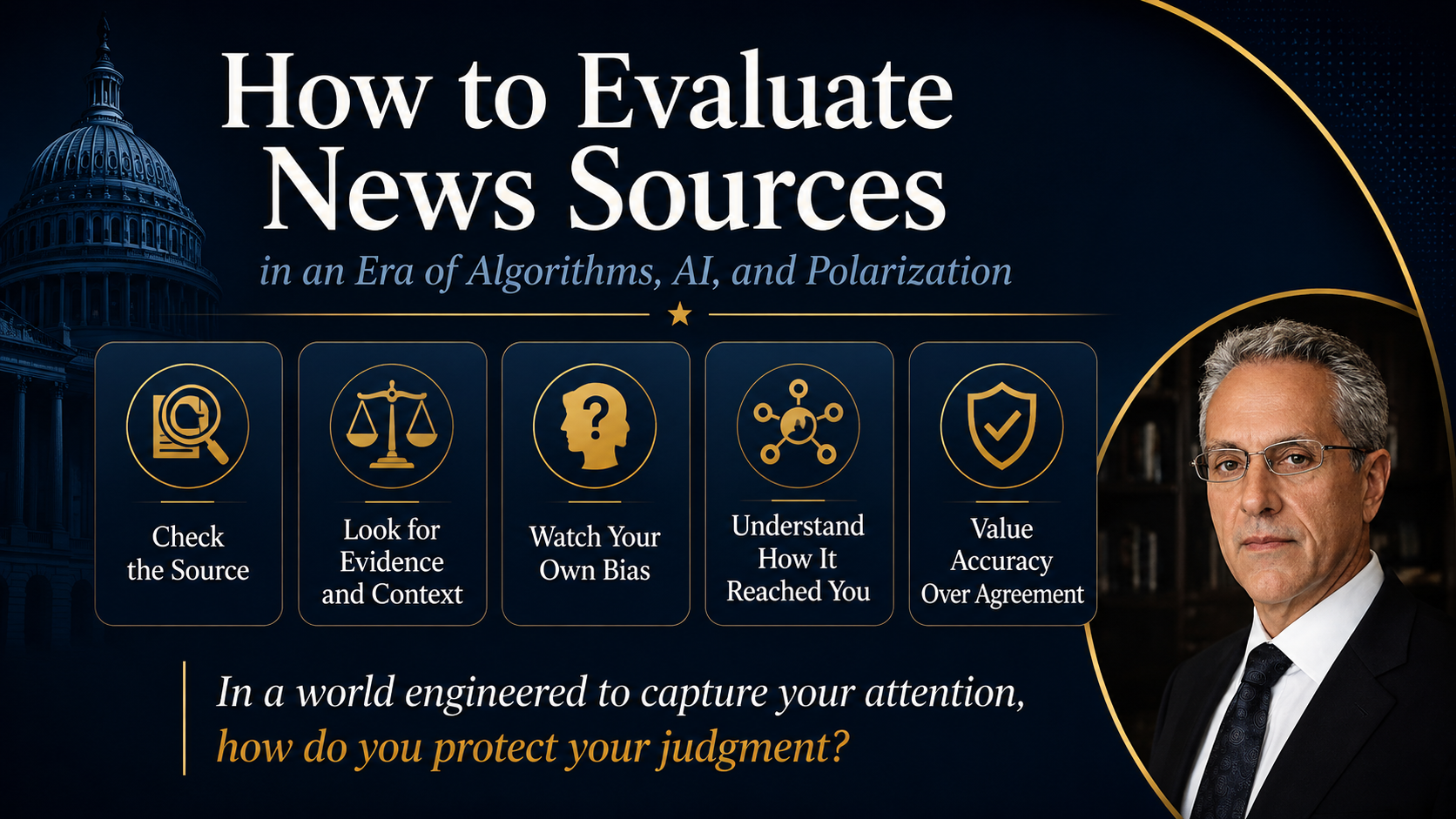
Preface: Why Return To This Topic?
I have written previously about the challenge of extracting truth from a noisy media environment. That earlier essay focused mainly on practical habits: distinguishing news from opinion, comparing sources, reading past the headline, and slowing down before accepting emotionally charged claims.
This essay builds on that foundation, but it takes the question a step further. The problem is no longer simply that some outlets are biased or that some readers choose unreliable sources. The deeper problem is that citizens now receive information through an ecosystem shaped by collapsing trust, social-media algorithms, fragmented audiences, emotionally driven engagement, and increasingly artificial intelligence.
In other words, readers are not merely evaluating newspapers, television networks, or websites. They are evaluating a system.
A responsible reader still needs the basic tools of media literacy, but those tools now have to be applied in a far more complicated environment. We need to understand not only whether a story is accurate, but what kind of content it is, how it reached us, what incentives shaped it, whether it has been stripped of context, and whether our own prior beliefs are influencing how we interpret it.
The goal of this essay is not to tell readers which sources to trust. It is to argue for something more durable: a disciplined method for evaluating information in an age when speed, emotion, ideology, algorithms, and artificial intelligence all compete with careful judgment.
Why This Is Harder Than It Should Be
Trying to evaluate news sources used to feel more straightforward than it does nowadays.
That does not mean the past was some golden age of perfect journalism. Newspapers had biases. Television networks made mistakes. Journalists occasionally failed to verify claims or challenge prevailing narratives. Yet most readers generally understood the difference between a news story, an editorial, and an advertisement.
Today, those distinctions are often blurred. A news story may first appear as a social-media post. An opinion column may be shared as though it were factual reporting. A video clip may circulate without context. A podcast host may function as both journalist and commentator. Increasingly, AI-generated content can mimic legitimate reporting while obscuring its origins.
At the same time, trust in the media has fallen dramatically. Gallup reported in 2025 that trust in mass media reached its lowest level on record. (1,2) In 2026, the Pew Research Center found that most Americans feel exhausted by the amount of news they encounter and have reduced their news consumption altogether. When people describe the modern information environment as noisy, confusing, and exhausting, they are not imagining things.
The challenge is no longer simply deciding which sources to trust. The challenge is learning how to evaluate information inside a system that rewards speed, outrage, tribal affirmation, and constant reaction. That requires a disciplined method of evaluating.
What Responsible Journalism Is Supposed To Do
Before evaluating media organizations, it helps to understand what high-quality journalism is supposed to do.
The Society of Professional Journalists states that journalists should verify information before publishing it, use original sources whenever possible, provide context, acknowledge uncertainty, and correct errors when they occur. (3) The Associated Press emphasizes similar principles: accuracy, fairness, transparency, independence, and clear correction practices. (4)
Notice what is absent from these standards. There is no requirement that journalists make readers comfortable. There is no obligation to support a political movement. There is no expectation that reporting must reinforce a preferred narrative. The core mission is much simpler: gather evidence, verify facts, provide context, and tell readers what is known.
That may sound obvious, but it provides an important standard that we should expect with responsible journalism. Before asking whether a source agrees with us politically, we should first ask whether it follows the basic practices of responsible journalism. Does it verify? Does it provide evidence? Does it acknowledge uncertainty? Does it correct mistakes?
News, Analysis, Opinion, And Performance Are Not The Same Thing
One reason readers become frustrated and confused is that much of what appears to be "news" is not actually news reporting.
Some content is straightforward reporting. Some is analysis. Some is opinion. Some is performance. Reporting attempts to establish facts. Analysis attempts to explain what those facts may mean. Opinion advocates for a particular interpretation. Performance seeks attention, engagement, affirmation, outrage, or entertainment.
All four likely have a place in public discourse. Problems arise when readers confuse one category for another. A columnist is not pretending to be neutral. A political commentator is not performing the same function as a beat reporter. An influencer may not be practicing journalism at all. Yet in digital media, these categories often appear side by side, making distinctions harder to recognize.
One useful habit is simply asking: What kind of content am I consuming now? If that question cannot be answered clearly, caution is warranted.
Why Readers Struggle To Tell The Difference
The difficulty is not simply a failure of individual judgment. Research by the Pew Research Center found that many Americans struggle to distinguish factual statements from opinion statements in news content. Performance varies substantially depending on education, political knowledge, and media literacy. (5)
In other words, the environment itself contributes to confusion. A reported story may reach readers through a screenshot, a podcast clip, a social-media post, or a secondhand summary stripped of its original context. By the time information arrives, readers may no longer be seeing the original reporting at all. They may be consuming somebody else's interpretation of it.
This helps explain why many people feel informed while possessing only a partial understanding of events. The burden on readers is therefore greater than it once was. Confidence does not equal accuracy. Familiarity does not equal credibility. Popularity does not equal truth.
The Incentives That Distort Coverage
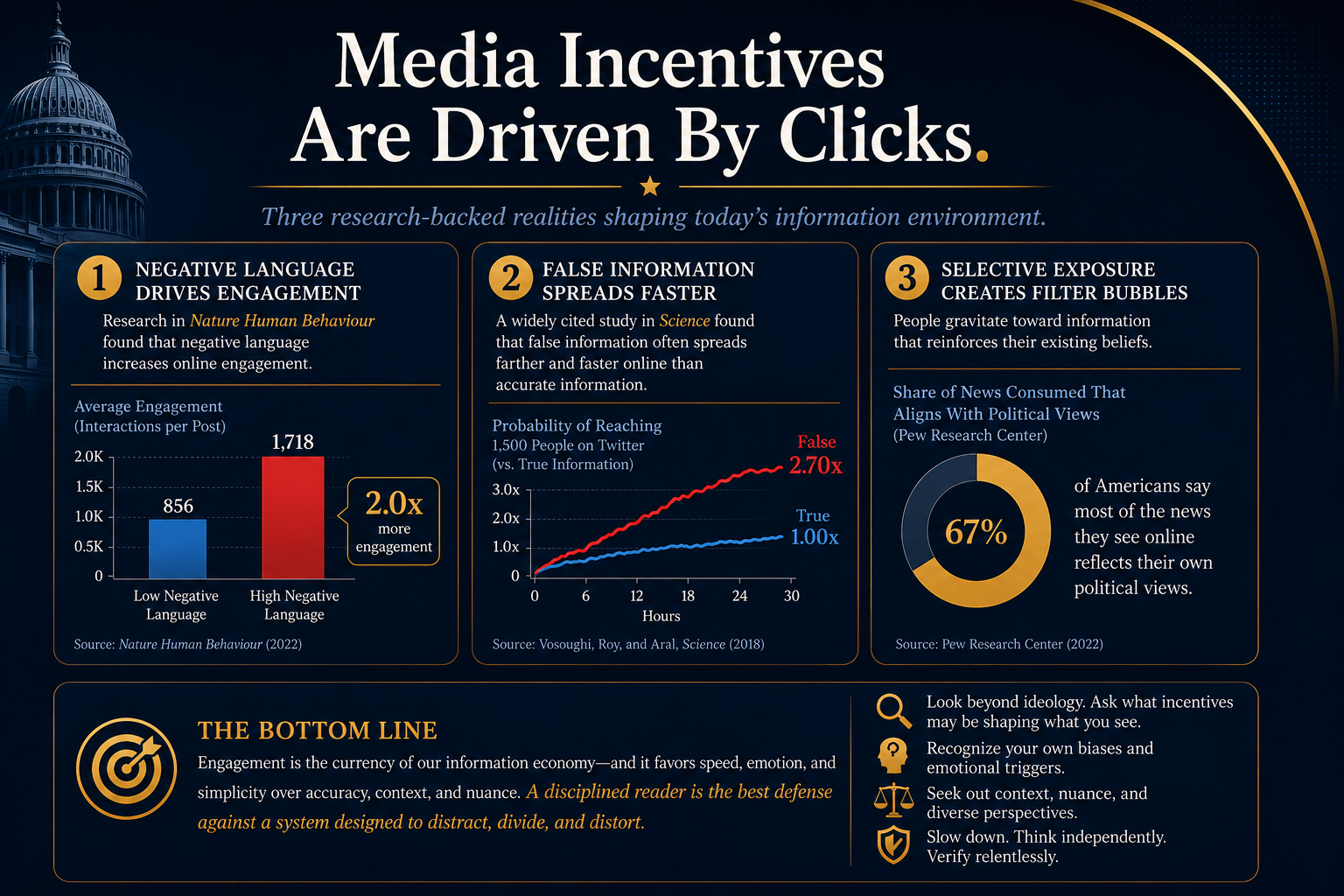
This figure highlights three incentives that shape modern news: negative language attracts more engagement, false information often spreads faster than accurate information, and audiences tend to prefer information that confirms existing beliefs. Together, these forces help explain why engagement and accuracy do not always align. Understanding this system is not cynicism; it is media literacy. (6,7,8)
The Information System Is Not Neutral
Recent research in media and information science suggests that algorithms often amplify emotionally charged, identity-reinforcing, and highly engaging content. This does not mean algorithms create political divisions on their own, but they can increase exposure to material that provokes outrage, strengthens group loyalties, and deepens existing divisions. (9,10)
Researchers have also found that misinformation is often easier to prevent than correct. So-called "prebunking" strategies—teaching people to recognize manipulation tactics before exposure—appear more effective than attempting to change minds after false claims have spread. (11,12)
The rise of artificial intelligence adds another challenge. The concern is not simply fabricated stories. AI systems can now generate plausible articles, images, audio recordings, and videos at an extraordinary scale and speed. (13,14) As these tools become more sophisticated, determining the origin of information becomes increasingly difficult.
Citizens now face two related problems: misinformation and information overload. The question is no longer merely whether a claim is true. Increasingly, it is also whether readers can determine where the information originated and whether the source itself is trustworthy.
Technology does not eliminate personal responsibility, but it undeniably shapes the conditions under which judgments are formed.
Why Ideologues Read Differently
Not all bias originates in newsrooms. Some of it originates in readers.
Psychologists have long studied what is known as the hostile media phenomenon. Strong partisans on opposite sides of an issue often view the exact same coverage and conclude that it was biased against them. (15) That finding remains remarkably relevant today.
Political identity can become so central to a person's worldview that evidence is evaluated not on its merits but on whether it supports a preferred narrative. The question gradually shifts from "Is this true?" to "Whose side does this help?"
This tendency affects conservatives, liberals, independents, activists, and partisans alike. It is not a problem confined to any particular ideology. It is a feature of human psychology.
A serious reader should occasionally ask a difficult question: Am I rejecting this because the evidence is weak, or because it threatens something I already believe? That is not an easy exercise, but it may be one of the most important disciplines in civic life.
Warning Signs That Should Make Readers Slow Down
Several warning signs deserve attention.
The first is emotional overload. If a story seems designed primarily to make readers furious, terrified, or morally exhilarated, it is worth slowing down. Emotional intensity does not prove a claim is false, but it does increase the need for verification. Facts often arrive more quietly than outrage.
A second warning sign involves weak sourcing. Extraordinary claims require strong evidence. Anonymous sources, selective clips, vague assertions, and unsupported allegations should all trigger caution. Serious reporting may occasionally rely on confidential sources, but the stronger the claim, the stronger the supporting evidence should be.
A third warning sign concerns corrections. Responsible organizations make mistakes. What distinguishes serious journalism is the willingness to acknowledge and correct those mistakes openly. A source's correction culture often reveals as much about its credibility as the original reporting itself.
A fourth warning sign involves uncertainty about authorship and provenance. Readers increasingly encounter AI-generated text, synthetic images, manipulated audio, and recycled content presented without clear disclosure. The question is no longer simply whether information is accurate. It is whether readers can determine its origin. Source transparency may become one of the defining media-literacy skills of the coming decade.
When Opinion Borrows Authority
Opinion sections serve an important role in journalism. Their purpose is not to report neutrally but to persuade, critique, interpret, and advocate.
Problems arise when readers fail to recognize the distinction.
Many opinion pieces borrow credibility from the broader news organization that publishes them. Readers may encounter a column on social media, in search results, or via a shared link and assume they are reading objective reporting when they are actually reading advocacy.
That does not invalidate opinion writing. It simply means readers should apply different standards. Evidence still matters. Logic still matters. The strength of an argument should not be confused with the intensity of its rhetoric.
The stronger the language, the more important it becomes to separate facts from interpretation and evidence from assertion.
When Commentary Becomes A Personal Brand
A related challenge is the rise of individual commentators who function almost like media institutions in their own right.
Some of these writers are intelligent, experienced, and worth reading. They may have worked inside journalism for years. They may have tens of thousands of subscribers. They may understand their subject well. But none of that automatically makes them neutral, thorough, or reliable.
A large audience tells us that a writer has built a following. It does not indicate that the writing has been adequately tested. In fact, the modern media economy often rewards the opposite: confidence, moral clarity, sharp villains, tribal affirmation, and emotionally satisfying conclusions.
A recent essay about the Washington Post provides a useful example. The article raises a legitimate concern: serious journalism can be damaged when management treats reporting as a measurable production process rather than a professional craft. That is a fair issue. But the piece also illustrates the risk of confusing forceful commentary with demonstrated analysis. Its language is loaded, its villain is clear from the beginning, and its broader conclusion is asserted with more certainty than the evidence supports.
That does not mean the author should be ignored. It means the piece should be placed in the correct category. It is not neutral reporting. It is an argument. It may contain useful insight, but it is also trying to persuade the reader into a worldview.
This distinction matters because many readers now develop trust not only in institutions, but in personalities. A newsletter writer, podcast host, YouTube commentator, or social-media analyst can become a trusted guide for an entire audience. That trust may be earned, but it should still be tested.
The key question is not, “Is this person popular?” The better questions are: What is the author’s lane? What assumptions are driving the argument? What evidence is offered? What is being left out? Is the writer helping me think more clearly, or mainly inviting me to share their outrage?
A Practical Method For Evaluating A Story
A useful framework does not need to be complicated.
First, identify the type of content. Is it reporting, analysis, opinion, commentary, advocacy, or simply a social-media reaction? If that distinction is unclear, caution is appropriate.
Second, examine the evidence. What documents, transcripts, court filings, interviews, datasets, or primary sources support the claims being made? Are readers being shown evidence or simply being asked to trust a conclusion?
Third, separate facts from framing. What is actually known? What is inferred? What remains uncertain? Many disagreements arise not from the facts themselves but from how those facts are presented and interpreted.
Fourth, compare multiple credible sources, particularly on controversial topics. This does not mean collecting five versions of the same argument. It means looking for genuinely different treatments of the same event.
Fifth, revisit developing stories. Breaking news is often incomplete, and initial reports are sometimes wrong. Responsible journalism evolves as new evidence becomes available. Readers should allow their understanding to evolve as well.
This approach will not eliminate uncertainty. It will, however, make readers less vulnerable to manipulation, emotional appeals, and narrative capture.
What Reputable Outlets Get Wrong—And Why It Matters
One of the most important lessons in media literacy is that mistakes are not limited to fringe outlets. Respected institutions fail as well.
The New York Times' reporting on Iraqi weapons of mass destruction before the Iraq War remains one of the most cited examples. Subsequent reviews concluded that some reporting relied too heavily on official sources while giving insufficient attention to skeptical voices. (16)
The Rolling Stone University of Virginia story demonstrated how a compelling narrative can overwhelm verification standards. Investigations later concluded that the failures extended beyond a single reporter and involved breakdowns in editing, fact-checking, and editorial oversight. (17)
CBS's 2004 National Guard controversy highlighted failures in document authentication and source verification. The issue was not ideology but the inability to adequately substantiate important claims before publication. (18)
The Boston Marathon bombing investigation revealed how both traditional and social media can spread misinformation during fast-moving events. In environments characterized by uncertainty and urgency, speed often becomes the enemy of accuracy. (19)
These examples do not prove journalism is broken. They demonstrate something more practical: reputation alone is not enough. Every story deserves evaluation on its own merits.
How To Build A Healthier Media Diet
A healthier media diet does not require consuming equal amounts of every viewpoint. Nor does it require pretending that all sources are equally credible. It does require discipline.
Read more reporting and fewer reactions. Look beyond headlines. Whenever possible, examine primary sources directly. Court decisions, government reports, transcripts, speeches, and original documents often contain more nuance than the coverage built around them.
Be cautious of sources that consistently leave you agitated but rarely leave you informed. Outrage can be emotionally satisfying, but it is not a substitute for understanding.
It also helps to step outside your informational comfort zone from time to time. Not because every opposing viewpoint is correct, but because intellectual isolation makes independent judgment increasingly difficult. If all of a person's information comes from sources that reinforce the same narrative, distinguishing evidence from affirmation becomes harder over time.
Restoring credibility is not the reader’s responsibility alone. Journalists, editors, commentators, and independent writers also have obligations. They can help rebuild trust by separating reporting from opinion, clearly correcting errors, resisting audience capture, and refusing to turn every issue into tribal theater. The temptation is obvious: confidence, outrage, and audience flattery often produce more attention than restraint, balance, and uncertainty. But credibility is not restored by telling readers only what they want to hear. It is restored by earning trust over time through fairness, evidence, humility, and a willingness to disappoint one’s own side when the facts require it.
Final Thought
The central problem in modern news is not simply bias on the left or the right.
It is that we now live inside an information system that rewards speed, negativity, tribal identity, emotional engagement, and constant stimulation. At the same time, many readers are tired, distrustful, and increasingly tempted to remain inside familiar informational lanes.
That reality places greater responsibility on both journalists and citizens. Readers need a method. They need to understand what kind of content they are consuming, what evidence supports it, how it is being framed, and whether either the source or the reader is being influenced by ideology, emotion, or group loyalty.
Good journalism still exists. Serious reporting still matters. But credibility should be earned story by story, not assumed because a source is famous, familiar, or emotionally satisfying.
In an era shaped by algorithms, polarization, and artificial intelligence, the most valuable skill may not be finding information. It may be learning how to evaluate it.
Reference List
Gallup. Trust in Media at New Low of 28% in U.S. October 2, 2025.
https://news.gallup.com/poll/695762/trust-media-new-low.aspxPew Research Center. Americans’ Complicated Relationship With News. February 11, 2026.
https://www.pewresearch.org/journalism/2026/02/11/americans-complicated-relationship-with-news/Society of Professional Journalists. SPJ Code of Ethics.
https://www.spj.org/spj-code-of-ethics/Associated Press. News Values and Principles.
https://www.ap.org/about/news-values-and-principles/Pew Research Center. Distinguishing Between Factual and Opinion Statements in the News. June 18, 2018.
https://www.pewresearch.org/journalism/2018/06/18/distinguishing-between-factual-and-opinion-statements-in-the-news/Robertson CE, Pröllochs N, Schwarzenegger K, et al. Negativity drives online news consumption. Nature Human Behaviour. 2023;7:812-822.
https://www.nature.com/articles/s41562-023-01538-4Vosoughi S, Roy D, Aral S. The spread of true and false news online. Science. 2018;359:1146-1151.
https://www.science.org/doi/10.1126/science.aap9559Steppat D, Castro L, Hameleers M, et al. Selective exposure in different political information environments: How media fragmentation and polarization shape congruent news use. European Journal of Communication.2022;37:493-512.
https://pubmed.ncbi.nlm.nih.gov/35360473/Rathje S, Van Bavel JJ, van der Linden S. Out-group animosity drives engagement on social media. Proceedings of the National Academy of Sciences. 2021;118:e2024292118.
https://www.pnas.org/doi/10.1073/pnas.2024292118Reuters Institute for the Study of Journalism. Digital News Report 2025.
https://reutersinstitute.politics.ox.ac.uk/digital-news-report/2025van der Linden S, Roozenbeek J, Compton J. Inoculating against fake news about COVID-19. Frontiers in Psychology. 2020;11:566790.
https://www.frontiersin.org/articles/10.3389/fpsyg.2020.566790/fullLu C, Hu B, Li Q, et al. Psychological inoculation for credibility assessment, sharing intention, and discernment of misinformation: Systematic review and meta-analysis. Journal of Medical Internet Research. 2023;25:e49255.
https://www.jmir.org/2023/1/e49255/RAND Corporation. Generative Artificial Intelligence Threats to Information Integrity and Potential Policy Responses. 2023.
https://www.rand.org/pubs/perspectives/PEA3089-1.htmlCybersecurity and Infrastructure Security Agency, National Security Agency, Federal Bureau of Investigation. Strengthening Multimedia Integrity in the Generative AI Era. 2025.
https://media.defense.gov/2025/Jan/29/2003634788/-1/-1/0/CSI-CONTENT-CREDENTIALS.PDFVallone RP, Ross L, Lepper MR. The hostile media phenomenon: Biased perception and perceptions of media bias in coverage of the Beirut massacre. Journal of Personality and Social Psychology. 1985;49:577-585.
https://pubmed.ncbi.nlm.nih.gov/4045697/Columbia Journalism Review. Okrent Lays Down a Challenge. May 31, 2004.
https://www.cjr.org/behind_the_news/okrent_lays_down_a_challenge.phpColumbia Journalism Review. Rolling Stone’s Investigation: “A Failure That Was Avoidable.” April 5, 2015.
https://www.cjr.org/investigation/rolling_stone_investigation.phpCBS News. A Look Back at the Controversy. January 10, 2005.
https://www.cbsnews.com/news/a-look-back-at-the-controversy/Nieman Journalism Lab. This Week in Review: Verification and the Crowd in Boston, and the Kochs’ Newspaper Plans. April 26, 2013.
https://www.niemanlab.org/2013/04/this-week-in-review-verification-and-the-crowd-in-boston-and-the-kochs-newspaper-plans/
