
Returning to Healthcare: Cost, Complexity, and the Culture of Care
Several weeks ago, I wrote a series of posts examining the Affordable Care Act—how it works, how it is funded, and what it has meant for patients. That was an important discussion because the ACA changed the coverage landscape in lasting ways. It expanded access, reshaped insurance markets, and established protections that are now deeply woven into most Americans' expectations of healthcare.
But the ACA, important as it is, did not resolve the larger structural problems in American healthcare.
So for the next few posts, I want to return to healthcare from a broader vantage point. The central question now is not simply who has insurance, but why the system remains so expensive, so administratively burdensome, and so often frustrating for both patients and clinicians. Coverage matters. It matters a great deal. But coverage alone does not explain rising hospital spending, physician-payment distortions, drug-pricing strain, bureaucratic overload, or the growing sense that modern medicine has become harder to navigate even as it has become more technologically capable.
That broader question matters because insurance is only one layer of healthcare. A system can expand coverage and still remain unaffordable, confusing, and badly misaligned in the way it delivers and pays for care. That is largely where the United States still finds itself. In 2024, national health spending reached $5.3 trillion, or 18.0 percent of GDP. CMS projects that healthcare will consume 20.3 percent of GDP by 2033. Meanwhile, federal outlays for the major health programs continue to climb, and families feel the pressure directly through premiums, deductibles, and out-of-pocket costs. In 2025, the average annual premium for employer-sponsored family coverage reached $26,993, with workers contributing $6,850 toward that cost.
In one sense, American healthcare has improved dramatically. Medicine today can diagnose more, treat more, and rescue more than it could a generation ago. But in another sense, the system has become more costly, more bureaucratic, and less personal. We have improved the science of care more than the experience of care.
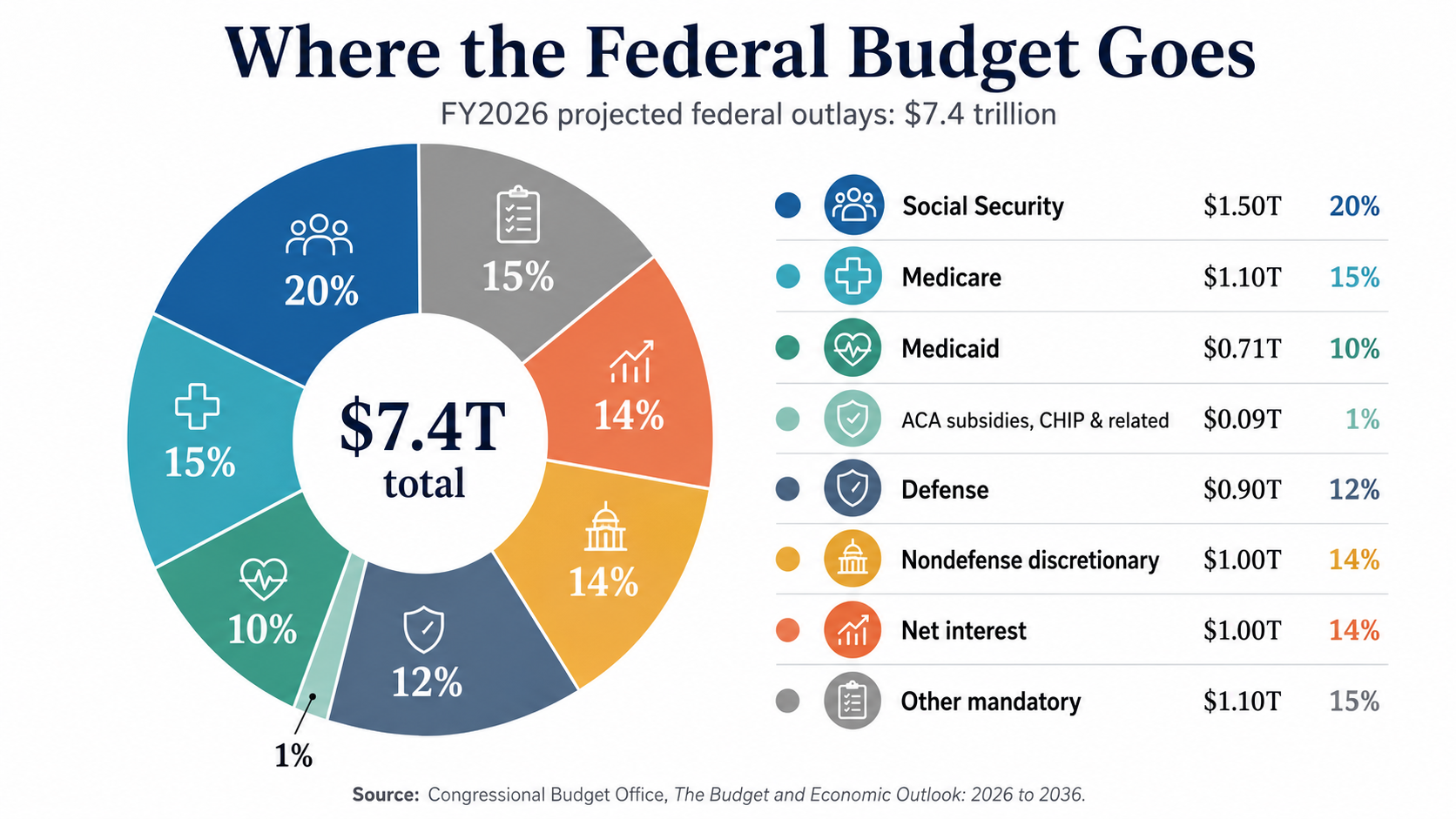
This chart makes one point hard to ignore: healthcare already occupies an enormous share of the federal budget. In FY2026, projected federal outlays are about $7.4 trillion, and the major federal health programs—Medicare, Medicaid, and ACA-related subsidies—account for roughly $1.9 trillion of that total. That means about one in every four federal dollars is tied to healthcare. Whatever one thinks about the ACA, Medicare, Medicaid, or future reforms, the fiscal reality is the same: healthcare is no longer just a clinical issue or an insurance issue. It is one of the central budgetary issues of modern America.
The ACA Helped Access While Leaving the Cost Engine Running
The ACA was a major coverage law, but it was never a full solution to medical inflation. It reduced the uninsured rate, expanded Medicaid in participating states, created marketplaces, and provided subsidies that made private insurance more attainable for many lower-income households. Those were substantial gains.
At the same time, the ACA expanded coverage within a system that was already overpriced, fragmented, and administratively bloated. In that sense, it did not create the cost problem, but it did build on it. By helping more people obtain insurance and directing more public subsidies and private premium dollars into the system, the law made healthcare more inclusive without fundamentally reducing the underlying cost of care.
What the ACA did not fully solve were the deeper structural forces that drive costs throughout the system. Rising premiums are often blamed entirely on insurers or subsidy design, when in reality they also reflect the underlying price of hospital care, physician and outpatient services, pharmaceuticals, and the large administrative overhead of a fragmented payment system. The law improved access, but it left many of the core drivers of medical inflation substantially in place.
That is why the future of healthcare policy cannot focus only on who gets help buying insurance. It must also confront why care itself is so expensive and why payment for that care has become so operationally burdensome. The American healthcare debate is often distorted by the wrong question. Public argument tends to center on who pays the premium, while the more important long-term question is why the underlying bill keeps rising in the first place.
Charges Are Not the Same as Payments
One of the most misunderstood features of American healthcare is the difference between what hospitals charge and what they are actually paid.
Hospitals maintain chargemasters and list prices that can look astonishing on paper, but Medicare generally does not simply pay those sticker prices. It pays according to the administered formulas. Medicaid pays according to its own rules. Private insurers negotiate contracted rates. The true economic transaction is usually the negotiated or administered payment amount, not the frightening number printed on the initial bill.
That distinction matters because public discussion often fixates on the size of the charge without asking what was ultimately paid, by whom, and under what payment rules. The policy problem is not merely that list prices can be absurd. It is that the real payment system is a dense and often opaque mix of administered public rates, private negotiations, patient cost sharing, denials, appeals, and unpaid balances. Those mechanics shape premiums, public spending, and patient financial stress far more than the chargemaster alone.
In other words, the posted bill is theater. The payment system behind it is the real economic story.
A cardiologist once joked to me that he was “charging $1,000 for every EKG,” even though he was paid only a small fraction of that amount. It was amusing in the moment, but also sad, because it captured something deeply wrong in the economics of American medicine. The price that appears on paper often bears little resemblance to what the physician receives, what the insurer pays, or what the service itself is really worth. That disconnect is not a minor quirk of the system. It is one of the reasons healthcare pricing feels so opaque and so untrustworthy to patients and clinicians alike.

Hospitals Remain the Largest Cost Center
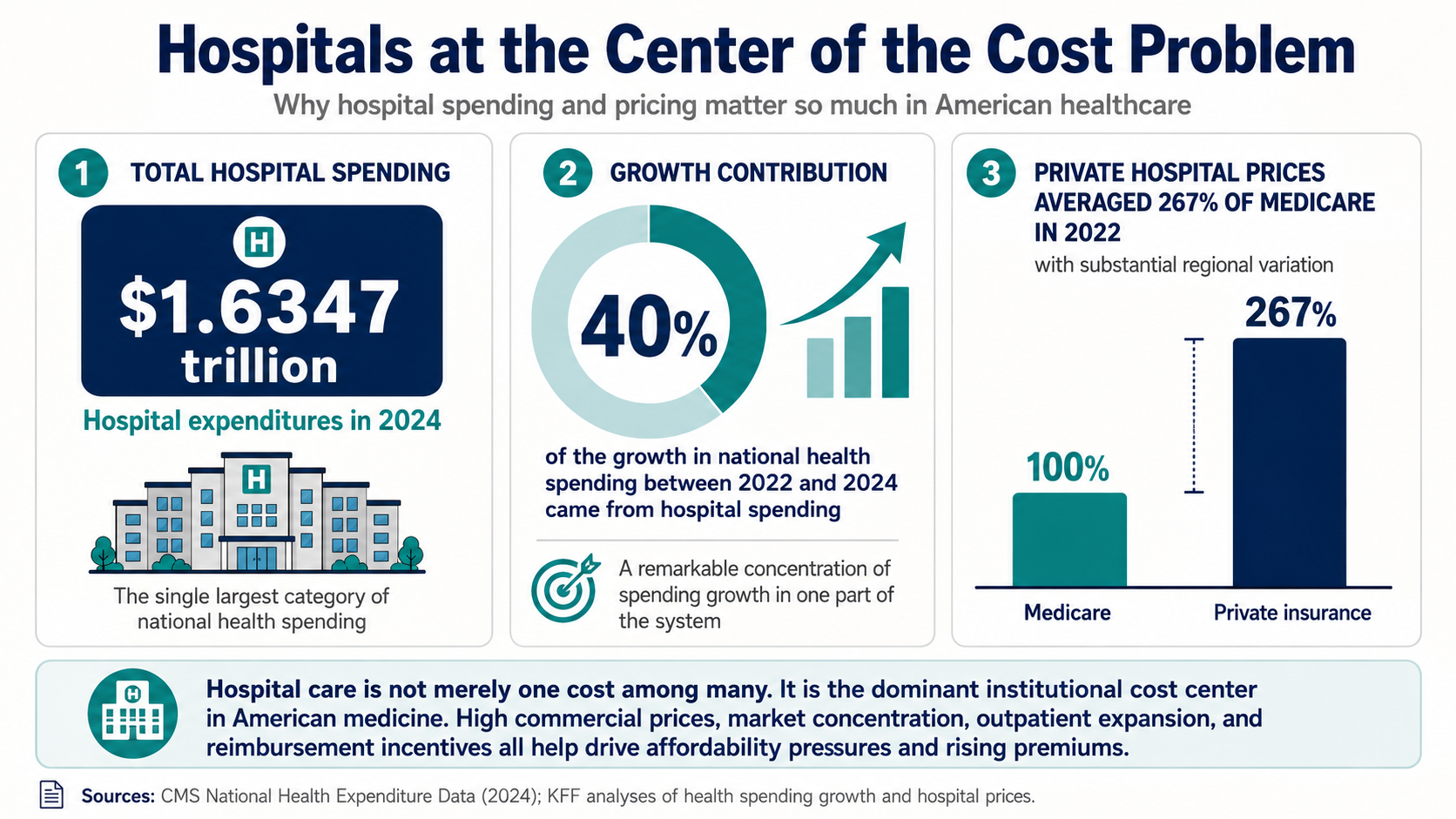
Hospitals still sit near the center of the affordability problem. CMS reports hospital expenditures of $1.6347 trillion in 2024, making hospital care the single largest category of national health spending. KFF has noted that hospital spending accounted for 40% of the growth in national health expenditures between 2022 and 2024. That is a remarkable concentration of spending growth in one part of the system.
This helps explain why healthcare remains so expensive even when debate fixates elsewhere. Hospital care is not merely one cost among many. It is the dominant institutional cost center in American medicine, and any serious effort to improve affordability must grapple directly with hospital pricing, hospital market power, outpatient expansion, and the incentives embedded in hospital reimbursement.
The pricing gap between public and private payment is especially important. KFF reports that prices paid by private insurance for hospital care averaged 267% of Medicare rates in 2022, with substantial regional variation. That helps explain why premiums can rise even when Medicare payment updates appear relatively restrained. In many local markets, private-sector prices are driven less by clinical necessity than by negotiating leverage, consolidation, and the market power of large health systems.
Uncompensated Care Is Real, but It Does Not Explain Everything
Hospitals do provide substantial care for which they are never fully paid. Some patients are uninsured. Others receive extensive treatment and then are unable to pay their balances. Hospitals, therefore, argue, with some justification, that they must recover losses somewhere else on the balance sheet. That is one basis for the familiar claim that higher commercial prices help offset underpayment or nonpayment elsewhere.
There is truth in that argument, but it is not the whole explanation.
The gap between public and private payment rates is also shaped by consolidation, negotiating leverage, service mix, payer mix, and local market structure. In some regions, highly consolidated hospital systems have become essential network participants for insurers. When that happens, bargaining power shifts sharply, and prices can rise well beyond what uncompensated care alone would justify.
So, uncompensated care is part of the financial story, but not the full story. It helps explain why hospitals defend higher commercial rates. It does not automatically justify every high price in the private sector.
Drug Prices Are a Major Source of Frustration
Prescription drugs make up a smaller share of total health spending than hospital care, yet they remain a major source of public concern because some therapies are extraordinarily expensive and their costs are unusually visible. Patients encounter them at the pharmacy counter. Employers see them in benefit spending. Government programs absorb them through Medicare and Medicaid. And unlike many hospital prices, drug prices are easier for the public to identify as a discrete policy problem.
International comparisons reinforce that concern. A 2024 ASPE summary of RAND work found that U.S. prices across all prescription drugs in 2022 were 2.78 times those in 33 comparison countries. For brand-name drugs, the gap was even larger. That does not mean every drug is overpriced in every context, and it does not erase the fact that the United States often gets earlier access to new therapies. But it does mean that Americans frequently pay far more than patients in peer nations for the same products.
That disparity has re-entered the political debate more directly. On May 12, 2025, President Trump signed an executive order directing the administration to pursue a most-favored-nation approach to prescription drug pricing, with the stated goal of bringing American drug prices closer to those paid in comparable countries. Whether such an approach can be implemented effectively, survive legal and political challenge, and produce durable savings remains uncertain. But the policy signal is clear: international drug price gaps are no longer treated merely as an academic complaint. They are now a live political target.
Still, pricing reform is not simple. The American drug market runs through manufacturers, pharmacy benefit managers (PBMs), insurers, pharmacies, employers, Medicare, and patients. Lower benchmark prices do not automatically flow through cleanly to the patient standing at the counter. Some savings may reduce public spending. Some may reduce insurer costs. Some may be blunted by rebate structures or benefit design. The lesson is that savings are filtered through a system with multiple intermediaries.
Payment Patterns Shape the Physician Workforce
Another structural issue is physician reimbursement. Payment does not always align with what patients or even physicians would intuitively think matters most: time, judgment, continuity, responsibility, and the difficult management of chronic illness over time. For years, payment systems have often rewarded procedures and billable intensity more generously than cognitive and longitudinal care.
Those incentives matter not only to physician income but also to workforce stability. A payment system signals to the next generation of doctors which kinds of medicine it values most. When cognitive care is persistently undervalued relative to procedural care, trainees predictably drift toward higher-paid subspecialties and away from primary care and general internal medicine. That transforms compensation into a workforce issue and, ultimately, an access issue.
HRSA projects a shortage of 70,610 primary care physicians by 2038, with especially severe shortages in nonmetropolitan areas. Whatever one thinks of the exact number, the directional problem is obvious: a system that under-rewards longitudinal, relationship-based care should not be surprised when it struggles to sustain enough clinicians willing to provide it.
Administrative Complexity Is a Cost Center of Its Own
Administrative complexity is often described as overhead, but that woefully understates the problem. It does not merely add cost around the edges. It changes behavior throughout the entire system.
Because payment often depends on coding specificity, severity adjustment, documentation detail, prior authorization, medical-necessity language, and quality reporting, physicians, hospitals, coders, consultants, and billing staff devote enormous effort to revenue capture and payment defense. Some of this work is legitimate. Sicker patients do require more resources, and reimbursement systems should recognize that. But the same structure also creates a powerful incentive to document every possible severity marker, comorbidity, and reimbursable distinction that can increase payment. At the edges, that becomes aggressive upcoding or fraud. More commonly, it becomes a massive diversion of time and attention toward the invoice.
This is one of the clearest signs that American healthcare is not merely expensive because medical care costs money. It is also expensive because payment itself has become a large operational industry.
International comparisons make this even harder to ignore. In the Commonwealth Fund’s 2024 comparison of ten nations, the United States again ranked last overall and continued to perform poorly on administrative efficiency. That should surprise no one inside American medicine. Patients confront prior authorizations, network rules, formularies, surprise bills, and appeals. Clinicians confront coding rules, documentation demands, quality checklists, utilization review, and payment denials. Administrative complexity is no longer peripheral to care. It is one of the defining features of the system.
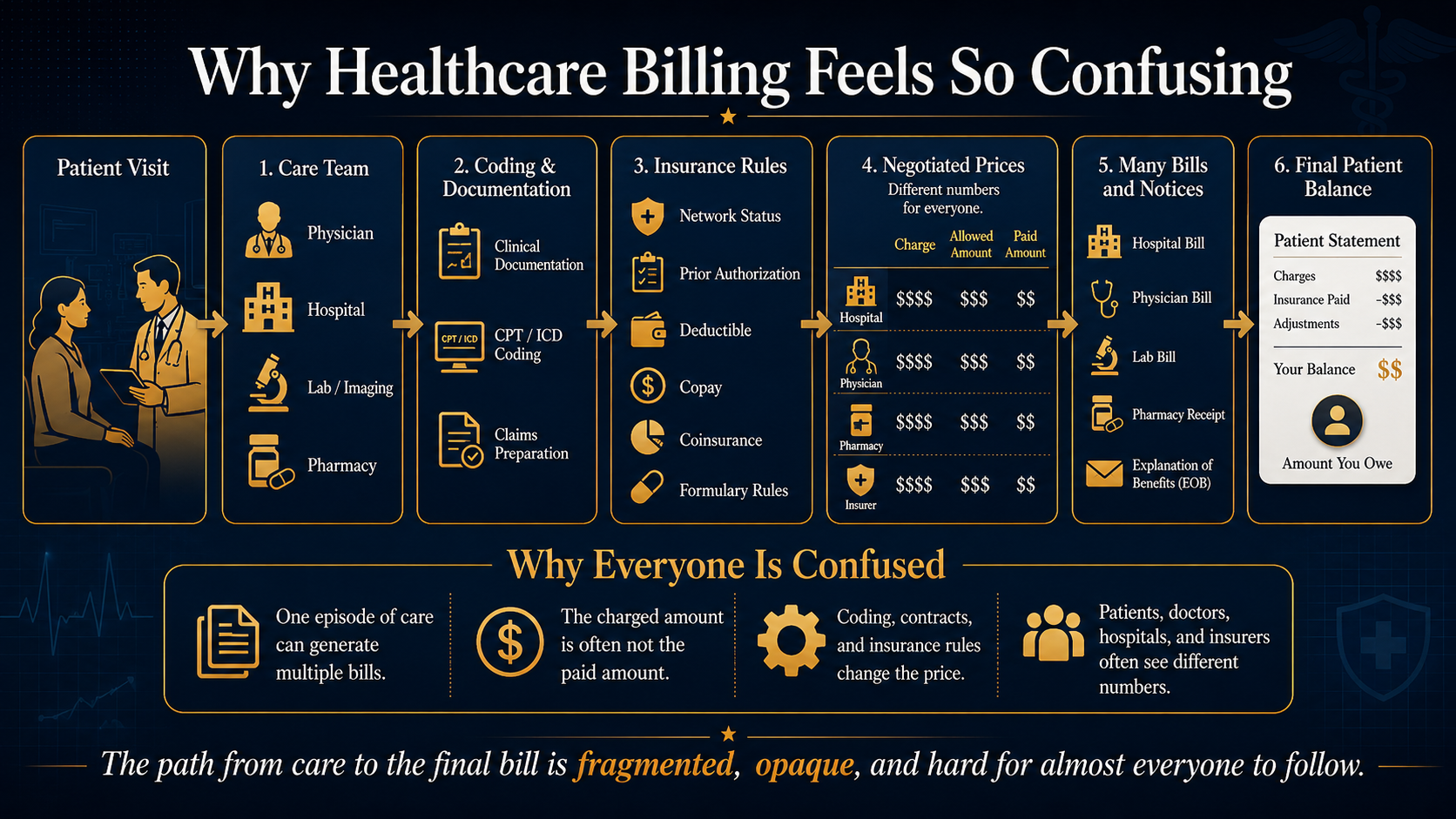
If this figure feels complicated, that is partly the point. It reflects the fragmented and layered process that turns a single episode of care into a billing experience that is often confusing for almost everyone involved.
When the Medical Note Becomes an Invoice
Perhaps the clearest sign of administrative distortion is what has happened to the medical note itself.
In many settings, physicians and nurses spend extraordinary amounts of time documenting not simply to communicate clinical thinking, but to support billing, coding, compliance, legal defensibility, and quality reporting. That is why clinicians sometimes sarcastically refer to notes as invoices.
The problem is not that documentation is unnecessary. The problem is that the modern note is often asked to serve too many nonclinical purposes at once. Instead of asking, “What does the next clinician most need to know about this patient?” the system often pushes clinicians toward asking, “What must be documented so this encounter can be billed, defended, measured, and processed correctly?”
In too many settings, the chart has become a financial and regulatory document first, and only secondarily a clinical narrative.
The result is a record that can be longer, more repetitive, and less clinically useful even as it becomes more elaborate. When clinicians begin to think of the patient note as an invoice, it is a sign that the system’s administrative logic has begun to overtake the clinical one. And once that happens, the costs are not merely financial. They include lost time, professional frustration, and less attention available for the patient at the bedside.
Better Medicine, Worse Experience
The honest answer to whether American healthcare has improved or been compromised is: both.
The system has unquestionably improved in what it can do. Patients today benefit from better diagnostics, safer surgery, more effective critical care, improved cancer therapy, transplantation, dialysis, advanced imaging, and a vastly larger evidence base. In that sense, modern medicine is more capable and, in many ways, more humane than it once was.
But the growth of bureaucracy has compromised care in another sense. The experience of care is often less direct, less intelligible, less personal, and more administratively burdened than it should be. Clinicians spend significant time documenting, coding, responding to billing requirements, and navigating utilization controls. Patients face a maze of bills, prior authorizations, networks, formularies, and appeals. The result is a system that has advanced impressively in clinical capability while often regressing in simplicity, clarity, and human connection.
Put differently, American healthcare has improved the science of care more than the experience of care.
That is the tension that any serious discussion of reform must confront. The next phase of the debate cannot only be about expanding, defending, or financing coverage. It must also ask whether the system is organized to preserve time, judgment, trust, and attention at the bedside.
Looking Ahead: Understanding where the cost problem lives is only the beginning. In the next post, I will turn to reform: not in broad ideological terms, but in the more difficult practical sense of what could actually be changed to make American healthcare less expensive, less confusing, and more humane.
References
Blumenthal D, Collins SR, Fowler EJ. The Affordable Care Act at 10 Years—Its Coverage and Access Provisions. N Engl J Med. 2020;382(10):963-969. doi:10.1056/NEJMhpr1916091.
Centers for Medicare & Medicaid Services. NHE Fact Sheet. Updated January 14, 2026. Accessed June 21, 2026.
Congressional Budget Office. The Budget and Economic Outlook: 2026 to 2036. Published February 11, 2026. Accessed June 21, 2026.
KFF. 2025 Employer Health Benefits Survey. Published October 22, 2025. Accessed June 21, 2026.
Godwin J, Levinson Z, Neuman T. Hospital Spending Accounted for 40% of the Growth in National Health Spending Between 2022 and 2024. KFF. Published February 11, 2026. Accessed June 21, 2026.
KFF. Key Facts About Hospitals. Accessed June 21, 2026.
Godwin J, Levinson Z, Neuman T. One or Two Health Systems Controlled the Entire Market for Inpatient Hospital Care in Nearly Half of Metropolitan Areas in 2024. KFF. Published March 27, 2026. Accessed June 21, 2026.
Blumenthal D, Gumas ED, Shah A, Gunja MZ, Williams RD II. Mirror, Mirror 2024: A Portrait of the Failing U.S. Health System—Comparing Performance in 10 Nations. Commonwealth Fund. Published September 19, 2024. doi:10.26099/ta0g-zp66.
Assistant Secretary for Planning and Evaluation, U.S. Department of Health and Human Services. Comparing Prescription Drugs in the U.S. and Other Countries: Prices and Availability. Published January 31, 2024. Accessed June 21, 2026.
Federal Trade Commission. Pharmacy Benefit Managers: The Powerful Middlemen Inflating Drug Costs and Squeezing Main Street Pharmacies. Interim Staff Report. Published July 2024. Accessed June 21, 2026.
Lo J, Levitt L, Ortaliza J, Cox C. ACA Marketplace Premium Payments Would More than Double on Average Next Year if Enhanced Premium Tax Credits Expire. KFF. Published September 30, 2025. Accessed June 21, 2026.
