
Briefs: Gerrymandering – When the Map Becomes the Election
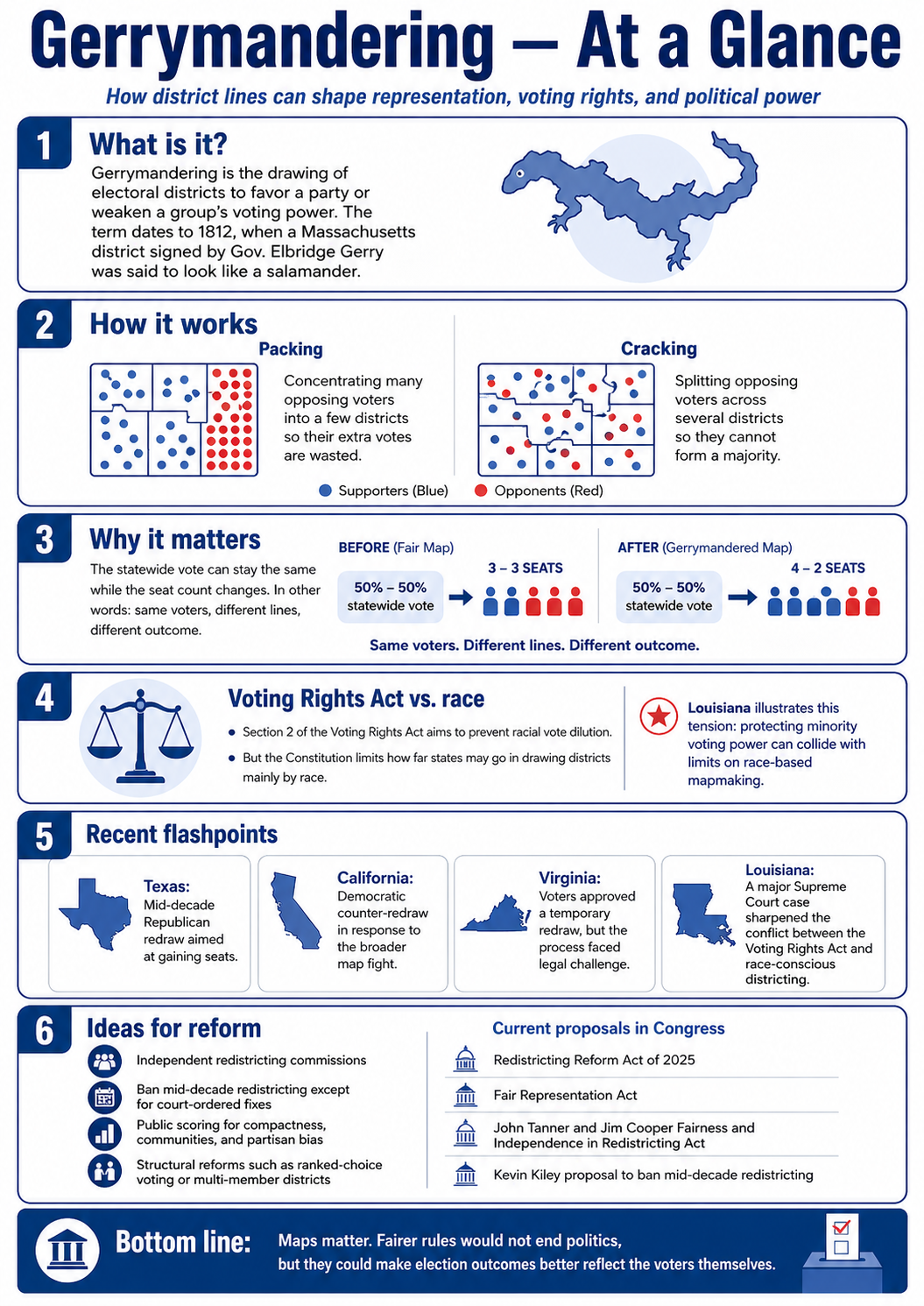
Gerrymandering sounds like a technical issue, but it goes to the heart of representative government. Every ten years, after the census, states redraw congressional districts so that representation reflects population change. That process is necessary. Populations move, cities grow, suburbs expand, and rural areas shrink.
The problem begins when district lines are drawn less to represent voters than to protect political power. A fair map allows voters to choose their representatives. A gerrymandered map allows representatives — or their parties — to choose their voters.
The Strange History of the Word
The term gerrymander dates to 1812, when Massachusetts Governor Elbridge Gerry signed a redistricting plan that benefited his Democratic-Republican Party. One oddly shaped district was said to resemble a salamander. The Boston Gazette called it a “Gerry-mander,” and the name stuck.
The word began as political satire. The practice became a durable feature of American politics.
Gerrymandering is not new. What is new is the precision. Modern software, voter files, demographic data, and partisan modeling allow mapmakers to draw lines with remarkable accuracy. A neighborhood here, a suburb there, a city split down the middle — small changes can produce large political effects.
Not Every Lopsided District Is Gerrymandered
Some districts will naturally lean Democratic. Others will naturally lean Republican. That is not necessarily abuse.
Geography, culture, economics, education, religion, race, age, and urban-rural differences all shape voting patterns. Downtown Denver, rural Alabama, northern Virginia suburbs, west Texas, and parts of Louisiana are not politically identical places.
The real problem is not that some districts are predictable. The problem is when mapmakers deliberately manipulate the districts in between — the ones that could be competitive — by packing one group’s voters into a small number of districts or cracking them across many districts so they cannot influence outcomes.
That is where the map becomes part of the election itself.
Packing, Cracking, and Power
Two tactics define most gerrymanders:
Packing concentrates voters from one party or group into a small number of districts. They may win those districts overwhelmingly, but their excess votes are wasted.
Cracking splits voters from one party or group across several districts so they are never numerous enough to win.
Both tactics can be used for partisan advantage. They can also weaken racial or ethnic minority representation, especially where race, geography, and party preference overlap.
That overlap is the hard part. A mapmaker may say, “We were targeting Democrats,” while the practical effect may be to weaken Black, Latino, Native American, Asian American, or other minority voters. Conversely, a state may say it is protecting minority representation, while critics may argue that the state is sorting voters too explicitly by race.
That tension sits at the center of the current debate.
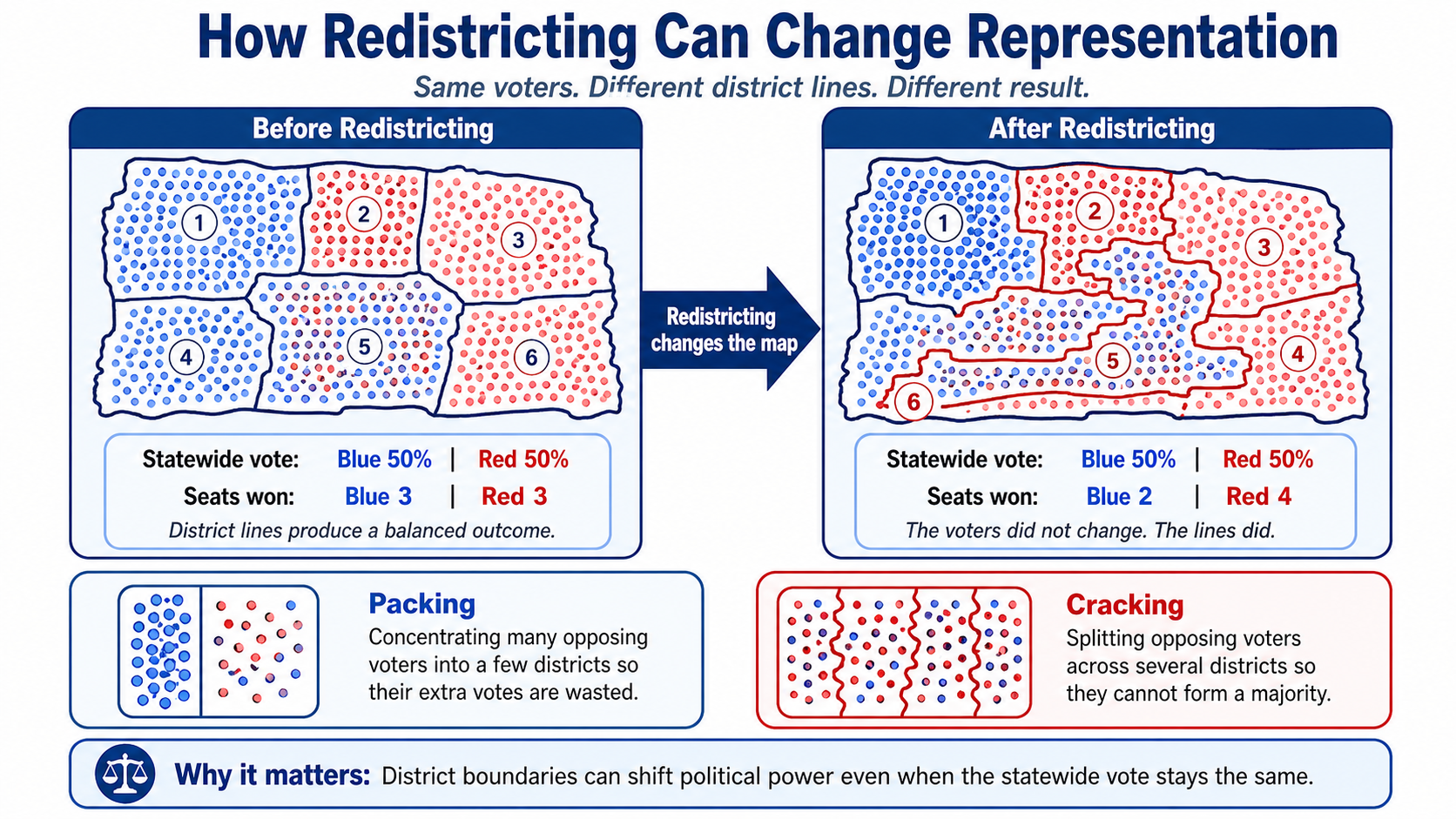
Redistricting can change political outcomes without changing a single voter. By packing some voters into a few districts and cracking others across many districts, mapmakers can turn the same statewide vote into a very different balance of representation.
The Voting Rights Act and the Race Problem
The Voting Rights Act of 1965 was passed because formal voting rights were not enough. A person could have the legal right to vote yet live under election rules that make meaningful representation nearly impossible.
Section 2 of the Voting Rights Act prohibits voting practices that deny or abridge voting rights based on race, color, or membership in certain protected language-minority groups. It is not limited to Black voters. It can also apply to Latino, Native American, Asian American, Alaska Native, and other protected minority communities when the legal standards are met.
In redistricting, the core concern is racial vote dilution. That does not mean someone is prevented from casting a ballot. It means district lines are drawn so that a minority group’s votes are packed or cracked, weakening its ability to elect candidates of its choice.
But there is a competing constitutional principle: government generally may not sort citizens by race unless it has an extremely strong justification. So the law pulls in two directions:
The Voting Rights Act says: Do not draw maps that dilute minority voting power.
The Constitution says: Do not assign voters to districts mainly based on race.
That is the collision.
Louisiana: The Hard Case
Louisiana shows why this issue is so difficult. The state has six congressional districts. Black residents make up roughly one-third of Louisiana’s population, but the earlier congressional map had only one majority-Black district.
Voting-rights plaintiffs argued that this diluted Black voting power and that a fair map should include a second district where Black voters had a realistic opportunity to elect their preferred candidate. Louisiana then adopted a map with a second majority-Black district.
But that map was challenged by voters who argued that the state had used race too heavily when drawing the lines. The Supreme Court agreed. In Louisiana v. Callais, the Court invalidated the map and sharply limited the use of race-conscious districting under Section 2 of the Voting Rights Act.
Supporters of the ruling described it as a necessary enforcement of a colorblind constitutional principle. Government, in this view, should not divide voters into racial blocs, even for remedial purposes.
Critics described the ruling as a major weakening of the Voting Rights Act. In their view, ignoring race in places where race, geography, party, and political power are deeply intertwined may preserve the effects of past discrimination.
Both concerns are serious. That is why Louisiana cannot be reduced to a slogan. It is not simply about “fair maps.” It is about two anti-discrimination principles colliding with each other.
Recent Redistricting Flashpoints
The Louisiana case is part of a broader national fight over congressional maps. The details differ by state, but the larger pattern is clear: redistricting has become a national arms race.
Texas
Texas became a central example of mid-decade redistricting. Republican leaders backed a new congressional map designed to increase the number of Republican-leaning seats.
Texas officials have defended the effort as partisan mapmaking rather than racial discrimination. Opponents argue that, in a state where race, ethnicity, geography, and party preference overlap, aggressive partisan line-drawing can also dilute minority voting power.
California
California responded from the other direction. The state moved toward a new congressional map intended to benefit Democrats, which supporters framed as a response to Republican redistricting efforts elsewhere.
That makes California a useful example of the redistricting arms race: one party redraws in one state, and the other party responds in another.
Virginia
Virginia has also entered the fight. Voters approved a temporary redistricting measure backed by Democrats, but the process faced legal challenge.
Virginia illustrates a different problem: even voter-approved redistricting changes can give rise to procedural and constitutional disputes.
Louisiana
Louisiana is different from Texas, California, and Virginia because the dispute is not only partisan. It is centered on race, the Voting Rights Act, and the Equal Protection Clause.
The state was first pushed toward a second majority-Black district because of Section 2 concerns. Then the Supreme Court rejected the resulting map as unconstitutional racial gerrymandering.
Together, these states show why redistricting has become one of the most consequential fights in American politics. Texas and California show the partisan arms race. Virginia shows the procedural and institutional instability. Louisiana shows the collision between minority-vote protection and constitutional limits on race-conscious government action.
Why the Courts Have Not Solved It
The courts have only partly addressed the problem. In Rucho v. Common Cause, the Supreme Court held that partisan gerrymandering claims generally present political questions beyond the reach of federal courts. In plain English, federal courts usually will not strike down a map simply because it gives one party too much advantage.
Race is treated differently. Courts can still review racial gerrymandering and racial vote-dilution claims. But the Louisiana decision makes that line harder to draw.
States may not dilute minority voting power. But they also may not rely too heavily on race to fix that problem.
That is why redistricting is not easily solved by saying, “Draw fair maps.” A fair map has to balance several principles at once:
Equal population
Contiguous districts
Reasonable compactness
Respect for cities, counties, parishes, towns, and communities of interest
Compliance with the Voting Rights Act
Protection against extreme partisan entrenchment
Transparency in how the final map was chosen
No single rule solves the problem. Compactness helps, but a compact district can still split a real community. Competitiveness helps, but not every district should be artificially competitive. Race cannot be ignored, but race should not become the sole organizing principle. Party data may reveal manipulation, but party preference is also part of democratic life.
Why the Problem Is Getting Worse
For most of modern American history, redistricting was mainly a once-every-ten-years process. That norm is weakening.
The National Conference of State Legislatures reported that in 2025, states were undertaking mid-decade redistricting at rates “not seen since the 1800s.” That is a warning sign.
Once one state redraws its map for partisan gain, the other side feels pressure to retaliate somewhere else. Texas prompts California. California prompts more Republican states. Virginia enters the fight. Louisiana opens new legal questions.
The mapmaking process becomes a national arms race. Both parties can justify their own maps as defensive. Both can accuse the other side of hypocrisy. But the public interest gets lost.
The principle should not depend on which party benefits today.
Proposals Already in Congress
Several members of Congress have proposed reforms.
The Redistricting Reform Act of 2025, introduced by Sen. Alex Padilla and Rep. Zoe Lofgren, would prohibit mid-decade congressional redistricting nationwide and require states to establish independent redistricting commissions.
The Fair Representation Act, reintroduced by Rep. Don Beyer and Rep. Jamie Raskin, would go further. It would use ranked-choice voting and multi-member districts for U.S. House elections, with districts drawn under nonpartisan redistricting rules.
Rep. Steve Cohen has introduced the John Tanner and Jim Cooper Fairness and Independence in Redistricting Act, which would require states to use independent redistricting commissions and more directly remove politics from congressional redistricting.
Rep. Kevin Kiley has proposed legislation to prohibit mid-decade redistricting nationwide. His proposal is narrower than the commission-based bills, but it addresses the same escalation problem.
These proposals differ, but they share an important premise: the people who benefit from district lines should not have unchecked power to draw them.
A Practical Path Forward
No reform will make redistricting perfectly neutral. Communities are not perfect squares. Political geography is real. Racial geography is real. Some districts will naturally lean Democratic, and others will naturally lean Republican. The goal should not be to manufacture artificial competitiveness everywhere.
The better goal is more modest and more important:
Do not manufacture political outcomes that voters themselves did not create.
A practical reform package should begin with the current system and make it harder to abuse.
Keep the ten-year census cycle.
Redistricting should ordinarily happen after the census, not whenever one party sees an advantage. A stable cycle gives voters, candidates, and election officials a predictable map.Ban mid-decade redistricting except when a court finds the existing map illegal.
This would reduce the current arms race, in which one state redraws for partisan gain and another state responds in kind.Use independent or genuinely bipartisan commissions.
Legislators should not have unchecked power to choose their own voters. Commissions are not perfect, but they can reduce the most obvious conflict of interest.Require public map scoring.
Every proposed map should be evaluated for equal population, compactness, city-county splits, community integrity, racial vote dilution, partisan bias, and competitiveness. Citizens should be able to see how a map performs, not simply be told that it is fair.Allow prompt judicial review under clear rules.
Courts should not become permanent mapmakers, but they should be able to enforce transparent standards when a map violates the Constitution, the Voting Rights Act, or state-law requirements.
These reforms would make the existing single-member district system more honest. But they do not answer the deeper question: is the single-member, winner-take-all district itself part of the problem?
In the current system, each district elects one representative. A candidate who wins 51 percent of the vote receives 100 percent of that district’s representation. That makes district lines enormously powerful. A small change in the boundary can decide which party wins the seat.
That is why some reformers argue for a more structural change: larger multi-member districts, ranked-choice voting, or some form of proportional representation. These systems would not eliminate politics, but they could reduce the power of any single boundary line. Instead of fighting endlessly over where to draw six separate winner-take-all districts, a state might elect several representatives from a larger region in a way that more closely reflects the voters within it.
That idea deserves serious consideration. It also deserves caution. Proportional systems can be well or poorly designed. Depending on the details, they may empower party insiders, confuse voters, encourage small factional parties, or shift political bargaining into less visible places. They may solve one problem while creating another.
So the path forward likely has two levels.
The first is immediate and practical: fairer maps, independent commissions, limits on mid-decade redistricting, public scoring, and judicial review.
The second is structural: asking whether winner-take-all single-member districts are still the best way to represent a large, polarized, and geographically sorted country.
Gerrymandering will never disappear entirely. Political power always creates temptation. But a representative democracy need not accept temptation as destiny.
A fairer system begins with a simple principle:
Voters should choose their representatives. Representatives should not choose their voters.

References
U.S. Census Bureau. Congressional Apportionment.
Library of Congress. Gerrymandering: The Origin Story.
U.S. Department of Justice. Section 2 of the Voting Rights Act.
U.S. Supreme Court. Rucho v. Common Cause.
U.S. Supreme Court. Louisiana v. Callais.
National Conference of State Legislatures. Changing the Maps: Tracking Mid-Decade Redistricting.
Sen. Alex Padilla and Rep. Zoe Lofgren. Redistricting Reform Act of 2025.
Rep. Don Beyer and Rep. Jamie Raskin. Fair Representation Act.
Rep. Steve Cohen. John Tanner and Jim Cooper Fairness and Independence in Redistricting Act.
Rep. Kevin Kiley. Proposal to prohibit mid-decade redistricting.
