
If You Think It’s Bad Now…
Political Cruelty Is as Old as America. Its Unlimited Amplification Is Not.
A recent post on Substack got me thinking about political cruelty—particularly the ugliness directed toward Charlie Kirk and the sense that something in American political culture took a darker turn after 2016. I do not necessarily disagree. The contempt is easier to find now. It is more casual, more personal, and often more gleeful. People say things publicly that, not so long ago, they might at least have had the good judgment to mutter privately. Still, as I read the piece, I kept thinking about the presidential biographies I have read over the past several years. Nearly every biography contains at least several moments when I stopped and thought:
Good grief. These people were nasty.
Not merely critical. Not simply partisan. Nasty.
They accused one another of adultery, atheism, drunkenness, cowardice, treason, corruption, insanity, illegitimacy, racial betrayal, sexual depravity, and plotting to destroy the republic. Presidents were drawn as kings, snakes, monkeys, turtles, demons, children, puppets, and assorted barnyard animals.
Some of it was cruel. Some of it was dangerous. And some of it—viewed from the safe distance of two centuries—is almost impossible not to find absurdly funny.
This raises an uncomfortable realization:
American politics did not suddenly become cruel in 2016. We have always been this way. What changed was our ability to amplify the cruelty instantly, universally, and almost without restraint.
Before deciding that our age invented political ugliness, it is worth opening a few old newspapers.
The Trouble With Marble Statues
History has cleaned up the past for us. We encounter George Washington in marble, Thomas Jefferson beneath a dome, Abraham Lincoln seated solemnly in his memorial, and Franklin Roosevelt looking confidently toward the future. Their speeches have been edited, their portraits restored, and their more dignified statements carved into stone.
The daily political noise did not receive the same treatment. The insults yellowed inside newspapers. The pamphlets disappeared into archives. The cartoons were packed into boxes. The tavern arguments evaporated altogether. As a result, we remember statesmen while forgetting the people who called them monsters.
George Washington: Traitor, King, and Impostor
One might assume George Washington was exempt. After all, this was George Washington—the victorious general, the father of our country.
Not quite.
By his second term, opposition newspapers were portraying Washington as monarchical, aristocratic, corrupt, and dangerously sympathetic to Britain. His support for the Jay Treaty produced especially bitter attacks. Critics claimed that he had betrayed the Revolution and undermined republican government. Thomas Paine, whose Common Sense had helped inspire the Revolution, ended a published attack by asking whether Washington would ultimately be remembered as an “apostate or an impostor.” (1)
So much for the universal admiration of the founding generation. Apparently, even the father of our country could be recast as another King George.
Nothing new to see here. Move along.
The Election of 1800: Civilization Ends Again
The contest between John Adams and Thomas Jefferson is often presented as an elevated debate over constitutional philosophy. It was that. It was also, in the Library of Congress’s understated description, an “extremely partisan and outright nasty” campaign. (2)
Jefferson was accused of atheism and sympathy for the excesses of the French Revolution. One surviving cartoon shows him kneeling before an altar of “Gallic despotism,” preparing to throw the Constitution into a fire fueled by radical writings while God and an American eagle attempt to stop him. (3) Subtle it was not. The warnings surrounding Jefferson’s election went far beyond tax policy or foreign affairs. Religion would collapse. Morality would disappear. Social order would dissolve. The radical Jacobins might arrive next.
In other words, it was once again the most important election of anyone’s lifetime.
Adams and the Federalists were treated with equal warmth. They were accused of constructing an aristocratic, perhaps hereditary government under the thin disguise of republicanism. Each side believed, or at least claimed, that the other represented an existential threat to the nation. The republic survived.
The friendship between Adams and Jefferson did not, at least for a while.
John Quincy Adams: The Corrupt, Gambling International Pimp
The election of 1828 may be the moment when American campaigning truly found its rhythm.
John Quincy Adams had already been burdened by the allegation that he obtained the presidency through a “corrupt bargain” with Henry Clay after the disputed election of 1824. When Adams subsequently appointed Clay secretary of state, Andrew Jackson’s supporters treated the sequence not as suspicious but as conclusive. The bargain had been made. The presidency had been stolen. The people had been betrayed. (4)
That was only the beginning.
Adams purchased a billiard table with his own money. His opponents transformed it into “gambling furniture” installed in the White House at public expense.
More remarkably, Jackson’s supporters circulated the claim that, while Adams was serving as minister to Russia, he had procured a young American woman for the sexual pleasure of Czar Alexander I.
Let that sink in.
A highly educated former diplomat, son of a president, and rather austere New Englander was presented to the American public as a corrupt, taxpayer-funded gambler who moonlighted as an international pimp. The allegation had grown out of an innocent court introduction involving a young woman in the Adams household, but innocence was apparently an unnecessary complication. (5)
Modern opposition researchers might study 1828 with professional respect.
Adams’s supporters responded by portraying Jackson as a murderer, tyrant, adulterer, and blood-soaked barbarian. The infamous “Coffin Handbills” displayed coffins representing men Jackson had ordered executed during his military career. One broadside reportedly went so far as to suggest that Jackson had slaughtered Native Americans and eaten a dozen of them for breakfast. (5)
The allegation was false.
It was also admirably specific.
Andrew Jackson: King, Murderer, and Husband of an Adulteress
Jackson’s opponents found an image that has endured: “King Andrew the First.” The famous 1833 cartoon dressed Jackson in royal robes, placed a scepter in one hand and his veto in the other, and positioned him squarely atop a torn Constitution. (6) The charge was clear: this was not a president exercising authority but a despot placing himself above the law. The cartoon is both effective and ridiculous. Jackson looks like an irritable actor who wandered into the wrong Shakespeare production.
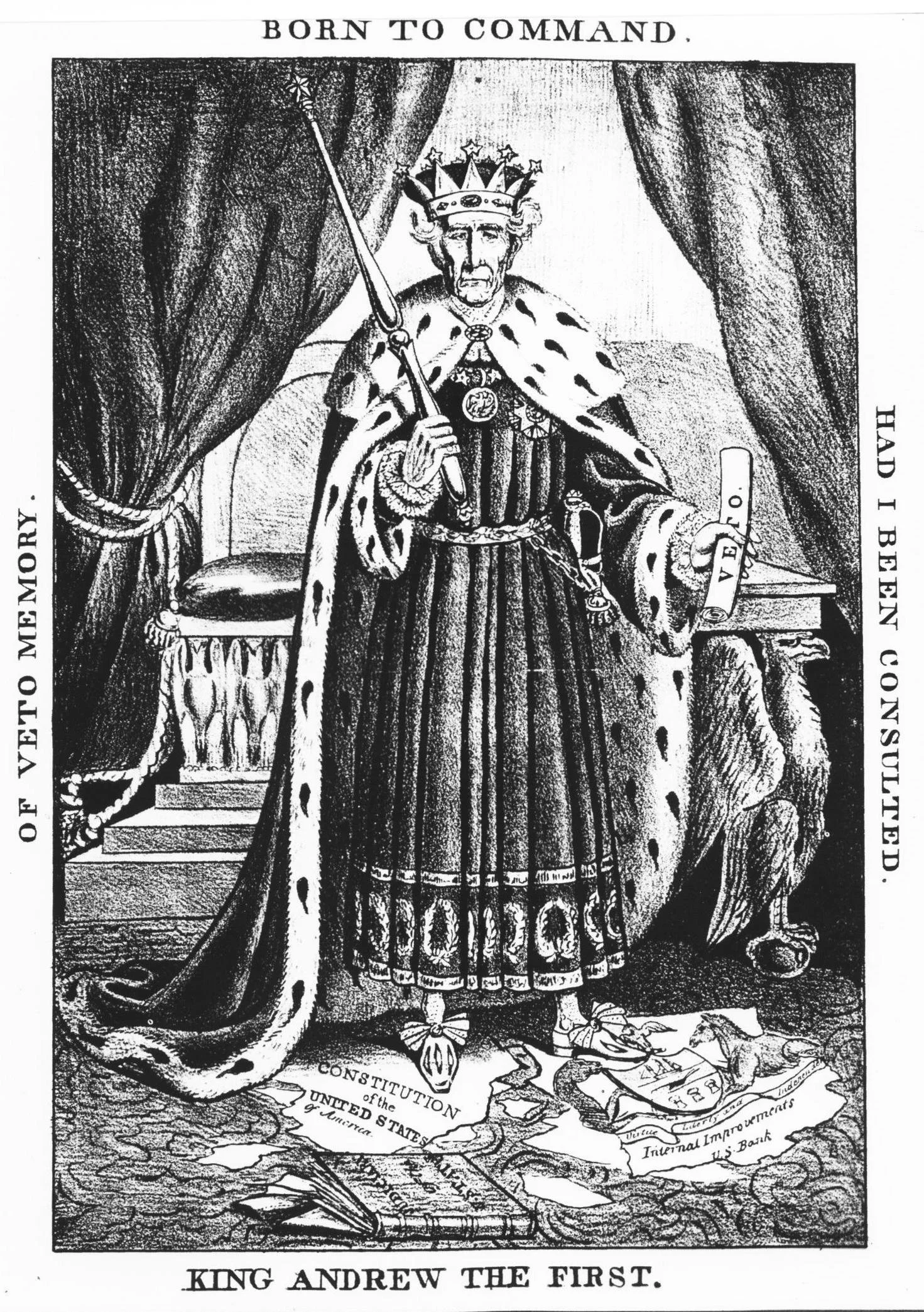
Dictator Rhetoric, 1833
Andrew Jackson becomes “King Andrew the First”—royal robes, scepter, veto, and Constitution underfoot
Image: “King Andrew the First,” 1833. Library of Congress, Prints and Photographs Division. Public domain.
But the attacks did not stop at Jackson. They reached his wife. Rachel Jackson’s first marriage had ended under legally confusing circumstances. Her divorce was not completed when she and Jackson initially believed it had been, giving opponents an opening to label her an adulteress and bigamist. Jackson was accustomed to being called a murderer. The attacks on Rachel wounded him far more deeply. She died shortly before his inauguration, and Jackson blamed the campaign’s slanders for worsening her health. (5, 7)
Here, the laughter properly fades. Political cruelty has always found spouses, children, marriages, illnesses, and private vulnerabilities to exploit.
Martin Van Buren Requires the Assistance of Satan
If Jackson were a king, his successor would need a more ambitious treatment.
During the Panic of 1837, a cartoon titled Capitol Fashions for 1837 showed Martin Van Buren wearing a princely cloak, trampling the Constitution, and being crowned “Ragamuffin King” by a demon acting “in the name of Belzebub.” His royal garment was decorated with depreciated currency, lest anyone miss the monetary-policy critique. (8)
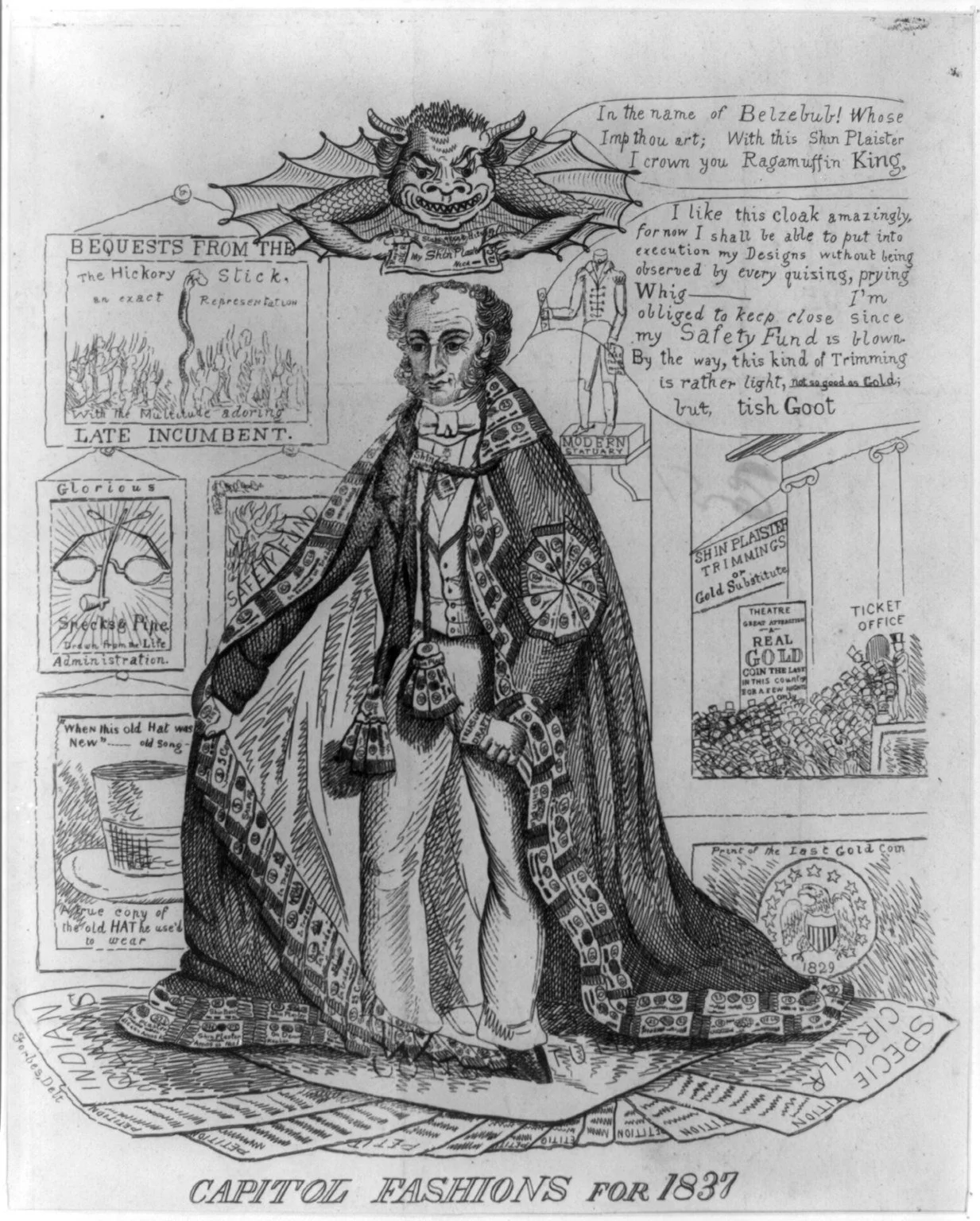
A Banking Crisis Apparently Required Satan
Martin Van Buren becomes the “Ragamuffin King” in an elaborate 1837 attack on his economic policies
Capitol Fashions for 1837,” 1837. Martin Van Buren is crowned “Ragamuffin King” by Beelzebub during the Panic of 1837. Library of Congress, Prints and Photographs Division. No known restrictions on publication
One has to admire the effort.
The nineteenth-century political cartoon was not merely a picture with three words in capital letters. It might require a working knowledge of banking, the Constitution, classical mythology, the Old Testament, and the physical characteristics of several small mammals.
Van Buren was variously transformed into a fox, an opossum, and other creatures. Political opponents have apparently always found it useful to turn human beings into animals. We simply do it faster now.
“Old Granny” Harrison and the Insult That Backfired
William Henry Harrison was old by the standards of his time, and Democratic newspapers did not let the matter go unnoticed. They called him “Old Granny” Harrison, depicted him as weak and senile, and suggested he would happily retire to a log cabin if provided with a pension and a barrel of hard cider. (9)
The Whigs did something very modern: they appropriated the insult. Harrison became the log-cabin-and-hard-cider candidate. The campaign built log cabins on wheels, distributed cider, printed songs, and turned an accusation of age and indolence into a populist brand. The episode offers a useful warning to political strategists:
Before insulting an opponent, make sure the insult will not look good on a hat.
Harrison won the election and died only a month after taking office. His successor, John Tyler, was then dismissed as “His Accidency.” Critics argued that he was merely the vice president acting as president and had no right to claim the full office. Even disputes over presidential legitimacy are nothing new. (10)
Franklin Pierce: A Hero of the Bottle
Franklin Pierce served in the Mexican-American War and suffered an injury when his horse fell during battle. His opponents converted the episode into cowardice and called him “Fainting Frank.”
They also mocked his drinking by calling him the:
“Hero of many a well-fought bottle.” (11)
That is cruel. It is also annoyingly good. Political insults were sometimes written by people with a genuine ear for language. A modern focus group might spend $100,000 and still fail to produce “hero of many a well-fought bottle.”
Pierce won overwhelmingly.
James Buchanan: Ten-Cent Jimmy
James Buchanan entered the 1856 campaign carrying the nickname “Ten-Cent Jimmy.” Labor critics claimed he believed ten cents per day was sufficient compensation for an American worker. A surviving cartoon shows Buchanan addressing laborers and promising that, under his leadership, they would be placed on the same economic footing as European workers—ten cents a day—while the cartoon carefully displays food prices, demonstrating how impossible that wage would be. (12)
The cartoon could easily be updated today. Replace the lithograph with a digital meme, adjust the clothing, add a few corporate logos, and send it into circulation.
The underlying accusation remains familiar: the politician is rich, detached, controlled by elites, and contemptuous of ordinary workers.
When the Jokes Became Blows
It would be easy to treat all of this as an entertaining museum of American exaggeration. Kings. Demons. Adulterers. Drunks. International pimps. Ten-cent wages. Presidents eating political opponents, or possibly Native Americans, for breakfast.
But ridicule can become dehumanization, and dehumanization can make violence easier to excuse.
By the 1850s, political language was colliding with the country’s deepest moral and sectional crisis. Senator Charles Sumner, an antislavery Republican, delivered his long “Crime Against Kansas” speech in 1856. Sumner’s cause was serious. His rhetoric was not restrained. He described Senator Stephen Douglas as a “noisome, squat, and nameless animal” and accused Senator Andrew Butler of taking slavery as his mistress—the “harlot, Slavery.” (13) Representative Preston Brooks, Butler’s relative, responded by entering the Senate chamber and beating the seated Sumner with a metal-topped cane until he was unconscious.
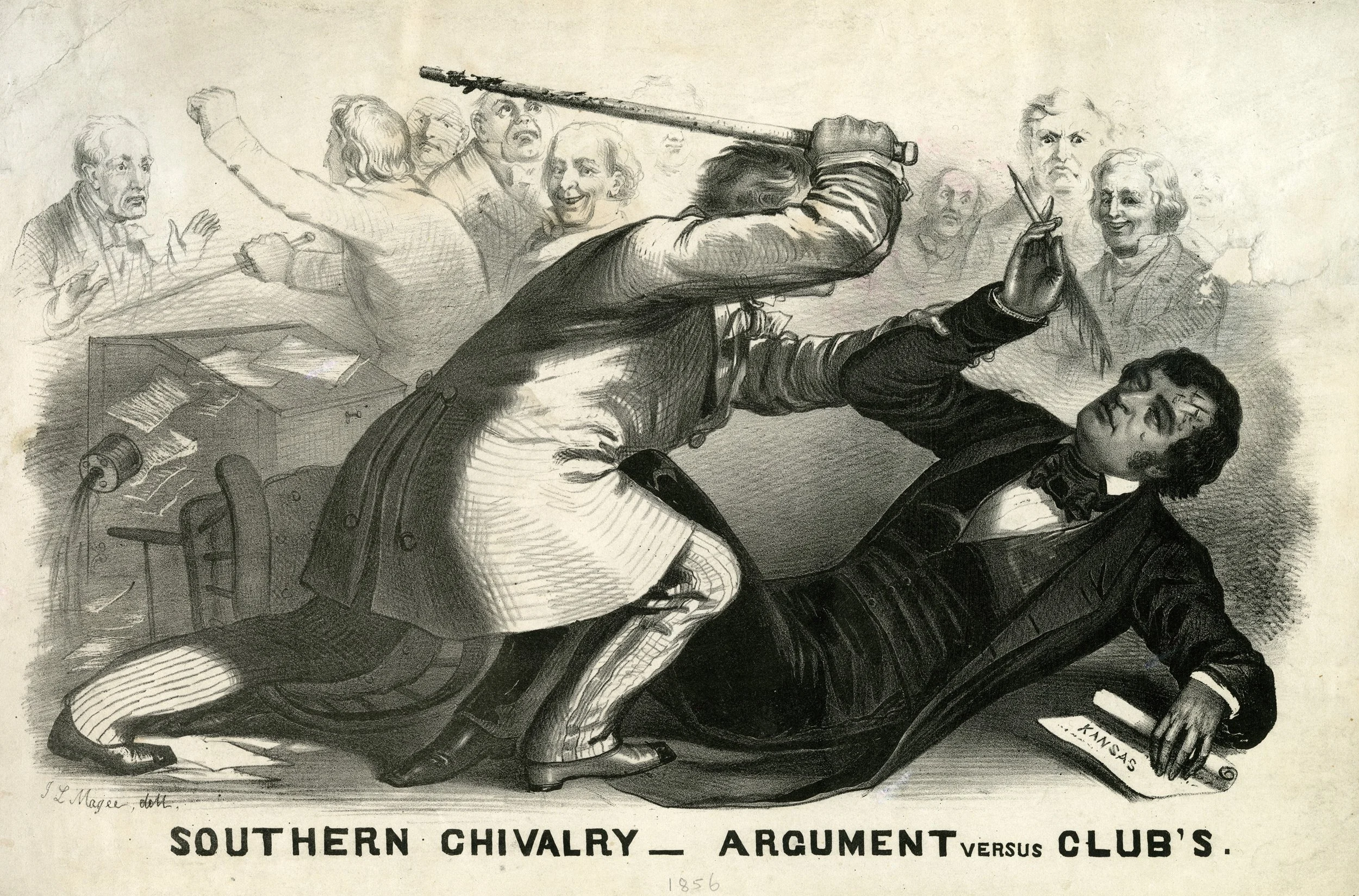
When the Jokes Became Blows
Representative Preston Brooks attacks Senator Charles Sumner on the Senate floor after Sumner’s antislavery speech, 1856
John L. Magee, “Southern Chivalry—Argument versus Club’s,” 1856. Boston Public Library, Print Department. No known copyright restrictions.
Brooks was celebrated across much of the South. Admirers sent him replacement canes. He resigned his seat and was promptly reelected. Both Brooks and Sumner became regional heroes. (14)
Two years later, more than 30 representatives joined a late-night brawl on the House floor. During the melee, members tore the hairpiece from Mississippi Representative William Barksdale, temporarily dissolving the fight into laughter and jeering. (15)
CNN would have enjoyed spectacular ratings.
Yet the humor should not obscure the warning. The country was no longer merely caricaturing its divisions. It was acting them out physically, and civil war was approaching.
Lincoln: The Memorial Came Later
We now remember Abraham Lincoln through the Gettysburg Address, the Second Inaugural, the Emancipation Proclamation, and that enormous, reverent figure seated in Washington. His contemporaries did not always see the memorial.
They mocked his height, face, clothing, voice, frontier background, intelligence, and physical awkwardness. He was presented as an ape, a baboon, a fool, a tyrant, a racial radical, and an undertaker presiding over the death of the Union. Some attacks came from opponents of emancipation. Others came from abolitionists who believed he moved too slowly. Still others came from members of his own party who considered him hopelessly unequal to the crisis. (16)
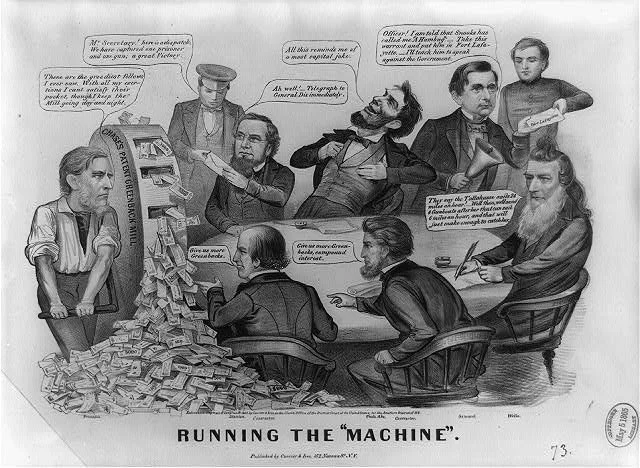
Running the Machine
Lincoln’s administration was portrayed as an incompetent, repressive, money-printing circus during the 1864 election
Currier & Ives, “Running the ‘Machine,’” c. 1864. Lincoln laughs at a joke while his administration prints greenbacks, exaggerates a minor military success, imprisons a critic, miscalculates naval strategy, and pays government contractors. Library of Congress, Prints and Photographs Division. No known restrictions on publication
Lincoln was revered later. During his presidency, he was hammered from almost every direction. That may be worth remembering whenever we become too confident that history will confirm our own contemporary judgments.
The Magnificent Campaign of 1884
The election between Grover Cleveland and James G. Blaine may represent the high point of American campaign poetry.
Blaine faced allegations of corruption and became:
“Blaine, Blaine, James G. Blaine,
The continental liar from the state of Maine.”
Cleveland, meanwhile, was accused of fathering a child outside marriage. Republicans serenaded him with:
“Ma, Ma, where’s my Pa?”
After Cleveland won, Democrats reportedly completed the rhyme:
“Gone to the White House, ha, ha, ha.”
The campaign also produced “The Tattooed Man,” a widely reproduced image of Blaine covered with the names of his various alleged scandals. Cleveland’s private life and Blaine’s financial dealings became popular entertainment through cartoons, songs, posters, chants, and handbills. There was no TikTok. They managed. (17)
The artistic production was slower, but the instinct was fully developed.
Roosevelt, Taft, Wilson—and the Expanding Cartoon Zoo
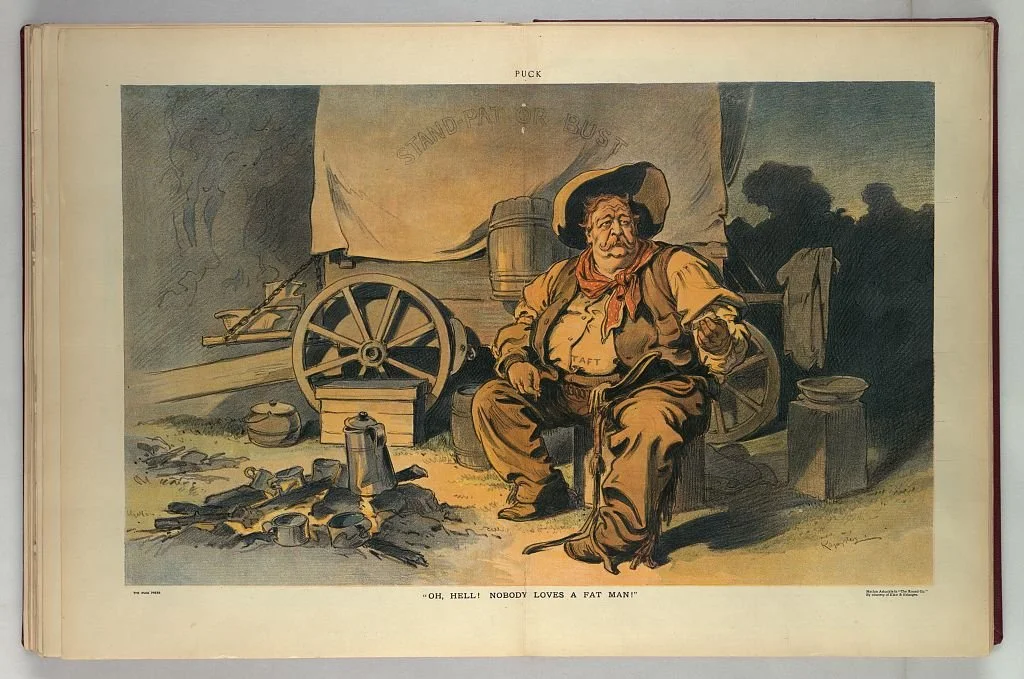
Nobody Loves a Fat Man
William Howard Taft’s weight becomes a metaphor for political isolation in this unusually blunt 1910 cartoon
Udo J. Keppler, “Oh, Hell! Nobody Loves a Fat Man!,” Puck, May 18, 1910. Library of Congress, Prints and Photographs Division. No known restrictions on publication.
By the early twentieth century, mass-circulation newspapers and magazines had made political cartoons a national institution.
Theodore Roosevelt was drawn as a cowboy, a wild animal, an emperor, a lunatic, a preacher, a policeman, and a rampaging child. His energy made him irresistible to cartoonists.
William Howard Taft’s weight was exploited relentlessly. His physical size and appetite were treated as evidence of indolence, weakness, and comic incompetence. There was almost no pretense that personal appearance was off-limits.
Woodrow Wilson was caricatured as a sanctimonious professor, an indecisive schoolmaster, an autocrat, a coward, and an intellectual hopelessly detached from ordinary life. (18)
The accusations were familiar:
He is mentally unstable.
He is physically unfit.
He thinks he is morally superior.
He is controlled by someone else.
He secretly wants dictatorial power.
He is destroying the Constitution.
He is embarrassing the country abroad.
Change the names and wardrobe, and most of it is ready for tonight’s cable panels.
FDR: Socialist, Fascist, Communist—and Aristocrat
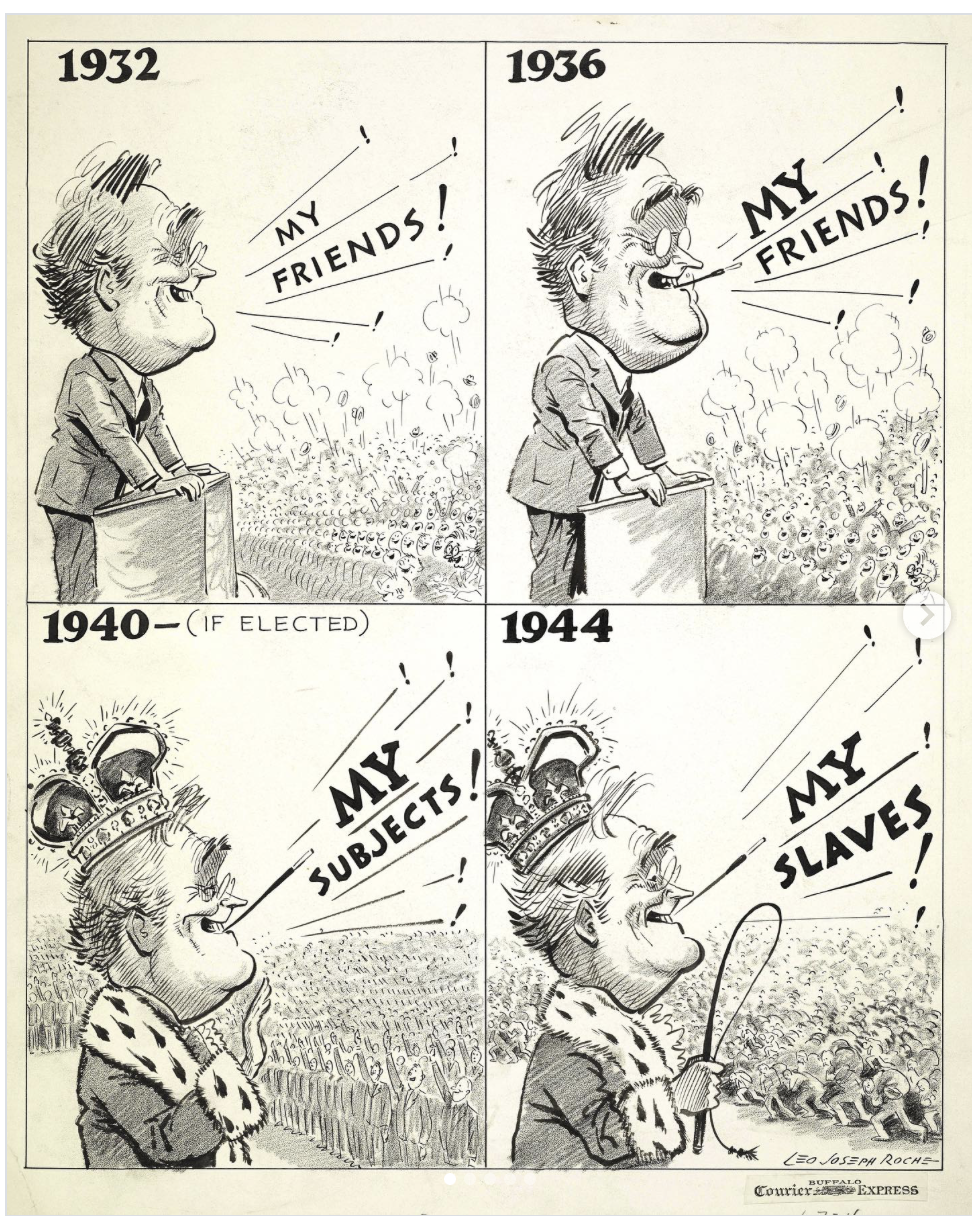
From “My Friends” to “My Slaves”
A 1939 cartoon imagines Franklin Roosevelt’s pursuit of additional terms transforming an elected president into a crowned ruler
Leo Joseph Roche, “The Fourth Term,” 1939. Published in the Buffalo Courier-Express. The cartoon imagines Roosevelt’s continued reelection transforming “my friends” into “my subjects” and ultimately “my slaves.”
Franklin Roosevelt provides a logical stopping point for the main historical survey because radio and national mass media were creating something closer to our present political environment.
Depending on which opponent was speaking, Roosevelt was a communist, socialist, fascist, dictator, class traitor, reckless aristocrat, enemy of business, enemy of liberty, and aspiring king.
His proposal to enlarge the Supreme Court intensified charges that he sought personal control over the constitutional system. Opponents warned that the plan would subordinate the judiciary to the president and replace a government of laws with a government of men. It became one of the greatest political defeats of his presidency. (19)
The labels were not entirely coherent. Roosevelt could apparently be a communist and a fascist simultaneously, while also remaining a privileged patrician conspiring against his own class.
Political anger has never required ideological tidiness.
Nothing New to See Here?
Move through the postwar presidents, and the pattern continues.
Truman was a machine politician unworthy of the office. Eisenhower was intellectually passive. Kennedy was young, Catholic, privileged, and controlled by his father. Johnson was crude, corrupt, and power-mad. Nixon became “Tricky Dick.” Ford was a bumbling accident. Carter was weak. Reagan was an ignorant actor. George H.W. Bush was an out-of-touch aristocrat. Clinton was morally corrupt. George W. Bush was stupid or fascistic. Obama was foreign, socialist, illegitimate, or secretly hostile to the country. Trump was fascist, insane, treasonous, and subhuman. Biden was corrupt, senile, illegitimate, and controlled by unseen handlers.
Some criticisms had legitimate foundations. Others were gross distortions. Still others were fantasies.
That has always been the mixture.
The point is not that all accusations are equivalent, or that every age has been equally dangerous. Slavery, civil war, segregation, economic depression, foreign war, and political assassination produced conflicts of profoundly different moral seriousness.
Nor is the point that Americans should shrug at present cruelty because our ancestors behaved badly.
The point is simply this:
Political contempt is not a post-2016 invention. It is an old human impulse wearing new clothes.
So What Really Changed?
It may still be right that 2016 represented a turn for the worse. But it was probably an acceleration, not an origin. (21)
Partisan hostility had been rising for decades. By June 2016, Pew found that Democrats’ and Republicans’ views of the opposing party were already more negative than at any point in nearly a quarter-century of its polling. Majorities in both parties held very unfavorable views of the other side, and sizable groups regarded the opposing party as a threat to the nation’s well-being. (20)
What changed most dramatically was the machinery surrounding the hostility.
Everyone Became a Publisher
In 1800, producing a political attack required an author, an editor, a printing press, paper, ink, money, and a distribution network.
Today, it requires a thumb. The ordinary citizen now carries a printing press, camera, television station, international delivery network, and permanent archive in a pocket. This has democratized political speech. That has many benefits.
It has also democratized the role of the village crank.
The Friction Disappeared
Old publication systems were hardly models of responsibility. Editors printed outrageous lies, and partisan newspapers sometimes functioned as party organs. But publication required steps. One had to write the attack, deliver it, typeset it, print it, and distribute it. Delay did not guarantee reflection, but it at least created the possibility.
Today, the distance between emotional impulse and worldwide publication may be five seconds. Restraint has lost its head start.
Cruelty Is Rewarded
Social-media feedback does more than distribute outrage. It teaches people that outrage works. Research has found that positive feedback—likes, shares, and other forms of approval—makes users more likely to express outrage again. Outrageous material also tends to attract more engagement and can therefore be elevated by systems designed to maximize attention. (22, 23)
The old newspaper wanted circulation. The modern platform wants engagement. Neither necessarily cares whether the reader leaves wiser.
We Confuse Visibility With Prevalence
This may be one of the most important distinctions. In an earlier age, the ugliest statement made in a distant tavern disappeared when the tavern closed. Today, the most offensive reaction from an obscure person can be found, captured, and presented to millions as evidence of what “the other side” believes.
We see ten thousand vicious comments gathered in one place and understandably conclude that society has become vicious. But ten thousand people within a nation of hundreds of millions may represent a large mob, a tiny minority, or both.
Research suggests that people tend to overestimate how much moral outrage others actually feel when judging them through social-media posts. The platform does not merely display hostility; it can make hostility appear more universal than it is. (24)
The nastiness is real. Its visibility may exaggerate its representativeness.
The Mob Acquired a Perfect Memory
An eighteenth-century insult might survive in a pamphlet if someone preserved it. Most did not.
A modern remark can be screenshotted, searched, reposted, monetized, and resurrected years later. Nothing truly disappears, including the thing said in anger, ignorance, grief, intoxication, or at age seventeen. The technology did not invent the mob.
It gave the mob global reach, instantaneous coordination, measurable applause, and almost perfect memory.
Perhaps We Should Laugh—A Little
There is a temptation to treat political cruelty with unbroken solemnity. Some of it deserves exactly that, particularly when ridicule moves toward dehumanization or violence. But some of it is ridiculous.
Martin Van Buren was crowned by Beelzebub over a disagreement involving banking policy.
Andrew Jackson appeared in royal costume, trampling the Constitution.
Franklin Pierce became the hero of the bottle.
James Buchanan became Ten-Cent Jimmy.
Grover Cleveland lost track of his alleged child in a catchy campaign rhyme.
These were serious accusations deployed in consequential elections. They were also performances—exaggerated, theatrical, frequently clever, and sometimes absurd. Laughter may help us see political hysteria for what it is. It punctures the self-importance of every generation that believes its opponents are uniquely monstrous and its election uniquely apocalyptic.
The laughter should not become indifference. Political rhetoric matters. Lies matter. Cruelty matters. The caning of Charles Sumner reminds us that words and violence are not separated by an impenetrable wall.
But historical perspective matters too. We did not fall from a lost age of universal civility. Washington, Jefferson, Adams, Jackson, Lincoln, and Roosevelt did not preside over a quiet republic populated by thoughtful citizens respectfully debating policy over tea. They inhabited the same human world we do—vain, fearful, tribal, inventive, funny, vicious, loyal, courageous, and occasionally unhinged.
The Old Impulse and the New Machine
So, did American political culture become nastier after 2016?
Perhaps. The evidence of growing partisan animosity is difficult to dismiss. The casual denial of sympathy to political opponents should concern us. Celebrating death, humiliation, or violence is not rendered harmless merely because earlier generations also behaved disgracefully.
But I am increasingly skeptical that human nature changed in 2016. The more plausible explanation is that an old impulse encountered a new machine.
We have always insulted our leaders. We have always accused our opponents of betraying the country. We have always enjoyed caricature, rumor, conspiracy, and the occasional wonderfully crafted cheap shot.
What we did not always possess was the ability to publish every impulse instantly, deliver it to millions, receive a score for its viciousness, and preserve it forever.
The past was not kinder. It was less connected.
And so, the next time someone announces that our political opponents are tyrants, traitors, perverts, fools, agents of Satan, enemies of the Constitution, or the final obstacle standing between America and national ruin, we might pause, look at Martin Van Buren being crowned by Beelzebub, and say:
Nothing new to see here. Move along.
Except for the amplifier. That part really is new.
References
George Washington’s Mount Vernon. “Press Attacks.” Digital Encyclopedia. Includes the Jay Treaty press campaign and Thomas Paine’s charge that Washington was “an apostate or an impostor.”
https://www.mountvernon.org/library/digitalhistory/digital-encyclopedia/article/press-attacksLibrary of Congress. “Election of 1800.” Creating the United States exhibition. Describes the contest as an “extremely partisan and outright nasty campaign.”
https://www.loc.gov/exhibits/creating-the-united-states/election-of-1800.htmlLibrary of Congress. “Jefferson Attacked as an Infidel.” Religion and the Federal Government, Part 2. Includes The Providential Detection and its “Altar to Gallic Despotism.”
https://www.loc.gov/exhibits/religion/rel06-2.htmlMiller Center, University of Virginia. “The Corrupt Bargain.” Contested Presidential Elections.
https://millercenter.org/contested-presidential-elections/corrupt-bargainThe New Yorker. “Watching Andrew Jackson’s Inauguration.” Discusses the 1828 attacks involving Adams’s billiard table, the Russian-court allegation, the Coffin Handbills, Jackson’s alleged cannibalism, and Rachel Jackson.
https://www.newyorker.com/news/news-desk/watching-andrew-jacksons-inaugurationLibrary of Congress. “King Andrew the First.” Prints and Photographs Online Catalog, 1833.
https://www.loc.gov/pictures/item/2008661753/Smithsonian Magazine. “Rachel Jackson Was the Original Monica Lewinsky.”
https://www.smithsonianmag.com/history/rachel-jackson-was-original-monica-lewinsky-180963713/Library of Congress. “Capitol Fashions for 1837.” Prints and Photographs Online Catalog.
https://www.loc.gov/pictures/item/2008661297/Jill Lepore. “Bound for Glory.” The New Yorker, October 20, 2008. Discusses the “Old Granny,” log-cabin, and hard-cider attacks on William Henry Harrison.
https://www.newyorker.com/magazine/2008/10/20/bound-for-gloryWhite House Historical Association. “John Tyler and Presidential Succession.” Discusses the dispute over Tyler’s status and the nickname “His Accidency.”
https://www.whitehousehistory.org/john-tyler-and-presidential-successionLarry Gara. The Presidency of Franklin Pierce. Lawrence: University Press of Kansas, 1991, p. 38. Discusses the 1852 attacks portraying Pierce as a coward and “the hero of many a well-fought bottle.”
Library of Congress. “Shall I Vote for Ten Cents a Day?” Prints and Photographs Online Catalog, 1856.
https://www.loc.gov/pictures/item/2010643201/United States Senate Historical Office. “The Crime Against Kansas.”
https://www.senate.gov/artandhistory/history/minute/The_Crime_Against_Kansas.htmUnited States Senate Historical Office. “The Caning of Senator Charles Sumner.”
https://www.senate.gov/artandhistory/history/minute/The_Caning_of_Senator_Charles_Sumner.htmUnited States House of Representatives, History, Art & Archives. “The Most Infamous Floor Brawl in the History of the U.S. House of Representatives.”
https://history.house.gov/Historical-Highlights/1851-1900/The-most-infamous-floor-brawl-in-the-history-of-the-U-S--House-of-Representatives/Abraham Lincoln Presidential Library and Museum. “President Lincoln and Political Cartoons”; Library of Congress, “The Grave of the Union”; Indiana University Lilly Library, “Lincoln as a Monkey, Holding a Copy of the Emancipation Proclamation.”
https://presidentlincoln.illinois.gov/education/educator-resources/teaching-guides/political-cartoons/
https://www.loc.gov/pictures/item/2008661679/
https://collections.libraries.indiana.edu/lilly/exhibitions/items/show/46Library of Congress. “Election Week Special: ‘The Dodger’ and the Election of 1884.” Folklife Today.
https://blogs.loc.gov/folklife/2016/11/election-week-special-the-dodger-and-the-election-of-1884/Library of Congress. “Puck Cartoons Launched at Last” and “Political Cartoons and Public Debates.” Collections documenting caricatures of Theodore Roosevelt, William Howard Taft, Woodrow Wilson, and their contemporaries.
https://blogs.loc.gov/picturethis/2012/12/puck-cartoons-launched-at-last/
https://www.loc.gov/classroom-materials/political-cartoons-and-public-debates/National Constitution Center. “How FDR Lost His Brief War on the Supreme Court.” February 5, 2024.
https://constitutioncenter.org/blog/how-fdr-lost-his-brief-war-on-the-supreme-court-2Pew Research Center. “Partisanship and Political Animosity in 2016.” June 22, 2016.
https://www.pewresearch.org/politics/2016/06/22/partisanship-and-political-animosity-in-2016/Daniel Külz et al. “United States Politicians’ Tone Became More Negative with 2016 Primary Campaigns.” arXiv:2207.08112, 2022.
https://arxiv.org/abs/2207.08112William J. Brady et al. “How Social Learning Amplifies Moral Outrage Expression in Online Social Networks.” Science Advances 7, no. 33 (2021): eabe5641.
https://www.science.org/doi/10.1126/sciadv.abe5641Smitha Milli et al. “Engagement, User Satisfaction, and the Amplification of Divisive Content on Social Media.” arXiv:2305.16941, 2023.
https://arxiv.org/abs/2305.16941William J. Brady et al. “Overperception of Moral Outrage in Online Social Networks Inflates Beliefs About Intergroup Hostility.” Nature Human Behaviour 7 (2023): 917–927.
https://doi.org/10.1038/s41562-023-01582-0
