
No Kings, But Plenty Of Thrones: Protest, Power, And The Problem Of Entrenched Rule
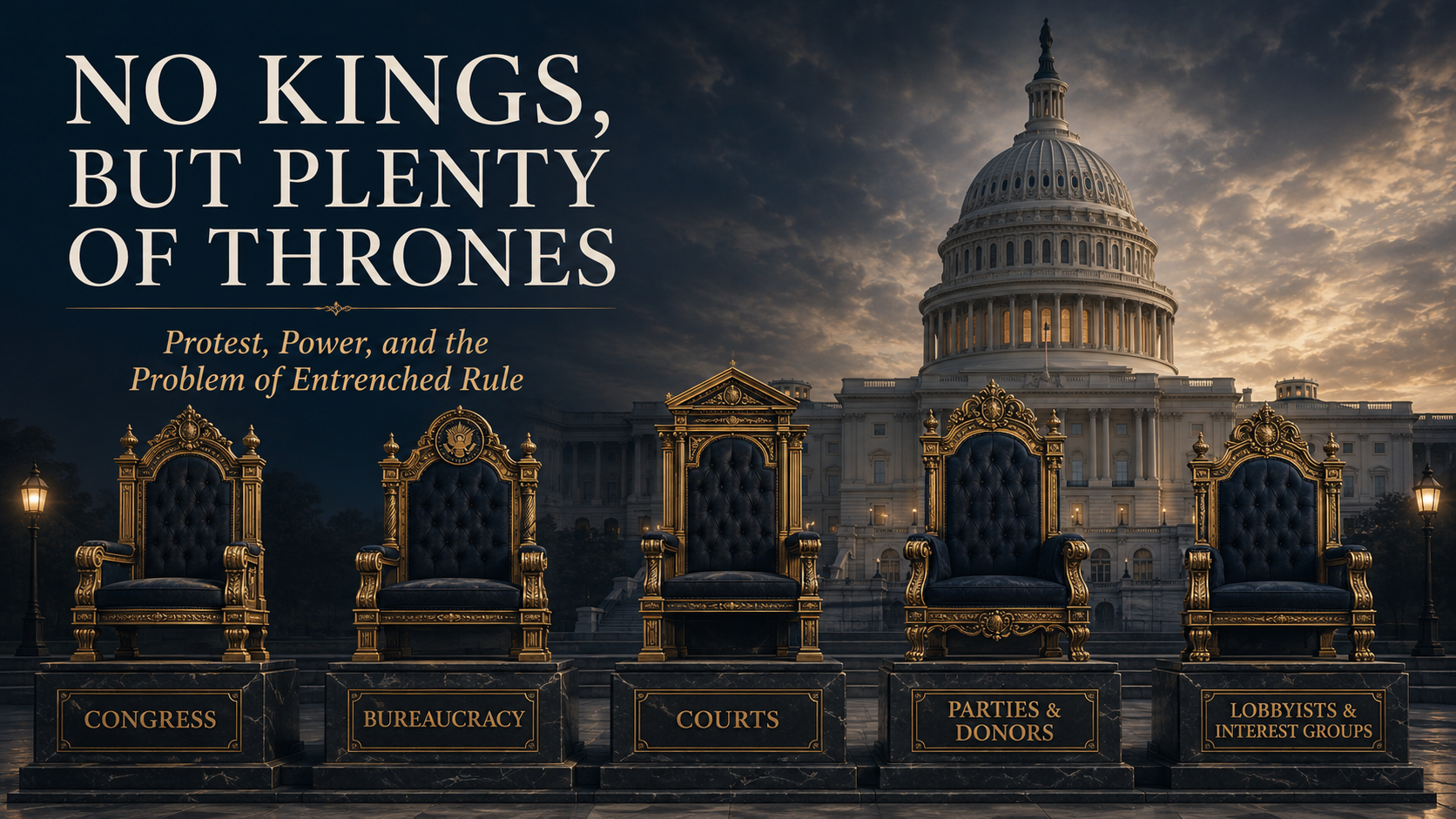
A Republic That Routinely Protests Presidents
Americans have long protested presidents and presidential power. This is not new, and it is not partisan. Citizens protested the Vietnam War under Lyndon Johnson and Richard Nixon. Millions marched worldwide against the Iraq War under George W. Bush. Immigration policies and executive actions, including DACA, drew both support and protest during Barack Obama’s presidency. More recently, large-scale demonstrations have responded to a wide range of policies and rhetoric under Donald Trump.
Protest against presidential power is not an aberration in American life. It is one of the recurring features of republican government.
The more important question is not simply whether Americans protest presidents. They always have, and almost certainly always will. The better question is whether those protests clarify the real location of power. Sometimes they do. At other times, they focus public anger on the most visible figure in government while leaving deeper structures of influence untouched.
That distinction matters because the American problem is rarely a monarchy in the literal sense. It is something quieter, more durable, and harder to dislodge: entrenched power.
A Catchy Slogan, but an Incomplete Diagnosis
The phrase “No Kings” is rhetorically powerful because it evokes arbitrary power, inherited privilege, and contempt for limits. It reminds Americans of one of the republic's founding instincts: executive power must be restrained, divided, challenged, and held accountable.
But as a literal description of American government, the phrase is imprecise. The United States does not operate under hereditary rule. Presidents are not kings. They remain constrained by elections, law, courts, Congress, federalism, public opinion, and constitutional institutions.
Yet many citizens who respond to the slogan are sensing something real. They are not necessarily describing a monarchy. They are describing power that feels distant, permanent, self-protective, and difficult to remove. That perception has less to do with crowns than with durability.
The House’s own historical office reports that 33 members have served 40 years or more in that chamber. The list includes Democrats and Republicans. It illustrates a broader point: in a republic, power can become remarkably durable without ever wearing a crown.
If there are “thrones” in American life, they are not crowns passed by bloodline. They are positions reinforced by time, structure, money, seniority, party machinery, name recognition, institutional advantage, and public inattention.
The Thrones We Actually Built
There is nothing inherently dishonorable about a long career in public service. Serious legislators learn how government works, how laws are written, how committees function, and how coalitions are built. A republic needs adults who understand its inner workings.
But there is also a danger when public office becomes less a temporary stewardship than a permanent profession.
Over time, incumbency can become self-reinforcing. Name recognition grows. Donor networks mature. Party leaders invest in the familiar. Committee assignments accumulate. Staff systems, constituent services, media access, and political relationships all become advantages that challengers rarely possess. The result is not a monarchy, but it can begin to feel like ownership.
This is the quieter version of entrenched power. It does not require crowns, titles, or hereditary succession. It operates through seniority, safe seats, fundraising, party machinery, committee assignments, and the sheer difficulty of dislodging someone who has spent decades building a political fortress.
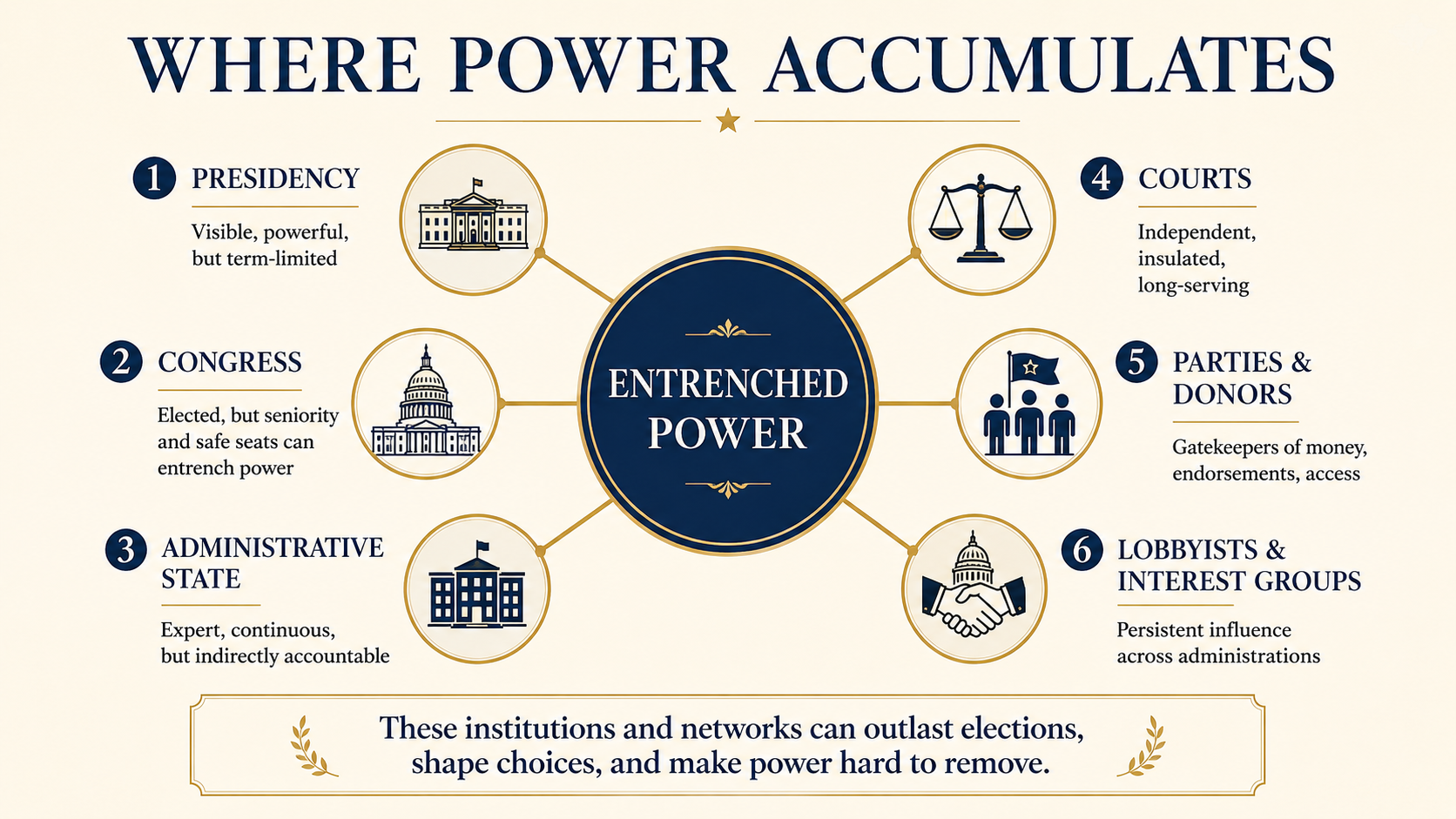
In that sense, the American “throne” is often not the presidency. It may be the congressional seat no one seriously contests, the committee chair who outlasts presidents, the party leader who controls access, the appointed official insulated from voters, or the political class that treats office as a career ladder rather than a temporary act of service.
That does not mean every long-serving politician is corrupt. Nor does it mean experience should be treated as a vice. But it does mean citizens should be honest about the incentives of political permanence. A person who spends decades in office may begin as a representative of the public and gradually become a guardian of the institution that sustains them.
That is not a uniquely Democratic or Republican problem. It is a human problem. Power tends to protect itself.
The Career Politician Problem
The phrase “career politician” is often used as an insult, but the real issue is more specific. The danger is not merely that someone has served for a long time. The danger is that public office can become a professional identity, a personal platform, and a source of institutional power so durable that democratic replacement becomes more theoretical than real.
In a healthy republic, office is supposed to be held, used responsibly, and eventually surrendered. That does not require mandatory term limits in every case, but it does require a political culture that remembers the difference between service and ownership.
Career politicians accumulate more than years. They accumulate relationships, favors, donors, procedural knowledge, institutional leverage, media access, and party protection. In Congress, seniority can translate into committee power. In state and local politics, long tenure can mean control over endorsements, appointments, contracts, and informal networks of influence. In both parties, the machinery tends to favor those already inside it.
This matters because protest often aims upward at the presidency, while entrenched power is often spread sideways through the system. Presidential power is visible. It is dramatic. It has a face, a name, a voice, and a motorcade. It is easy to oppose symbolically.
Legislative and institutional power are harder to see. They hide in rules, districts, committees, bureaucracies, donor circles, ballot access, and party structures. They persist quietly. Presidents come and go, but some political actors, staff networks, agencies, interest groups, and congressional leaders remain.
The current Congress illustrates part of this tension. The 119th Congress is somewhat younger than the previous one, but its median age remains 57.5 in the House and 64.7 in the Senate, according to Pew Research Center. Age itself is not the problem. But age, tenure, seniority, fundraising, and institutional power often travel together.
That is why protests aimed only at presidential symbolism can feel emotionally satisfying but politically incomplete. If the concern is concentrated power, then the question cannot be limited to who occupies the White House. It must also include who controls the committees, who writes the rules, who funds the campaigns, who draws the districts, who determines access, who regulates the regulators, and who benefits from a system that ordinary citizens often experience as immovable.
A republic does not need kings to develop thrones. It only needs power to become comfortable.
The Permanent Government
There is another kind of entrenched power that deserves careful treatment: the permanent government itself.
Some people call this the “deep state,” but that phrase often obscures more than it clarifies. It can imply a secret, coordinated conspiracy operating behind the elected government. That is usually the wrong frame. The more serious issue is the permanent administrative state: career officials, regulatory agencies, national-security institutions, legal offices, inspectors, analysts, and technical experts who remain in place as presidents, cabinet secretaries, and members of Congress come and go.
This permanence is not inherently sinister. Modern government is too complex to be run entirely by temporary political appointees. A serious republic needs expertise, continuity, institutional memory, scientific judgment, legal competence, and professional administration. We need people who understand tax systems, drug approvals, aviation safety, banking regulation, military logistics, public health, intelligence, environmental rules, food safety, and nuclear security. The public should not want every technical function of government reinvented after every election.
The scale is large. The Office of Personnel Management reports that roughly 2 million federal civilian employees serve in the federal workforce. That number should not be exaggerated into a shadow government. Most federal workers are not secret power brokers. Many are clerks, nurses, inspectors, analysts, park employees, law-enforcement personnel, engineers, physicians, scientists, and administrators doing ordinary work in ordinary offices.
But scale does matter. Large permanent institutions develop cultures. They develop habits, assumptions, internal loyalties, and informal ways of doing business. They can shape what options elected leaders see, how policies are interpreted, how quickly priorities are implemented, and which decisions become difficult to reverse.
That creates a legitimate democratic tension. Career expertise protects government from amateurism, corruption, and constant political whiplash. But career permanence can also frustrate electoral accountability. Experts may be right more often than politicians, but they are not automatically accountable merely because they are experts.
The current debate over Schedule Policy/Career, formerly associated with Schedule F, captures this tension. Supporters argue that policy-influencing career officials should be more accountable to elected leadership. Critics warn that weakening civil-service protections could politicize expertise, punish dissent, and turn professional administration into partisan compliance. Both concerns deserve to be taken seriously. A democratic government needs both competence and accountability. It should not have to choose only one.
That is the real issue. Not necessarily a hidden monarchy, but a government so large, specialized, and permanent that citizens often cannot tell who is actually responsible for a decision. Elected officials blame agencies. Agencies blame statutes. Courts blame precedent. Congress blames the executive. The executive blames career resistance. Everyone is involved, yet no one seems fully accountable.
This belongs in the same family as career politicians and safe seats. It is another way power becomes durable without becoming hereditary. It is another throne without a crown.
Wilson’s Accountability Paradox
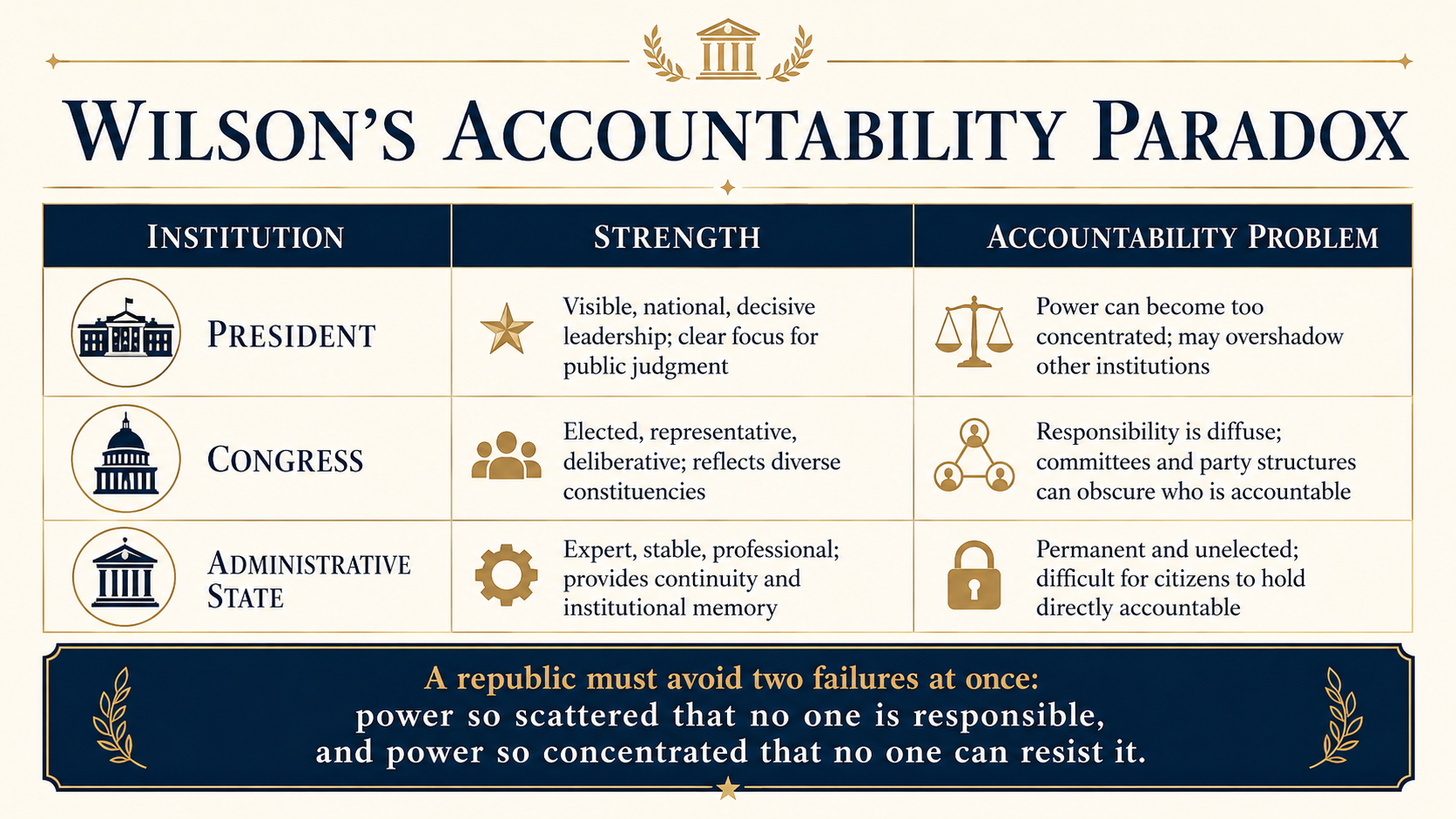
Woodrow Wilson, long before he became president, argued that Congress suffered from a basic accountability defect. Its power was real, but responsibility was diffuse. Committees made decisions. Party structures obscured responsibility. Legislative action was divided among many hands. Voters could be angry at Congress in general while finding it difficult to know whom, exactly, to hold responsible.
Wilson saw the presidency differently. The president was visible, national, and personally answerable in a way Congress was not. A president could speak for the whole country, set an agenda, and be judged by the public. In Wilson’s view, executive leadership could make democratic accountability clearer because responsibility had a name, a face, and an office.
But Wilson made that argument before the modern two-term limit on presidents. Today, the presidency is both powerful and time-limited. Congress is formally accountable to voters, but congressional power can become remarkably durable. A president may dominate the national conversation for four or eight years. A member of Congress, committee chair, party leader, judge, agency official, or institutional network may shape public life for decades.
That creates a modern paradox Wilson could not fully see. The president is more visible but temporary. Congress is less visible but potentially permanent. The bureaucracy is often unelected but continuous. The courts are insulated but enduring. Each part of the system solves one accountability problem while creating another.
A republic must therefore guard against two failures at once: power so scattered that no one is responsible, and power so concentrated that no one can effectively resist it.
What Peaceful Protest Actually Tells Us
Modern protest movements are often interpreted as signs of democratic breakdown. That reading is usually too simple. The First Amendment expressly protects “the right of the people peaceably to assemble, and to petition the Government for a redress of grievances.” The ability to gather, protest, disperse, and return to ordinary life is more often evidence of a functioning constitutional order, even if a strained one.
That does not mean everything is healthy. Protest can reflect frustration, distrust, and perceived institutional failure. People do not usually march because they believe ordinary politics is working beautifully. They march because they believe something important is being ignored, abused, threatened, or hidden.
But peaceful protest also reflects a system still capable of absorbing dissent without extinguishing it. In that sense, protest is not merely an act of opposition. It is a stress test of constitutional culture.
The test is not whether everyone agrees with the protest. They never will. The test is whether citizens can speak, assemble, criticize, organize, and return home without systematic state repression.
That is no small thing.
Why Protest Matters
Protest remains one of the most direct ways citizens can participate in public life outside of formal institutions. It allows individuals and groups — especially those without ready access to political power — to draw attention to grievances that might otherwise be ignored.
Throughout American history, protest has helped bring attention to civil rights, labor conditions, war, government accountability, women’s suffrage, policing, taxation, and constitutional limits. In that sense, protest serves an essential democratic function: it gives citizens a platform when ordinary politics seems unresponsive.
Just as importantly, protest can shape public understanding over time. Even when a protest does not produce immediate policy change, it can elevate issues, influence cultural norms, and create pressure for future action. Many significant reforms in American history were preceded by sustained public demonstration and civic engagement.
But protest is strongest when it is disciplined, focused, morally serious, and connected to institutional action. A protest can open the door. It rarely walks through the door by itself.
What Protest Looks Like Without Democracy
The meaning of protest becomes clearer when viewed beyond democratic systems. In authoritarian states, protest is often not absorbed as a normal civic act. It is treated as a threat to regime control.
China offers one version of this problem. Freedom House describes China as having one of the world’s most restrictive media environments, supported by extensive censorship and surveillance. Yet its China Dissent Monitor has still documented hundreds of protest or dissent events in a single quarter. Grievances remain real, but the state works aggressively to suppress information about them and prevent their consolidation into broader movements.
Iran offers a starker example. Amnesty International and Human Rights Watch have described repeated protest crackdowns marked by lethal force, arbitrary detention, disappearances, and severe abuses against detainees. Those responses are not incidental. They are part of the machinery by which an authoritarian system deters sustained dissent.
Russia’s recent anti-war and anti-dissent crackdowns point in the same direction. Human Rights Watch reports that authorities have intensified efforts to eradicate dissent through arrests, repressive legislation, punitive prison sentences, and the closure of civil society groups.
North Korea represents the outer limit of this pattern. Freedom House describes it as a one-party totalitarian dictatorship in which freedom of assembly is not recognized, surveillance is pervasive, and punishments for political offenses are severe. In such a system, open protest is not simply risky. It is nearly incompatible with the structure of the regime itself.
This contrast clarifies an important point. The ability to protest openly, organize at scale, criticize leaders, and return to ordinary life without systematic repression is not a universal condition. It is one of the distinguishing features of a functioning democratic order, however imperfect that order may be.
Why Many Protests Feel Important — but Incomplete
There is a reason many modern protests feel simultaneously meaningful and unsatisfying. A protest can signal dissent, demonstrate numbers, raise awareness, and recruit participants. But those are not the same as achieving policy change.
Recent research makes this distinction clearer. A review in Trends in Cognitive Sciences concluded that protest effectiveness depends on the type of action, the audience, and the outcome being measured. A 2024 National Bureau of Economic Research working paper examining 14 U.S. social movements from 2017 to 2022 found that protests generated substantial internet activity but, on average, had limited effects on public opinion and political attitudes, with Black Lives Matter after George Floyd’s murder standing out as a notable exception.
The lesson is not that protest is useless. It is that protest, by itself, is usually an incomplete political instrument.
This helps explain a common modern experience: a protest can feel significant in the moment while leaving unclear what, concretely, has changed.
Part of the problem is that many contemporary protests are broad umbrella events. They combine multiple grievances, constituencies, slogans, and policy concerns into one gathering. That breadth can generate impressive turnout, but it can also blur the central demand. A movement broad enough to include almost every grievance may struggle to define what victory would actually look like.
A protest against a king has a clear target. A protest against entrenched power has a harder task. It must identify not only who is being opposed, but what structures need to change.
When Protest Becomes Effective
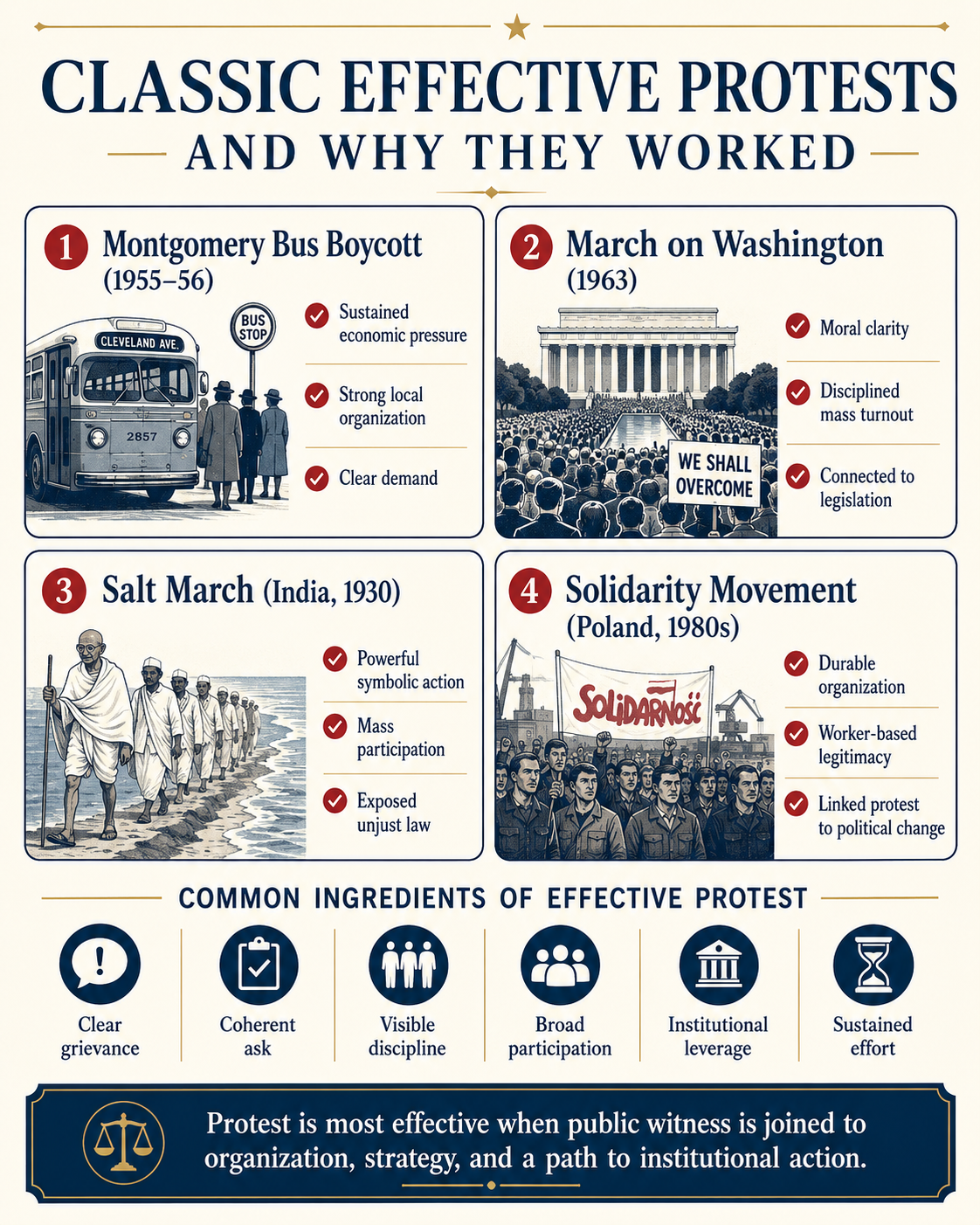
History suggests that protests are most effective when several conditions are met: a clear grievance, a coherent ask, visible discipline, moral legitimacy, institutional connection, and sustained effort.
The civil rights movement remains the clearest example. The National Park Service notes that an estimated 250,000 people attended the March on Washington for Jobs and Freedom in 1963, and it credits the march with helping spur the Civil Rights Act of 1964 and the Voting Rights Act of 1965. What gave the event unusual force was not crowd size alone. It was the way public witness was joined to leadership, organization, moral clarity, and legislative purpose.
The March on Washington did not succeed merely because people gathered. It succeeded because the gathering was connected to a larger movement, a clear moral claim, a disciplined strategy, and a legislative agenda.
That is a useful lesson for the present. If citizens are concerned about presidential overreach, protest may be appropriate. If citizens are concerned about entrenched power, protest may also be appropriate. But the next question must be harder: what form of accountability follows?
Does the protest lead to voting? Candidate recruitment? Primary challenges? Institutional reform? Campaign finance scrutiny? Redistricting reform? Term-limit debates? Congressional oversight? Civil-service reform? Agency transparency? Local engagement? Civic education? Legal action? Legislative proposals?
Without those next steps, protest can become a form of civic expression without civic consequence.
From Protest to Accountability
If the deeper concern is entrenched power, then citizens should look beyond the presidency. The presidency matters enormously, but it is not the only place where power accumulates.
Power accumulates in Congress. It accumulates in agencies. It accumulates in courts. It accumulates in state legislatures, city councils, school boards, county offices, party committees, lobbying networks, donor circles, media ecosystems, advocacy organizations, and bureaucratic institutions. It accumulates anywhere influence becomes durable and accountability becomes weak.
That is why a serious critique of power must be broader than a slogan. It must ask whether representatives are genuinely representative. It must ask whether districts are competitive. It must ask whether party primaries reward seriousness or extremism. It must ask whether campaign finance gives ordinary citizens a meaningful voice. It must ask whether long-serving officials remain public servants or become institutional landlords.
It must also ask whether voters have become too comfortable outsourcing citizenship to periodic outrage. Protest can be noble. Protest can be necessary. But a republic ultimately requires more than attendance at a march. It requires attention, patience, local engagement, institutional memory, and the willingness to replace leaders who have confused public service with entitlement.
This is where the “No Kings” slogan can become more useful. Taken literally, it exaggerates the American condition. Taken seriously, it asks the right question: how much power should any one person, office, institution, party, agency, court, bureaucracy, donor class, or political career be allowed to accumulate?
That question should not be reserved for presidents.
The More Important Question
So the central question is not whether Americans protest presidents. They always have, and likely always will.
The more important question is this: are protests clarifying problems and advancing solutions, or simply amplifying dissatisfaction?
If the deeper American challenge is not monarchy but entrenched power, then protests aimed only at presidential symbolism risk missing the broader structure of influence. The presidency is powerful, visible, and worthy of scrutiny. But some of the most durable power in American life sits elsewhere: in safe seats, seniority systems, party machinery, donor networks, bureaucratic structures, courts, agencies, and political careers that become nearly indistinguishable from the offices themselves.
Woodrow Wilson’s paradox still lingers over the system. Congress can be too diffuse to hold responsible. The presidency can be too concentrated to restrain. The bureaucracy can be too permanent to fully supervise. The courts can be too insulated to feel accountable. Each institution checks another, but each also develops its own forms of power.
And if peaceful protest ends with a return to ordinary life, that does not necessarily indicate a failure of democracy. It may suggest something more complicated and more American: a republic that is noisy, frustrated, imperfect, and still resilient enough to absorb dissent without collapsing under it.
That is not a trivial fact. It may be one of the clearest signs that the system, however strained, continues to function.
But resilience should not become complacency. A republic can survive protest and still suffer from entrenched rule. It can reject kings and still build thrones. It can celebrate accountability while quietly rewarding permanence.
The slogan “No Kings” captures a real American instinct: power should be limited, temporary, accountable, and subject to challenge. But if that instinct is to mean anything, it must apply not only to presidents we oppose, but also to the quieter structures of power we have learned to tolerate.
A republic does not need kings to lose its balance.
It only needs citizens to stop noticing how long some people have been sitting on the throne.
References
History, Art & Archives, U.S. House of Representatives. Members With 40 Years or More House Service. Last updated January 3, 2026. Accessed April 1, 2026.
Library of Congress. U.S. Constitution — First Amendment. Accessed April 1, 2026.
Wilson W. Congressional Government. 1885.
Wilson W. Constitutional Government in the United States. 1908.
National Constitution Center. Twenty-Second Amendment. Accessed July 2026.
Pew Research Center. Age and Generation in the 119th Congress: Somewhat Younger, With Fewer Boomers and More Gen Xers. Published January 16, 2025.
U.S. Office of Personnel Management. Federal Workforce Data: Workforce Size and Composition. Accessed July 2026.
Congressional Research Service. Schedule Policy/Career: 2026 Final Rule, Legal Considerations. Published March 26, 2026.
U.S. Office of Personnel Management. OPM Finalizes Schedule Policy/Career Rule to Strengthen Accountability. Published February 2026.
National Park Service. March on Washington for Jobs and Freedom. Last updated November 20, 2023. Accessed April 1, 2026.
National Constitution Center. 3.1 Info Brief: Summary of Shays’ Rebellion. Accessed April 1, 2026.
Alcohol and Tobacco Tax and Trade Bureau. The Whiskey Rebellion. Accessed April 1, 2026.
National Park Service, Pullman National Historical Park. The Strike of 1894. Last updated December 29, 2022. Accessed April 1, 2026.
NC State University Libraries Special Collections. The Moratorium to End the War in Vietnam. Published June 23, 2011. Accessed April 1, 2026.
Shuman E, Goldenberg A, Saguy T, Halperin E, van Zomeren M. When are social protests effective? Trends in Cognitive Sciences. 2023. doi:10.1016/j.tics.2023.10.003.
Gethin A, Pons V. Social Movements and Public Opinion in the United States. National Bureau of Economic Research Working Paper 32342. Published April 2024.
U.S. Department of Homeland Security. Napolitano J. Exercising Prosecutorial Discretion with Respect to Individuals Who Came to the United States as Children. June 15, 2012.
Freedom House. China: Freedom in the World 2024 Country Report. Accessed April 1, 2026.
Amnesty International. What Happened at the Protests in Iran? Published January 26, 2026. Accessed April 1, 2026.
Human Rights Watch. World Report 2024: Russia. Published 2024.
Freedom House. North Korea: Freedom in the World 2025 Country Report. Accessed April 1, 2026.
