
Lowering the Temperature on Climate Change
A realist case for energy abundance, public trust, and nuclear seriousness
Climate change sits at the intersection of science, energy, economics, politics, national security, agriculture, healthcare, litigation, celebrity activism, corporate incentives, and public trust. That makes it unusually vulnerable to distortion. One side sometimes speaks as if catastrophe is certain, imminent, and morally obvious. The other sometimes speaks as if uncertainty means nothing serious is happening. Neither position is good enough.
The firmer starting point is quieter: Earth is warming, human greenhouse-gas emissions are the dominant cause of recent warming, and the risks are real. The Intergovernmental Panel on Climate Change states that human activities, principally through greenhouse-gas emissions, have “unequivocally caused global warming,” and NASA summarizes the evidence as broad and consistent: rising global temperature, warming oceans, shrinking ice sheets, glacier retreat, declining Arctic sea ice, and sea-level rise.
But saying climate change is real does not settle the policy debate. It does not automatically tell us which policies are affordable, fair, scalable, reliable, or politically durable. It does not mean every wildfire, flood, drought, or hurricane was “caused by climate change” in a simple one-factor sense. It does not prove every green subsidy is wise. It does not make every celebrity advocate an energy expert. It does not erase the fact that energy is the foundation of modern life.
A serious climate argument has to hold several ideas at once: the science is strong, the future is uncertain, the rhetoric has often been poor, fossil-fuel dismissal is not credible, energy security is non-negotiable, and any solution that feels like scarcity will struggle to survive democratic politics.
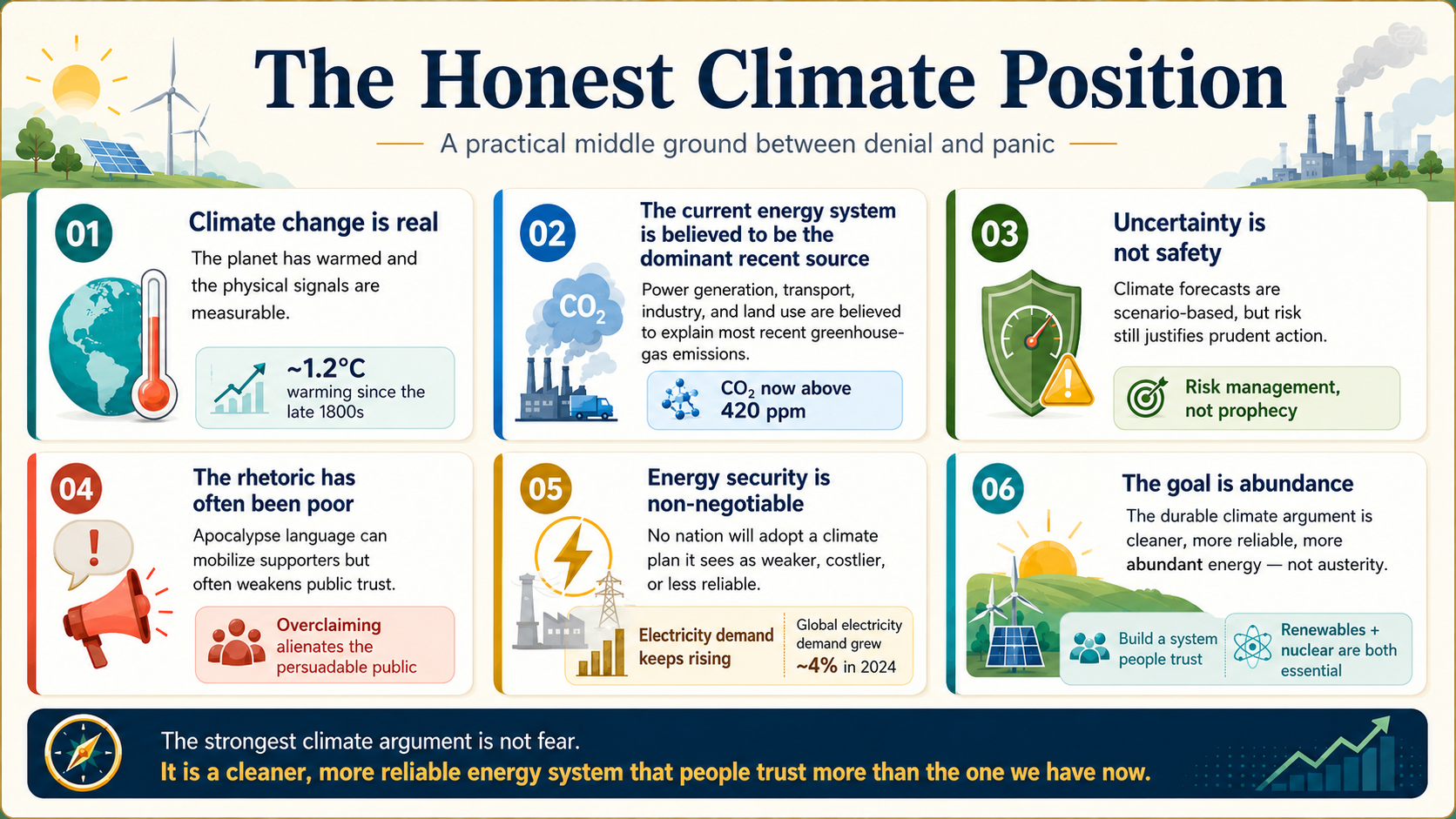
A balanced climate position begins with two truths at once: climate change is real, and the public debate has often been poorly framed. The strongest argument is not fear or accusation, but practical energy realism: reduce avoidable emissions, preserve reliability, take nuclear seriously, and build a cleaner energy system people can trust.
The problem with “believe the science”
“Believe the science” is a weak phrase, even when the science is strong. It asks the public to accept a conclusion without helping people understand what kind of evidence supports it, where uncertainty remains, and what tradeoffs follow.
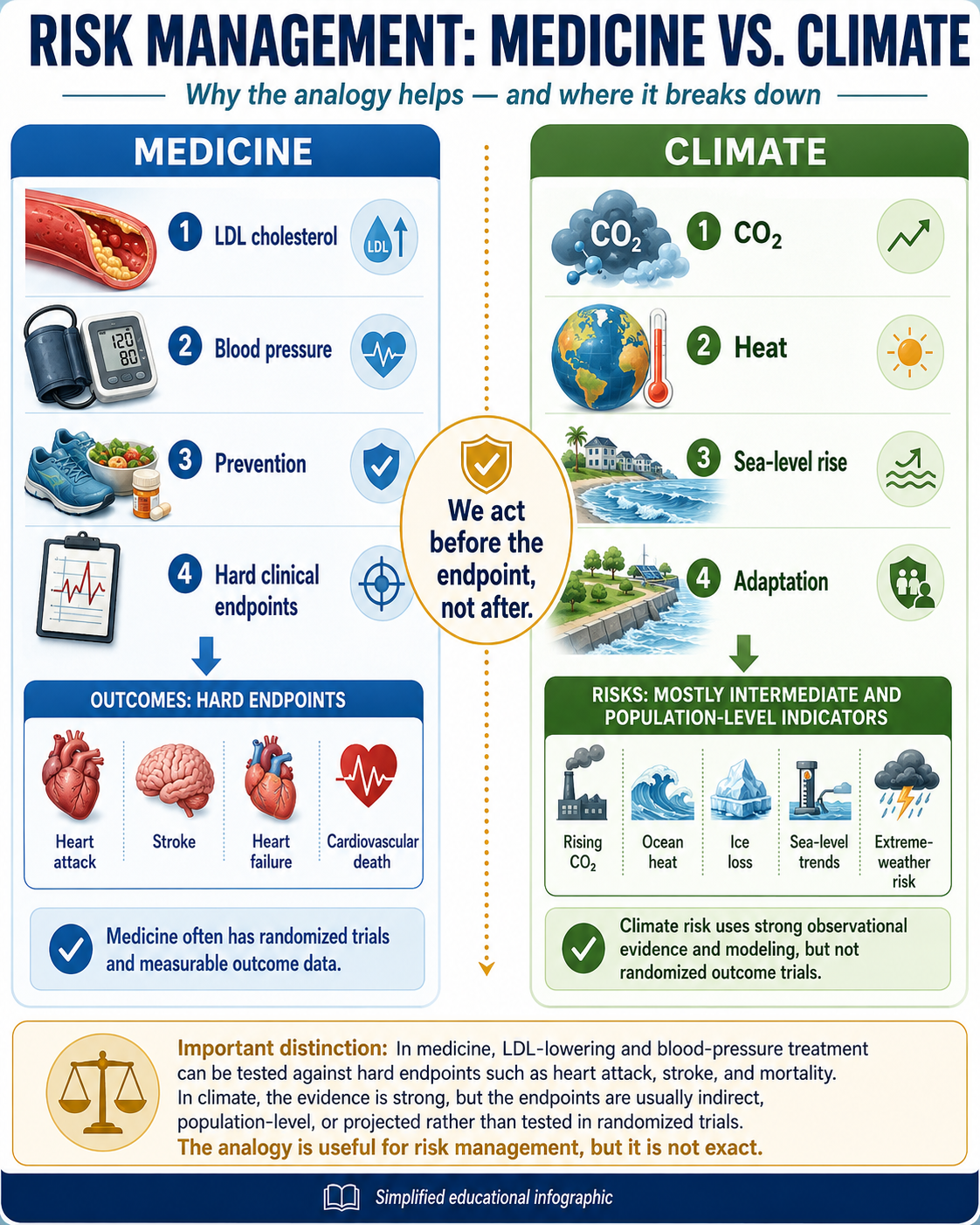
In medicine, we rarely ask patients to “believe the science” in the abstract. We explain risk. High LDL cholesterol increases cardiovascular risk. Hypertension increases the risk of stroke, heart failure, and kidney disease. Smoking increases cancer and cardiovascular risk. The endpoints are visible: myocardial infarction, stroke, hospitalization, death.
Climate change is different. Its strongest evidence is cumulative and distributed: average temperature, ocean heat content, greenhouse-gas concentrations, ice mass, sea level, regional extremes, and long-term projections. The most severe harms are often discussed as future risks. That creates a public proof problem. People do not live inside confidence intervals. They live inside grocery bills, electric bills, insurance premiums, gasoline prices, family budgets, and local weather.
That is why climate change is best framed not as prophecy, but as risk management.
We do not treat hypertension because every patient will have a stroke. We treat it because the risk is real, measurable, biologically plausible, and modifiable. We do not buy insurance because we know our house will burn down. We buy it because the downside is large enough to justify preparation. Climate policy should be argued in the same spirit: not as guaranteed apocalypse, but as a serious risk that becomes harder and more expensive to manage the longer it is ignored.
That analogy has limits, however. Cardiovascular medicine has hard outcome trials. Climate policy does not. We cannot randomize one planet to fossil-fuel dependence and another to rapid decarbonization, then compare outcomes over a century. We cannot prove in advance exactly how many fires, floods, crop failures, insurance crises, or heat deaths will be prevented by a given policy.
The honest claim is narrower but still important: if human emissions are adding heat-trapping gases to the atmosphere, then reducing those emissions should reduce the amount of additional warming pressure we impose on the system. That does not mean every proposed climate policy is wise. It does not mean benefits will be obvious next year. It does not mean natural variability disappears. It means that reducing a known driver should reduce future risk.
Science changes — and that should make us humble
One of the hardest things to explain to the public is that science can be both reliable and provisional. In medicine, we see this repeatedly. Treatments once considered logical fall out of favor. Treatments once viewed with suspicion become standard care.
The history of beta-blockers in heart failure is a useful example. Older teaching warned against them because they could weaken cardiac contraction. Over time, clinical trials and outcome data changed the field. Today, evidence-based beta-blockers are part of guideline-directed therapy for heart failure with reduced ejection fraction. That was not a small adjustment. It was a reversal.
Climate science is different from clinical medicine in important ways. It does not have randomized trials with hard endpoints in the same way cardiovascular medicine does. We cannot run a controlled experiment on two Earths. We cannot know exactly how climate science will look 50, 100, or 200 years from now. Some current assumptions may be refined. Some models may improve. Some risk estimates may be revised downward. Others may be revised upward. Some processes we currently understand poorly — clouds, aerosols, ocean dynamics, regional extremes, feedback loops, ecosystem change — may look very different to future scientists.
That possibility should not lead to nihilism. The fact that science changes does not make it useless. It means we act on the best evidence available while remaining humble enough to revise when better evidence arrives. In medicine, we still treat patients using the best evidence available now, while remaining open to better evidence later. Climate should be approached the same way. The current evidence for warming, greenhouse-gas forcing, rising CO₂, and ocean heat uptake, is strong enough to take seriously. But the complexity of the system should restrain the rhetoric. Good science does not need theatrical certainty.
Climate has always changed — but that does not dismiss modern warming
A common skeptical point deserves respect: Earth is about 4.5 billion years old, and climate has changed dramatically many times. There have been ice ages, warm periods, volcanic episodes, orbital cycles, ocean-circulation changes, and large natural shifts before modern industry existed.
The modern instrumental temperature record is short compared with Earth history — roughly since the late 19th century. Deep-time climate records are reconstructed from proxies: ice cores, ocean sediments, fossils, isotope ratios, cave deposits, tree rings, corals, and ancient soils. These are not thermometer readings. They are models, and the farther back we go, the less precise they become.
But that does not make them useless. The deep climate record is reliable for broad patterns, not exact annual temperatures. It shows that climate can change substantially, that greenhouse gases matter, that ice sheets and oceans appear to respond, and that rapid changes may be disruptive. The fair statement is not “climate has always changed, therefore humans cannot be responsible.” The fair statement is: climate has always changed, so the question is whether the current change is real, unusually rapid by human-civilization standards, and substantially driven by the current energy grid.
On that core question, the evidence is strong. The IPCC’s conclusion is not based on 150 years of thermometer data alone. It rests on physics, observed warming patterns, greenhouse-gas measurements, ocean heat, paleoclimate context, and comparisons between observed changes and known natural drivers.
Why scientists point to human activity
A careful climate argument has to explain why scientists are so confident about “human” influence without turning the discussion into an accusation. The claim should not be that every person driving to work, heating a home, flying to see family, or buying ordinary goods is personally “to blame” in some moral sense. Most of us live inside an energy system we did not design. Modern life was built on coal, oil, and natural gas because they are dense, reliable, transportable, and historically inexpensive. They powered industrial growth, hospitals, transportation, food production, housing, national defense, and the conveniences of everyday life.
That reality deserves humility, not finger-pointing.
But humility about blame should not obscure the evidence. Scientists are highly confident that our current energy grid is the dominant recent driver of warming because the evidence comes from several independent directions. Greenhouse gases trap heat; that basic physics has been understood since the 19th century. Atmospheric carbon dioxide has risen sharply since industrialization. NOAA states that fossil fuels are the only source large enough to raise atmospheric CO₂ so high so quickly, and the fossil-fuel fingerprint is visible in atmospheric carbon because fossil fuels are depleted in carbon-13 and contain no carbon-14. NASA also states that the Sun cannot explain the recent warming trend.
Attributing climate disasters to these changes is not based on one thermometer record or one computer model. It is the convergence of physics, chemistry, observational studies, and pattern matching. The lower atmosphere has warmed, the oceans have absorbed heat, ice has declined, and sea level has risen. At the same time, known natural explanations, such as solar variation, volcanic activity, orbital cycles, and internal ocean-atmosphere variability, do not adequately reproduce the scale and pattern of recent global warming.
That distinction matters for public trust. Saying humans are the dominant recent driver is not the same as saying ordinary people are reckless, selfish, or immoral. It means the industrial energy system that lifted billions of people into modern life also changed the chemistry of the atmosphere. That is a hard truth, but it is not a moral indictment of daily life. It is a systems problem. And systems problems are solved less by shaming people than by building better systems.
The measurement problem is real
A serious climate argument should acknowledge that climate measurement is not infallible. The planet is not a laboratory instrument. Temperature records come from land stations, ocean measurements, satellites, historical records, and proxy evidence. Over time, stations move, instruments change, cities expand, airports grow, pavement appears, observation practices shift, and new data systems replace older ones.
That is a lot of moving parts. It is enough to make even a generally sympathetic reader cautious.
NASA explicitly acknowledges that urban heat islands are real, while stating that the effect does not significantly explain overall global warming because scientists account for it in global analyses. NASA’s GISTEMP documentation also describes how temperature records are adjusted and analyzed to address issues such as changing instrumentation and urbanization.
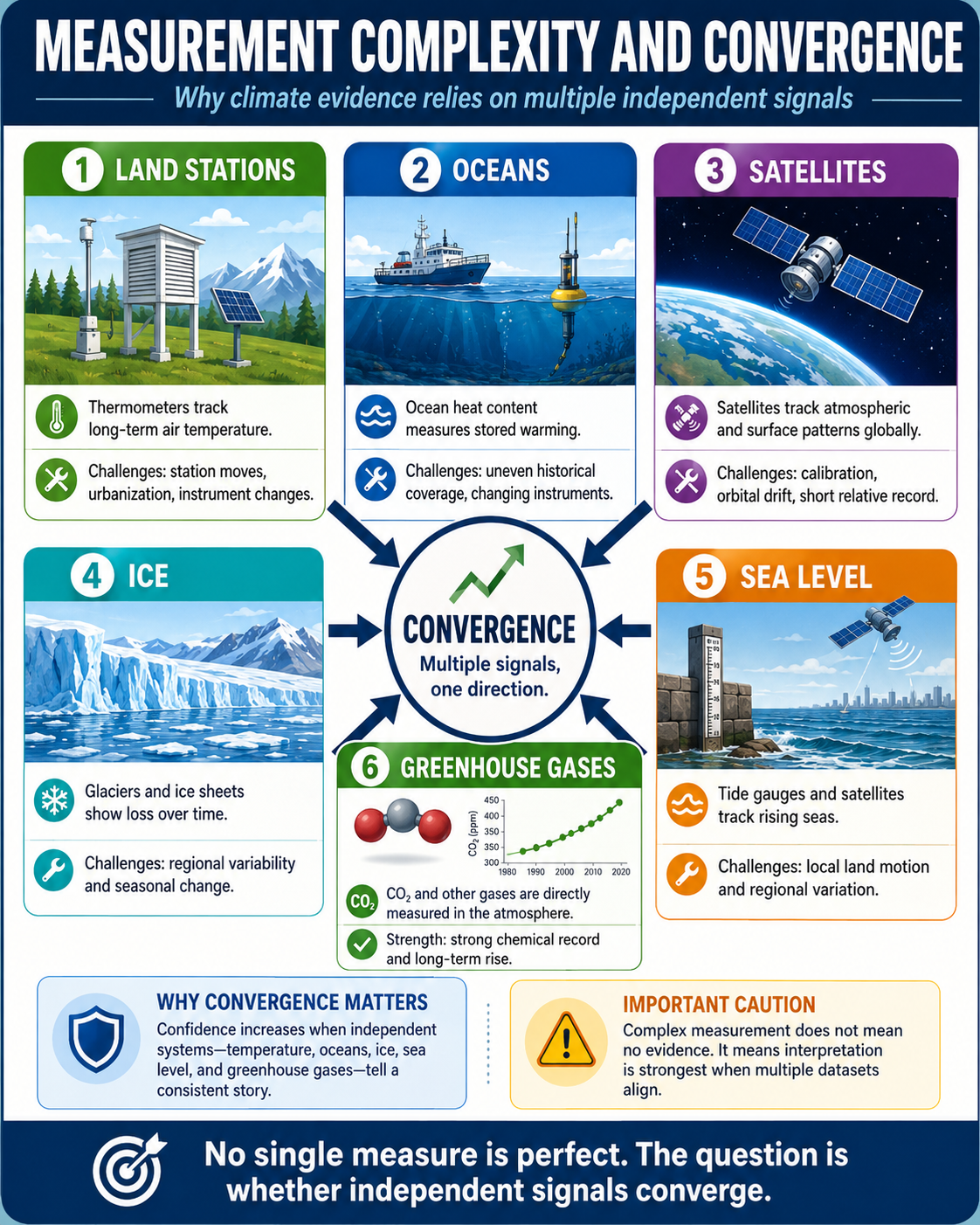
That does not mean every adjustment is beyond question. It does mean the issue is not being ignored. The stronger climate case is not that every measurement station is pristine. It is that the warming signal appears across multiple independent systems: land stations, ocean measurements, satellites, ocean heat content, glacier retreat, sea-level rise, and Arctic sea-ice decline.
Skeptics sometimes point to Mars and ask whether warming or climate variability on another planet weakens the case for human-caused warming on Earth. The question is fair. NASA’s Mars Global Surveyor documented possible climate change on Mars, including polar-cap changes. But Mars is not Earth. Mars has a thin atmosphere, no oceans, no industrial emissions, no Earth-like biosphere, and a climate system strongly shaped by dust and surface reflectivity. Mars reminds us that planets can change naturally. It does not explain away the fossil-fuel fingerprint, ocean heat, atmospheric chemistry, and vertical warming pattern observed on Earth.
The public deserves humility here. Climate science should be defended by convergence, not by pretending every measurement is perfect.
The Double Uncertainty Problem
Climate change is harder to argue than many medical risks because uncertainty exists at both ends of the chain. In cardiovascular medicine, the measurement and the outcome are often concrete. LDL cholesterol can be measured in a laboratory. Blood pressure can be measured in a clinic. Drugs can be tested in randomized trials. The outcomes — myocardial infarction, stroke, heart failure hospitalization, cardiovascular death — are real, countable, and clinically visible.
Climate is different. The measurements are more complex, and the outcomes are more diffuse. Temperature records depend on land stations, ocean measurements, satellites, historical adjustments, and proxy evidence. Each method has limitations. Stations move. Cities grow. Instruments change. Ocean measurements evolve. Satellites require calibration. Proxy records are indirect. That means the public is justified in asking how the measurements are constructed and how reliable they are.
The outcome side is also harder. Climate change does not usually present as a single endpoint like death from myocardial infarction. It presents as changed probabilities and accumulating pressures: more heat risk, rising sea level, ocean warming, shifting rainfall patterns, drought stress, wildfire conditions, crop vulnerability, insurance costs, migration pressure, and infrastructure strain. These are consequential, but they are not as cleanly measurable as a death certificate or a hospital admission. The harm is distributed across time, geography, ecology, economics, and public health.
That double uncertainty creates a real communication problem. Advocates sometimes speak as though the evidence has the simplicity of a clinical trial, while skeptics sometimes treat complexity as proof that nothing is really known. The better position is to say that climate evidence is not trial-based medicine; it is convergence-based risk science. No single measurement is perfect, and no future outcome can be proven in advance. But many independent signals point in the same direction, and the causal chain is strong enough to justify prudent action.
The honest argument is that we cannot prove exactly which future harms will be prevented by a specific policy. The honest argument is that adding heat-trapping gases to the atmosphere likely increases risk, and reducing avoidable emissions, waste, methane leaks, and energy inefficiency should reduce that risk. That is a weaker proof structure than a cardiovascular outcomes trial, but it is still a serious basis for policy, especially when the solutions may also improve energy security, air quality, and infrastructure.
Climate science has dissenters too
A fair climate essay should acknowledge that the scientific community is not monolithic. The mainstream conclusion remains strong: the existing energy grid has warmed the atmosphere, ocean, and land. But there are credentialed scientists and scholars who dissent from parts of the dominant climate narrative.
Those dissenters are not all saying the same thing. Some accept grid-caused warming but argue that uncertainty is underplayed. Some believe climate models run too hot or that natural variability has been minimized. Some focus less on the physics and more on policy, arguing that mitigation is costly, legally overextended, or unlikely to produce measurable benefits soon enough. Others reject much more of the mainstream risk assessment.
These voices should not be dismissed simply because they complicate the story. Good science needs skeptics. A field that cannot tolerate hard questions becomes brittle. At the same time, dissent does not automatically carry equal weight. A credentialed scientist can be useful, mistaken, selective, or outside their strongest domain of expertise. Minority views deserve consideration; they do not automatically overturn the larger body of evidence.
The public loses confidence when dissent is treated as heresy. It also loses confidence when dissent is used to imply that nothing is known. The honest position is narrower but stronger: climate science contains uncertainty, disagreement, and minority views, but the central conclusion that the current energy grid has warmed the planet remains well supported.
Where climate advocacy went wrong
Climate advocacy has done some good. It forced climate risk into the public conversation. It pushed governments, companies, universities, investors, and voters to take emissions seriously. Without activists, climate change might still be treated as a narrow technical subject rather than a public-policy issue.
But advocacy has also damaged trust.
Too often, climate messaging has relied on apocalypse, moral accusation, exaggerated certainty, and one-size-fits-all policy demands. Every fire, flood, hurricane, or drought gets pulled into the climate narrative before the causal chain is explained. Sometimes climate change increases the probability or severity of events. But disasters are multifactorial. Wildfire depends on ignition, fuel, land management, weather, housing patterns, development choices, utility infrastructure, invasive grasses, and suppression history. Climate change may dry the kindling, but it is not usually the lighter.
If advocates say every disaster is climate change, skeptical readers hear manipulation. If skeptics say climate change has nothing to do with disasters, they ignore the way warming can change the odds and intensity of some events. The honest position lies between slogan and denial.
Climate rhetoric also suffers from green marketing. Some “net zero” claims depend on offsets or accounting strategies that may not reduce real emissions. Carbon offsets can be legitimate, but they can also become a loophole: companies can claim climate virtue without deeply changing their own emissions.
None of this disproves climate change. It shows that climate rhetoric can become sloppy, moralized, and self-protective.
The messenger problem
Climate science becomes harder to hear when the public face of the issue is not science but politics, celebrity, or moral theater.
John Kerry is a useful example. Kerry is not a climate scientist. He is a political and diplomatic actor. His role was to translate climate concern into international policy agreements. That role is legitimate, but it is not scientific authority. When politicians become the public face of climate science, the issue inevitably sounds partisan — even when the underlying science is not.
Celebrity activists create a related problem. Entertainers and public figures can raise money, normalize behavior, tell stories, pressure institutions, and bring attention to issues the public might otherwise ignore. Visibility is not worthless. But visibility is not expertise.
A celebrity can make climate change visible. A celebrity cannot make climate policy workable. This is not an argument for silencing non-scientists. Public issues need public voices. It is an argument for role clarity. Scientists should explain evidence. Engineers should explain feasibility. Economists should explain cost. Policymakers should explain tradeoffs. Advocates can mobilize attention. Confusion begins when attention is treated as authority.
Public trust is now part of the climate problem
The climate debate does not occur in a high-trust society. Pew reported in January 2026 that 77% of U.S. adults say they have a great deal or fair amount of confidence in scientists to act in the public’s best interests, but it also noted that confidence remains below early-pandemic levels and is politically divided. Gallup reported in July 2026 that Americans’ average confidence in core institutions was 27%, near historic lows. In that environment, climate advocates cannot simply demand trust. They have to earn it. That means measured claims, transparent uncertainty, clear separation between evidence and advocacy, honest accounting of costs, and a willingness to confront conflicts of interest on all sides.
When climate science enters the courtroom
Extreme-event attribution is one of the most important recent developments in the climate debate. It attempts to estimate whether, and to what extent, human-caused climate change influenced a specific heat wave, rainfall event, drought, wildfire condition, hurricane, or other event. This is real science. It should not be dismissed as fake simply because lawyers and regulators care about it. The National Academies’ report says extreme-event attribution has advanced and can provide information useful for public understanding, planning, risk management, scientific research, and policy and legal contexts. The same report also highlights continuing challenges and the need for careful methods.
That legal relevance matters. Once climate science enters lawsuits, permitting challenges, damages claims, and climate-liability statutes, its credibility depends on transparency far more than institutional prestige. The public is justified in asking: who funded the report, who served on the committee, what assumptions were used, how strong is the confidence by event type, and where does science stop and advocacy begin? The problem is not that attribution science exists. The problem is that high-stakes uses of attribution science require unusual discipline.
Conflicts of interest exist on both sides
Climate debates are not populated by pure truth-tellers on one side and corrupt actors on the other. They are full of incentives. The fossil-fuel side has the most obvious conflict. Coal, oil, and gas companies have enormous financial exposure to climate policy. Aggressive decarbonization can reduce demand, strand assets, restrict drilling, raise compliance costs, and change investment flows.
But the climate-action side is not incentive-free. Renewable-energy firms, battery companies, EV manufacturers, nuclear developers, carbon-credit brokers, consultants, nonprofits, universities, and political organizations can all benefit from climate urgency. The International Energy Agency estimates that global energy investment in 2025 will reach $3.3 trillion, with about $2.2 trillion going to clean energy and $1.1 trillion to oil, gas, and coal. Climate finance is now a vast ecosystem, not a small moral campaign.
Climate Policy Initiative estimated that global climate finance reached $1.9 trillion in 2023, with mitigation finance at about $1.78 trillion, adaptation at $65 billion, and dual-benefit finance at $58 billion. That scale creates its own incentives, lobbying, institutional growth, and potential for greenwashing.
The presence of a conflict does not automatically make a claim false. But whenever money, ideology, reputation, or power is involved, the first question should be: who benefits if I believe this?
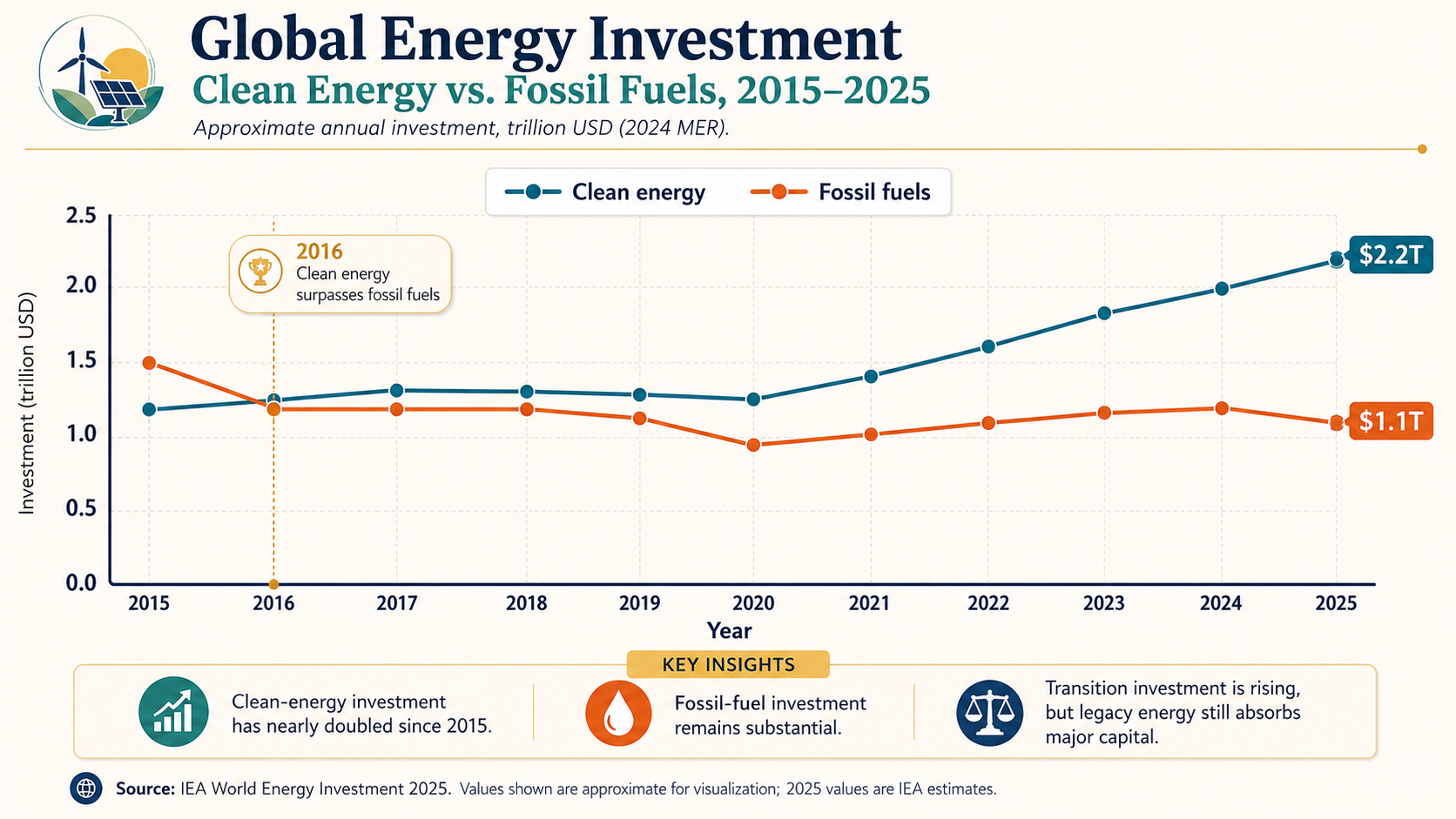
Clean-energy investment has climbed rapidly and now exceeds fossil-fuel investment, but fossil fuels still attract enormous capital. The energy transition is underway, yet the old system remains heavily financed.
Emissions, investment, and per-capita responsibility
Countries can be compared by how much carbon they generate, how much they invest in cleaner energy, how much they emit per person, and how much they have emitted historically. Each metric tells a different story. By total current emissions, EDGAR’s 2025 report identifies China, the United States, India, the EU27, Russia, and Indonesia as the world’s largest greenhouse-gas emitters in 2024; together, they account for 61.8% of global GHG emissions, 64.2% of fossil-fuel consumption, 62.5% of global GDP, and 51.4% of global population.
Investment tells a different story. BloombergNEF estimated that global energy-transition investment reached a record $2.3 trillion in 2025. China was the largest national market at about $800 billion, followed by the European Union at $455 billion, the United States at $378 billion, and India at $68 billion. In other words, China is both the world’s largest emitter and the world’s largest clean-energy investor.
Per-capita emissions complicate the morality map even further. Our World in Data emphasizes that per-capita emissions vary widely among countries and that production-based emissions count fossil CO₂ produced within a country’s borders rather than emissions embedded in imports. China emits more in total than any other country, but wealthy and fossil-fuel-producing countries often emit far more per person. India is a major total emitter because of its population, but its per-person emissions remain far below those of the United States, Russia, Canada, and Australia.
That means the climate debate changes depending on the question asked. If the question is who emits the most now, China dominates. If the question is who emits heavily per person, wealthy and fossil-fuel-producing countries rise to the top. If the question is who is investing most in the transition, China again leads by a wide margin, followed by the EU and the United States. If the question is who still needs more energy to develop, India and much of Africa look very different from high-income economies.
The better conclusion is not that one country is virtuous and another is guilty. The better conclusion is that every major country faces a different version of the same problem: reduce emissions without weakening energy security, economic growth, public health, industrial capacity, or political stability.
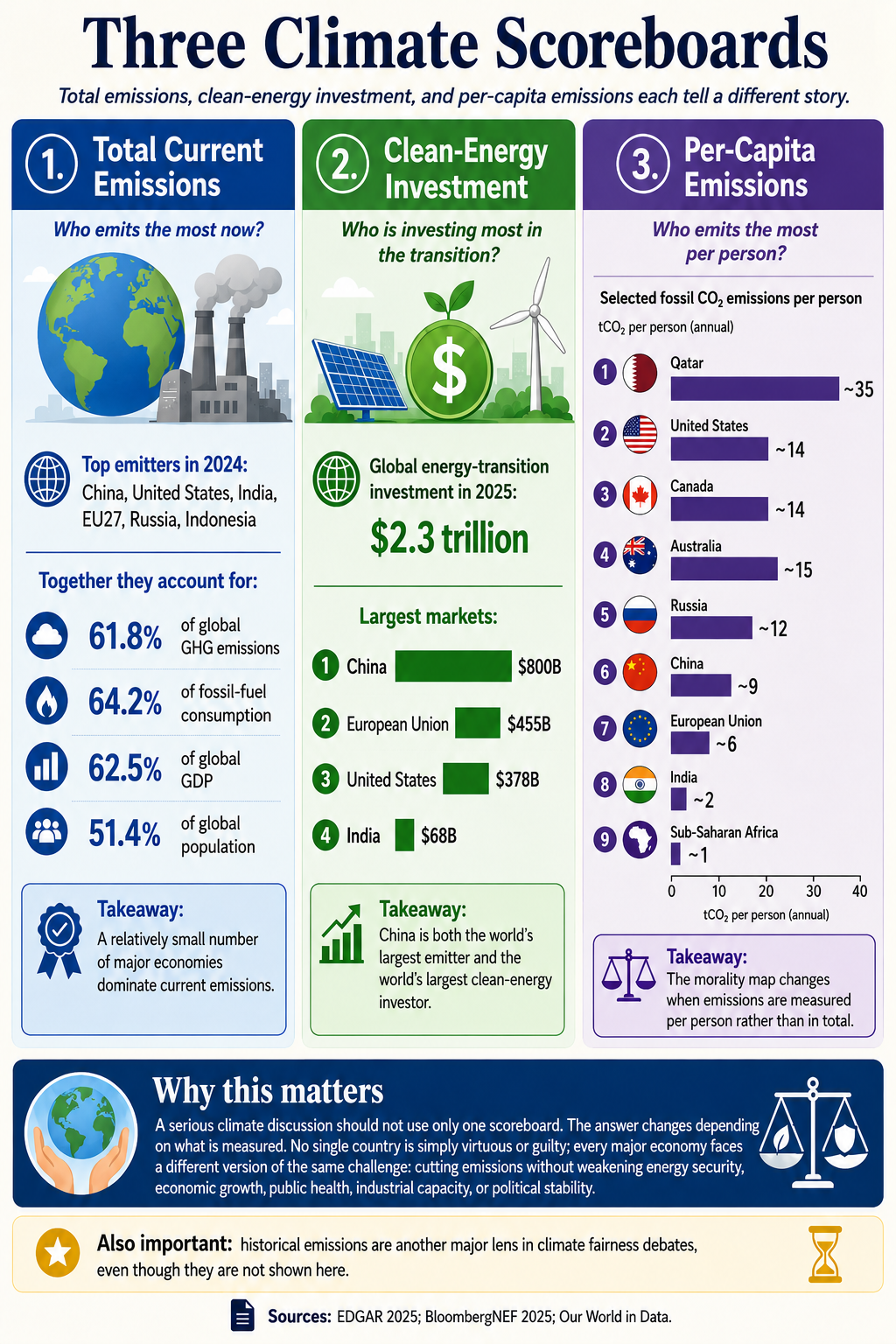
China’s lead in clean-energy investment should not be confused with climate virtue. It reflects scale, industrial policy, manufacturing dominance, energy security, and export ambition. The United States remains a major energy power, but more of its investment remains tied to oil, gas, and LNG. The uncomfortable reality is that China is simultaneously the world’s largest emitter, the largest clean-energy investor, and a dominant manufacturer of the technologies other countries will need if the transition continues.
Energy is the hard center of the issue
Energy drives everything.
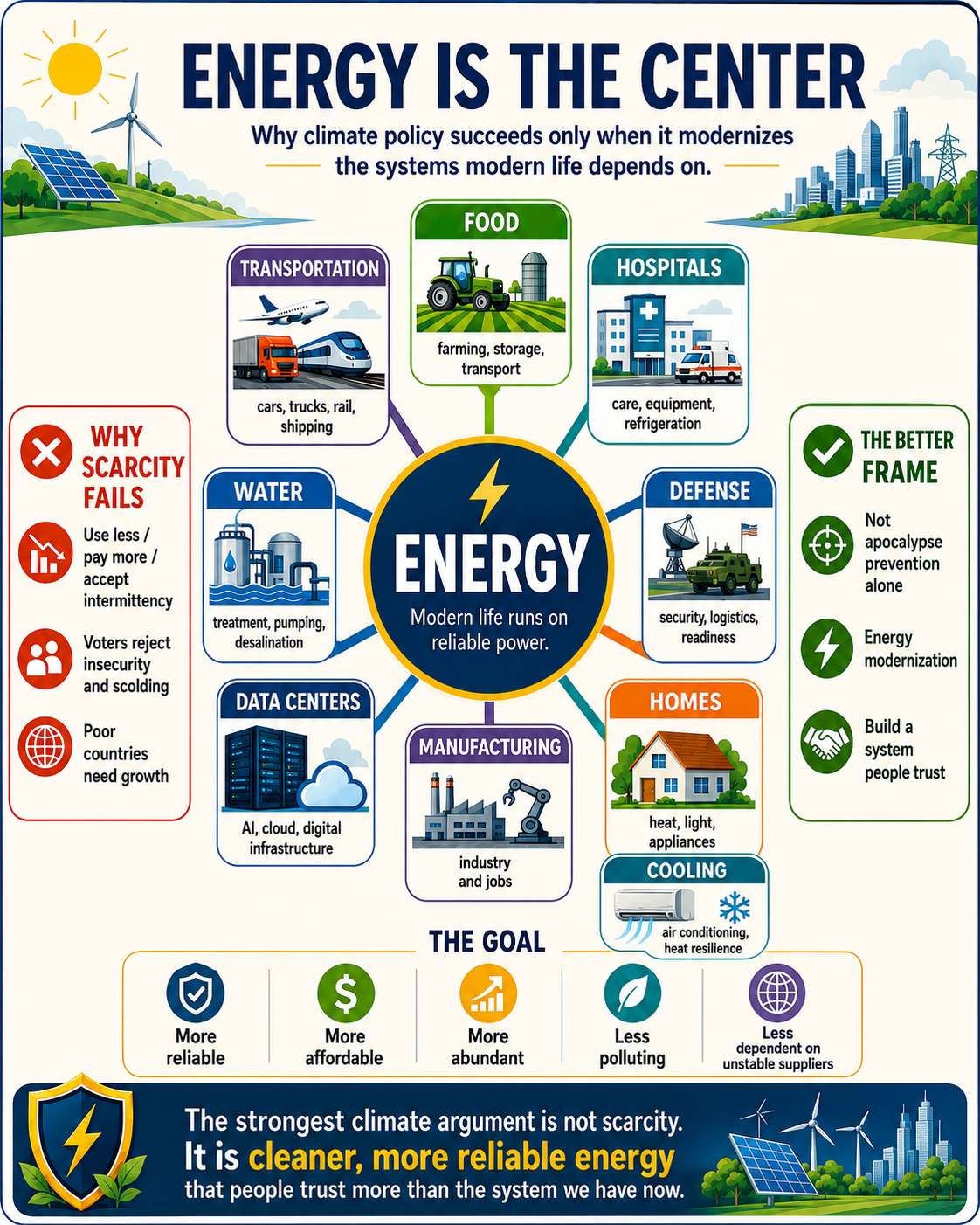
It powers transportation, heating, cooling, agriculture, hospitals, manufacturing, defense, water treatment, data centers, mining, construction, refrigeration, and everyday life. No country willingly risks its economy, military readiness, food system, industrial base, or political stability on an energy transition it does not trust.
That is why climate policy becomes so difficult. Energy demand is not shrinking. The IEA reported that global energy demand grew by 2.2% in 2024, faster than the prior-decade average, while global electricity demand surged by 4.3%. Demand for all fuels and technologies expanded in 2024. Renewables accounted for the largest share of energy-supply growth, but natural gas, coal, oil, and nuclear also grew.
This is the central political reality: the world is not simply replacing old energy with new energy. It is still trying to satisfy rising total demand.
A climate strategy built around “use less, pay more, and accept intermittency” will fail. People may say they care about climate change, but they will not accept energy insecurity as the price of moral seriousness. Nations will not surrender energy dominance to rivals. Poor countries will not remain poor to satisfy wealthy-country climate preferences. Industrial countries will not casually abandon manufacturing. Voters will not tolerate policies that feel like scolding, scarcity, or national weakness.
The winning climate argument is not apocalypse prevention. It is energy modernization.
The goal should be to build a cleaner energy system that people trust more than the one we have now: more reliable, more affordable, more abundant, less polluting, and less dependent on hostile or unstable suppliers.
The demand problem: clean energy is chasing a moving target
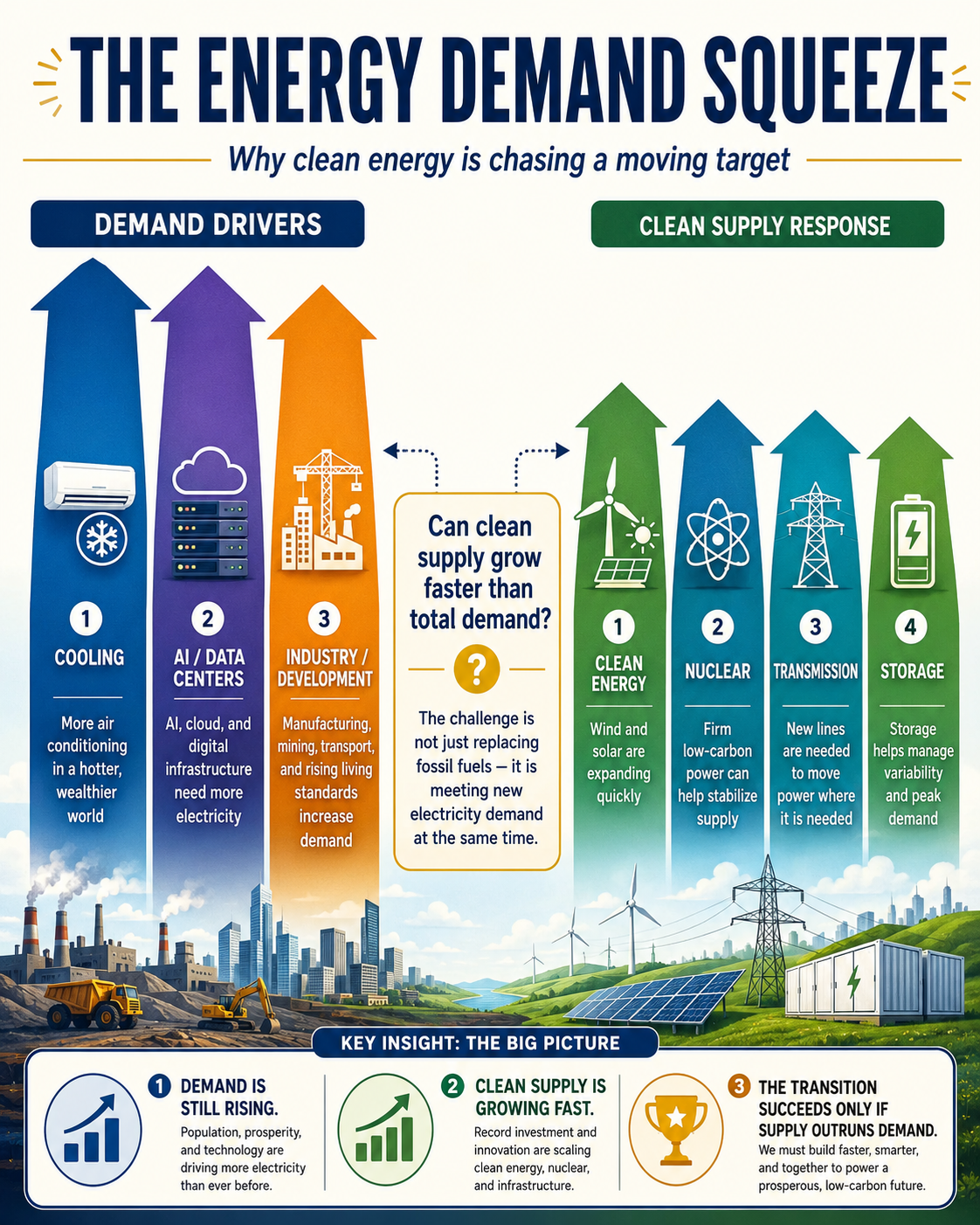
One of the underappreciated realities of climate policy is that clean energy is not replacing a fixed amount of fossil energy. It is chasing a moving target. The world needs more electricity for air conditioning, AI data centers, electric vehicles, heat pumps, manufacturing, mining, desalination, hospitals, refrigeration, and the basic development needs of poorer countries.
AI and data centers make this especially visible. The IEA projects that global electricity consumption by data centers could more than double to about 945 TWh by 2030, representing just under 3% of total global electricity consumption. The same analysis says data-center electricity demand is projected to grow by about 15% per year from 2024 to 2030, more than four times faster than electricity demand from all other sectors.
Cooling may be even more consequential. A hotter and wealthier world will need more air conditioning, not less. IEA says space cooling is now the fastest-growing source of energy demand from buildings, rising by almost 4% annually to 2035 under current policies, with most growth expected in emerging and developing economies.
That is the practical challenge. The clean-energy system must do two jobs at once: replace the fossil-fuel system we already have and supply the additional electricity modern life keeps demanding.
Climate is not the only human emergency
One reason climate politics becomes strained is that climate advocates sometimes speak as if climate change is the single organizing problem of human life. It is a potentially serious problem, but it exists alongside many others: hunger, basic healthcare, infectious disease, clean water, maternal and child mortality, agricultural productivity, poverty, education, war, corruption, and energy access.
That matters because public resources are limited. A dollar spent on one priority cannot be spent somewhere else — unless the investment also improves health, food security, infrastructure, or energy reliability. That does not mean climate spending is wrong. It means climate spending must justify itself against other serious claims on human concern.
The scale of other human needs is sobering. FAO estimates that 645 million people faced hunger in 2025 and that healthy diets were unaffordable for about 2.7 billion people worldwide. WHO and the World Bank estimate that 4.6 billion people still lack access to essential health services and 2.1 billion experience financial hardship in accessing healthcare. The World Bank reported in 2025 that more than 666 million people still lacked electricity access in 2023.
This is especially important for poor countries. A wealthy nation can debate electric vehicles, heat pumps, carbon offsets, and offshore wind. A poor nation may be trying to keep food affordable, build hospitals, prevent blackouts, expand irrigation, reduce childhood disease, and create jobs. Telling such countries to prioritize emissions above development can sound less like compassion and more like wealthy societies pulling up the ladder behind them.
The better test is human welfare. Climate policy should be judged not only by tons of carbon avoided, but by whether it helps people live safer, healthier, more productive lives.
Nuclear power: history, fear, and the practical case
Nuclear power may well be the most important subject in the climate debate.
For decades, much of the environmental movement treated nuclear power as inherently unacceptable. The public memory is easy to understand: Three Mile Island, Chernobyl, and Fukushima. Radiation is invisible. Nuclear accidents are frightening. They are linked emotionally to cancer, evacuation, secrecy, weapons, contamination, and loss of control.
That fear is not irrational. But it is often imprecise. Three Mile Island was a serious accident, but the U.S. Department of Energy reports that about 2 million people in the area received an estimated average radiation dose of about 1 millirem above natural background, with no detectable health effects on plant workers or the surrounding public. Chernobyl was different: a catastrophic Soviet RBMK reactor accident during a low-power test. The IAEA says the Unit 4 RBMK reactor went out of control during a planned low-power test on April 26, 1986. It involved design flaws, unsafe operating conditions, poor safety culture, and lacked a full Western-style containment building.
Fukushima was different again: an earthquake and tsunami overwhelmed plant defenses, causing loss of cooling and reactor meltdowns. The lesson is not that nuclear power is risk-free. The lesson is that nuclear power requires exceptional engineering, regulation, siting, emergency planning, transparency, and institutional competence.
For many readers, the word “nuclear” immediately brings Chernobyl to mind. Chernobyl was one of the worst industrial disasters in modern history, and its image still shapes public perception of nuclear energy decades later. But if nuclear is to be discussed seriously, Chernobyl has to be understood in context. It was not simply “what nuclear power is.” It was a disaster involving a particular reactor design, a particular safety culture, and a particular sequence of technical and human failures.
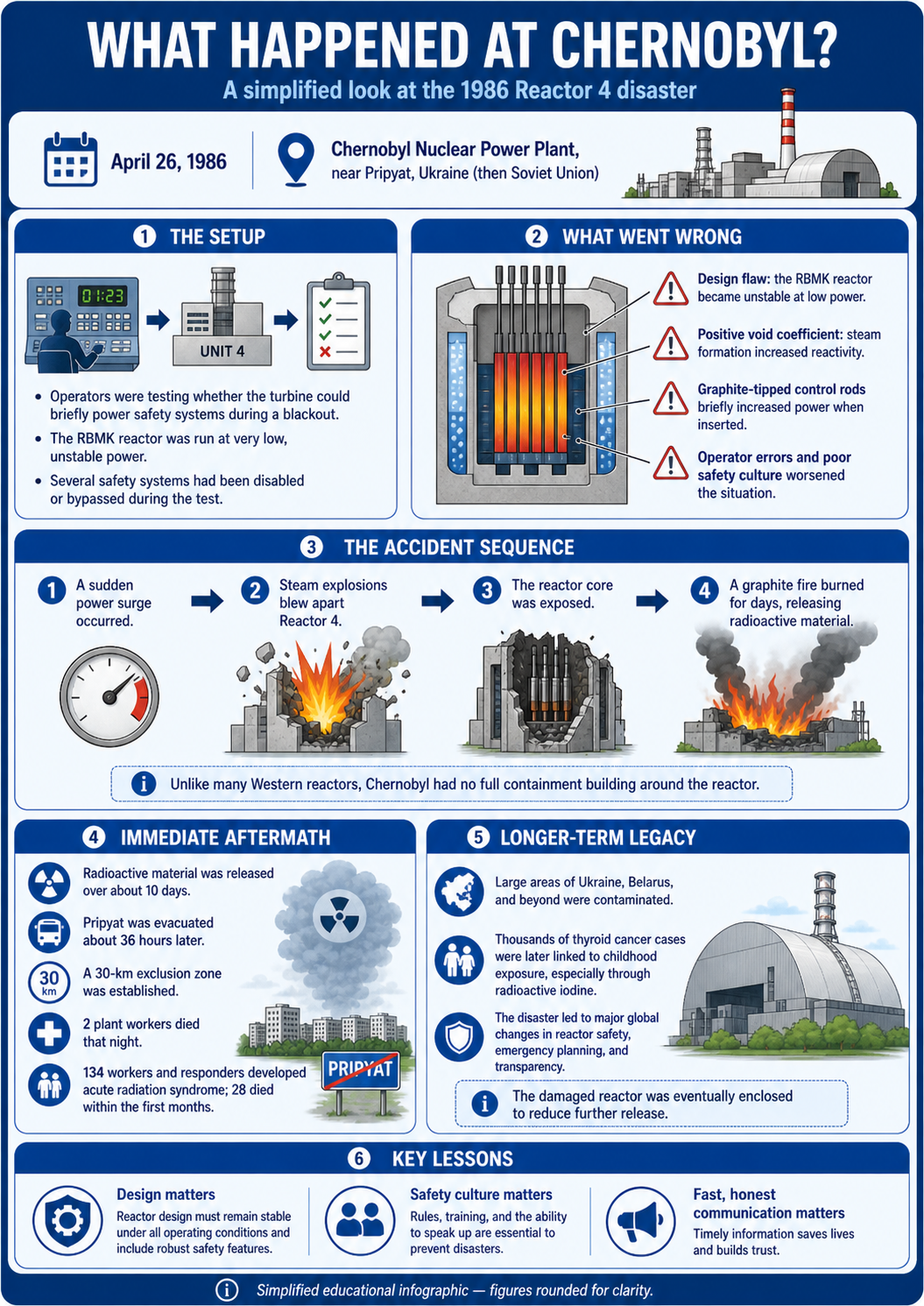
The 1986 Chernobyl disaster was not simply a generic “nuclear accident.” It involved a specific Soviet RBMK reactor design, unstable operating conditions, operator errors, disabled safety systems, and the absence of a full containment structure. Chernobyl remains a defining nuclear warning, but it should be understood as a particular failure rather than as a complete description of modern nuclear power.
If Chernobyl is treated as the universal picture of nuclear power, the conversation stops before it begins. A more useful question is how present-day nuclear plants differ from that design and why many climate pragmatists now believe nuclear deserves a serious place in a low-carbon energy portfolio. To answer that, it helps to look at how a modern reactor actually works.
The case for nuclear is simple: it produces large amounts of low-carbon electricity around the clock on a small land footprint. It is one of the few mature technologies capable of providing firm, industrial-scale, low-carbon power. This is why nuclear is becoming more acceptable among climate pragmatists. At COP28, countries launched a declaration to work toward tripling nuclear energy capacity globally by 2050, explicitly recognizing nuclear’s role in net-zero goals and energy security.
If nuclear energy is to be judged fairly, readers need more than historical fear. They need a basic understanding of how modern reactors function. At a broad level, nuclear plants are not mysterious: they use controlled fission to generate heat, convert that heat into steam, and use the steam to spin turbines that make electricity. What makes them distinctive is not just the source of heat, but the layers of engineering, containment, and fail-safe systems built around that process.
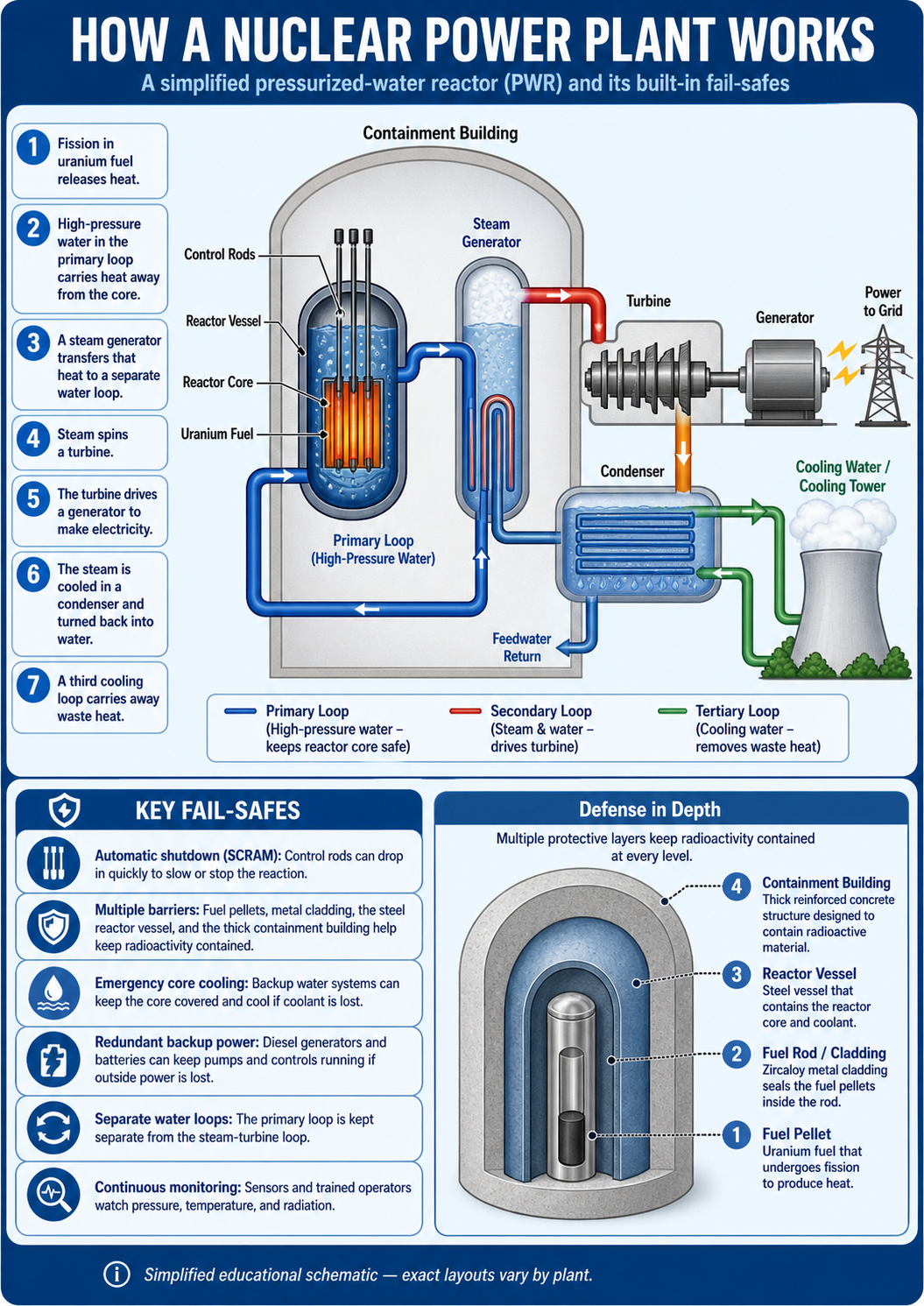
Modern nuclear power plants generate electricity by using heat from controlled fission to produce steam, which drives a turbine and generator. Present-day reactor systems also rely on multiple layers of safety, including separate cooling loops, containment structures, emergency shutdown systems, backup power, and continuous monitoring. The aim is not to claim zero risk, but to show why modern nuclear differs substantially from the circumstances that produced Chernobyl.
This is the practical case for keeping nuclear in the conversation. Modern nuclear is not risk-free, and new plants remain expensive, slow to build, and remain politically charged. But nuclear provides steady low-carbon electricity on a scale that wind and solar alone cannot realistically match. For that reason, the climate debate is gradually shifting from “nuclear is too dangerous to consider” toward a more pragmatic position: deep decarbonization is unlikely without it.
The honest position is: keep safe existing nuclear plants open; build new nuclear where it can be standardized, financed, permitted, and constructed predictably; invest in advanced reactors without overselling them; and treat nuclear as part of a portfolio that includes renewables, storage, transmission, geothermal, hydropower, efficiency, and methane reduction.
Wind, solar, hydro, geothermal — and their limits
Wind and solar are important. They are cheap, scalable, and fast to build. Hydropower is valuable where geography allows. Geothermal is excellent where the subsurface resource is favorable. Batteries are improving quickly. Transmission and grid modernization are essential. But each technology has limits.
Solar output varies with time of day, weather, season, and latitude. Wind varies with wind conditions and location. Hydropower depends on geography and water availability. Geothermal depends on geology. Batteries help manage short-duration variation but do not yet solve every long-duration, seasonal, or continent-scale storage challenge. Tidal and wave energy remain intriguing but immature. Fusion remains a long-term prize, not a realistic grid solution.
This is why the climate debate should avoid technology tribalism. The answer is not “renewables only” or “nuclear only.” The answer is a layered system: cheap variable power, firm low-carbon power, storage, transmission, demand management, cleaner fuels for hard-to-electrify sectors, methane reduction, and adaptation.
A serious climate discussion has to begin with the actual energy menu available to modern societies. Much of the public debate is framed as though there were a single obvious replacement for fossil fuels, but that is not how real energy systems work. Different sources provide different benefits — some are cheap and scalable, some are steady and reliable, some are constrained by geography, and some remain politically difficult. The real challenge is not finding one perfect solution, but building an energy mix that is cleaner, more dependable, and capable of supporting modern life.
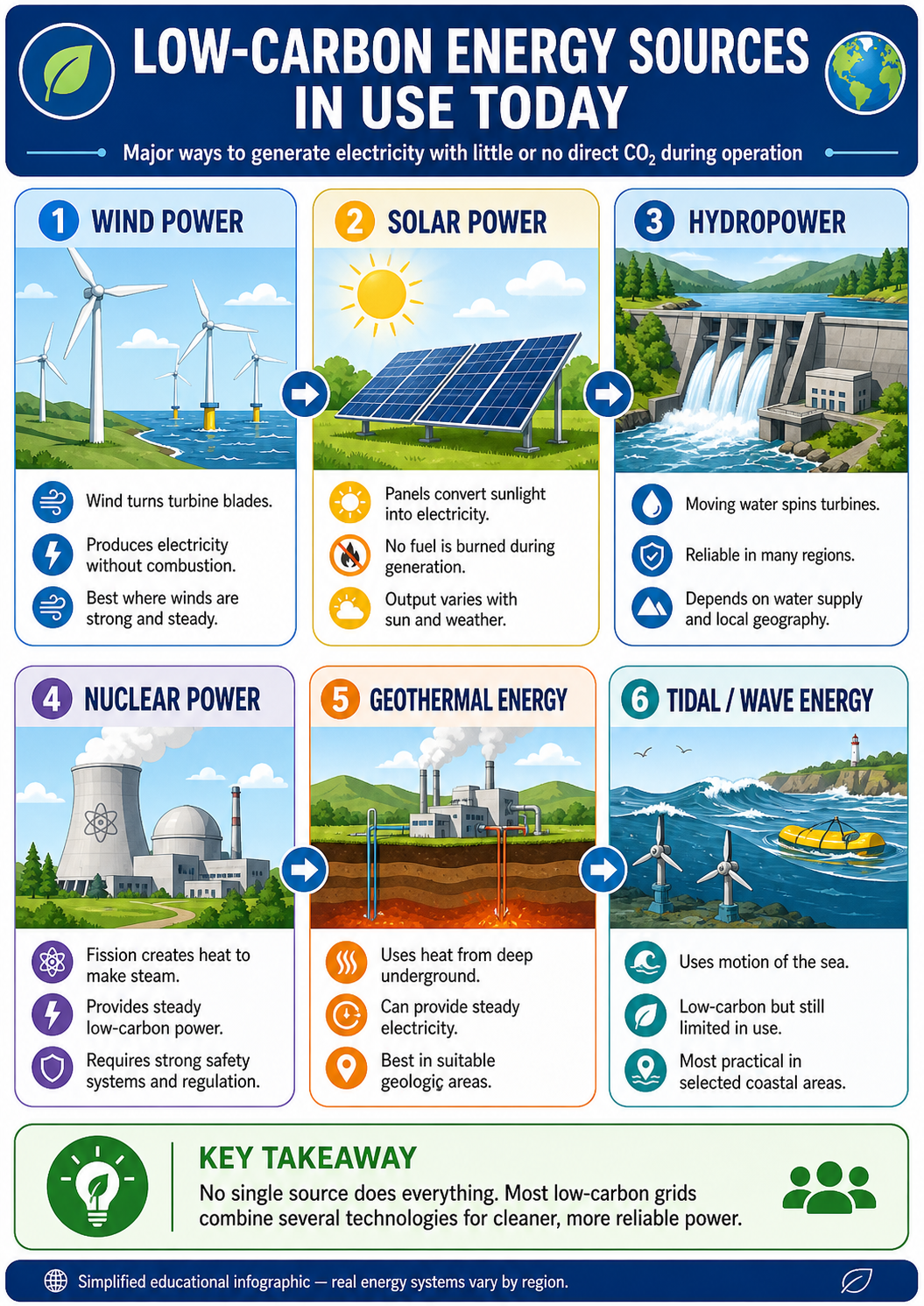
A modern low-carbon grid does not depend on a single technology. Wind, solar, hydropower, nuclear, geothermal, and selected emerging sources each contribute different strengths and limitations. The central lesson is practical: cleaner energy systems are usually built as portfolios, not as one-size-fits-all solutions.
This is why slogans such as “just build more renewables” or “nuclear alone can solve it” are too simplistic. No single source does everything. The climate problem is not merely about generating electricity with less carbon. It is about building a system that remains affordable, reliable, and abundant enough to power homes, hospitals, transport, industry, and economic growth.
EVs, lithium batteries, and the clean-energy tradeoff
Electric vehicles are often presented as clean transportation, but that phrase needs precision. EVs have no tailpipe emissions, but they are not impact-free. Their batteries require mining, refining, manufacturing, shipping, charging electricity, and eventually reuse, recycling, or disposal. Critics are right to ask about lithium, cobalt, nickel, graphite, battery fires, mineral supply chains, end-of-life handling, and whether EVs simply move environmental harm somewhere else.
The answer is not that EVs are perfect. Battery manufacturing can produce higher upfront emissions than manufacturing a conventional gasoline vehicle. EPA acknowledges that EV manufacturing and end-of-life emissions can be higher than those of gasoline vehicles, largely because of battery production. But EPA also states that, over their full lifecycle, EVs typically have lower greenhouse-gas emissions than comparable gasoline vehicles, even after accounting for manufacturing and electricity generation.
That conclusion depends on context. The benefit of an EV is stronger when the grid is cleaner, the vehicle is driven for many years, the battery is right-sized rather than excessive, and the supply chain becomes cleaner. A small or moderate-sized EV charged on a cleaner grid is a different proposition from a very large battery vehicle charged mostly from coal. Hybrids and plug-in hybrids may also be practical bridge technologies for households that lack reliable charging, live in cold climates, tow frequently, or need long-range flexibility.
Battery disposal is a real issue, but the word “disposal” is partly misleading. Lithium-ion batteries should not be thrown into ordinary household trash or standard curbside recycling. EPA warns that lithium-ion batteries can start fires in waste and recycling systems if handled improperly, and it recommends taking used batteries to separate recycling or household hazardous-waste collection points. EPA also notes that lithium-ion batteries contain valuable critical minerals that can be recovered and reused.
The good news is that batteries are not gasoline. Once gasoline is burned, it is gone. Battery minerals can, in principle, be recovered and reused. The challenge is building the collection, transportation, fire-safety, processing, and economic systems that make battery recycling routine rather than exceptional. Future EV policy should therefore emphasize right-sized vehicles, cleaner battery supply chains, responsible mining, grid decarbonization, domestic refining where feasible, second-life battery storage where practical, and safe end-of-life rules.
The fair conclusion is neither “EVs are fake green” nor “EVs are automatically clean.” EVs can reduce lifecycle emissions, especially as grids and battery manufacturing get cleaner, but they create serious mineral, manufacturing, safety, and recycling challenges that must be managed honestly.
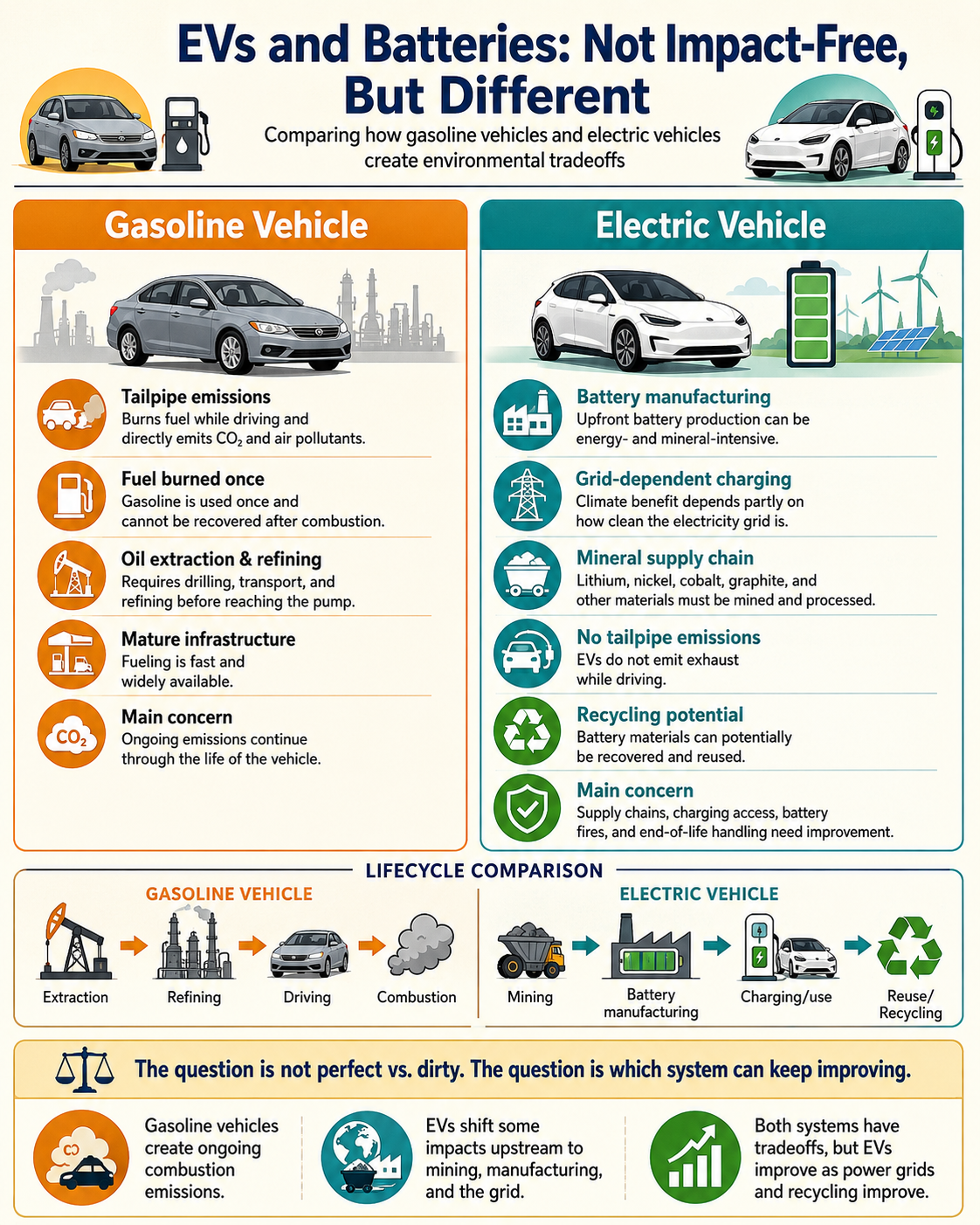
Electric vehicles are not emission-free in a full lifecycle sense. Building an EV battery can require substantial energy, and in some countries that energy may still come from coal or other fossil fuels. But the same is also true for manufacturing combustion vehicles, which require mining, steel, plastics, refining, shipping, and assembly. The key difference is what happens after purchase: a gasoline vehicle continues producing emissions every time fuel is burned, while an EV’s emissions depend heavily on how clean the electricity grid becomes. The practical question is not which vehicle is perfect, but which system can achieve the cleaner lifetime energy profile as manufacturing, grids, and recycling improve.
Can fossil fuels be made less damaging?
A practical climate strategy has to admit that fossil fuels will remain part of the world’s energy system for some time. The question, then, is whether the existing fossil system can be made less damaging while cleaner energy scales.
The answer is yes — but only partially.
We can reduce methane leaks, stop routine flaring and venting, improve plant efficiency, recover waste heat, install pollution controls, retire the dirtiest coal plants first, and use carbon capture selectively in hard-to-abate sectors. These steps will not make fossil fuels clean, but they can reduce avoidable harm.
The clearest low-hanging fruit is methane. Methane leaks from oil, gas, and coal systems are both a climate problem and an energy-waste problem. The IEA’s Global Methane Tracker 2026 says around 70% of methane emissions from fossil fuels — nearly 85 Mt — can be abated with existing technology, and that more than 35 Mt could be avoided at no net cost based on 2025 energy prices because captured gas has market value.
This is climate policy without the sermon: find leaks, stop venting, reduce flaring, capture usable gas, and verify performance.
For coal and gas plants that remain in service, modern pollution controls can reduce sulfur dioxide, nitrogen oxides, particulates, mercury, and other harmful pollutants. That matters for public health. But those controls do not erase CO₂. Carbon capture may help in selected settings, especially cement, chemicals, hydrogen, ammonia, and perhaps some power plants, but it remains expensive, energy-intensive, and difficult to scale. It should be treated as a tool for hard cases, not a blanket excuse for fossil-fuel expansion.
Few energy topics are discussed more often and understood less clearly than fracking. It is commonly praised as an engine of American energy independence or condemned as an environmental hazard, often without much explanation of what it actually involves. A clearer understanding of the process helps lower the rhetorical temperature. Fracking is neither magic nor mystery. It is a specific drilling technique with measurable upsides, real risks, and important implications for the broader energy and climate picture.
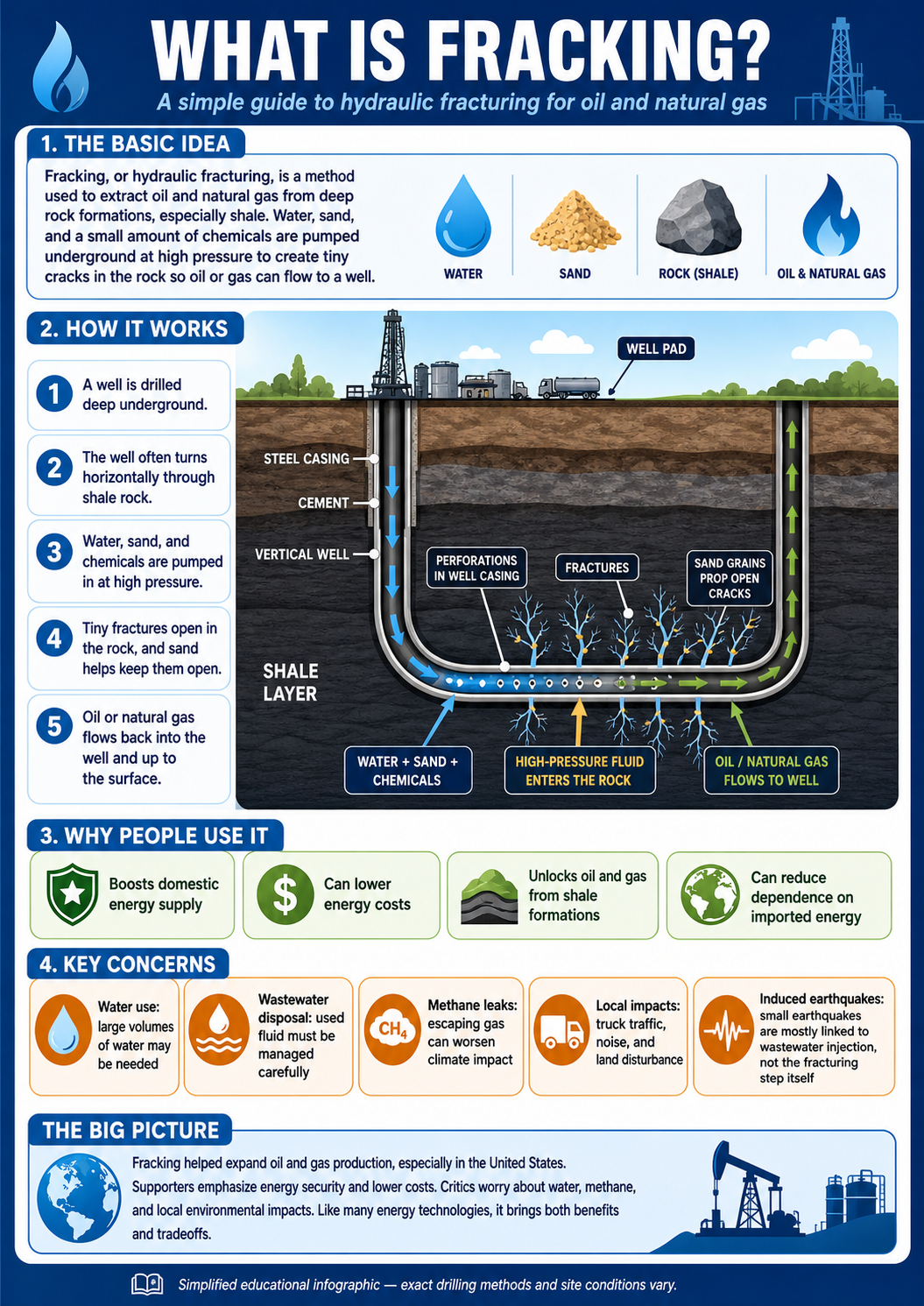
Hydraulic fracturing, or fracking, is a drilling technique used to extract oil and natural gas from deep rock formations, especially shale. Supporters credit it with expanding domestic energy supply and lowering some costs, while critics point to concerns over water use, wastewater disposal, methane leakage, and local environmental disruption. Like many energy technologies, it brings both benefits and tradeoffs.
Fracking helps explain why climate policy is so politically and economically difficult. It expanded access to oil and natural gas, increased domestic supply, and helped lower some energy costs, particularly in the United States. At the same time, it does not eliminate the climate problem. It may reduce some emissions relative to coal in certain contexts, but it still depends on fossil fuels and introduces concerns about methane leakage, water use, and local environmental effects. It is therefore best understood not as a final answer, but as one chapter in a much larger energy story.
Gates, Musk, and the shift from panic to abundance
Two of the more interesting climate voices are not climate scientists at all: Bill Gates and Elon Musk. That should be stated clearly. Neither should be treated as a scientific authority on atmospheric physics. But both have major stakes in the energy transition, and both have helped move parts of the public conversation away from pure climate moralism toward technology, abundance, and practical systems change.
Gates is especially relevant because his language has changed. Earlier, he wrote in terms of avoiding a climate disaster. More recently, his emphasis has shifted toward human welfare: health, poverty reduction, agriculture, adaptation, innovation, and energy access. In his 2025 essay, Gates argued against a “doomsday view” of climate change and urged climate strategy to focus more directly on improving human lives, especially in poorer countries. He still accepts climate change as a serious problem, but he is pushing against climate absolutism — the idea that temperature targets should eclipse every other human priority.
Gates also deserves some credit because he has put capital behind his views through Breakthrough Energy and other innovation efforts. One can debate his priorities, but this is different from celebrity advocacy or moral performance. It is an attempt to make clean technologies cheaper, more scalable, and more useful in the real world.
Musk approaches the issue differently. Tesla’s Master Plan Part 3 argues that a sustainable global energy economy is technically feasible through end-use electrification, sustainable electricity generation, and storage. It is an explicitly abundance-oriented argument: build the new system so it works better than the old one.
At the same time, Musk has warned against demonizing oil and gas in the medium term. Reuters reported in 2023 that Musk said oil and gas should not be “demonized” in the medium term, while also saying it was important to reduce carbon emissions. That position is messy but important. It recognizes that the world cannot simply turn off the energy system that keeps civilization running, even if the long-term goal is to build something cleaner.
Both men are imperfect messengers. Gates is criticized by some activists for underplaying urgency. Musk is polarizing for reasons that extend far beyond climate. But the underlying shift is important. The climate argument is moving, at least among some technology pragmatists, from “fear, sacrifice, and restriction” toward “innovation, electrification, nuclear seriousness, and energy abundance.”
That is the direction durable climate politics probably has to go. The public will not be persuaded by guilt alone. Nations will not surrender energy security. Poor countries will not give up development. A cleaner energy system must become better energy: cheaper where possible, more reliable where necessary, more abundant, more domestic, and less polluting.
Adaptation deserves more respect
Climate discussion often focuses on mitigation — reducing emissions. But adaptation may be the most politically neglected and broadly acceptable climate strategy.
Adaptation includes wildfire mitigation, water storage, flood control, stronger building codes, heat planning, resilient power for hospitals, better drainage, coastal planning, crop resilience, forest management, insurance reform, emergency alerts, and protection of vulnerable populations.
This is where climate policy can become practical even for skeptical readers. One does not have to accept every long-range model to support better infrastructure, better emergency preparation, more resilient electric grids, and smarter land-use decisions.
As a physician, I find adaptation intuitively similar to prevention. We do not wait for the stroke before treating blood pressure. We do not wait for the ICU admission before vaccinating. We do not wait for the fire before clearing brush around a home. Climate adaptation is not surrender. It is prudence.
What can the average person do without being lectured?
The average person cannot solve climate change alone, and pretending otherwise is one reason climate messaging has become so irritating. Most people did not design the energy system. They live inside it. They drive to work, heat and cool their homes, buy groceries, take care of families, and pay bills. Throwing guilt into their faces is not only unfair; it is politically counterproductive.
A better message is this: do the things that make sense anyway.
Waste less energy. Maintain heating and cooling systems. Seal ducts and leaks. Use smart thermostats where they help. When old equipment wears out, replace it with the most efficient practical option. When buying a car, consider fuel economy, hybrid, plug-in hybrid, or electric options based on real driving needs rather than ideology. Reduce food waste. Use electricity at smarter times where convenient. Support local and national policies that build reliable, cleaner energy rather than policies that merely punish consumption.
This is not about living a smaller life. It is about living a less wasteful one. Efficient cooling is not anti-comfort; it preserves comfort while using less power. A well-insulated home is not a political statement; it is a better home. A hybrid or efficient vehicle is not an apology; it is a practical machine. Reducing food waste is not climate theater; it is household competence.
Some climate-friendly choices are not sacrifices at all. They are cost-effective household upgrades that reduce waste, improve comfort, and may save money over time. The least controversial climate action is the one that also lowers bills, improves comfort, or reduces waste.
When buying a vehicle, the practical question is not whether a person has joined the “EV side” or the “gas side.” The practical question is what vehicle best fits the household’s real needs with the least waste. For some households, that may be an EV. For others, it may be a hybrid, plug-in hybrid, smaller gasoline vehicle, or simply keeping a reliable car longer rather than replacing it prematurely. EVs can reduce lifecycle emissions, but they are not morally magic. They depend on battery manufacturing, mineral supply chains, grid quality, charging access, and eventual recycling. That makes them useful tools, not virtue objects.
This is the tone that avoids backlash. The public does not want to be told that driving a gasoline car makes them immoral. But many people will consider a vehicle that is cheaper to fuel, easier to maintain, reliable, and suited to their daily needs. Climate action becomes more acceptable when the better option is actually better for the user.

The opportunity-cost problem
Climate policy also faces an uncomfortable budget reality: money spent on one priority cannot be spent on another. A dollar directed toward climate mitigation may be unavailable for healthcare, agriculture, biomedical research, infrastructure, defense, education, or debt reduction.
That does not mean climate spending is wrong. It means climate spending has to justify itself against other serious human needs.
This is especially important because climate advocates sometimes speak as though mitigation is morally self-evident. But public budgets are not moral wish lists. They are tradeoff documents. NIH research may produce cancer treatments, vaccines, kidney-disease advances, Alzheimer’s therapies, or cardiovascular breakthroughs. Agricultural research may improve crop yields, food security, drought tolerance, soil health, and nutrition. Public-health investments may save lives now. Climate investments may reduce future risk, but often with less immediate and less individually visible outcomes.
The answer should not be to deny opportunity cost. The answer should be disciplined climate policy. Climate spending should be judged by whether it reduces measurable risk, strengthens energy reliability, improves resilience, lowers pollution, supports innovation, and avoids undermining other essential priorities.
The tradeoff is not always climate versus human welfare. Some climate-related investments also support other priorities. Efficient cooling protects health during heat waves. Cleaner air reduces respiratory and cardiovascular disease. Methane reduction reduces waste and pollution. Nuclear and reliable clean power can support hospitals, industry, water systems, and economic growth. Agricultural adaptation can improve drought resilience and food security. Grid modernization improves reliability.
The better question is not, “Should we spend on climate or on people?” The better question is:
Which climate investments also strengthen human welfare, energy security, public health, agriculture, and economic resilience?
The only climate argument that can win
Ultimately, climate policy succeeds only when cleaner energy becomes better energy. Not morally better. Practically better. Cheaper where possible. More reliable where needed. More abundant. More domestic. Less polluting. Less vulnerable to hostile suppliers. Easier for households, businesses, hospitals, farms, factories, and data centers to trust.
That is the point at which the politics change. People do not need to be shamed into buying a better product. Countries do not need to be lectured into adopting a stronger energy system. Markets, governments, and households move when the alternative is plainly superior.
This is why climate policy should be framed less as sacrifice and more as modernization. Wind and solar are already highly competitive in many settings, and their growth is reshaping the global electric system. But low-cost generation is not the same as a complete grid. The real challenge is building an energy system that works all the time: during heat waves, cold snaps, nights, windless periods, industrial peaks, data-center surges, and emergency conditions.
The same principle applies to electric vehicles and batteries. EVs will not win because people are scolded into buying them. They will win when they are affordable, convenient, reliable, easy to charge, durable, and supported by a recycling system people trust. Batteries will not win because they are called clean. They will win when the supply chain becomes cleaner, safer, less dependent on hostile or unstable suppliers, and more circular.
Clean energy does not get a pass on tradeoffs. It has to earn public trust by becoming better in practice.
If clean energy is merely an obligation, the public will resist it. If it is cheaper, more reliable, cleaner, and strategically safer, the public will adopt it. That is how climate policy stops being a cultural fight and becomes an infrastructure upgrade.
What a reasonable climate position looks like
A reasonable climate position should be able to say all of the following:
Global warming is real.
Our current energy grid is likely the dominant cause of recent warming based on the best evidence.
The future contains uncertainty, but uncertainty is cause for concern.
The measurement record has complexities, but the evidence converges across independent systems.
Science changes, so humility belongs in the argument.
Skeptics should not be treated as fools simply for asking hard questions.
Apocalyptic rhetoric has damaged trust.
Energy security is non-negotiable.
Developing countries need more energy, not less.
Nuclear power deserves a serious place in the portfolio.
Wind, solar, hydro, geothermal, storage, and transmission are complementary.
EVs and batteries are useful tools, but their full lifecycle must keep improving.
Methane reduction is a practical near-term win.
Forests matter, but conservation has to be economically viable.
Climate litigation and attribution science require unusual transparency.
Adaptation is not optional.
Other human needs — hunger, healthcare, agriculture, electricity access — must remain central.
The goal is not guilt or sacrifice. The goal is a cleaner, safer, more abundant energy system.
That is the lane I would call measured realism.
Measured realism rejects both denial and panic. It accepts the physical facts without accepting every activist slogan. It takes energy seriously without making fossil fuels sacred. It supports innovation without pretending technology arrives by magic. It recognizes nuclear risk without treating Chernobyl as the only image of nuclear power. It respects developing countries without ignoring global emissions. It understands that climate policy must survive contact with voters, prices, reliability, and national interest.
Conclusion: the argument that might actually work
Climate change will remain a hard sell if the public hears only: trust the predictions, accept sacrifice, and let experts redesign your life. That message may mobilize committed activists, but it will not persuade enough ordinary people to sustain a durable transition.
The better argument is not fear. It is competent energy modernization. Build a cleaner energy system that is more reliable than the old one. Make electricity abundant. Preserve and expand firm low-carbon power where practical. Modernize the grid. Reduce methane. Protect forests by making protection economically real. Invest in adaptation. Accelerate technologies that lower costs rather than raising guilt. Stop treating every skeptic as immoral and every activist as informed. Stop confusing celebrity attention with expertise. Stop pretending energy is just another policy category.
Energy is power. Energy is health. Energy is food. Energy is national security. Energy is modern life.
Climate policy will fail if it feels like scarcity, scolding, or surrender. It has a chance if it offers abundance, reliability, resilience, and strategic strength. The goal should not be to frighten people into compliance. The goal should be to build a cleaner energy future so practical, reliable, and abundant that people no longer experience climate policy as a demand for sacrifice, but as an upgrade to modern life.
Climate policy will not be won by fear. It will be won, if at all, by building an energy system people trust more than the one we have now.
Selected references
IPCC, AR6 Synthesis Report: Headline Statements.
NASA, Evidence: The Evidence for Rapid Climate Change Is Compelling.
NOAA Climate.gov, How do we know the build-up of carbon dioxide in the atmosphere is caused by humans?
NASA, Can you explain the urban heat island effect?
NASA GISS, GISTEMP Frequently Asked Questions.
NASA/JPL, NASA’s Global Surveyor Sees Possible Climate Change on Mars.
Pew Research Center, Americans’ confidence in scientists.
Gallup, Confidence in U.S. Institutions Remains Near All-Time Low.
National Academies, Attribution of Extreme Weather and Climate Events and Their Impacts.
IEA, World Energy Investment 2025.
BloombergNEF, Global energy transition investment reached $2.3 trillion in 2025.
EDGAR/JRC, GHG Emissions of All World Countries: 2025 Report.
Global Carbon Project, Fossil fuel CO₂ emissions hit record high in 2025.
Our World in Data, CO₂ emissions per capita.
IEA, Energy demand from AI.
IEA, Staying cool without overheating the energy system.
FAO, State of Food Security and Nutrition in the World / FAO hunger estimate.
WHO / World Bank, Universal Health Coverage report.
U.S. Department of Energy / NRC, Three Mile Island summary and accident background.
IAEA, Chernobyl Accident FAQ.
Tesla, Master Plan Part 3.
Bill Gates, Three Tough Truths About Climate.
Reuters, Elon Musk says oil and gas should not be demonized.
EPA, Used Lithium-Ion Batteries.
IEA, Global Methane Tracker 2026.
