
Iran and the Possibility of a Cold Peace
In Brief
The conflict with Iran has become increasingly difficult to follow: military strikes alternate with ceasefires, negotiations proceed through intermediaries, Iran denies talks that Washington describes as productive, and the Strait of Hormuz repeatedly appears close to reopening only to become contested again.
The history is equally complicated. Iran is an ancient civilization with a powerful national identity and a long memory of foreign intervention, including the American-backed overthrow of Prime Minister Mohammad Mossadegh in 1953. The Islamic Republic that emerged after the 1979 revolution has nevertheless given Americans legitimate reasons for deep distrust: the hostage crisis, support for armed groups that have killed Americans and Israelis, decades of explicit hostility, and a nuclear program that by 2025 included more than 400 kilograms of uranium enriched to 60 percent. International inspectors can no longer fully account for that stockpile.
Whatever one thinks of the decision to go to war, we cannot return to the day before it began. Ground invasion and foreign-imposed regime change offer little reason for confidence, while simply backing away would leave serious nuclear and maritime risks unresolved. Nor is Westernizing Iran a realistic or appropriate objective.
A more achievable goal is a cold peace: not friendship, rehabilitation, or trust, but peaceful coexistence backed by strength and verified conduct.
Iran would preserve its sovereignty and gain a path toward sanctions relief, normal commerce, and a genuinely civilian nuclear program. In return, the enriched uranium would be located and reduced to civilian levels under intrusive monitoring; Hormuz would remain open; material support for armed attacks abroad would decline; and an identifiable Iranian authority would demonstrate that it can enforce the agreement.
The burden now falls heavily on Iran to prove that such an arrangement is possible. The American offer should remain straightforward:
Verify first. Reward second.
Henry Kissinger once asked whether Iran wished to be a cause or a nation. A cold peace gives Iran a chance to answer “nation” without humiliation—but the answer must come through conduct, not rhetoric.
Readers who want the central argument can stop here. The full essay below provides the history, evidence, qualifications, and reasoning behind it.
The Problem Before Us
Few foreign-policy stories have become harder for the average American to follow than Iran. One day, negotiations are said to be progressing. The next, Iran says no negotiations with the United States are occurring. Oman describes constructive discussions over the Strait of Hormuz. Washington predicts an agreement. Iran's Revolutionary Guard says reopening the Strait is not dependent on those discussions. Another commercial vessel is attacked, another military response follows, and diplomacy somehow remains alive.
As this is written on August 9, Iran says its maritime arrangement with Oman is in its “final stages,” but also says that agreement alone will not reopen Hormuz. Tehran continues to link reopening to broader American actions involving sanctions, compensation, military operations, and the blockade of Iranian ports. Washington, in turn, has offered to lift the port blockade if normal commercial shipping is restored.
It is little wonder that people tune out.
But buried beneath the diplomatic noise are several questions that cannot be ignored. Where is Iran's highly enriched uranium? Can ordinary commercial vessels again move safely through Hormuz? Is there anyone in Iran with enough authority to make an agreement and compel the military-security establishment to honor it? And what exactly constitutes an acceptable end to this war?
This essay is not an argument that the war was necessarily wise, unavoidable, or well executed. Nor is it an attempt to minimize Iran's nuclear activities, attacks on shipping, regional armed relationships, or long history of hostility toward the United States and Israel.
It is instead an attempt to answer a more practical question:
We are here. What would a reasonable outcome now look like?
To answer it, we first have to understand how we arrived here.
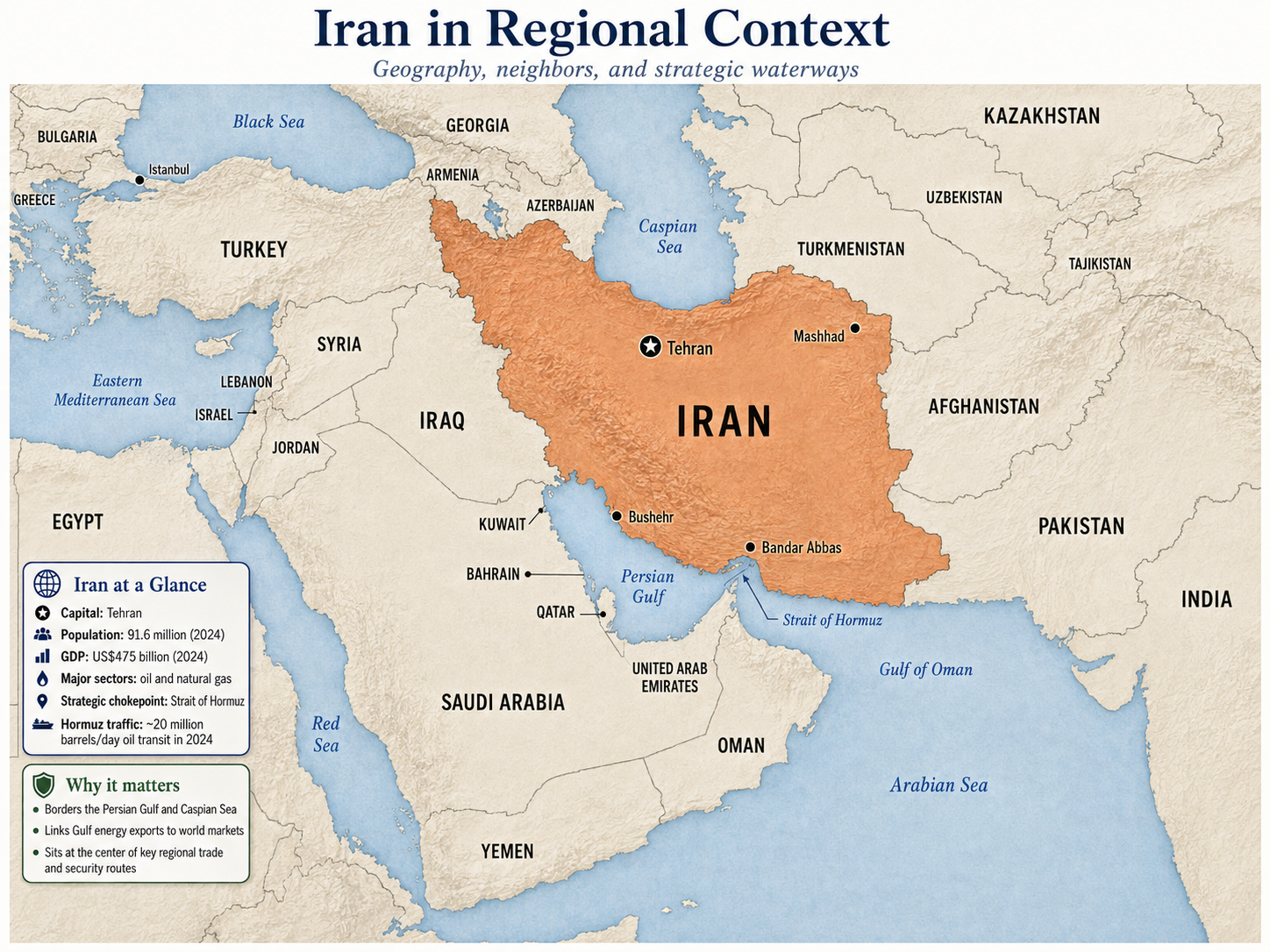
Iran’s strategic importance begins with geography: it sits between the Caspian Sea and Persian Gulf, borders major regional powers and conflict zones, and occupies the northern side of the Strait of Hormuz—one of the world’s most important energy chokepoints.
Iran Is Older Than the Islamic Republic
The first mistake in thinking about Iran is to confuse the country with the government established in 1979.
Iran is the political home of a Persian civilization extending back millennia. Its language, literature, historical memory, Shiite religious tradition, and sense of national identity survived conquest, dynastic change, and repeated foreign pressure. Modern Iranian identity developed from a combination of pre-Islamic Persian history, Islamic and Shiite traditions, and an increasingly explicit nationalism during the nineteenth and twentieth centuries.
During the Qajar era, Iran was comparatively weak and subject to considerable Russian and British influence. The Constitutional Revolution of 1905–1911 was therefore about more than creating a parliament. It reflected demands for law, representative government, economic independence, modernization, and resistance to foreign encroachment.
That history matters because the desire for political reform in Iran did not originate in Washington, London, or the modern Iranian diaspora. It has indigenous roots.
Reza Khan eventually emerged from the instability of the early twentieth century, founded the Pahlavi dynasty in 1925, and became Reza Shah. He built a stronger central government, expanded secular education, strengthened the bureaucracy and military, developed infrastructure, and promoted an explicitly Persian national identity. Those reforms substantially modernized the state. They were also authoritarian and imposed largely from above.
Then foreign intervention returned. Britain and the Soviet Union occupied Iran in 1941 during World War II. Reza Shah abdicated, and his son Mohammad Reza Shah took the throne. Contemporary American diplomatic records document both the occupation and the externally shaped succession.
Whatever the wartime justification, another Iranian lesson was reinforced: powerful outsiders could determine who governed Iran.
Mossadegh, Eisenhower, and the Long Shadow of 1953
The most consequential American intervention came twelve years later. Prime Minister Mohammad Mossadegh was an Iranian nationalist who sought control over the country's oil resources. In 1951 his government nationalized the Anglo-Iranian Oil Company, challenging Britain's enormously valuable commercial and strategic position. Britain applied economic pressure and ultimately encouraged the United States to help remove him.
When Dwight Eisenhower entered office in 1953, almost every major foreign-policy decision was viewed through the lens of the Cold War. Iran bordered the Soviet Union. The oil confrontation was damaging Iran's economy. The Communist Tudeh Party was active. Eisenhower and senior advisers feared that continued instability might eventually allow Iran to move into the Soviet orbit.
That concern was not invented; however, the American intelligence record was more nuanced than the later justification sometimes suggests. Contemporary CIA assessments did not conclude that an immediate Communist seizure of power was inevitable, and documents show considerable uncertainty about whether Mossadegh could be removed successfully or whether the Tudeh Party could actually take control. Nevertheless, Eisenhower approved the covert operation that helped overthrow Mossadegh and restore the Shah's authority. Eisenhower later acknowledged privately that the United States had helped bring about the Shah's restoration and Mossadegh's removal.
In the narrow Cold War sense, the operation succeeded. Iran remained outside the Soviet sphere. Oil production resumed. The Shah became a central American strategic partner. But the longer-term consequences were much less favorable. Mohammad Reza Shah presided over substantial modernization. Education, infrastructure, industrial capacity, and opportunities for women expanded dramatically. But political power also became increasingly centralized, opposition was constrained, and the security state became notorious.
More importantly for the future American relationship, the Shah became inseparable in many Iranian minds from U.S. sponsorship. The 1953 coup did not single-handedly cause the 1979 revolution. History is rarely that simple. But it became powerful evidence for a narrative that remains influential today: Western countries speak of sovereignty and democracy until Iranian choices conflict with Western strategic interests.
Americans and Iranians therefore entered the modern relationship carrying very different memories.
The Revolution—and the American Ledger
The Iranian Revolution of 1979 was not initially a unified clerical movement. Religious conservatives, nationalists, liberals, students, leftists, workers, and others opposed the Shah for very different reasons. Ayatollah Ruhollah Khomeini and the clerical faction ultimately consolidated power.
Then came the U.S. Embassy seizure. Fifty-two Americans were held hostage for 444 days. For an entire generation of Americans, the Islamic Republic entered public consciousness through images of blindfolded American diplomats and crowds chanting against the United States. The relationship deteriorated further during the decades that followed.
American servicemen were killed in the 1983 Beirut Marine barracks bombing, which U.S. officials have attributed to Iranian-backed Hezbollah. Iran subsequently developed or strengthened relationships with Hezbollah, Palestinian armed groups, Iraqi militias, and later the Houthis. The degree of Iranian control varies considerably among these organizations, and they should not all be described simply as Iranian puppets. But Iranian money, weapons, training, and technical support have been important to several of them.
Americans therefore have legitimate reasons for emotional resistance to the idea of becoming “friends” with the Islamic Republic.
Iranians have their own grievances.
That is why friendship is the wrong primary objective.
Peace does not require either society to forget its history.
The Nuclear Problem Was Real—and It Was Not Sudden
The nuclear issue deserves particular care because two errors are easy to make. One is to exaggerate the evidence and claim that Iran had already built a nuclear weapon. The other is to minimize the danger because no completed bomb had been demonstrated.
The 2015 Joint Comprehensive Plan of Action placed substantial restrictions on Iran's enrichment program in return for sanctions relief. Whatever one thinks of the agreement's sunset provisions or its failure to address missiles and regional armed groups, Iran's initial compliance should be acknowledged accurately.
The IAEA repeatedly reported that Iran was implementing its nuclear-related JCPOA commitments. The United States withdrew from the agreement in May 2018 and reimposed sanctions. The remaining JCPOA participants later noted that Iran continued observing its nuclear commitments for approximately fourteen months after the American withdrawal before progressively reducing compliance in 2019. That history demonstrates something important for the future:
Iran is capable of complying with a tightly defined agreement when it believes the bargain remains in its interest.
It also demonstrates that compliance cannot be assumed permanently. On April 17, 2021, the IAEA verified that Iran had begun producing uranium enriched up to 60 percent U-235. That level is extraordinarily difficult to explain as ordinary civilian power-reactor activity. Uranium containing 20 percent or more U-235 is classified as highly enriched uranium; ordinary commercial power reactors generally operate with much lower enrichment. Sixty-percent uranium is not a nuclear bomb, and producing it does not prove that Iran's leadership made a final political decision to build one. But it moves the material much closer to weapons-grade and sharply reduces the time needed for further enrichment.
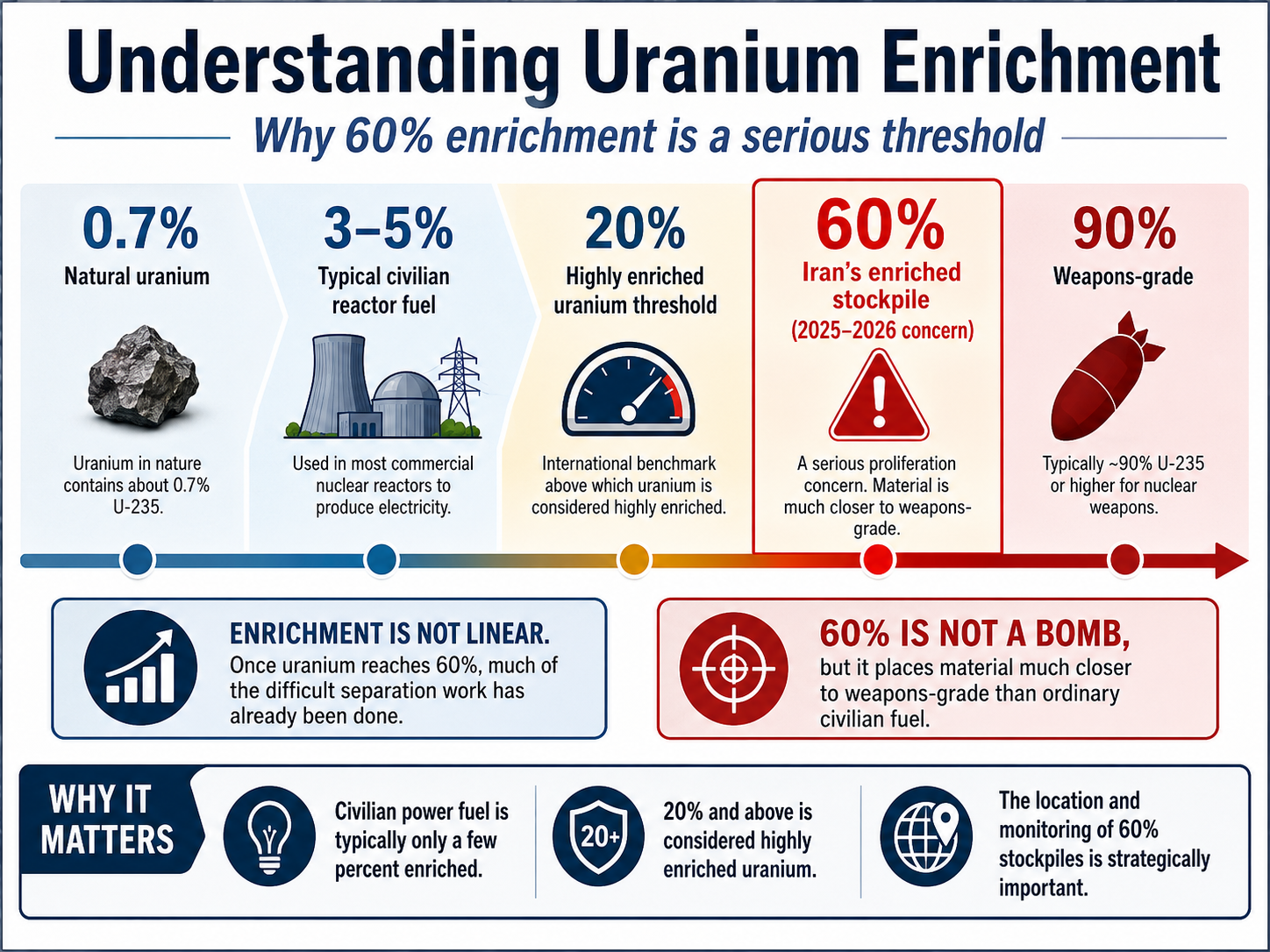
By June 13, 2025, the IAEA estimated that Iran had accumulated 440.9 kilograms of uranium enriched up to 60 percent, of which 432.9 kilograms had been verified. Then verification deteriorated dramatically.
Following attacks on Iranian nuclear facilities in June 2025, the IAEA lost access to important sites. By February 2026, it reported that it could not determine the current size, composition, or whereabouts of Iran's enriched uranium stockpile, could not verify whether enrichment had stopped, and could not establish Iran's current inventory of centrifuges. The agency described its loss of continuity of knowledge as a proliferation concern requiring urgent resolution.
This is one reason I find the nuclear threat difficult to dismiss. The Islamic Republic's revolutionary rhetoric—including “Death to America”—does not prove an intention to use a nuclear weapon. Nor should official government rhetoric be confused with the views of ninety million Iranians. But rhetoric, regional violence, degraded inspections, advanced centrifuges, and hundreds of kilograms of 60-percent uranium cannot simply be separated from one another when assessing risk. One can question a war while still acknowledging the seriousness of the threat that preceded it.
Hormuz: Geography as Iran's Great Equalizer
The Strait of Hormuz is easier to understand if the Persian Gulf is imagined as a large cul-de-sac with one narrow driveway. The Strait is that driveway. Major oil and gas producers—including Saudi Arabia, Iraq, Kuwait, Qatar, the United Arab Emirates, and Iran itself—depend heavily on passage through Hormuz to reach the open ocean.
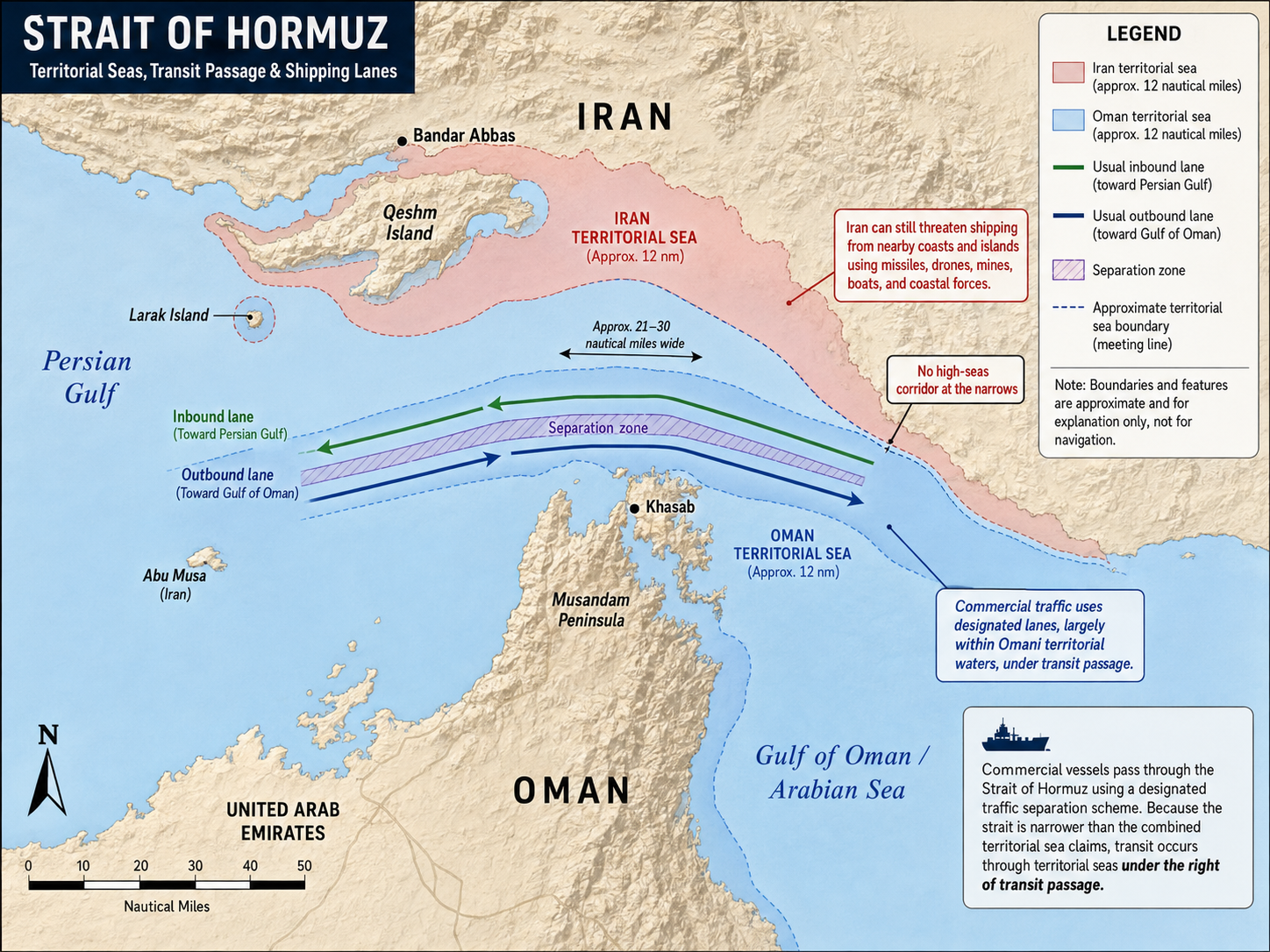
The Strait takes its name from Hormuz, the medieval Persian Gulf trading center and island kingdom that once dominated commerce through the narrow passage; the name itself may ultimately derive from the Persian religious name Hormizd, associated with Ahura Mazda.
In 2024, roughly 20 million barrels of petroleum per day passed through the Strait, about one-fifth of global petroleum consumption and more than a quarter of worldwide seaborne oil trade. Around one-fifth of global liquefied-natural-gas trade also moved through Hormuz. Alternative pipelines exist, but their spare capacity is nowhere near sufficient to replace normal maritime flows.
Iran and Oman have legitimate responsibilities there. The internationally recognized Traffic Separation Scheme was proposed by the two countries and adopted by the International Maritime Organization in 1968. For decades, they jointly coordinated a system of designated traffic lanes intended to make passage safe.
But Hormuz is also an international strait. The IMO has rejected efforts to impose coercive tolls or discriminatory conditions on passage and has reiterated the international principles of freedom of navigation and transit through the Strait. Iran's military advantage does not arise because it must physically occupy those shipping lanes. It merely needs to make them dangerous. Mines, drones, missiles, small boats, seizures, electronic interference, and uncertainty can make commercial operators reluctant to transit even while the U.S. Navy retains overwhelming conventional superiority.
This distinction is crucial:
The ability of a warship to force passage is not the same thing as the ability of ordinary commerce to move safely every day.
Tanker owners require crews willing to enter the Strait. Insurers require predictable risk. Energy markets require reliability. A few attacks can disrupt all three. That is why Hormuz has become such a powerful Iranian bargaining instrument.
How Did We Get From Pressure to War?
According to U.S. Central Command, Operation Epic Fury began on February 28, 2026. The Trump administration publicly described its principal objectives as degrading Iran's missile-production capability and navy, severing its support for armed proxy groups, and preventing Iran from obtaining a nuclear weapon. Those objectives should be distinguished from speculation about a broader political strategy.
It is plausible that Washington and Jerusalem believed intense pressure, and perhaps the removal or weakening of senior Iranian leadership, could produce a more pragmatic authority willing to negotiate. That possibility is consistent with the absence of preparations for a large American occupation and with the continued use of regional intermediaries throughout the conflict. But it remains an inference, not an established fact. There is no public evidence demonstrating that Washington possessed a fully organized successor government ready to assume command of Iran.
If planners expected one to emerge organically, they may have encountered the central problem of leadership decapitation:
The people capable of obstructing an agreement may also be part of the machinery required to enforce one.
Destroying command structures can weaken an adversary. It can also fragment authority. And an agreement with an Iranian diplomat is of limited value if that diplomat cannot make the IRGC, maritime forces, nuclear establishment, and regional armed networks comply. The United States does not merely need someone who can speak for Iran. It needs someone who can make Iran obey an agreement.
Why Regime Change Is So Dangerous
The history of externally imposed regime change should make Americans cautious.
Germany and Japan remain the great success stories. But their circumstances were extraordinary: total military defeat, unconditional surrender, prolonged occupation, disarmament, large-scale reconstruction, functioning bureaucratic institutions, and long-term American security guarantees. RAND's comparative work on nation-building concluded that successful political reconstruction requires substantial commitments of time, manpower, and money. Germany and Japan established standards that later interventions repeatedly failed to match.
Iraq, Afghanistan, and Libya offer less reassuring lessons. Iran would be more difficult still. It is large, mountainous, historically cohesive, institutionally complicated, and home to more than ninety million people. It possesses conventional armed forces, the IRGC, intelligence services, nuclear sites, missile infrastructure, ports, oil facilities, and numerous local centers of authority.
The United States could probably defeat Iran's conventional military in a major ground campaign. That might be the easy part. The harder questions would begin afterward:
Who secures the uranium?
Who controls the missile sites?
Who protects the power grid and oil infrastructure?
Who keeps the ministries operating?
Who prevents insurgency?
Who governs?
The danger is not simply that the United States could lose an invasion. It is that it could win the invasion and inherit a country no one could reliably govern.
Venezuela offers an interesting contemporary contrast. After U.S. forces removed Nicolás Maduro in January 2026, Vice President Delcy Rodríguez assumed the acting presidency while substantial portions of the existing Venezuelan state remained intact. The transition remains politically unresolved and cannot yet be called a long-term success. But it illustrates the distinction between removing a leader and destroying the state itself.
Iran is vastly larger and more complicated. The principle nevertheless deserves attention: Preserve the state even when leadership must change.
Trump Had One Important Principle Right in Riyadh
In May 2025, President Trump delivered a remarkable speech in Riyadh.
He argued that the modern Gulf had been built not by Western interventionists but by the people of the region themselves. He criticized nation-building efforts by outsiders who entered complex societies they did not understand and argued that those efforts had often destroyed more than they built. Whatever one thinks of Trump's broader foreign policy, that principle is sound. The West should demand peaceful conduct, not cultural conversion.
Iran does not have to become Western. It may remain Persian, Muslim, nationalist, socially conservative, politically different from the United States, and deeply skeptical of Israel. Those characteristics are not inherently incompatible with peace. What cannot reasonably be accepted is a political system that combines nuclear opacity, attacks on international commerce, armed regional proxies, and threats against neighboring states while demanding unrestricted economic normalization. Iran's future political system should ultimately be decided by Iranians. The outside world's legitimate interest is in behavioral compatibility, not Westernization.
The Negotiation Circus
Which brings us back to the present. The negotiations appear absurd because they are simultaneously real and theatrical. Washington communicates through Oman, Qatar, and other intermediaries and calls that negotiation. Tehran can respond that it is not negotiating directly with Washington and also be technically correct. Iran wants to avoid appearing to surrender directly to the country bombing it. The Trump administration wants to show that military pressure is producing concessions. Oman and the Gulf states want to prevent a wider war. Israel wants to preserve freedom to act if it believes Iran is rebuilding prohibited capabilities. Every side therefore describes the same process differently. The result is diplomatic ambiguity that has become nearly impossible for the public to interpret.
The latest round illustrates the problem perfectly. Iran says a technical arrangement with Oman over Hormuz is nearly complete, while simultaneously insisting that the Strait will remain restricted until the United States satisfies broader political demands. The IRGC has publicly separated the question of reopening Hormuz from the Oman negotiations. Shipping-industry officials have also questioned whether proposed Iranian fees and oversight would be commercially workable.
Instead of following every claim of progress, the public should use a simpler scoreboard: Are ships moving safely? Are attacks stopping? Are inspectors inside the nuclear facilities? And is there an identifiable Iranian authority whose orders are actually obeyed? Everything else is secondary.
Diplomacy is indispensable. But diplomacy without consequences can become a delay. And Iran currently has reasons to delay. Time may increase American political pressure, elevate energy costs, expose strains within the governing coalition, and allow Tehran to discover whether the November midterm elections change Washington's negotiating position. There is no public evidence that Iran has formally adopted “wait until the midterms” as a strategy. But a policy of talking without concluding and conceding without surrendering would be entirely rational if Tehran believes time is improving its leverage.
That is why the endless cycle—negotiate, pause, strike, retaliate, negotiate again—is so dangerous. Diplomacy can cease to be the path out of war and become merely another stage of it.
We Cannot Go Back
The decision to begin the war will be debated for years. It should be. The nuclear danger was real. So were Iran's missiles, regional relationships, and ability to disrupt Hormuz. But the existence of real threats does not prove that every military response was necessary, proportional, or strategically wise. That is a question for history. Policy must begin somewhere else: We cannot return to February 27.
Whatever mistakes preceded the war, the current responsibility is to avoid making the situation worse. A ground invasion is extraordinarily risky. Perpetual bombing is not an end state. Unconditional withdrawal while the nuclear material remains inadequately accounted for and Hormuz remains vulnerable would also be difficult to defend. And simple reliance on diplomacy has repeatedly proved inadequate. The question is no longer whether Iran should have been confronted differently five years ago. The question is what arrangement can plausibly work now.
There will be readers on both sides who find this proposal objectionable. Some Americans will reasonably ask why a government associated with attacks that killed Americans should receive sanctions relief, investment, or security guarantees. Some Iranians will ask why their country should surrender strategic capabilities after decades of sanctions, foreign interference, and military pressure.
Peace does not require pretending that the past was harmless or that every grievance carries equal moral weight. It requires deciding whether perpetuating the conflict is a useful way to honor those grievances.
A cold peace would therefore not be reconciliation. It would be a bargain between adversaries who remain adversaries in memory, culture, and perhaps even political rhetoric—but who agree that verifiable restraint, sovereignty, and normal commerce are preferable to another generation of retaliation.
Not Friendship: A Cold Peace
For a fleeting moment, it was tempting to describe the desirable outcome as a partnership with Iran. But there is too much history. Americans remember the hostages, Beirut, Iranian-supported attacks on American personnel, assassination plots, “Death to America,” and the nuclear program.
Iranians remember Mossadegh, the Shah, sanctions, American support for Iran's adversaries, covert operations, and military attacks.
The two historical ledgers are not identical. But they are both politically real. No American president can credibly ask the public to forget Americans killed by forces supported by Tehran. Nor can an Iranian government simply erase forty-seven years of propaganda portraying the United States as the principal enemy of the revolution.
Fortunately, neither is necessary. Peace does not require friendship. What is possible is a cold peace. The United States and Iran do not have to like one another. They do not have to agree about the past. They do not even have to trust one another. They need only construct a system in which peaceful behavior is more advantageous than renewed confrontation. John Kerry's defense of the JCPOA contained the right practical principle: the agreement was to rest on verification and proof, not Iranian goodwill.
For the present situation, I would go one step further: Do not trust and then verify. Verify first, then reward.
What Does Iran Actually Want?
Looking at the conflict from Iran's perspective does not require sympathy for the Islamic Republic. It requires understanding incentives. A rational Iranian government wants to survive first. It wants an end to American and Israeli attacks. It wants reassurance that the United States will not occupy Iran or dictate its political system. It wants sanctions lifted, oil exports restored, frozen assets released, foreign investment returned, and access to normal banking and trade. It also wants recognition that Iran is an important regional power. It wants some legitimate role in Gulf affairs.
And it almost certainly wants enough defensive capacity that it never again feels wholly vulnerable to an American or Israeli attack. Those desires help explain nuclear hedging, missiles, regional armed relationships, and Hormuz leverage. They do not justify them. But they show where a bargain might be found.
Instead of allowing Iran to seek security through dangerous instruments, the outside world could offer substitutes.
Security guarantees instead of nuclear latency.
Trade instead of sanctions evasion.
Legitimate maritime participation instead of coercive tolls.
Normal relations with neighboring governments instead of proxy warfare.
Economic success instead of permanent revolutionary isolation.
China and Russia have understood part of this better than Washington. Both treat Iran as a permanent sovereign state rather than a society awaiting Western political reconstruction. China explicitly describes Iran as a strategic partner and emphasizes sovereignty and national dignity; Russia's long-term strategic agreement with Iran expands cooperation while stopping short of a mutual-defense guarantee.
Their relationships are highly transactional, however, and neither Beijing nor Moscow has solved Iran's underlying security dilemma.
The United States could offer something more consequential—but only conditionally.
What Would Iran Have to Give?
A cold peace cannot simply mean giving Iran economic rewards in return for another promise to behave differently. Iran would have to make verifiable concessions in several areas. First, the nuclear material must be located. The IAEA needs unrestricted physical access sufficient to establish the quantity, enrichment level, chemical form, and location of the existing stockpile.
The 60-percent material should then be exported or diluted to ordinary civilian power-reactor levels. Iran could retain a safeguarded civilian nuclear program, and specialized research needs could be met through monitored fuel arrangements. What it cannot reasonably retain is a large, poorly monitored stockpile positioned close to weapons-grade enrichment.
Second, enrichment infrastructure must remain observable. Monitoring has to include advanced centrifuges, component manufacturing, assembly facilities, and declared enrichment sites. Diluting today's uranium accomplishes little if tomorrow's stockpile can be recreated quickly outside meaningful verification.
Third, international commercial passage through Hormuz must become routine again. Iran and Oman can legitimately participate in traffic management, navigation, rescue, environmental protection, and other maritime services. Transparent charges for actual services may be reasonable. Payment demanded in exchange for refraining from seizure or attack is not.
Fourth, Iran must mitigate its support for armed hostility toward Israel.
Iran does not need to become pro-Israel. Immediate formal recognition may be politically unrealistic. Iran can continue supporting Palestinian self-determination, criticizing Israeli policy, and providing humanitarian assistance.
But normal economic integration with the West cannot coexist with continued financing, weapons transfers, training, intelligence, or operational support for groups attacking Israel.
Support for Palestinians could become hospitals instead of missiles, reconstruction instead of tunnels, education instead of perpetual warfare. That would arguably serve Palestinian people and culture better than another generation of regional conflict.
Israel Has Obligations Too
Israel would have to be incorporated into any settlement as a principal security stakeholder. It has legitimate reasons to demand reliable nuclear verification, restrictions on dangerous missile capabilities and transfers, and an end to material support for armed attacks. But Israel cannot receive absolute security while Iran gives up every source of deterrence.
A compliant Iran would need reciprocal protection from attack. Israel would therefore have to accept that, as long as Iran remained within the verified agreement, it would not attack Iranian territory, sabotage safeguarded civilian nuclear facilities, assassinate Iranian officials, or seek to overthrow the government.
Israel would not have to trust Iran.
Iran would not have to trust Israel.
Both would have to trust observable compliance and predefined consequences. That is the essence of cold peace.
What Does Iran Get in Return?
A serious bargain should offer Iran benefits: an explicit American rejection of occupation and forced Westernization; progressive removal of oil, banking, shipping, aviation, and investment sanctions; access to frozen assets; legitimate oil exports; infrastructure investment; scientific and medical exchange; civilian nuclear cooperation; and eventually normalized diplomatic and commercial relations.
These benefits should not arrive all at once. They should be sequential.
Iran opens Hormuz and commercial traffic moves safely for a specified period.
A defined economic restriction is removed.
Inspectors enter and establish nuclear material accountancy.
Another benefit activates.
The highly enriched uranium is diluted or exported.
Another group of sanctions is suspended.
Iranian-supported attacks stop.
Investment and trade expand further.
A serious violation reverses the corresponding benefit.
This would resemble a high-risk commercial agreement more than a peace treaty between friends.
Iran performs. The outside world performs.
That is much more credible than another dramatic signing ceremony followed by argument over what everyone actually promised.
Congress Must Make the American Promise Credible
Iran is not the only party with a credibility problem. Tehran watched the United States leave the JCPOA after the IAEA had repeatedly verified Iranian compliance with its nuclear commitments. One can agree or disagree with Trump's 2018 withdrawal. But from Iran's perspective, the lesson was obvious: a presidential agreement may not survive the next president.
That makes irreversible Iranian concessions harder to obtain.
If the United States wants Iran to dilute its highly enriched uranium, constrain centrifuges, relinquish coercive leverage in Hormuz, and reduce support for regional armed groups, the American side of the bargain needs durability. Congress therefore matters enormously.
In June and July 2026, Congress demonstrated increasing unease with an open-ended Iran conflict. The Senate adopted an Iran War Powers concurrent resolution 50–48 on June 23, and the House later passed another War Powers measure 214–208. These votes do not indicate sympathy toward Tehran. They indicate significant concern over the scope, authorization, and duration of the war.
Congress should move beyond merely deciding whether the president may continue fighting. It should help define what peace means. A durable settlement would specify in legislation what Iranian actions trigger sanctions relief, what constitutes a material violation, what automatically restores sanctions, what defensive military actions remain authorized, and what commitments the United States makes while Iran remains compliant.
The executive branch can negotiate. Congress will be necessary to make the agreement believable.
Europe Cannot Simply Wait
Europe's caution is understandable. European governments did not design this war and have legitimate reservations about being pulled into offensive operations without a clearly defined endpoint.
But Europe also insists that Iran must not acquire a nuclear weapon and that Hormuz must remain open. Those positions carry responsibilities. The European Union has expanded sanctions against Iranian individuals and entities involved in threatening freedom of navigation and has discussed strengthening its ASPIDES maritime mission. But its public posture still emphasizes a larger operational role once conditions permit. That is increasingly insufficient. Europe does not need to bomb Iran. It could instead become a principal guarantor of the settlement: provide IAEA technical support, help supervise uranium dilution or removal, lead mine clearance and maritime surveillance, help insure commercial shipping, coordinate sanctions relief, and participate in Iranian reconstruction tied to compliance.
Iran is weakened now but remains governable. That may be exactly the moment when European initiative matters most. Waiting until every danger disappears may mean waiting until the opportunity disappears as well.
Would Ordinary Iranians Want This?
One must be cautious about speaking for an entire population, particularly in an authoritarian society where reliable polling is difficult. But available evidence suggests substantial interest in normalization. A 2024 telephone survey conducted inside Iran found that 67 percent supported normalizing relations with the United States. The same work found substantial support for reaching a nuclear agreement with Western countries, even while other responses demonstrated continuing nationalist and security concerns.
That does not mean most Iranians want to become culturally Western or politically subordinate to Washington. Those are different propositions. Many may simply want something more ordinary: an end to war, access to trade and travel, jobs, investment, educational opportunity, a more stable currency, less international isolation, and the ability to develop their country without permanent confrontation. The distinction between the Iranian people and the Islamic Republic is therefore essential. Iranian culture does not need to be transformed for Iran's foreign behavior to change.
Kissinger's Challenge: A Cause or a Nation?
Henry Kissinger framed the Iranian problem unusually well twenty years ago.
He argued that Iranian leaders ultimately had to decide whether they represented “a cause or a nation”—whether their basic motivation was crusading or international cooperation.
That question reaches far beyond centrifuges.
What is the primary responsibility of the Iranian state? Is it to perpetuate a revolutionary struggle against America, Israel, and the existing regional order? Or is it to protect the security, culture, prosperity, and future of Iranians? Iran can remain Islamic and answer “nation.” It can remain Persian and answer “nation.” It can remain critical of the United States and answer “nation.” It can advocate for Palestinians and answer “nation.”
What changes is the method. A revolutionary cause measures success partly by the damage inflicted on adversaries. A nation eventually has to measure success by what happens to its own people.
That is why Kissinger's question is so useful. Iran's choice is not really between surrender and resistance. It is between permanent revolutionary confrontation and normal nationhood.
The Choice Now Belongs Mostly to Iran
There is an American responsibility in this story. The United States should not attempt to Westernize Iran, choose its government, or impose political institutions on a civilization it cannot remake from the outside. Washington should also define clearly what peaceful Iranian behavior could eventually earn: reduced sanctions, restored commerce, civilian nuclear cooperation, and freedom from attack while Iran remains compliant.
But there is a danger in carrying that argument too far. The present problem is not simply a misunderstanding between two equally troublesome countries. The Islamic Republic is an unusually repressive government whose revolutionary institutions have made confrontation with the United States, Israel, and much of the region an important part of their identity. Its nuclear program reached levels for which there is no persuasive ordinary civilian justification. The Revolutionary Guard has supported armed organizations operating beyond Iran's borders, while Tehran has used its proximity to the Strait of Hormuz as a source of coercive leverage.
Those realities matter. Acknowledging America's mistakes, including the 1953 intervention, does not require pretending that responsibility for the present crisis is evenly distributed. The United States can offer Iran a reasonable exit. It cannot make Iran take it.
That is why a cold peace should remain deliberately limited. America need not become Iran's friend. It should not rush toward strategic partnership, unrestricted investment, or dependence on Iranian energy. Nor should it assume that one agreement transforms the character of a regime that has spent decades organizing substantial parts of its foreign policy around hostility toward the West.
Instead, Washington should offer something narrower and more defensible: peaceful coexistence, respect for sovereignty, and progressive economic normalization in exchange for demonstrated and sustained changes in Iranian conduct. Nothing more needs to be promised in advance.
Strength Without Permanent War
Standing firm does not require permanent military escalation. The United States should retain enough military, economic, and diplomatic leverage that Tehran understands the consequences of returning to nuclear breakout, maritime coercion, or attacks conducted directly or through forces it materially supports.
But force should remain connected to defined objectives. The purpose should not be to punish Iran indefinitely or to wage war until the political character of the country changes. It should be to establish conditions under which Iran concludes that compliance is safer and more profitable than confrontation.
That suggests a straightforward sequence. Iran first opens Hormuz and demonstrates that commercial ships can move safely. International inspectors then regain meaningful access to nuclear facilities and determine the location and quantity of the highly enriched uranium. The 60-percent stockpile is subsequently diluted or removed, enrichment returns to agreed civilian limits, and support for armed attacks abroad declines demonstrably. Only as those things occur should increasingly significant economic benefits follow.
The governing principle is therefore not simply trust but verify. It is:
Verify first. Reward second.
Major benefits should also remain reversible if Iran materially violates the arrangement. That protects against naïveté without making another war inevitable.
Cold Peace Is Not Rehabilitation
One reason the phrase cold peace works is that it establishes realistic limits.
The United States should not pretend that decades of hostility disappear because diplomats sign a document. Americans have legitimate reasons to distrust the Islamic Republic. American diplomats were held hostage. American servicemen have been killed by forces supported by Tehran. Iranian officials have been accused of sponsoring plots against Americans, and the government's revolutionary rhetoric has repeatedly identified the United States and Israel as enemies.
A peace agreement does not erase any of that, and sanctions relief should not be confused with moral approval.
The United States maintained working relationships with the Soviet Union during the Cold War without admiring its political system. Agreements over arms control, communications, trade, and crisis management were possible precisely because neither side confused practical coexistence with friendship. Iran may require a similar realism.
A cold peace would mean that the United States no longer seeks to overthrow or culturally reconstruct Iran, while Iran abandons nuclear-threshold coercion, interference with international shipping, and material support for attacks against its neighbors. Lawful Iranian commerce would no longer face automatic American hostility, but Iran would also understand that serious violations would carry predetermined consequences.
The relationship could remain guarded for years. Given the history, that may be prudent.
Iran Has More to Prove
The asymmetry here is important. The United States can demonstrate its intentions comparatively easily: cease offensive military operations while Iran complies, reject occupation and forced regime change, define sanctions relief in advance, and involve Congress in any major long-term American commitment.
Iran faces the harder test because the central uncertainty is not merely what its diplomats are willing to promise. It is whether the Iranian state can make its security institutions obey.
Can an Iranian government control the Revolutionary Guard? Can it ensure that commercial vessels pass safely through Hormuz? Can it provide inspectors with meaningful access to nuclear material and facilities? Can it stop weapons, money, and military assistance from reaching organizations conducting attacks abroad? And can the government demonstrate that concessions made by its negotiators actually represent national policy rather than the preferences of one faction?
Until those questions are answered, caution is not hostility. It is prudence.
It is fair to ask whether any of this is naïve. Perhaps Iran's governing institutions are too invested in revolutionary confrontation to accept such a bargain, or too divided to enforce one even if negotiators sign it. Nothing in this proposal requires optimism about the Islamic Republic. I have little reason to admire the regime, and its treatment of its own people and its conduct abroad justify considerable skepticism. The argument is narrower: if a verifiable arrangement can leave Iran more secure and prosperous while leaving the United States, Israel, and the region materially safer, it deserves to be tested. A cold peace is not a prediction that Iran will change. It is an offer structured so that we do not have to assume that it will.
Kissinger's Question Still Stands
Henry Kissinger's challenge therefore remains a particularly useful way to think about Iran's future: does Iran want to be a cause or a nation?
A revolutionary cause requires continuing enemies. Its legitimacy rests partly on resistance, ideological struggle, and its ability to impose costs on adversaries. A nation has different obligations. It must certainly protect its sovereignty, but it must also ask whether its policies make its own citizens safer, more prosperous, and better able to build their future.
Iran can remain Muslim and choose nationhood. It can remain proudly Persian, nationalistic, politically unlike the United States, and deeply critical of Israel. None of those things prevents it from behaving as a responsible nation-state.
What must change is the use of nuclear ambiguity, proxy violence, and international commerce as instruments of permanent confrontation. The outside world can offer Iran a path away from that model, but it cannot walk the path for Iran.
An Opportunity, Not an Obligation to Trust
Iran is considerably weakened today, but it remains a functioning state. That combination may present an unusual opportunity.
A collapsed Iran could become vastly more dangerous. Nuclear material might disappear, armed organizations could fragment, government institutions could fail, and no authority might possess enough power to enforce an agreement. At the opposite extreme, a fully recovered Iran might decide that rebuilding its nuclear, missile, and maritime leverage offers better terms than compromise.
The present moment therefore deserves serious diplomatic effort. But opportunity should not be confused with optimism. Iran's past behavior provides ample reason for caution, and the United States should not expose itself unnecessarily while waiting to discover whether Tehran has genuinely changed.
The offer should therefore be generous enough to make peaceful conduct attractive and strict enough to make cheating costly. It should preserve Iranian sovereignty and provide a credible road back to normal commerce while retaining American and allied leverage until compliance becomes established.
That is not Westernization. It is not regime change. It is not friendship, and it is certainly not surrender.
It is an offer of coexistence backed by strength.
Ultimately, much now depends on Iran. The United States can leave the door open and explain clearly what lies on the other side. Iran must decide whether it wants to walk through it.
Kissinger asked whether Iran wanted to be a cause or a nation. A cold peace gives Iran the opportunity to answer “nation” without humiliation. But the answer must come through conduct, not rhetoric.
References
Encyclopaedia Iranica. “Iranian Identity iv. 19th–20th Centuries” and “Iranian Identity i. Perspectives.” These essays provide historical context for the development of Persian and modern Iranian national identity.
Encyclopaedia Iranica. “Constitutional Revolution i. Intellectual Background.” Particularly useful for the relationship among constitutionalism, nationalism, representative government, and resistance to foreign interference.
Encyclopaedia Iranica. “Administration in Iran vii. Pahlavi Period” and “Economy ix. In the Pahlavi Period.” Background on Reza Shah's administrative, educational, economic, and centralizing reforms.
U.S. Department of State, Office of the Historian.Foreign Relations of the United States, 1952–1954, Iran, 1951–1954. Documents on Mossadegh, the Tudeh Party, Operation TPAJAX, and the Eisenhower administration's decision-making.
U.S. Department of State, Office of the Historian. “The Reagan Administration and Lebanon, 1981–1984”; Department of State, “Anniversary of the Beirut Barracks Bombings.” Historical and official U.S. accounts of the 1983 Beirut attack and Iranian-linked Hezbollah.
International Atomic Energy Agency. Iran safeguards and enrichment reporting, including verification of 60-percent enrichment beginning in April 2021.
International Atomic Energy Agency.Implementation of the NPT Safeguards Agreement and Relevant Provisions of Security Council Resolutions in the Islamic Republic of Iran, GOV/2026/8, February 27, 2026. The principal source for the 440.9-kilogram 60-percent stockpile estimate and the current loss of verification access.
International Atomic Energy Agency and European External Action Service. JCPOA implementation records, including IAEA findings of Iranian nuclear compliance before the U.S. withdrawal and the JCPOA participants' acknowledgment of approximately fourteen additional months of compliance afterward.
U.S. Energy Information Administration. Analyses of petroleum and LNG flows through the Strait of Hormuz and available pipeline bypass capacity.
International Maritime Organization. Strait of Hormuz Traffic Separation Scheme and statements on maritime navigation. The IMO notes that the scheme was proposed by Iran and Oman and adopted in 1968.
International Maritime Organization. Statements rejecting coercive tolls and discriminatory conditions on passage through the Strait of Hormuz.
U.S. Central Command.Operation Epic Fury Fact Sheet, April 6, 2026; White House, “President Trump's Clear and Unchanging Objectives Drive Decisive Success Against Iranian Regime,” April 1, 2026. These are administration sources and should be read as official statements of U.S. objectives rather than independent evaluations of success.
Reuters. Current reporting on Iran-Oman negotiations, Iran's broader conditions for reopening Hormuz, and disagreements over maritime control and commercial fees, August 6–9, 2026.
RAND Corporation. James Dobbins et al., America's Role in Nation-Building: From Germany to Iraq, 2003. Comparative analysis of the resources and conditions associated with successful and unsuccessful post-conflict reconstruction.
Reuters and Associated Press. Reporting on Venezuela following Nicolás Maduro's removal and Delcy Rodríguez's assumption of the acting presidency, including the continuing uncertainty over the political transition.
The White House. President Donald Trump, remarks in Riyadh, Saudi Arabia, May 13, 2025. Especially relevant to the critique of externally imposed nation-building and the importance of locally rooted political development.
Henry A. Kissinger. “The Next Steps With Iran,” 2006. Source of Kissinger's formulation that Iranian leaders must decide whether they represent “a cause or a nation.”
U.S. Department of State. Secretary Madeleine K. Albright, “Remarks before the American-Iranian Council,” March 17, 2000. Albright acknowledged the 1953 intervention while outlining a gradual pathway toward improved relations conditional on changes in Iranian behavior.
U.S. Department of State. Secretary John Kerry, remarks defending the JCPOA, September 2, 2015. Kerry emphasized that the agreement rested on verification rather than trust.
U.S. House of Representatives and U.S. Senate. 2026 roll-call votes concerning Iran and the War Powers Resolution.
Council of the European Union and European External Action Service. EU sanctions and policy statements concerning freedom of navigation in Hormuz, Iran's nuclear program, and potential European maritime involvement.
Ministry of Foreign Affairs of the People's Republic of China. Statements describing Iran as a comprehensive strategic partner and emphasizing sovereignty, security, and national dignity; Reuters, reporting on the Russia-Iran strategic partnership and its lack of a mutual-defense clause.
Middle East Institute / Stasis Consulting. 2024 Iranian public-opinion survey reporting 67 percent support for normalizing relations with the United States. Polling in authoritarian societies should be interpreted with appropriate methodological caution.
