
Climate and Energy in Plain English
A shorter guide to the argument behind “Lowering the Temperature on Climate Change”
Some subjects deserve more than one doorway. The full essay was written for readers who want the evidence, complexity, and references. This shorter version is for readers who want the central argument without the full journey.
The point is not to dilute the original essay, but to make its main argument more accessible: climate change is real, but fear will not build the future. Competent energy modernization will.
Climate change is real, but the public debate surrounding it is often overheated, moralized, and politically ineffective. Too often, the issue is framed as a choice between catastrophe and denial, virtue and ignorance, or sacrifice and irresponsibility. That framing has damaged public trust and made a difficult subject even harder to discuss.
The better climate argument is not fear. It is competence. The goal should be to build a cleaner energy system that people trust more than the one we have now: more reliable, more affordable, more abundant, less polluting, and less dependent on hostile or unstable suppliers.
The Core Argument
The Earth is warming, and the strongest scientific evidence indicates that human greenhouse-gas emissions are the dominant driver of recent warming. That conclusion rests on multiple lines of evidence, including rising atmospheric carbon dioxide, fossil-fuel carbon signatures, ocean heat accumulation, melting ice, rising sea levels, and the inability of natural factors alone to explain the observed pattern.
At the same time, climate science is complex. It depends on land stations, ocean measurements, satellites, historical records, proxy data, and models. That complexity does not make the science meaningless. It means the argument should be careful, transparent, and humble. Science changes. That means knowledge improves as better evidence accumulates. The honest position is this: climate change is real, the energy grid matters, and uncertainty remains.
Where the Public Argument Has Failed
Climate advocacy has done important work by bringing the issue into public view. But it has often done so with rhetoric that is too apocalyptic, too moralizing, or too dismissive of tradeoffs. Not every hurricane, fire, flood, drought, or heat wave can be reduced to a single cause. Climate may increase background risk, shift probabilities, or worsen certain conditions, but disasters also reflect infrastructure, land management, building decisions, insurance incentives, population growth, and local geography.
When every event becomes “proof,” skeptical readers stop listening. When policy is presented as a test of moral seriousness, ordinary people hear scolding. When proposed solutions feel like scarcity, higher costs, or national weakness, voters push back. Public trust has to be earned. That requires better evidence, better language, and more respect for practical concerns.
Energy Is the Center
Energy is not a side issue in the climate debate. It is the foundation of modern life.
Energy powers homes, hospitals, transportation, food production, manufacturing, water systems, refrigeration, defense, data centers, mining, construction, and cooling. No serious country will willingly sacrifice energy security. Poor countries will not remain poor to satisfy wealthy-country climate preferences. Industrial countries will not casually abandon manufacturing. Voters will not tolerate policies that feel like punishment.
That is why a climate strategy built around “use less, pay more, and accept intermittency” will fail. The winning argument is energy modernization. Cleaner energy must also become better energy: reliable enough for hospitals, affordable enough for families, abundant enough for industry, and secure enough for national defense.
Clean Energy Is Chasing a Moving Target
The challenge is not simply replacing today’s fossil-fuel system. It is replacing much of that system while total energy demand continues to rise.
Cooling demand is growing. Artificial intelligence and data centers are adding major electricity needs. Developing countries need more power for housing, agriculture, transportation, clean water, healthcare, and industry. Wealthy countries are electrifying vehicles, heating, and parts of manufacturing.
This creates the central squeeze: clean supply must grow faster than total demand.
Wind and solar matter, and they will remain essential. But they are not complete systems by themselves. They require transmission, storage, backup power, permitting, grid modernization, and firm low-carbon generation. Batteries help, but they do not yet solve every reliability problem. The climate challenge is now decarbonization plus growth.
Nuclear, EVs, and Fossil Fuels Require Realism
A serious climate strategy should take nuclear power seriously. Nuclear is not magic. It faces cost, permitting, financing, waste, and public-trust challenges. But it provides firm, industrial-scale, low-carbon electricity with a small land footprint. Dismissing nuclear outright makes the climate problem harder.
EVs and batteries also require realism. Electric vehicles are not impact-free. Battery production requires mining, refining, manufacturing, shipping, electricity, and eventual recycling. But gasoline vehicles are not clean either, and they continue producing emissions every time fuel is burned. The question is not perfect versus dirty. The question is which system can achieve the cleaner lifetime energy profile as grids, batteries, manufacturing, and recycling improve.
Fossil fuels, meanwhile, cannot disappear overnight. They remain deeply embedded in the global energy system. But they can be made less damaging through methane reduction, less flaring and venting, better pollution controls, efficiency gains, and selective carbon capture where it actually makes sense. Fossil fuels can be made cleaner at the margin, but not fully clean.
Development and Adaptation Matter
Climate policy must also be serious about poverty and development. Billions of people still need reliable electricity, refrigeration, clean water, transportation, medical infrastructure, air conditioning, and industrial capacity. Energy is not a luxury for them. It is the path out of poverty. Wealthy countries cannot build prosperity through centuries of fossil-fuel use and then lecture poorer countries into permanent scarcity. The only goal is clean energy abundance.
Adaptation also deserves more respect. Better water storage, wildfire mitigation, flood control, drainage, building codes, heat planning, forest management, crop resilience, and resilient power systems are not signs of surrender. They are prudence.
What Ordinary People Can Do
The average person did not design the global energy system and should not be treated as morally guilty for living within it. Practical action should be framed around competence, not shame.
Improve home efficiency. Reduce waste. Replace old appliances or vehicles when it makes sense. Choose the right vehicle for actual needs. Reduce food waste. Use electricity intelligently. Support resilient local infrastructure. Favor policies that make cleaner systems cheaper, stronger, and more reliable.
Less guilt. Less waste. Better systems.
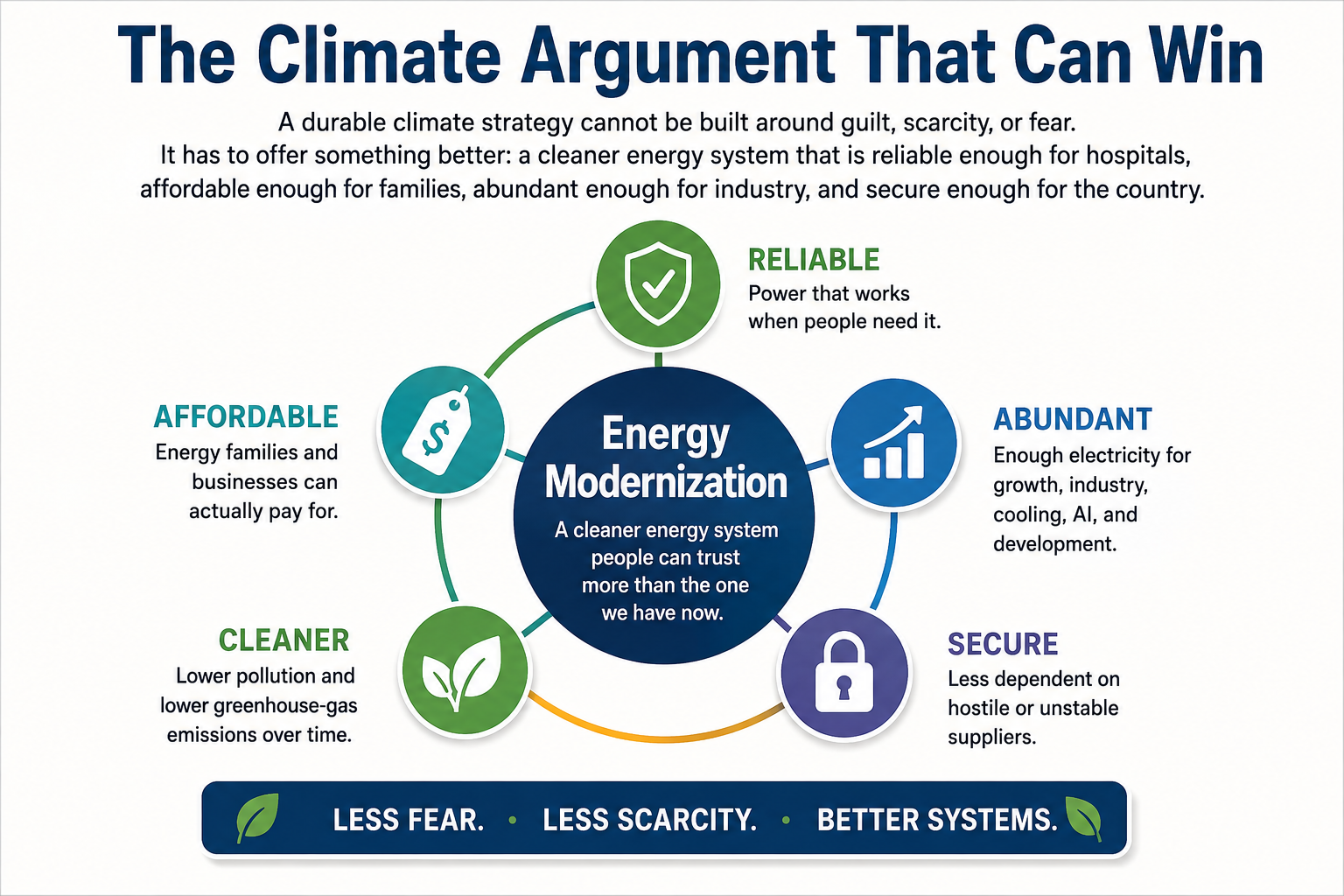
Climate policy succeeds when cleaner energy becomes better energy. The practical goal is not guilt, scarcity, or fear, but a modern energy system that is more reliable, affordable, abundant, secure, and less polluting than the one we have now.
Bottom Line
Climate change is real. The science is strong but complex. Public rhetoric has often damaged trust. Energy security is non-negotiable. Poor countries need development. Industrial countries need reliable power. Nuclear deserves renewed seriousness. EVs and batteries have tradeoffs but real potential. Fossil fuels can be made less damaging but not fully clean. Adaptation matters.
The climate argument most likely to endure is not apocalypse prevention. It is energy modernization.
Fear may draw attention, but competence is what builds durable solutions. The path forward is a cleaner, stronger, more abundant energy system that people can trust.
