
When Bigger Is No Longer the Answer

Government, Dependency, and the Limits of Help
An author’s note on perspective: This essay sits slightly outside my usual zone of neutrality. I can understand the logic behind the New Deal and the Great Society even where I question their long-term consequences. The modern democratic-socialist argument is harder for me to accept. Its critique of concentrated private power deserves consideration; its proposed remedy—transferring still more economic authority to political institutions and a new class of administrators—does not follow logically to me. I have tried to present that argument fairly before explaining where it loses me.
Several days ago, I found myself returning to a deceptively simple proposition:
Government exists to help people.
Superficially, it is easy to recognize the argument. Government protects rights, preserves order, responds to emergencies, corrects injustice, supplies public goods, and acts when individuals or communities cannot reasonably solve a problem alone.
A government indifferent to suffering would not be worthy of a civilized society.
The difficulty lies in the word help.
Does government help by establishing a dependable foundation on which citizens can build their lives? Or does it help by assuming continuing responsibility for healthcare, education, housing, employment, childcare, retirement, income, economic security, and an ever-expanding range of human outcomes?
Those are not the same vision.
The first protects citizens from catastrophe and removes genuine barriers to opportunity. The second gradually makes government the permanent manager of ordinary life.
The United States has spent nearly a century moving from the first vision toward the second. Some of that movement was plainly necessary. Much of it produced lasting benefits. But the accumulated system has grown enormously while many of the problems used to justify further growth remain stubbornly unresolved.
That leaves an uncomfortable question:
Why should further expansion remain the automatic answer when the system has already expanded for generations and still declares itself inadequate?
At some point, government—and those who consistently demand more of it—must look in the mirror.
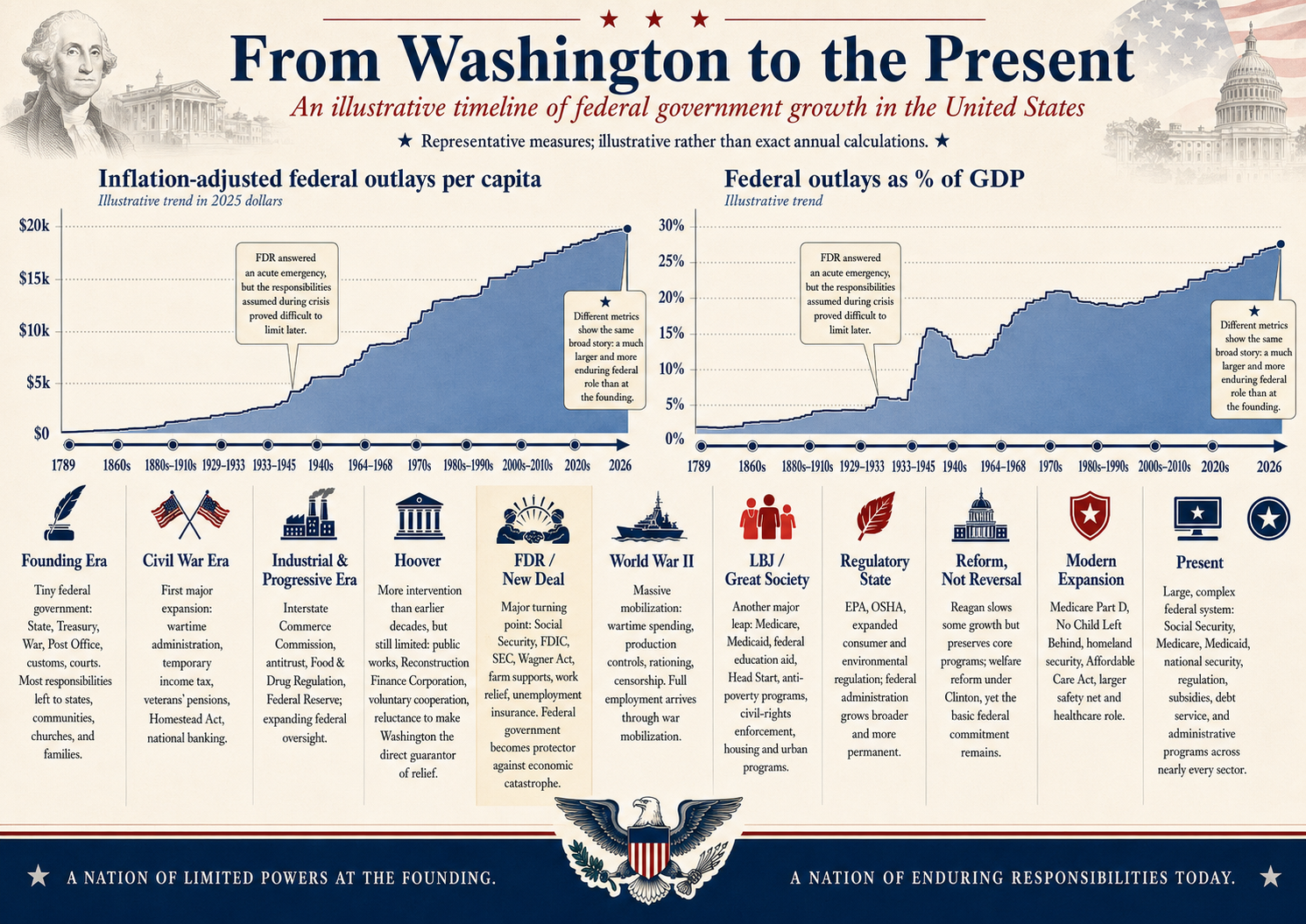
Government has grown enormously over the last century, yet many of our biggest problems remain. This post explores where help became dependency, why more growth is not always the answer, and why a better system may matter more than a bigger one.
Before Washington Became the First Call
Before the New Deal, the federal government played a comparatively limited role in the everyday economic security of most Americans. When someone became unemployed, elderly, disabled, widowed, or impoverished, responsibility generally began close to home—with the individual, family, neighbors, church, ethnic association, fraternal society, labor organization, employer, charity, municipality, or state.
Public relief existed, but it was local, inconsistent, and frequently unpleasant. Poorhouses and almshouses relieved suffering while often deliberately discouraging dependence. Assistance could turn on where someone lived, which organizations he/she belonged to, and whether the surrounding community possessed adequate resources.
This older arrangement had meaningful strengths. Help could be personal. Communities often knew the people they were assisting. Churches, unions, mutual-aid societies, and civic associations created reciprocity, belonging, and an expectation that those able to contribute would do so. But the system also had serious weaknesses. It could be harsh, discriminatory, humiliating, or simply inadequate. Most importantly, it could not absorb a national catastrophe.
A community might help one family after a job loss. It cannot easily respond when banks fail, employers close, credit freezes, savings disappear, tax revenues collapse, and millions lose work at the same time.
The Great Depression overwhelmed nearly every institution expected to respond.
Hoover’s Misjudgment
Herbert Hoover is too often reduced to the caricature of a cold, passive president who watched the nation collapse.
I believe that judgment is unfair.
Few public figures of his generation had devoted more of their lives to humanitarian relief and voluntary public service. Hoover had organized food and humanitarian assistance on an extraordinary scale during World War I. Hoover became internationally known as the “savior of Belgium.” That description was not merely American promotion; it reflected the extraordinary scale of the undertaking. The Hoover-led Commission for Relief in Belgium (CRB) purchased and transported millions of tons of food, effectively operating its own shipping, warehousing, milling, rationing, and inspection system across enemy lines.
Belgian gratitude remains visible today, particularly in Leuven. The city has a Herbert Hooverplein, KU Leuven has a Herbert-Hooverhuis, and the university library contains a Hoover bust and memorials to the Commission. KU Leuven still describes the square as commemorating Belgium’s “lasting gratitude,” and credits Hoover’s personal efforts with helping make the reconstruction of its destroyed university library possible.
After the 1929 crash, Hoover urged businesses to maintain wages and employment, accelerated federal public works, encouraged state and local construction, and ultimately created the Reconstruction Finance Corporation to provide emergency loans to banks, railroads, and other threatened institutions. Those actions exceeded the normal federal role of earlier administrations, even though they remained more indirect and limited than the programs that followed.
Hoover’s error was not indifference. It was a misjudgment of scale, timing, and institutional capacity.
He believed that businesses, banks, communities, charities, states, and local governments could cooperate long enough for confidence and economic activity to recover. Perhaps, given sufficient time, they might have. But “eventually” was not an adequate answer when millions lacked work, and the very institutions expected to provide relief were themselves collapsing.
Hoover trusted American society to repair itself. He underestimated how thoroughly the Depression had disabled the mechanisms of self-repair.
Yet his deeper concern should not be dismissed. Hoover feared that emergency federal responsibility would become permanent responsibility, displacing voluntary organizations, local judgment, private initiative, and state authority.
That fear was not foolish. In the long run, it may have been prophetic.
John F. Kennedy, although hardly a disciple of Hoover’s limited-government philosophy, later praised Hoover’s achievements in promoting “efficiency and economy in government.” Kennedy and others understood that Hoover’s failed presidency did not erase an extraordinary record of humanitarian and administrative service.
The historical tragedy was symmetrical: Hoover saw the long-term danger but underestimated the immediate emergency.
FDR and The New Deal
Franklin Roosevelt understood the emergency. By March 1933, federal intervention was not merely attractive as an ideology. It was probably unavoidable. Banking failures, unemployment, collapsing credit, and widespread fear threatened the economic system and perhaps public confidence in democratic government itself.
The New Deal stabilized banks, protected deposits, restructured financial regulation, supported agriculture, created public employment, and provided relief on an unprecedented scale.
Roosevelt’s achievement was real. He arrested the collapse, restored confidence, relieved suffering, and persuaded Americans that constitutional government could respond to systemic failure.
But the New Deal did not, by itself, restore full employment or complete the recovery. The economy improved substantially after 1933, yet the recession of 1937–1938 produced another 10 percent decline in real GDP and unemployment near 20 percent. The Federal Reserve’s historical account dates the return to full productivity and employment to World War II.
The New Deal stabilized the system and began the recovery. It did not finish it.
Roosevelt also understood that relief could become corrosive. In 1935, he warned Congress that government had to preserve not only the physical survival of the unemployed but their “self-respect” and “self-reliance.” He rejected the idea that indefinite cash assistance or meaningless make-work could substitute for useful contribution.
That was the moral logic of work relief. Roosevelt wanted government to act, but he did not want able citizens to become permanent clients of government. Work provided more than income. It supplied structure, competence, social connection, contribution, and the knowledge that one remained useful. In that sense, Roosevelt was prescient. The irony is that the institutions created during his administration established the federal responsibility whose later expansion proved so difficult to contain.
FDR’s Complicated Legacy
Roosevelt’s legacy cannot fairly be reduced to either heroism or overreach. He confronted a genuine catastrophe and acted when the existing order had failed. Without federal intervention, the Depression might have deepened, political extremism might have grown, and the legitimacy of democratic capitalism might have faced a nearly insurmountable test.
Yet the solution changed the governing presumption.
Before Roosevelt, federal intervention in ordinary social and economic life generally required exceptional justification. After Roosevelt, the federal government increasingly became the institution expected to protect citizens from economic insecurity.
Some New Deal programs were temporary. Others—Social Security, unemployment insurance, deposit insurance, securities regulation, labor protections, and agricultural supports—were deliberately permanent.
The government’s role became familiar:
Crisis justified intervention.
Intervention established responsibility.
Responsibility created expectation.
Expectation produced institutions and constituencies.
Those institutions became difficult to reform or remove.
Roosevelt may have preserved confidence in limited constitutional government by temporarily moving beyond some of its former limits. The unresolved question was whether those limits could ever be restored.
When Work Became a National Mission
Economically, World War II represented federal intervention on a scale far beyond the peacetime New Deal. Washington borrowed and spent enormous sums, directed industrial production, rationed goods, allocated strategic materials, controlled prices and wages, conscripted millions, and coordinated labor and private industry around national objectives.
It was hardly a triumph of government withdrawal. But the war differed from ordinary social administration in four important ways.
First, the objective was unmistakable: defeat regimes profoundly hostile to American security and principles.
Second, nearly everyone was expected to contribute. Soldiers fought. Factory workers produced. Families rationed. Citizens bought bonds. Women entered industrial employment. Farmers increased output. Communities gathered materials and supported mobilization.
Third, sacrifice was visibly reciprocal. People did not see themselves merely as taxpayers and recipients. They shared a national burden.
Finally, the mission had an identifiable endpoint: victory.
This creates a revealing distinction: The New Deal offered work because people needed jobs. World War II offered work because the nation desperately needed what people could produce. The war did not merely provide employment. It provided purpose. Americans were not simply being supported. They were needed.
Johnson and the Great Society
Lyndon Johnson inherited a very different America. The country was prosperous, technologically advancing, and increasingly affluent. Yet poverty remained substantial. Racial injustice was deeply entrenched. Educational opportunity varied enormously. Many older Americans had difficulty obtaining healthcare. No, Johnson did not face a collapsed financial system. He faced a prosperous society whose opportunities and protections were unevenly distributed. The Great Society therefore represented another fundamental expansion in governmental ambition.
FDR had asked how Washington could rescue and stabilize a society in crisis.
Johnson asked how Washington could use national abundance to improve the quality of American life.
At the University of Michigan in 1964, Johnson said the Great Society required an end to poverty and racial injustice—but that these were only the beginning. He envisioned better education, stronger communities, more livable cities, broader cultural opportunity, and a society in which national abundance served more than material consumption.
In many respects, he succeeded. Medicare and Medicaid transformed access to healthcare. Federal education programs expanded opportunity from early childhood through college. Civil-rights and voting-rights legislation brought the country closer to its constitutional promises. Environmental, consumer, cultural, and urban initiatives established protections and institutions that Americans now largely take for granted. The Great Society materially improved millions of lives and broadened the meaning of American citizenship.
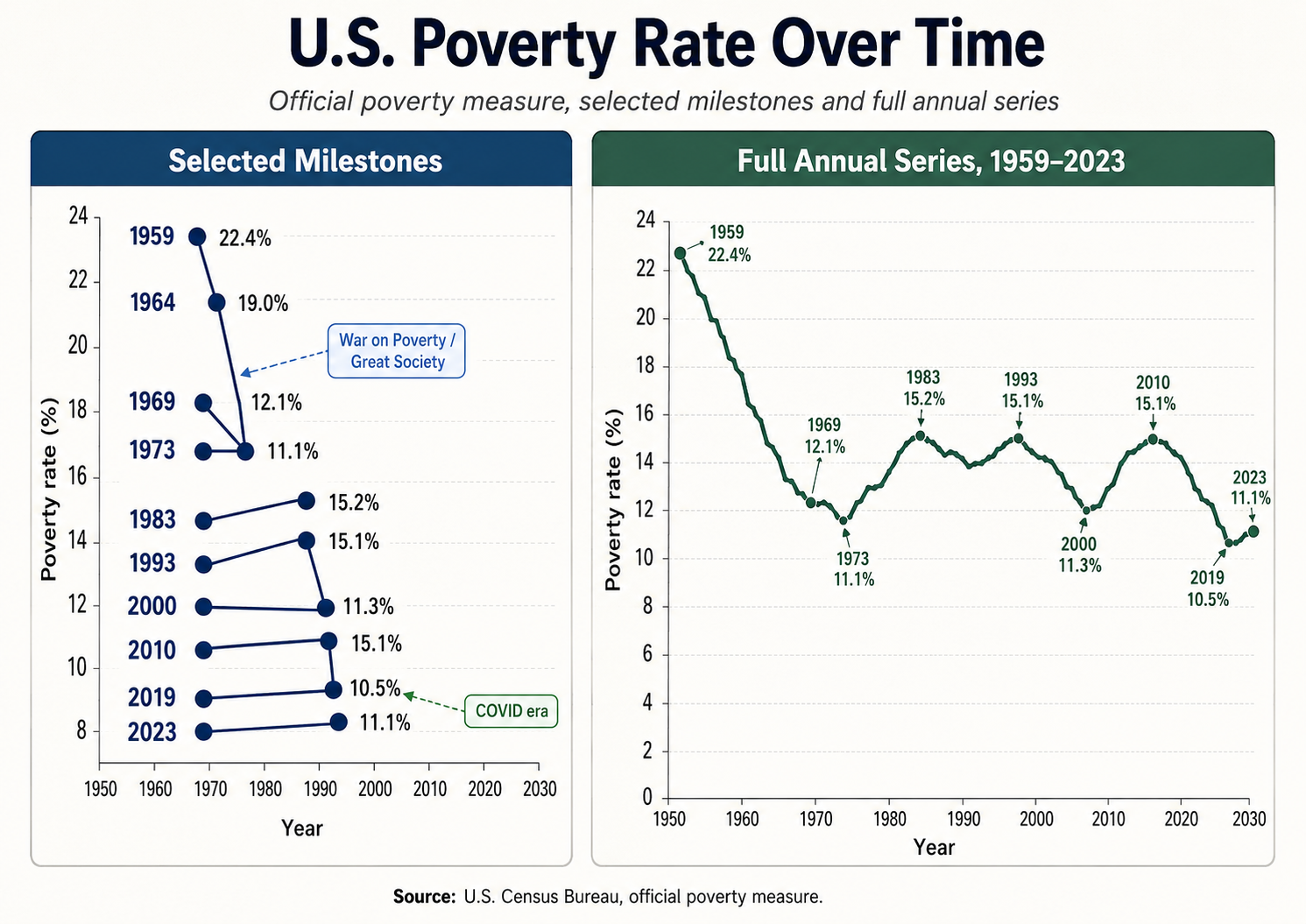
U.S. Poverty Rate Over Time, 1959–2023. The selected milestones at left highlight the dramatic decline in the official poverty rate from 22.4 percent in 1959 to 12.1 percent in 1969 and 11.1 percent in 1973. The complete annual series at right shows that this early progress was real but not continuous: poverty rose again during later recessions, reaching approximately 15 percent in the early 1980s, early 1990s, and after the 2008 financial crisis, before falling to 10.5 percent in 2019 and rising modestly to 11.1 percent in 2023.
The steep decline of the 1960s coincided with strong economic growth, rising employment and wages, Social Security expansions, and the War on Poverty and Great Society programs. No single factor explains the improvement, and the downward trend began before many Johnson-era programs were fully implemented. Still, the data support a balanced conclusion: government action and economic prosperity materially reduced poverty, but neither eliminated it. After the early 1970s, the challenge shifted from achieving a dramatic initial reduction to addressing a persistent poverty rate that continued to fluctuate with economic conditions and changes in public policy.
Source: U.S. Census Bureau, Official Poverty Measure. The official measure does not fully reflect taxes, tax credits, or many noncash benefits; the Supplemental Poverty Measure provides a broader contemporary assessment.
Johnson’s civil-rights achievements deserve separate recognition. The Civil Rights Act of 1964 prohibited major forms of segregation and employment discrimination. The Voting Rights Act of 1965 used federal authority to overcome state and local practices that had systematically prevented Black Americans from voting. These were not merely new benefits. They were exercises of federal power to enforce equal citizenship and constitutional rights.
Johnson’s broader social agenda was also more thoughtful than the caricature of simply giving people money. He believed poor health, hunger, weak schools, discrimination, and inadequate training prevented people from contributing fully.
The intended progression was attractive:
assistance → opportunity → independence
Who could object to helping a child become educated, an older person obtain medical care, a worker acquire skills, or a citizen exercise a right previously denied? The logic made sense.
The poverty rate fell from approximately 22 percent in 1959 to about 12 percent in 1969. That decline cannot be attributed entirely to Great Society programs; strong economic growth and trends already underway also mattered. But it would be equally unreasonable to claim that the decade’s public policies accomplished nothing.
The problem was not the absence of worthy goals. The problem was that the system became much better at initiating assistance than at creating independence.
How the Federal Role Became Permanent
The modern federal system was not constructed by Roosevelt and Johnson alone. Later presidents often criticized particular programs, but most accepted the underlying federal responsibilities.
Ronald Reagan challenged the philosophy of expansive government more directly than most modern presidents, yet he worked with Congress to preserve and refinance Social Security rather than dismantle it. Bill Clinton signed welfare reform that emphasized work, responsibility, and time-limited assistance—but retained a national safety net. George W. Bush increased federal involvement in education through No Child Left Behind and expanded Medicare through prescription-drug coverage. Barack Obama extended the federal healthcare commitment through the Affordable Care Act.
The parties disagreed about methods. Democrats generally emphasized wider eligibility, stronger guarantees, and increased public financing. Republicans more often emphasized work requirements, private delivery, state flexibility, competition, testing, or cost control. But the central responsibilities remained. The debate shifted from:
Should Washington assume responsibility for this problem?
to:
How should Washington administer the responsibility it has already assumed?
That is the ratchet. Government can expand through a succession of individually understandable decisions while the cumulative structure becomes difficult to control.
The Missing Brakes
The modern federal government did not become enormous because every program was foolish. Indeed, many programs are individually defensible. Social Security protects older Americans from destitution. Medicare provides healthcare to the elderly. Medicaid supports many poor and disabled citizens. Federal education assistance can widen opportunity. Disability benefits, veterans’ programs, unemployment insurance, environmental protections, and disaster relief address genuine needs.
The problem is cumulative. Programs create beneficiaries, employees, administrators, contractors, professional associations, regulated industries, advocacy organizations, and political constituencies. States and cities reorganize around federal grants. Hospitals, universities, schools, businesses, and nonprofits structure their operations around public financing and regulation.
Temporary initiatives become permanent. Narrow programs expand. New layers are added while old layers are rarely removed.
The benefits of expansion are concentrated and visible. The costs are dispersed among taxpayers, buried in complicated budgets, financed through borrowing, or transferred to future generations. Politicians receive credit for adding a benefit. They receive little credit for a liability they prevent.
Government therefore developed an accelerator more powerful than its brakes.
The Scale of Government’s Expansion
The growth of federal responsibility is not merely rhetorical. The Office of Management and Budget’s historical tables show federal outlays equal to approximately 3.4 percent of GDP in 1930 and 7.9 percent in 1933. Wartime mobilization drove the figure above 40 percent in 1943–1945, after which it fell sharply. Outlays stood at 17.9 percent of GDP in 1964, rose to 19.8 percent by 1968, and reached 23.1 percent in 2025. Total outlays include defense, interest, administration, and other functions, so they should not be confused with direct assistance to individuals.
OMB’s category of “payments for individuals” provides a more direct measure of the social commitment. Those payments—including direct benefits and grants to state and local governments used for individual benefits—equaled approximately 2.1 percent of GDP in 1940, 5 percent in 1964, 10 percent in 1980, and 16 percent in 2025. In 2025, payments for individuals accounted for approximately 69 percent of federal outlays.
That is an extraordinary transformation.
The Congressional Budget Office projects federal outlays of $7.4 trillion in 2026, equal to 23.3 percent of GDP. Using the Census Bureau’s latest annual population estimate of 341.8 million, that is roughly $21,600 in federal spending per resident—not a payment received by each person, but a tangible indication of scale. CBO projects the 2026 deficit at approximately $1.9 trillion and debt held by the public reaching 120 percent of GDP by 2036.
The data do not prove that government caused every modern social or economic difficulty. They do prove that government has not been absent.
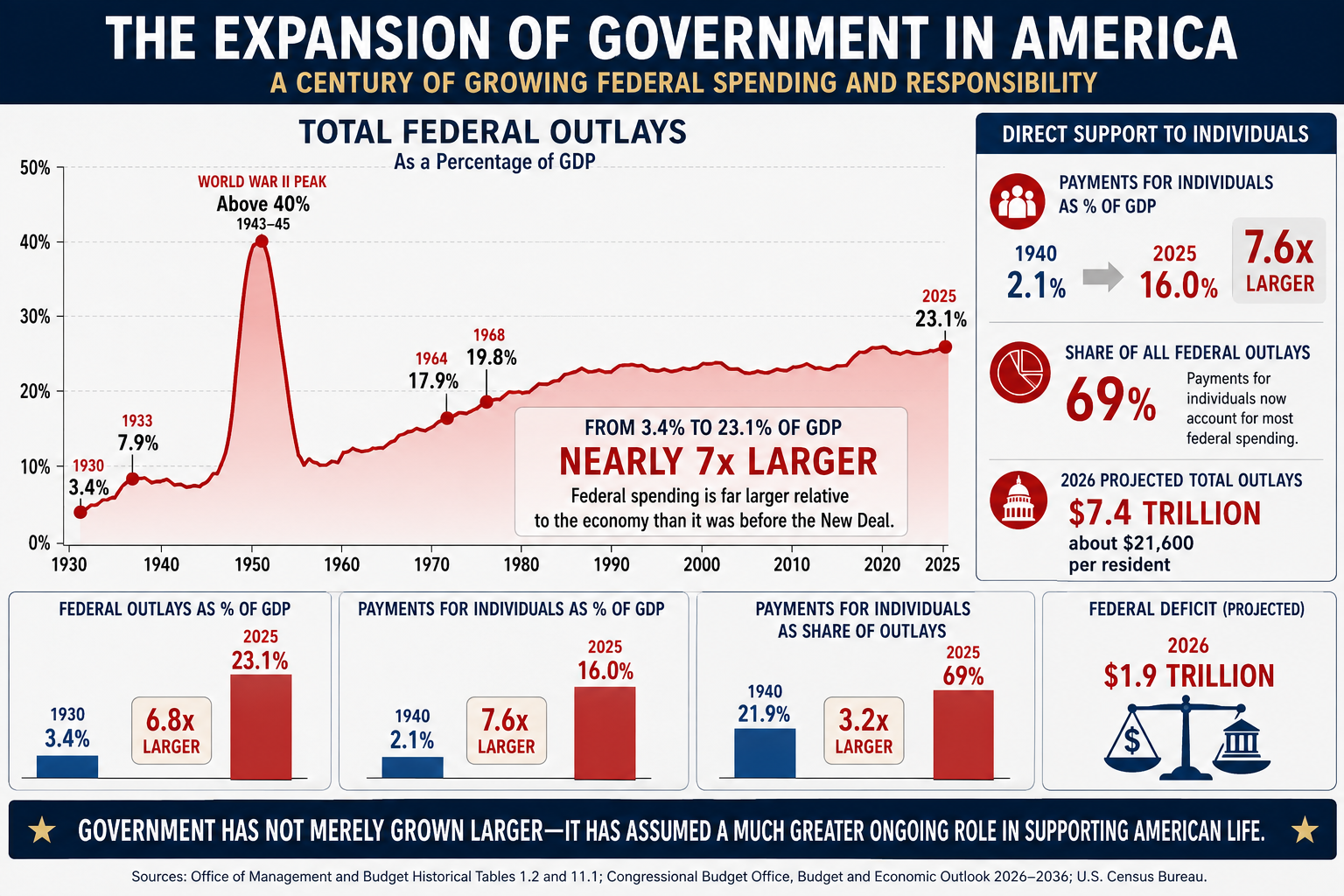
Federal spending now claims nearly seven times the share of the economy it did before the New Deal, while payments for individuals account for 69 percent of all federal outlays. The question is no longer whether government has grown—but whether further growth can solve the problems that so much growth has not.
The Burden of Proof Has Changed
The strongest modern argument for still larger government often rests on two claims. The first is that ordinary Americans suffer because government has not done enough. The second is that the current government is already heavily influenced by corporations, wealthy interests, entrenched institutions, and ineffective bureaucracies. Both observations may contain truth. Together, however, they raise an obvious question:
If government has already grown enormously and remains distorted, expensive, and unsatisfactory, why should transferring still more responsibility to it produce a better result?
You cannot have it both ways. America cannot simultaneously be described as a society abandoned to laissez-faire markets and as a country whose government spends trillions, finances retirement and healthcare, subsidizes education and housing, guarantees loans, supports states and cities, regulates nearly every economic sector, and allocates a historically large share of national resources.
Government is not absent. The relevant question is whether it helps competently, efficiently, and with adequate limits.
If housing, healthcare, education, poverty, and economic insecurity remain serious problems after decades of expanding public involvement, the explanation cannot be that government has not yet become large enough.
Other possibilities must be considered:
programs may be poorly designed;
incentives may reward continued enrollment or institutional preservation;
regulations may protect established interests;
public and private institutions may collude rather than compete;
bureaucracies may measure success by spending and participation rather than outcomes;
and national solutions may be too remote or uniform for many local problems.
At some point, the system must look in the mirror. Good intentions deserve respect. Results still require judgment.
A Flawed System Is Not an Argument for Takeover
A wealthier, older, and more complicated nation will reasonably devote more resources to retirement, healthcare, defense, science, infrastructure, and public administration.
Nor does the persistence of illness or poverty prove that earlier programs accomplished nothing. Some problems can be reduced without ever being eliminated. The fair question is whether the accumulated structure produces results proportionate to its cost, scale, and authority.
Consider healthcare. Government is already deeply involved through Medicare, Medicaid, veterans’ healthcare, tax preferences, public-employee coverage, research funding, insurance regulation, and subsidies. The system does not suffer from an absence of government. Its dysfunction arises partly from a dense public-private arrangement in which government, insurers, hospitals, employers, pharmaceutical companies, professional groups, and regulators have become mutually dependent.
Housing is similarly shaped by zoning, tax policy, subsidies, mortgage guarantees, environmental review, infrastructure, building codes, and local restrictions. Education involves public schools, federal and state financing, student lending, grants, accreditation, tax-supported universities, and extensive regulation.
In each case, the problem is that government has done many things simultaneously—sometimes incoherently, sometimes in ways that protect established institutions more effectively than the people those institutions were created to serve.
Democratic socialists may regard this as evidence that partial public intervention is inherently unstable: private interests capture government, dilute reform, and preserve profit within systems increasingly financed by taxpayers. Their answer is to replace the hybrid with more complete public ownership or political control.
That argument deserves to be stated clearly. But it does not follow that because the present combination is dysfunctional, concentrating still more authority in government will resolve the dysfunction. Public systems also face scarcity, lobbying, institutional capture, weak incentives, political favoritism, administrative rigidity, and resistance to admitting failure. A public monopoly may remove some private profits while leaving citizens with fewer alternatives and less ability to exit when the system performs poorly.
The burden is therefore not merely to show that the current arrangement is unsatisfactory. Most Americans already know that. The burden is to demonstrate that transferring broader ownership and control to political institutions would produce greater competence, accountability, innovation, and restraint.
A compromised hybrid is not proof that government should take over the whole system. It may instead be evidence that responsibilities have become blurred, incentives distorted, competition suppressed, and accountability dispersed among institutions that can always blame one another.
The better response may be neither another layer of government nor comprehensive public control. It may be to simplify the architecture, clarify responsibility, expose costs, restore competition where competition can work, preserve public guarantees where markets cannot, and ensure that failure has consequences.
Another program may relieve a symptom while making the underlying structure even harder to understand, reform, or escape. But replacing the entire structure with a political monopoly could make escape impossible.
The relevant question is not simply whether control should be public or private. It is whether power is limited, transparent, accountable, and subject to meaningful alternatives—regardless of who holds it.
Dependency Is Larger Than Welfare
Dependency is an easily abused word. It should not be reduced to the claim that people receiving assistance are lazy, irresponsible, or morally deficient. Many recipients are elderly, disabled, ill, caring for children, working at low wages, or responding rationally to the incentives they face.
The more important point is that dependency is not limited to individuals. There is material dependency, when a household cannot afford to lose a benefit. There is institutional dependency, when hospitals, schools, universities, municipalities, contractors, industries, and nonprofit organizations cannot function without continuing public support. There is political dependency, when parties build constituencies around benefits and portray any restraint as abandonment. There is psychological dependency, when citizens lose confidence that they can act without official permission, financing, or administration.
A society can gradually move from asking:
What can I do, and who around me can help?
to asking:
Which institution is responsible for fixing this for me?
That change does not necessarily arise from a failure of character. It arises from expectations created by institutions. When government assumes responsibility for more areas of life, citizens naturally blame government when those areas remain unsatisfactory. Politics then becomes an expanding contest over claims, resources, and blame.
The Democratic-Socialist Alternative
Not everyone looks at this tangled public-private system and concludes that government has already assumed too much responsibility. Democratic socialists draw almost the opposite lesson.
They argue that partial intervention leaves the worst features of both systems intact. Government supplies money, guarantees demand, absorbs risk, and regulates outcomes, while private institutions retain ownership, profits, and considerable influence over the rules. From that perspective, the problem is not excessive public involvement but public involvement that remains incomplete and vulnerable to capture.
That interpretation deserves a fair hearing because it begins with a legitimate concern.
Economic power can become concentrated. Large employers, insurers, landlords, banks, technology companies, and corporate boards make decisions that affect people who have little direct influence over them. A patient cannot realistically negotiate with a hospital system. A tenant may have few alternatives in a constrained housing market. An employee may depend on a large corporation not only for income but for health insurance and retirement security.
The Democratic Socialists of America argue that important economic institutions should therefore become subject to collective ownership and democratic control. Its public explanation specifically identifies major systems such as energy and transportation as economic drivers that should be collectively owned.
The strongest democratic-socialist response to the dependency argument is this:
People are already dependent on institutions. The real question is whether those institutions are privately controlled or democratically accountable.
That is not a foolish argument. It identifies a real weakness in the existing system: private authority can become concentrated, remote, and difficult to challenge.
Where the logic loses me is in the proposed remedy.
“The people” cannot personally administer power companies, hospitals, banks, housing systems, railroads, factories, insurance programs, and investment funds. Those decisions must be delegated to elected officials, political organizations, agencies, public boards, union leaders, technical experts, managers, and permanent administrators.
The movement therefore does not eliminate hierarchy or institutional dependency. It relocates them.
Power does not disappear.
It changes hands.
Collective Control Still Requires Controllers
The DSA itself demonstrates this ordinary organizational reality.
Its members do not collectively make every operational decision. Convention delegates establish priorities, while a National Political Committee functions as the organization’s governing board and directs staff and work between conventions. That is a perfectly normal structure for a national organization.
But it also illustrates the point. “Collective control” ultimately means delegated control. Millions of citizens do not continuously govern an economic system. A comparatively small number of officials administer it in their name. Elections provide accountability, but only intermittently. Voters choose among bundles of policies and personalities. They do not supervise thousands of daily decisions about prices, investment, employment, supply, eligibility, or production.
Private concentrations of power deserve scrutiny. But combining economic power with regulatory and coercive political power may create something more difficult to resist—not less.
Democratic socialism does not abolish elites.
It changes their titles.
Anarchic Toward One System, Controlling Toward the Next
The movement also contains a difficult internal tension.
It can appear almost anarchic toward existing institutions—police, prisons, corporations, landlords, markets, and inherited authority—while expressing remarkable confidence that newly designed public institutions should exercise far greater control over housing, healthcare, energy, transportation, investment, and production.
It distrusts authority as presently constituted. It places extraordinary faith in authority reorganized according to its own principles.
The debate over policing illustrates the problem. There are persuasive arguments for improved training, stronger accountability, civilian oversight, less militarization, and assigning some mental-health or social-service calls to professionals other than armed police officers. But DSA’s official abolition materials went considerably further. They called for rejecting increases in police budgets while reducing those budgets annually toward zero. The organization’s current program describes defunding and demilitarization as steps toward fully abolishing police and prisons.
Abolishing a police department does not abolish violence, investigation, emergency response, or the need to restrain dangerous people. Those functions must reappear somewhere—under another name, inside another institution, with someone authorized to enforce decisions.
The same pattern applies economically. Removing owners, executives, landlords, or private insurers does not remove the need to allocate capital, manage organizations, set priorities, resolve shortages, and deny some requests. The functions remain. The identity of the decision-maker changes.
That is why I find the movement’s reasoning asymmetrical:
It assumes existing institutions will abuse power, but gives surprisingly little attention to how its own replacement institutions might do the same.
Its weakness may not be bad intentions, but inadequate skepticism toward its own intentions.
It distrusts power in other hands while assuming that power will become more benign in its own.
The Founders’ Answer to the Power Problem
It is tempting to ask whether democratic socialists are historically uninformed or simply attracted to power.
That is probably neither useful nor fair.
The movement contains people with different motives, levels of knowledge, and personal interests. Many are sincere. They see unaffordable housing, expensive healthcare, insecure employment, concentrated wealth, and declining trust, and they want to build something better.
The proper criticism is structural rather than psychological.
No political movement should be trusted merely because its members believe they are more public-spirited than the people they would replace. Every movement believes its leaders are the good ones. Every reformer is tempted to believe that power will behave differently once placed in wiser or more compassionate hands.
The Founders regarded that confidence as dangerous.
The Constitution was not designed around the expectation that unusually virtuous people would govern. It was designed for ordinary human beings—ambitious, self-interested, fallible, factional, and reluctant to surrender authority. Madison’s famous answer was not to search for better rulers, but to arrange institutions so that “ambition must be made to counteract ambition.”
That insight shaped the entire constitutional architecture. Power was divided among three branches, split between two houses of Congress, shared between the federal government and the states, constrained by elections, and subjected to competing institutional interests. The purpose of checks and balances was to prevent any one branch—or any temporary majority—from becoming dominant.
The Founders understood that concentrated private power could be dangerous, but they were equally concerned about concentrated political power. Government acts not only through persuasion or exchange, but through law, taxation, regulation, and coercion. That makes the character of the current officeholder less important than the limits placed upon the office itself.
A durable system must therefore assume that future officials will possess ordinary human limitations: incomplete knowledge, ambition, factional loyalty, institutional defensiveness, self-interest, and a tendency to justify retaining authority once it has been acquired.
The answer to concentrated power is not to entrust it to supposedly better people. It is to divide it, constrain it, expose it to competition, and preserve alternatives for those subject to it.
That is where the democratic-socialist remedy seems most at odds with the American constitutional inheritance. The movement correctly warns that economic power can become concentrated in corporations, banks, insurers, landlords, and technology companies. But it then proposes moving more of that economic authority into political institutions—placing ownership, regulation, financing, and enforcement increasingly in the same hands.
The Founders would almost certainly have recognized the danger. The problem is not simply who controls the levers. It is how many levers any one institution is permitted to control.
A system that has already grown enormously, remains unsatisfactory, and responds by transferring still more authority to a new group of officials has not necessarily solved the underlying problem.
It may simply have changed the names on the doors.
A Century of Reinventing the Same Argument
Democratic socialism is not a newly discovered answer to a uniquely modern problem. DSA traces its lineage through older socialist, labor, and New Left traditions. Its own history distinguishes its ultimate goal—worker or social ownership—from the New Deal and from conventional social democracy.
Movements built around similar combinations of economic dissatisfaction, institutional distrust, participatory idealism, and centralized economic ambition have appeared repeatedly. Some of their criticisms became important reforms. Others encountered the same unresolved questions:
Who exercises collective power?
How is scarcity managed?
What replaces institutions after they are dismantled?
How can citizens escape a failing public monopoly?
What protects dissenters from a political majority?
Why should the new governing class possess greater wisdom or restraint than the old one?
Those who have lived long enough have seen movements arrive with moral urgency and claims of historical inevitability. Most eventually divide, moderate, merge into larger political coalitions, or disappear. Some of their ideas remain—usually stripped of their revolutionary language and adapted to the system they once promised to replace.
Production Still Comes Before Distribution
There is also a basic economic constraint that political rhetoric often obscures.
Before society can consume, someone must produce.
Before government can spend, someone must earn—or government must borrow against future production.
Declaring healthcare, housing, education, food, transportation, or energy a right does not create doctors, nurses, teachers, homes, fuel, machinery, engineers, or skilled workers. It does create a claim upon the labor and resources needed to provide them.
A prosperous society can reasonably protect citizens from destitution, provide education, maintain a humane safety net, and ensure access to essential care. But redistribution depends on production.
Capital must be saved and invested. Risks must be taken. Workers must be trained. Enterprises must be created. Innovation must be rewarded. Resources must be allocated among competing uses.
Markets perform those functions imperfectly. They can generate monopoly, instability, exploitation, and inequality. They need law, competition, public infrastructure, transparency, and regulation.
But replacing market imperfections with political allocation does not eliminate scarcity, ambition, incomplete knowledge, or self-interest. It transfers those problems to institutions that possess coercive authority and may offer fewer avenues of exit.
At some point, society must make money before it can spend money.
Prosperity can create a fantasy that resources are effectively inexhaustible—particularly when citizens are surrounded by images of extravagant wealth and encouraged to believe that someone else can always finance the next promise.
But no society can redistribute its way to lasting prosperity while weakening the productive system on which redistribution depends.
The Case for Limited, Effective Government
The alternative is not to return to 1928.
Families, churches, charities, and local governments could not manage the Great Depression. They cannot independently finance modern medical care for every older or severely disabled person. National rights cannot be left entirely to local majorities. Complex markets require national rules. Competent government remains essential. The better alternative is a mixed system with clearer boundaries, stronger accountability, and more respect for human agency.
Government should:
protect constitutional rights;
prevent destitution and catastrophic loss;
provide essential services and infrastructure that individuals or markets cannot reliably supply on their own;
act when state, local, private, or voluntary institutions are plainly incapable;
preserve competition rather than protect incumbents;
and maintain a strong but comprehensible safety net.
But new programs should face questions that existing programs too often escaped.
What is the specific objective?
How will success be measured?
Does the program increase independence or reward continued reliance?
Could the problem be solved more effectively by the individuals, communities, or states closest to it?
What are the full costs and tradeoffs?
Does the citizen have alternatives when the system fails?
What authority expires when the emergency ends?
Permanent programs should be periodically reviewed rather than treated as untouchable inheritances. Overlapping programs should be consolidated. Benefits should avoid abrupt cliffs that punish work or savings. Federal rules should allow meaningful state and local experimentation where constitutional rights are not at stake. Most importantly, programs should be judged by outcomes rather than inputs. Money spent is not the same as a problem solved. People enrolled are not necessarily people helped.
For many social programs, genuine success should eventually mean that fewer people need them.
Assistance Should Preserve Agency
A humane society owes protection to people who cannot provide for themselves. But when citizens remain capable of contributing, assistance should ordinarily preserve an expectation of effort—through work, training, adaptation, service, or some other form of responsible participation.
That expectation is not punitive. It reflects reciprocity.
A durable social compact cannot rest on rights alone. It must also recognize obligations, while recognizing that those obligations differ according to age, health, ability, and circumstance. Those who need help should receive it without humiliation. Those able to contribute should be encouraged—and expected—to do so.
The purpose of a safety net is not merely to maintain people in hardship, but whenever possible to help them recover stability, confidence, and independence.
What Government Can—and Cannot—Do
The case for effective government remains substantial.
Government can protect rights, enforce contracts, maintain order, defend the country, build infrastructure, fund basic research, provide education, protect citizens against certain catastrophic risks, regulate genuine abuses, and respond when families, communities, markets, or local institutions are overwhelmed.
But government should be judged neither by the moral attractiveness of its aims nor by the amount of money it spends. It should be judged by whether it solves identifiable problems, preserves human agency, rewards contribution, controls costs, limits institutional dependency, respects local competence, permits meaningful alternatives, and recognizes when its work is complete.
There are also important limits to what government can accomplish:
It can provide resources and opportunity, but it cannot provide purpose.
It can finance schools, but it cannot create a love of learning.
It can make healthcare available, but it cannot make people live wisely.
It can provide income support, but it cannot supply a reason to get out of bed.
It can protect freedom, but it cannot tell free people what their freedom is for.
Johnson himself understood part of this limitation. The Great Society was not supposed to be merely a gift from presidents or government. Its success would ultimately depend on the work, judgment, character, and fortitude of citizens. That may be the most important and neglected part of his vision. Government can establish conditions in which human flourishing becomes more possible. It cannot manufacture flourishing itself.
The Search for Purpose
Many people do find purpose. They find it in family, faith, vocation, friendship, service, environmental stewardship, care for the poor, business, scholarship, art, sport, community, or mastery of a craft. Those purposes are often powerful because they are concrete and reciprocal. A person knows who depends on them, what they are building, and what obligation remains.
But common purpose has become harder to sustain. Popular culture frequently offers fantasy in its place: enormous houses, celebrity wealth, curated bodies, luxury travel, effortless success, and families transformed into entertainment. We watch other people live and consume symbols of achievement without necessarily building something durable ourselves.
The ordinary sources of meaning—a stable marriage, dependable work, raising capable children, caring for aging parents, serving a church or community, maintaining a home, preserving an institution—rarely appear glamorous. Yet those are the activities on which society depends. Fantasy culture offers aspiration without obligation.
A functioning republic requires aspiration joined to contribution.
A National Purpose Without Another Federal Program
World War II provided an unmistakable national purpose, but at a terrible price. A free country should not need war, fear, or a permanent emergency to rediscover meaning. Nor should government attempt to manufacture national unity through ideological conformity or another boundless public crusade.
The national purpose can be quieter and more durable:
Preserve a free, prosperous, competent republic and leave it stronger for the next generation.
That purpose allows many callings. Families raise children. Schools educate citizens. Businesses produce and employ. Churches and associations create belonging. Physicians care for the sick. Scientists discover. Workers master useful skills. Communities preserve trust. Government protects rights and performs genuinely public functions.
Citizens need not share the same faith, profession, politics, or passion. They do need to believe that their different purposes belong within a common inheritance. Purpose is often found locally. Citizenship gives those purposes a common home.
The Real Question Is Not How Much, but How Well
Hoover, Roosevelt, and Johnson confronted different problems and understood different parts of the governing dilemma.
Hoover correctly feared that centralized responsibility would become difficult to reverse. He failed to appreciate how urgently the Depression required national action.
Roosevelt understood the emergency at hand and acted decisively. He also warned that relief must preserve self-reliance and dignity. Yet his success established a model of permanent federal responsibility.
Johnson looked at national abundance and asked why millions were excluded from its promise. His goals—civil rights, healthcare, education, and opportunity—made moral and practical sense. But the system he expanded lacked any comparable mechanism for setting limits, eliminating duplication, or returning responsibilities once assumed.
Later presidents of both parties modified the system without fundamentally reversing it.
The result is not a simple story of government failure. It is a system with genuine achievements, enormous obligations, weak brakes, and no broadly accepted stopping point. The answer is not the wholesale dismantling of the safety net.
It is a better system—one that provides a strong floor, preserves agency, demands honest tradeoffs, measures results, leaves room for competing institutions, and remains skeptical of concentrated power regardless of who holds it.
The central question is no longer whether government should help. The question is why a system that has already grown enormously remains unsatisfactory—and why growth itself is still treated as the default cure.
At some point, we have to look in the mirror.
When a system expands for generations and still declares itself inadequate, the problem may no longer be insufficient scale. It may be the design, incentives, complexity, and limits of the system itself. And placing a different group of people in charge of still more of our lives does not necessarily create democracy, competence, or freedom.
Selected References
Office of Management and Budget. Historical Tables: Budget of the United States Government, especially Tables 1.1, 1.2, 1.3, and 11.1.
Congressional Budget Office. The Budget and Economic Outlook: 2026 to 2036.
U.S. Census Bureau. “U.S. Population Growth Slows Due to Historic Decline in Net International Migration,” January 27, 2026.
Herbert Hoover Presidential Library and Museum. “The Great Depression.”
John F. Kennedy Presidential Library. “Remarks of John F. Kennedy at a Dinner Honoring Herbert Hoover,” February 4, 1957.
Franklin D. Roosevelt. “Annual Message to Congress,” January 4, 1935. The American Presidency Project.
Federal Reserve History. “The Great Depression” and “Recession of 1937–38.”
Lyndon B. Johnson Presidential Library. “Remarks at the University of Michigan,” May 22, 1964.
National Archives. “Civil Rights Act (1964)” and “Voting Rights Act (1965).”
U.S. Census Bureau. Poverty Continues to Decline in 1969.
Ronald Reagan Presidential Library. “Remarks on Signing the Social Security Amendments of 1983.”
Clinton White House Archives. “Moving Families From Welfare to Work.”
George W. Bush White House Archives. Materials on No Child Left Behind and Medicare prescription-drug coverage.
Obama White House Archives. “Health Care That Works for Americans.”
Democratic Socialists of America. “What Is Democratic Socialism?”
Democratic Socialists of America. “Leadership and Structure” and DSA Constitution and Bylaws.
Democratic Socialists of America. “Abolition Working Group” and Workers Deserve More: DSA Program.
Democratic Socialists of America. “History.”
