
In Brief
America has had Federalists, Whigs, Anti-Masons, Know-Nothings, Free Soilers, Populists, Socialists, and even a party named after a Bull Moose. Some won elections, others vanished almost overnight, and a few changed American politics long after they disappeared. Yet through wars, economic catastrophes, political scandals, and extraordinary social change, the country has repeatedly returned to two dominant political parties. How did that happen? This essay follows the colorful and sometimes turbulent evolution of American party politics, introducing the remarkable personalities, political bosses, reform movements, and historical turning points that shaped the system we know today.
Two lessons emerge. Political parties are not permanent collections of fixed beliefs. Their principles, supporters, and priorities change as Americans reconsider what they expect from government and how much independence they wish to preserve. And whatever their convictions, political parties ultimately need enough votes to win. That simple reality helps explain their shifting alliances, occasional opportunism, absorption of smaller movements, and remarkable ability to reinvent themselves. The names may remain familiar, but the parties behind them—and the voters who sustain them—have never stopped changing.
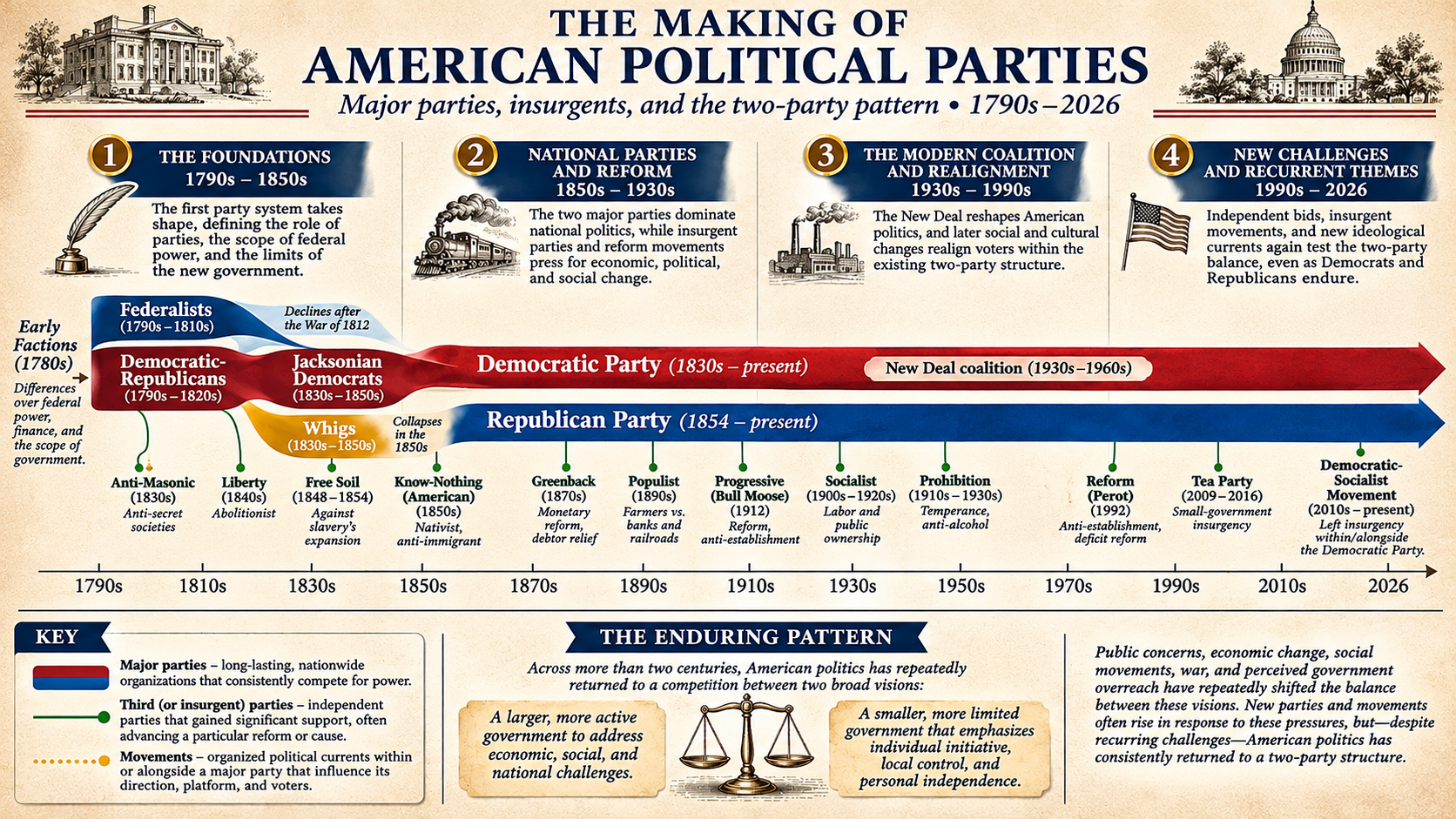
Power, Principle, Political Machines, and the Remarkable Pursuit of Votes
George Washington did not particularly like political parties. He feared that political factions would divide the young republic, encourage citizens to put party loyalty above national interests, and give ambitious individuals opportunities to gain power. Unfortunately for Washington, two of the principal architects of America's first political parties were serving in his own administration.
Alexander Hamilton and Thomas Jefferson disagreed profoundly about what kind of country the United States should become. Hamilton favored a vigorous national government, strong financial institutions, and commercial development. Jefferson feared concentrated federal authority and envisioned a republic grounded in agriculture, individual independence, and substantial powers reserved to the states. Their disagreements helped produce the Federalists (Hamilton) and Democratic-Republicans (Jefferson), America's first enduring national political rivals.
The Constitution established the framework for American government but made no provision for political parties. Yet the republic had scarcely begun before Americans were organizing themselves into opposing political camps.
More than two centuries later, we are still doing much the same thing.
But the journey from Hamilton and Jefferson to today's Democrats and Republicans was hardly a straight line. Along the way, Americans organized parties opposing Freemasonry, immigration, slavery, alcohol, concentrated wealth, and established political institutions. Federalists, Whigs, Anti-Masons, Free Soilers, Know-Nothings, Greenbackers, Populists, Progressives, Socialists, and a political movement named after a particularly large member of the deer family emerged. Some disappeared almost as quickly as they emerged. Others substantially altered the direction of American politics.
Political leaders changed parties. Parties changed their governing philosophies. Wars, economic crises, constitutional amendments, and social movements repeatedly changed what Americans expected from their government. Meanwhile, political organizers, newspaper editors, financiers, and local party bosses discovered that a compelling idea—or an emotionally powerful grievance—could be transformed into votes. The result is a remarkable history of ambition, conviction, political ingenuity, unlikely alliances, bitter disagreements, and occasional absurdity. Yet through nearly all of it, Americans have returned to two dominant political parties.
Why?
The answer begins with an unexpected champion of organized political opposition.
A Republic Discovers Political Parties (1790–1854)
From Washington's warning to Van Buren's solution
The presidential election of 1796 exposed an early weakness in the American electoral system. Under the Constitution's original arrangement, each elector cast two votes for president, without distinguishing between president and vice president. The candidate receiving the most votes became president, while the runner-up became vice president. The result was an awkward arrangement: Federalist John Adams became president, while his political opponent, Thomas Jefferson, became vice president.
Four years later, the problem became considerably more serious. In the exceptionally bitter election of 1800, Adams faced Jefferson again. This time, Jefferson and his intended vice president, Aaron Burr, received identical Electoral College totals because the system did not distinguish their intended offices. The election went to the House of Representatives, which required thirty-six ballots to select Jefferson.
The outcome exposed a fundamental problem the Constitution's framers had not adequately anticipated: the emergence of organized political parties running coordinated presidential and vice-presidential tickets.
The Twelfth Amendment, ratified in 1804, required electors to vote separately for president and vice president. But how did that produce the familiar presidential ticket Americans select today? The answer lies in the gradual evolution of state election laws and party organization. States increasingly permitted citizens to vote for presidential electors rather than having state legislatures choose them. Political parties assembled slates of electors pledged to their presidential and vice-presidential nominees. Ballots evolved so that citizens could select the pair together, effectively choosing a pledged slate of electors. Electors still cast separate constitutional votes for the two offices. The Constitution had established a method for choosing individual national leaders. Political parties transformed it into competition between governing teams.
The election of 1800 also accomplished something more consequential: a peaceful transfer of power between opposing political organizations. Parties, despite Washington's apprehensions, could function within the constitutional republic.
The Federalists gradually declined, particularly after the War of 1812. By James Monroe's presidency, the country was said to have entered an Era of Good Feelings, with little organized national opposition. But political harmony proved deceptive. Disagreements over banking, economic development, federal authority, and sectional interests continued within the dominant Democratic-Republican coalition.
By 1824, the Democratic-Republican Party had fractured into competing factions, producing four prominent presidential candidates: Andrew Jackson, John Quincy Adams, William Crawford, and Henry Clay. Jackson received the largest share of both the popular and electoral votes, but no candidate secured the Electoral College majority required to win.
Under the Twelfth Amendment, the election went to the House of Representatives, which could choose only among the three leading electoral vote recipients. Clay, who finished fourth, was eliminated. However, as Speaker of the House, he retained considerable political influence and threw his support behind Adams. The House subsequently elected Adams president.
When Adams appointed Clay secretary of state—then regarded as a stepping-stone to the presidency—Jackson's supporters cried foul, accusing the two men of arranging a “corrupt bargain.” Although no improper agreement was ever established, the accusation became a powerful political rallying cry, helping Jackson mobilize supporters for his successful presidential campaign in 1828.
Into this unsettled environment stepped Martin Van Buren. Van Buren understood political organization unusually well. His Albany Regency in New York demonstrated the value of local leadership, party loyalty, coordinated newspapers, and electoral organization. But his importance went beyond organizational skill: he believed parties could strengthen republican government. While Washington feared that factions would divide the republic, Van Buren argued that organized opposition could offer meaningful choices, establish accountability, and keep politics from becoming merely a contest among ambitious personalities. In an 1827 letter to newspaper editor Thomas Ritchie, Van Buren advocated substituting “party principle for personal preference.” He wanted voters to choose among identifiable political ideologies rather than simply select the most appealing individual. There was also an unmistakably practical dimension. Van Buren recognized Jackson's popularity and believed it could be combined with a national coalition capable of winning elections—and that broad parties could help contain sectional conflict.
Jackson won the presidency in 1828, and the modern Democratic Party began taking shape. But Van Buren's approach had a weakness. By bringing Northern and Southern interests together under one political organization, he helped build a powerful national coalition. Maintaining that unity, however, often meant avoiding the increasingly divisive issue of slavery. Rather than confronting the disagreement, party leaders sought to contain it, hoping to preserve support on both sides. In trying to hold the party together, its leaders risked sacrificing the very principle political parties were supposed to uphold: giving voters a meaningful choice on the issues that mattered most.
The Anti-Masons: A most peculiar political movement
In 1826, William Morgan disappeared in western New York after threatening to reveal Freemasonry's secret rituals. Morgan had been abducted, and several men associated with the fraternity were convicted in connection with the crime. His suspected murder, however, was never conclusively established. The episode fueled growing suspicion that Freemasonry exercised improper influence over courts, government officials, and public institutions.
The irony was considerable. Among the fraternity's distinguished American members were George Washington, Benjamin Franklin, and Paul Revere. Their reputations did not establish every Mason's innocence, but neither did the criminal conduct of individual members prove the existence of a nationwide conspiracy. The broader accusations extended well beyond the available evidence.
That did not make them any less useful politically.
Thurlow Weed, a talented organizer and newspaper publisher, recognized that public suspicion of Freemasonry could be transformed into opposition to Andrew Jackson and his supporters. Enter the Anti-Masonic Party. Many followers sincerely feared secret influence over government, while political organizers saw an opportunity to build a broader electoral coalition. Believing an accusation and believing it can win votes are not necessarily the same thing.
Then came an almost irresistible contradiction. In 1831, the Anti-Masonic Party held the first national presidential nominating convention. Its candidate was William Wirt, a former Freemason who did not share the movement's sweeping hostility toward the fraternity. Apparently, finding a nationally acceptable presidential candidate was harder than finding a politically attractive grievance.
Wirt carried Vermont in the 1832 election, but the Anti-Masonic Party subsequently declined, with many of its members joining the emerging Whig coalition. Its most important innovation, however, endured. National presidential nominating conventions soon became standard practice among the major parties.
The Anti-Masons never came close to winning the presidency, yet they changed how Americans would choose presidential candidates for generations.
Jackson, the Whigs, and The First Major Realignment
Jackson's opponents gradually coalesced into the Whig Party, united largely by their concern that he was concentrating too much power in the presidency. Henry Clay, Daniel Webster, and other Whig leaders accused Jackson of overstepping constitutional limits, particularly through his aggressive use of the presidential veto and his campaign against the national bank. Critics even portrayed him as “King Andrew I,” suggesting that his exercise of executive authority resembled the monarchy Americans had fought to escape. The Whigs favored stronger congressional leadership, while many also supported national economic development and infrastructure investment. For approximately two decades, Democrats and Whigs competed for national power.
But the Whigs contained Northern and Southern politicians whose differences over slavery became increasingly difficult to reconcile. Other movements emerged. The Liberty Party, founded in 1840, sought to organize antislavery sentiment through elections. The Free Soil Party, established in 1848, opposed slavery's expansion into western territories; its supporters included abolitionists, former Whigs, and Democrats concerned about slaveholding political power.
Then came another unexpected turn. Martin Van Buren—the man who helped construct the Democratic Party—became the Free Soil presidential nominee in 1848, receiving approximately 10% of the popular vote. Van Buren was not an abolitionist, and historians debate the combination of rivalry, ambition, and conviction behind his candidacy. Nevertheless, Free Soil helped prepare the ground for Republican organization.
Political allegiance was already proving less permanent than party names might suggest.
The Know-Nothings Arrive
The 1850s witnessed another unusual political movement, this one with a name that sounds almost comical today. The Know-Nothings emerged from secret organizations opposed to immigration, particularly from Catholic Ireland and Germany. Members were sworn to secrecy and, when questioned about their activities, were instructed to respond, “I know nothing.” The nickname stuck, although the movement eventually became known formally as the American Party. Ironically, only a generation after the Anti-Masons condemned secret societies, another political movement used secrecy to organize voters.
Their politics were serious. They opposed immigration, particularly from Catholic Ireland and Germany. Supporters feared that Catholic allegiance to the pope threatened American institutions. These anxieties attracted substantial support during rapid immigration and social change. The movement organized as the American Party and nominated former president Millard Fillmore in 1856. Fillmore received about 22% of the popular vote and carried Maryland. For a brief period, the Know-Nothings seriously challenged the established parties.
But they confronted the same issue dividing the Whigs: slavery. Northern and Southern members could not agree on its expansion, and the organization weakened quickly. The Know-Nothings showed how a powerful grievance could mobilize voters without creating a durable basis for governing. Their organization declined; nativism, however, has remained a recurring theme in American politics.
When Political Disagreement Became Bloodshed
The Kansas–Nebraska Act of 1854 turned an already bitter disagreement into something considerably more dangerous. Senator Stephen Douglas proposed allowing settlers in Kansas and Nebraska to decide whether slavery would be permitted—a principle known as popular sovereignty. The legislation overturned a central provision of the Missouri Compromise of 1820, which had maintained a delicate political balance by admitting Missouri as a slave state and Maine as a free state while prohibiting slavery in much of the remaining Louisiana Purchase territory north of latitude 36°30′.
Douglas hoped the measure would resolve the controversy by allowing settlers to decide for themselves. Instead, it encouraged competing factions to fight for control of the electorate. Proslavery activists crossed into Kansas from Missouri, casting fraudulent ballots and intimidating settlers. Antislavery groups organized their own settlements and political institutions. Elections were disputed, rival governments emerged, and violence followed.
In May 1856, proslavery forces attacked the antislavery town of Lawrence, destroying buildings and printing presses. The following day, Representative Preston Brooks brutally assaulted antislavery Senator Charles Sumner on the Senate floor. Two days later, abolitionist John Brown and his followers killed five proslavery men near Pottawatomie Creek. Kansas became known as Bleeding Kansas, its election fraud, intimidation, destruction, and bloodshed offering a disturbing preview of the much larger catastrophe approaching.
The political consequences were profound. The Whig Party, already divided over slavery, could no longer maintain its Northern and Southern constituencies. Former Whigs, Free Soilers, and antislavery Democrats increasingly rallied around the emerging Republican Party, founded in 1854. Within six years, Abraham Lincoln would win the presidency. The following year, the nation would be at war.
An attempt to resolve the slavery question through popular voting had instead intensified violence, destroyed one major political coalition, and accelerated the rise of another.
The two-party system survived. The Whig Party did not.
Political Machines, Money, and the Struggle for Power (1860–1912)
Reconstruction Changes the Electorate and Provokes Resistance. The Civil War and Reconstruction transformed America, reshaping political participation and the balance of power between the federal government and the states. The Thirteenth Amendment abolished slavery. The Fourteenth Amendment established fundamental guarantees of citizenship and equal protection. The Fifteenth Amendment prohibited denying voting rights on account of race, color, or previous enslavement.
Unfortunately, constitutional change did not necessarily translate into compliance. During Reconstruction, the Ku Klux Klan and other white supremacist organizations used intimidation, assault, and murder to suppress Black political participation and undermine Republican organizations in the South. Congress passed federal Enforcement Acts, but disenfranchisement persisted through subsequent decades.
This was not simply another episode of harsh campaign rhetoric. Political competition had become a struggle over whether entire groups of citizens could exercise their constitutional rights.
Meanwhile, the nation's rapid industrialization and urban growth were transforming political life in a different way. Immigrants arrived in enormous numbers, cities expanded rapidly, and government services often struggled to meet the needs of growing populations. For many working-class families, navigating public institutions could be difficult, and formal assistance was limited.
Into this environment stepped an increasingly influential political institution: the urban political machine.
The Political Boss Enters the Story. By the late nineteenth century, political parties had become deeply embedded in daily life. They organized elections, nominated candidates, distributed government employment through patronage, influenced municipal contracts, and maintained extensive networks of political loyalty.
Poverty and economic insecurity were pervasive among working-class families in rapidly expanding American cities. Wages were often low, employment unpredictable, and public assistance limited. Long before unemployment insurance, Social Security, or modern welfare programs, losing a job or suffering a serious illness could quickly plunge a family into desperation. These conditions created opportunities for political machines to provide assistance that established institutions often failed to deliver. They also created opportunities for exploitation. The same political boss who could find a job or provide food could use that assistance to cultivate loyalty and secure votes.
New York's Tammany Hall became one of the most recognizable examples. William “Boss” Tweed exercised enormous influence over municipal contracts, public employment, and political appointments, creating opportunities for both political power and personal enrichment. Thomas Nast's famous cartoons helped expose the corruption associated with his organization. Yet political machines were not exclusively criminal enterprises. In many cities, ward organizations provided services that struggling immigrant and working-class communities desperately needed. They helped families find work, navigate government, get emergency assistance, and build political connections.
These organizations could respond quickly, often with fewer formalities than established public institutions. They also understood something fundamental about electoral politics: a voter who received meaningful assistance was more likely to remember who provided it. George Washington Plunkitt, a prominent Tammany politician, openly discussed how helping constituents and rewarding supporters sustained political loyalty. He recognized that allegiance was not built solely through speeches or party platforms. Sometimes it was built through tangible help.
The arrangement could be mutually beneficial. But it also created opportunities for political dependence and abuse.
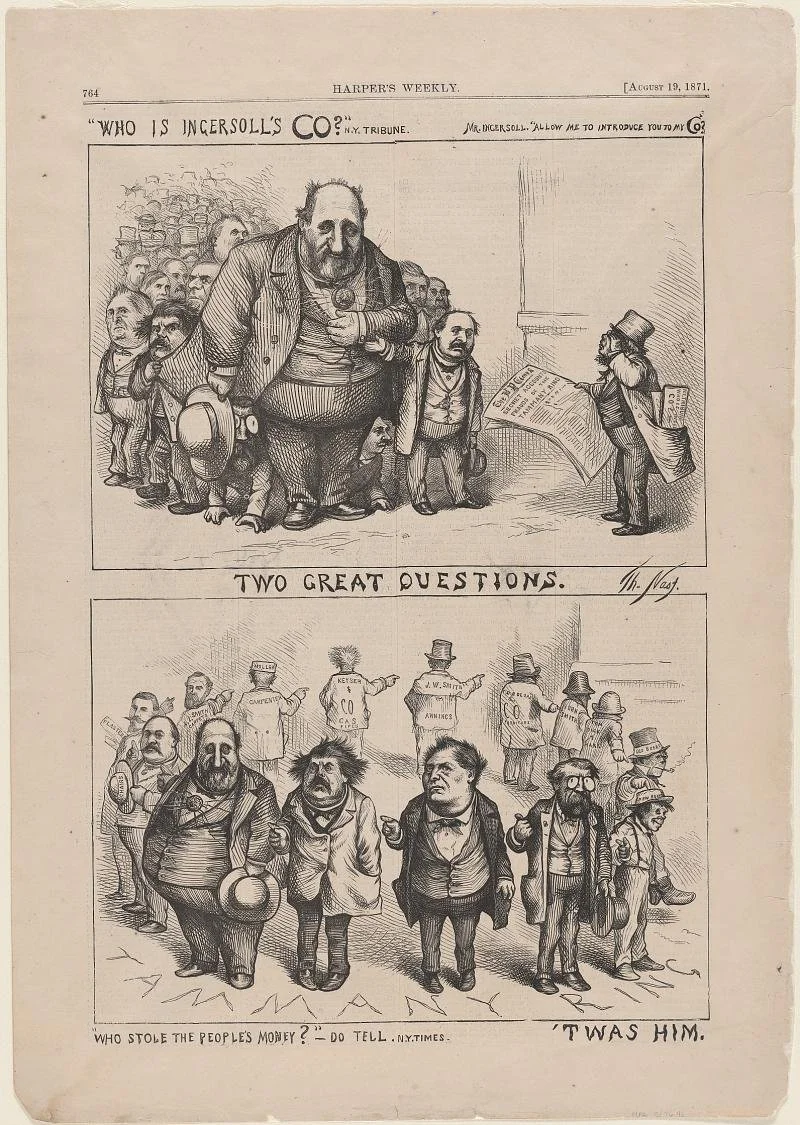
Thomas Nast, “Two Great Questions,” Harper's Weekly, August 19, 1871. Members of Boss Tweed's Tammany Ring point accusingly at one another when asked who stole the people's money. Smithsonian National Portrait Gallery.
Biting the Hand That Feeds You. Imagine a family of four living in a crowded New York tenement. The father has lost his job. The rent is overdue. Little food remains, and the children are hungry. The local ward boss arranges temporary employment, delivers groceries, or persuades the landlord to delay eviction. The assistance is immediate. Its value is undeniable.
Now imagine a respectable political reformer arriving to explain that the boss is corrupt and that responsible citizens should vote against his organization. The reformer may be entirely correct about the corruption. But the family has a different problem.
It is easy to sit in a warm home, sip brandy, and condemn yesterday's political machines. It is considerably harder to appreciate the desperation of parents unable to feed their children. For that family, the choice might not appear to be between honest government and dishonest government. It might be between the promise of better government tomorrow and the certainty of assistance tonight.
That does not excuse corruption. Nor does it suggest that the family was unaware of the machine's activities. The more difficult question is why vulnerable people sometimes depended on political organizations for help that public institutions failed to provide.
Historian Patrick Wayne Grigsby's study of working-class perspectives on Tammany Hall found that voters often valued patronage and informal assistance while simultaneously disapproving of corruption and poor municipal services. Some nevertheless preferred the machine to wealthy reformers whose proposals or attitudes they found even less appealing. That is considerably more complicated than simple bribery.
And another uncomfortable question remained: Whose hand was actually feeding the family? Sometimes assistance came from private resources. At other times, political organizations controlled access to public employment and services that citizens arguably should have received without partisan obligation. Gratitude could become dependence. Dependence could become political leverage.
Reformers confronted genuine abuses, but dismantling the machines without replacing their useful functions could impose substantial costs on the people who depended upon them. The historical reality was neither uniformly benevolent nor uniformly exploitative. Political bosses could provide genuine assistance while simultaneously corrupting the institutions they controlled. The families who supported them were not necessarily endorsing that corruption. They were often responding rationally to the choices available.
And herein lies a lesson that extends well beyond the political machines of the nineteenth century. Political loyalty is not always rooted in ideology. Sometimes it is earned through service, sustained through gratitude, or reinforced by necessity. For the political boss, these relationships helped turn personal loyalty into votes. For the struggling family, however, the calculation was considerably more immediate and personal. One wanted political power. The other wanted to survive.
Understanding both perspectives is essential to understanding why political machines endured—and why reforming them proved so difficult.
Patronage, assassination, and an unexpected reformer. Patronage extended beyond municipal government. Presidents and party leaders rewarded supporters with federal appointments, sustaining political organizations but creating opportunities for favoritism and incompetence.
In 1881, President James Garfield challenged the influence of powerful Republican patronage leaders, particularly New York Senator Roscoe Conkling. Garfield's vice president, Chester Arthur, had been closely associated with Conkling's political organization.
The struggle over patronage took a tragic and deeply ironic turn with Charles Guiteau, an unsuccessful office seeker who considered himself a loyal Republican Stalwart. Guiteau believed his modest contributions to Garfield's election entitled him to a diplomatic appointment. He also strongly supported the patronage system and regarded Garfield's challenge to established party leadership as a threat to the Republican Party itself.
When his requests for an appointment were rejected, Guiteau concluded that removing Garfield would elevate Arthur to the presidency, preserve the patronage system, and perhaps secure the position he believed he deserved. Acting on his own, he shot Garfield on July 2, 1881. The president died eighty days later, on September 19.
The irony was remarkable. Guiteau had assassinated Garfield partly to preserve the patronage system, yet the tragedy helped accelerate the movement to dismantle it. Arthur, himself a product of machine politics, subsequently (and remarkably) supported civil-service reform. Arthur signed the Pendleton Act in 1883, establishing merit-based protections for federal employees!
An assassination intended to preserve political patronage instead helped bring about one of the most consequential restrictions on its use.
Money, morality, and new political movements. Industrialization produced immense wealth, but it was unevenly shared. Farmers struggled with debt, transportation costs, unstable prices, and monetary policies that favored corporate interests.
The Greenback Party emerged after the Panic of 1873 and advocated expanding the circulation of government-issued paper money to ease debt and credit conditions. Later, it incorporated labor concerns such as shorter working hours. The organization waned during the 1880s, but its monetary and agrarian grievances resurfaced among the Populists.
The Prohibition Party, founded in 1869, was organized around another kind of concern. Supporters associated drinking with poverty, domestic instability, and workplace and social harms. The party also supported women's suffrage. Many women involved in the temperance movement—the campaign to restrict or prohibit alcohol—believed that gaining the vote would help them combat alcohol-related poverty, domestic abuse, and family hardship. It never became a major national electoral competitor, but the broader temperance movement eventually secured the Eighteenth Amendment, establishing national Prohibition in 1920. Its repeal in 1933 would become a revealing lesson about reform and unintended consequences.
The Populists challenge the establishment. The People's Party, or Populists, emerged from farmers' organizations and monetary reform movements during the 1890s. They challenged railroad practices, banks, and concentrated economic power. Their proposals included monetary reform, greater corporate regulation, a graduated income tax, and direct election of senators.
James B. Weaver, their 1892 presidential nominee, received about 8.5% of the popular vote and won several western states. The party declined, but some of its proposals entered the mainstream. The Sixteenth Amendment enabled a federal income tax, and the Seventeenth established direct election of senators, both in 1913. These were products of broader movements, not the Populists alone; nonetheless, they had championed these ideas. Political parties may disappear, but the ideas they champion can outlive them—and sometimes reshape the nation.
Mark Hanna and the business of winning elections. Mark Hanna, a wealthy businessman and strategist, helped assemble the resources and alliances supporting William McKinley's nomination and election in 1896. Hanna understood campaign finance and coalition-building. Some constituencies valued gold-standard stability; others sought development, patronage, or influence. Effective organizing required securing enough overlapping support to win. Hannah understood that not every ally needed to believe precisely the same things. That became particularly apparent sixteen years later, when a former president challenged the machinery of his own party.
Theodore Roosevelt and the Bull Moose rebellion. Theodore Roosevelt served as president from 1901 to 1909 and became one of the most popular and influential political figures of his era. His extraordinary energy, commanding personality, and progressive reforms transformed the presidency, expanding its authority and placing the president at the center of national political life. He supported William Howard Taft as his successor but became increasingly dissatisfied with Taft's leadership and challenged him for the Republican nomination in 1912.
Presidential primaries were relatively new. Only twelve states held them, and most delegates were selected through party-controlled procedures. Roosevelt won nine of the twelve primaries. Taft nevertheless secured the nomination amid bitter disputes over delegates and control of the convention. Roosevelt's supporters argued that party leaders had disregarded the wishes of primary voters. The result exposed the distinction between popular support and control of nomination machinery.
Roosevelt broke with the Republicans and accepted the Progressive Party nomination. The party's nickname was unmistakably Rooseveltian. Years earlier, he had described himself in a letter to Republican strategist Mark Hanna as being “as strong as a bull moose.” When reporters questioned his fitness for another presidential campaign in 1912, Roosevelt revived the expression. His supporters enthusiastically adopted it, and the Progressive Party became popularly known as the Bull Moose Party.
Then, in October 1912, the nickname acquired an extraordinary new meaning. While campaigning in Milwaukee, Roosevelt was shot in the chest by a would-be assassin. The bullet passed through his eyeglass case and folded speech manuscript before lodging in his body. Rather than seek medical treatment immediately, Roosevelt insisted on delivering his scheduled address. He opened by informing the startled audience that he had been shot, adding, “It takes more than that to kill a Bull Moose.” He spoke for more than an hour with the bullet still lodged in his chest.
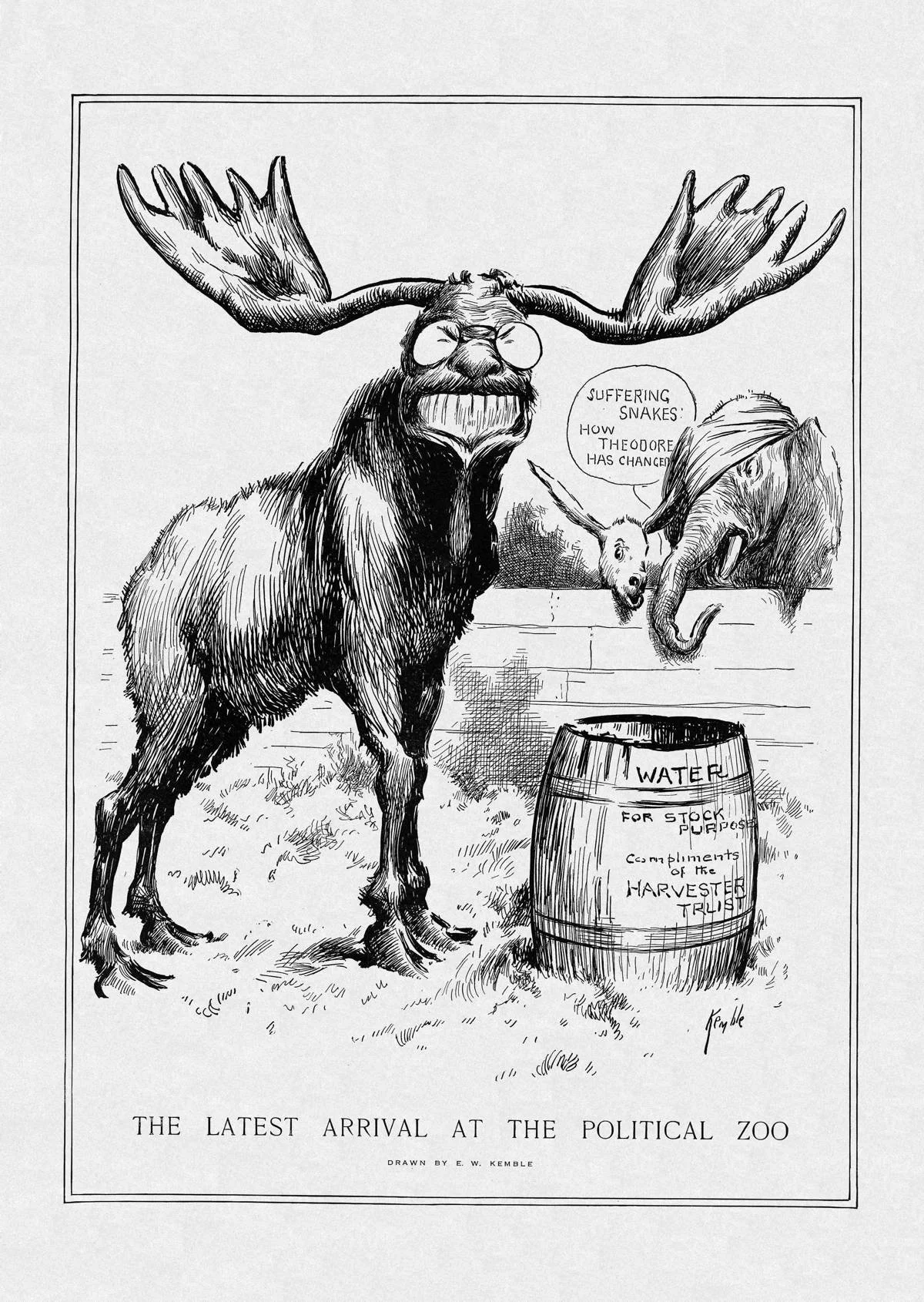
The Latest Arrival at the Political Zoo,” by E. W. Kemble, Harper's Weekly, July 20, 1912. Theodore Roosevelt's new Bull Moose Party joins the traditional Democratic donkey and Republican elephant, illustrating the political upheaval of the 1912 election.
The Bull Moose Progressives advocated an unusually ambitious program of political and social reform. Their 1912 platform called for stronger regulation of large corporations, restrictions on child labor, minimum wages for working women, workplace safety protections, and an eight-hour workday in specified industries. They supported women's suffrage, workers' compensation, and social insurance to protect Americans against sickness, unemployment, and old age—ideas that foreshadowed elements of the New Deal more than two decades later.
Roosevelt believed that industrialization had created concentrations of economic power that individuals could no longer effectively challenge on their own. His proposed solution was not to dismantle capitalism, but to use a stronger federal government to regulate its excesses and protect the public interest. His New Nationalism reflected the conviction that government should possess sufficient authority to confront the enormous corporations that had come to dominate American economic life.
Yet Roosevelt was hardly an advocate of restraint in every sphere. He remained a vigorous nationalist, championed military preparedness, and believed that American power should command respect internationally. His famous philosophy of speaking softly while carrying a big stick reflected his conviction that diplomacy was most effective when backed by credible military strength.
Here was a politician who advocated sweeping social reforms at home while embracing an assertive conception of American power abroad. Roosevelt's political philosophy was neither consistently liberal nor conservative by contemporary definitions. It reflected his belief that vigorous national leadership could protect the public interest, restrain concentrated private power, and advance American interests overseas.
Nor was he the only alternative candidate. Socialist Eugene Debs won approximately 6% of the popular vote, revealing a constituency for more fundamental economic reform.
Roosevelt won approximately 27%, ahead of Taft's 23%; Woodrow Wilson prevailed with about 42%. The Progressive Party subsequently declined, and many supporters returned to established parties. The organization faded, but reform ideas endured. Once again, the political river divided and then returned to two principal channels.
War, Depression, and Changing Expectations of Government (1917–1980)
World War I and the limits of dissent. When the United States entered World War I in 1917, Wilson oversaw expanded federal authority for military recruitment, industrial coordination, and wartime controls. With his support, Congress also enacted the Espionage Act of 1917 and the Sedition Act of 1918, restricting actions and expressions deemed harmful or disloyal to the war effort. Socialists, pacifists, and labor activists faced prosecution. Debs received a ten-year prison sentence following an antiwar speech in 1918, and the Supreme Court upheld his conviction. Remarkably, Debs ran for president from federal prison in 1920 and received more than 900,000 votes.
Repression did not end with the armistice. The Palmer Raids of 1919–1920 targeted suspected radicals amid serious civil-liberties concerns. Congress repealed the Sedition Act amendments in 1921, and President Harding commuted Debs's sentence that December. A government exercising emergency powers to protect the nation had also restricted its political critics. The emergency expanded federal authority; its aftermath encouraged demands for restraint.
Harding and the return to normalcy. After the war, Americans confronted inflation, labor unrest, social anxiety, and disappointment with international developments. Warren Harding promised a return to “normalcy.” The appeal reflected exhaustion and a desire for stability. It would be too simple to portray the election as a rejection of government. Several social and economic forces were at work. Yet it showed how rapidly public priorities could change: one era's urgent demand for mobilization became the next era's desire for relief from disruption.
The Republican Party was changing, too. Lincoln's Republicans had promoted Union preservation and national economic development; Harding's stressed business development, fiscal restraint, and postwar stability. The Democrats of Jackson, Cleveland, and Wilson were not ideologically identical either. Familiar names concealed changing coalitions.
Prohibition: When a Minor Party's Cause Became National Policy. The Prohibition Party, founded in 1869, never attracted enough votes to become a major national political force. Nevertheless, its central objective—prohibiting alcohol—eventually became part of the Constitution. The transformation occurred largely because the broader temperance movement learned to influence the established parties rather than depend upon its own electoral success. The Anti-Saloon League, particularly under the leadership of Wayne Wheeler, became extraordinarily effective at organizing voters and supporting candidates from either major party who favored Prohibition. The question was no longer whether the Prohibition Party could win elections, but whether its cause could attract enough political support to become law.
In 1919, the Eighteenth Amendment was ratified, establishing national Prohibition the following year. But the consequences proved considerably more complicated than its advocates anticipated. Illegal alcohol markets flourished, organized crime expanded, and enforcement became increasingly controversial. Al Capone became the era's most recognizable symbol. As public dissatisfaction grew, Prohibition itself became a political liability. Franklin Roosevelt supported repeal during his successful 1932 presidential campaign, and the Twenty-First Amendment ended national Prohibition in 1933.
The episode illustrates a remarkable feature of American party politics. A minor party's cause had become national policy through the support of the major parties. When public opinion shifted, those same political institutions helped reverse it. The Prohibition Party never needed to win the presidency to achieve its objective. But achieving that objective proved easier than sustaining public support.
The Great Depression changes the argument. The economic collapse beginning in 1929 transformed expectations of government. By 1933, approximately one-quarter of the labor force was unemployed. Banks had failed by the thousands; businesses closed; millions faced severe poverty. For a family without employment, savings, or food, federal assistance was no longer an abstract ideological proposition. It was a question of survival.
Herbert Hoover had undertaken substantial federal interventions, but they were insufficient to halt the collapse. Franklin Roosevelt's election in 1932 reflected demands for more effective national action. The New Deal expanded federal responsibility for banking regulation, economic recovery, employment, and social insurance. It also transformed the Democratic Party. Roosevelt assembled a coalition of labor, urban communities, Southern whites, and increasing numbers of Black voters. The coalition had deep internal conflicts, particularly over race, but enough members supported active federal action to sustain a new governing arrangement.
Americans' judgments about government's proper role changed because their circumstances changed. That did not make every New Deal policy effective or universally popular. It did, however, make a larger national role acceptable to millions.
World War II and national responsibility. Before the nation fully recovered from the Depression, World War II required extraordinary national mobilization. The government coordinated military recruitment, industrial output, transportation, rationing, and vast expenditures. American production reached a scale difficult to imagine only a generation earlier. The war also demonstrated the dangers of emergency authority. The forced removal and incarceration of Japanese Americans under Executive Order 9066 violated fundamental principles of liberty and justice.
For many Americans, the Depression and World War II had demonstrated the benefits of a more active federal government. Its ability to mobilize national resources, provide economic security, and coordinate an extraordinary war effort had changed expectations of what government could—and perhaps should—accomplish. Programs such as the GI Bill reinforced this evolving relationship between citizens and government, while the emerging Cold War established new and enduring national responsibilities. Americans did not necessarily want wartime controls to continue, but many no longer expected Washington to return to its earlier, more limited role.
The debate had come full circle, returning to a question that had divided Hamilton and Jefferson at the nation's founding: How much responsibility should the federal government assume in Americans' lives, and how much should remain with individuals and the states? The Depression and two world wars had dramatically changed the circumstances, but not the fundamental disagreement. Americans continued to debate which federal responsibilities should endure, which should be limited, and how national prosperity and individual freedom could coexist.
Civil Rights and the Changing Political Coalitions. The postwar civil rights movement challenged racial segregation, disenfranchisement, and governments' failure to enforce constitutional protections. But it also exposed deep divisions within the Democratic Party. Franklin Roosevelt's New Deal coalition had brought together Northern liberals, organized labor, Black voters, and Southern white Democrats. These groups shared certain economic interests but differed profoundly over racial equality. For years, Democratic leaders had struggled to maintain this coalition without confronting its internal contradictions.
Those tensions erupted in 1948 when President Harry Truman supported a stronger civil rights platform. Southern Democrats opposed to these policies broke away to form the States' Rights Democratic Party, commonly known as the Dixiecrats. Their presidential nominee, South Carolina Governor Strom Thurmond, carried four Southern states. The movement was short-lived, but the conflict it exposed was not.
During the Kennedy and Johnson administrations, civil rights moved to the forefront of national politics. Following Kennedy's assassination, President Lyndon Johnson made passage of the Civil Rights Act a priority. Southern Democrats opposed the legislation and organized a lengthy Senate filibuster. Its eventual passage in 1964 required cross-party cooperation. Democratic leaders, including Hubert Humphrey, worked with Republicans, particularly Senate Minority Leader Everett Dirksen, to secure the votes necessary to overcome the filibuster. The Voting Rights Act followed in 1965, providing stronger federal protections against discriminatory voting practices.
These legislative achievements accelerated changes already underway in American political loyalties.
Black voters had increasingly supported Democrats since the New Deal, and the party's growing commitment to civil rights strengthened that relationship. Meanwhile, many white Southern voters who had traditionally supported Democrats began moving toward the Republicans. Thurmond himself joined the Republican Party in 1964.
But this was not an overnight exchange of party identities. The transformation unfolded over decades, influenced by civil rights, regional development, economic change, religion, and cultural issues. The parties retained their familiar names while their underlying coalitions changed substantially.
The electorate was expanding as well. The Nineteenth Amendment had prohibited voting discrimination on account of sex in 1920. The Twenty-Third Amendment gave Washington, D.C., presidential electors in 1961. The Twenty-Fourth Amendment prohibited poll taxes in federal elections in 1964, and the Twenty-Sixth Amendment protected voting rights for citizens eighteen and older in 1971. These constitutional changes, together with federal legislation, expanded political participation, although effective enforcement remained essential. The result was a gradual transformation in who could participate in American elections, which political parties represented their interests, and what those parties stood for.
Once again, the two-party system endured, even as the political coalitions within it changed profoundly.
Chicago, 1968: Who Really Chooses the Nominee? While civil rights was reshaping the political coalitions of both major parties, another controversy was developing over who actually controlled them. For much of American history, presidential nominees had been selected through national conventions controlled by party officials, state organizations, and influential political leaders. Presidential primaries had gradually expanded public participation, but many remained nonbinding, and party leaders retained considerable control over the delegates who ultimately chose the nominee.
The 1968 Democratic presidential contest brought these tensions into the open.
The Vietnam War had deeply divided the party. Senator Eugene McCarthy challenged President Lyndon Johnson's handling of the war and performed unexpectedly well in the New Hampshire primary. Robert F. Kennedy subsequently entered the race, and Johnson announced that he would not seek reelection. Following Kennedy's assassination in June, the party's divisions grew even more pronounced. Yet when Democrats assembled in Chicago that August, Vice President Hubert Humphrey secured the presidential nomination without having competed in a single presidential primary.
How was that possible?
The answer lay in the party's delegate-selection system. State party organizations, rather than primary voters, chose many delegates. Influential officials, including Chicago Mayor Richard J. Daley, retained substantial power over the process. Humphrey relied on established political relationships, labor organizations, and delegates who were not bound by primary results. The arrangement was permitted under the existing rules, but to many antiwar Democrats it seemed profoundly undemocratic. Outside the convention, demonstrators clashed violently with Chicago police. Inside, delegates fought bitterly over Vietnam policy and the party's direction. Television brought much of the turmoil into American homes.
The convention exposed a fundamental problem: ordinary party members could participate in presidential primaries yet still have relatively little influence over who received their party's nomination. The Democrats responded by establishing the McGovern–Fraser Commission, named for Senator George McGovern and Representative Donald Fraser. Its investigation revealed that many states lacked clear delegate-selection rules and that some delegates had effectively been chosen before voters even knew which presidential candidates would be competing.
The commission proposed substantial reforms intended to make the process more open, transparent, and accessible. Beginning in 1972, primaries and caucuses assumed a much greater role in selecting convention delegates, who increasingly became committed to candidates according to voter preferences. The changes also encouraged broader participation by groups previously underrepresented in party leadership. The Republican nomination process evolved in the same direction.
The historical contrast was striking. In 1912, Theodore Roosevelt had won most Republican presidential primaries but lost the nomination to Taft through the convention system. In 1968, Humphrey had won the Democratic nomination without competing in the primaries at all. Both episodes demonstrated the extraordinary power of established party organizations.
The reforms changed that relationship. Presidential nominees increasingly had to win the support of primary and caucus participants rather than rely primarily on negotiations among party leaders. Yet greater voter participation introduced new questions. Campaign financing, media attention, political consultants, and organized interest groups became increasingly important. Party leaders retained influence, but the traditional convention boss was no longer the principal gatekeeper.
The reforms did not eliminate political power brokers. They fundamentally changed how political power was acquired and exercised.
As the country entered the 1970s, these changes occurred alongside another transformation: Americans were reconsidering the federal government's role in their economic and personal lives. That debate would help bring a former New Deal Democrat named Ronald Reagan to national prominence.
Reagan and the evolving meaning of government. Ronald Reagan began his political life as a Democrat and admirer of Franklin Roosevelt. New Deal programs had benefited his family. Over time, Hollywood, labor relations, and debates over taxes and federal regulation contributed to a shift toward conservatism. He formally became a Republican in 1962. By 1980, Reagan advocated tax reductions, deregulation, market incentives, and limits on certain domestic government activities. Yet he supported substantial defense spending. He did not oppose every use of federal authority, but he did judge its appropriate purposes differently.
Sometimes politicians changed parties because their convictions changed. Sometimes parties changed around them. Sometimes both happened together.
The Depression favored a more active federal economic role; decades later, inflation, stagnation, and dissatisfaction with government made a different approach appealing. Americans did not necessarily abandon either security or independence. Many wanted both, but reconsidered how to balance them.
The Outsiders Return—and the Two Parties Endure (1992–Present)
Ross Perot and another choice. In 1992, businessman Ross Perot challenged the major parties as an independent, focusing on deficits, trade, economic management, and frustration with established politicians. His television appearances and charts offered an unconventional form of direct communication. Perot received approximately 18.9% of the popular vote, and no electoral votes. Almost one in five voters supported an independent candidate, yet the Electoral College gave that dispersed support no representation.
Perot later helped establish the Reform Party, but it did not become a lasting national political party. His campaign demonstrated both the appeal of political alternatives and the structural obstacles they confront. It does not establish a simplistic claim that Perot alone determined the election's outcome.
The Tea Party challenges from within. Emerging in 2009, the Tea Party generally sought influence within the Republican coalition rather than founding a durable new party. Opposition to federal spending, taxation, and aspects of the financial-crisis response helped mobilize activists. It influenced primaries, congressional elections, and policy debates. Ted Cruz became one of its prominent political figures. Its significance lay in changing party leadership and priorities from within. Rather than form a new river, the movement redirected an established channel.
The continuing socialist tradition. American socialism did not begin with modern Democratic primaries. Debs and the Socialist Party had challenged the established economic order more than a century earlier. More recently, Bernie Sanders' campaigns renewed attention to democratic socialism, inequality, universal healthcare, and public responsibilities. Democratic Socialists of America, founded in 1982, grew after Sanders' 2016 campaign. Sanders remains an independent rather than a DSA member. DSA is an organization, not a conventional national electoral party; candidates associated with it often compete in Democratic primaries. Alexandria Ocasio-Cortez illustrates how a distinct ideological movement can influence an established party.
The Tea Party and democratic-socialist movements differ enormously in objectives. Yet both show how movements can challenge a major party's direction without replacing it.
When politicians—and parties—change. Reagan and Thurmond changed formal party affiliations under different circumstances. More recently, Tulsi Gabbard left the Democratic Party, became independent, and joined the Republicans. Robert F. Kennedy Jr. sought the Democratic presidential nomination, ran independently, and ultimately aligned with Donald Trump. Donald Trump's emergence as the Republican nominee in 2016 also changed the party's emphasis concerning immigration, trade, nationalism, and established political institutions. Not every Republican adopted identical positions. But a prominent individual helped redirect a major coalition.
Sometimes individuals change convictions. Sometimes organizations evolve. Sometimes opportunities change. Party affiliation is not necessarily permanent.
Familiar names, changing parties. Lincoln's Republican Party was defined by opposition to slavery's expansion and support for preserving the Union; Harding's emphasized business development and postwar stability. During John Kennedy's presidency, Republicans included moderate and conservative factions. Reagan's coalition and the contemporary Republican Party emphasized still other priorities.
Jackson's Democrats were not Cleveland's, Franklin Roosevelt's, Lyndon Johnson's, or Barack Obama's Democrats. It would be tempting to claim the parties simply exchanged philosophies, but the reality is more complicated. Economic ideas, racial attitudes, regional loyalties, and federal-government preferences did not change together or at the same rate.
The names stayed familiar while the coalitions behind them were continually renegotiated.
Why only two?
Part of the explanation is surprisingly simple: mathematics. Most American legislative elections take place in single-member districts, meaning only one candidate can win the seat. Unlike systems that distribute legislative seats proportionally among parties, American elections generally award the seat to whichever candidate receives the most votes, even without an outright majority.
Consider an election with three candidates receiving 40%, 35%, and 25% of the vote. The candidate with 40% wins the only seat, while the other two receive nothing, despite collectively getting 60% of the vote.
Now imagine that the two losing candidates represent parties with similar political interests. If they continue competing separately, they risk repeatedly dividing their supporters and losing to a candidate whom neither group favors. But if they join forces behind a single candidate, they may have a much better chance of winning. Not every voter will necessarily follow, of course, but the incentive to cooperate is substantial.
Over time, this encourages smaller parties to merge with larger ones, form electoral alliances, or abandon independent campaigns altogether. Political movements may retain their ideas and supporters, but their electoral ambitions are increasingly pursued through one of the two dominant parties.
The result is a system that rewards broad political coalitions while making it extraordinarily difficult for smaller parties to establish themselves as permanent competitors.
Political scientists call this tendency of single-member plurality elections to favor two competitors Duverger's law. It is a tendency, not an absolute rule. Geography, culture, and institutional arrangements also matter.
The Electoral College reinforces these incentives. Most states award all electors to the statewide presidential winner; Maine and Nebraska use district-based allocations with two additional statewide electors. National candidates therefore benefit from broad coalitions that can win states, not merely accumulate scattered support.
Established parties also possess campaign infrastructure, donor networks, ballot access, experienced personnel, and recognizable identities. But rules alone cannot explain their endurance. Both parties repeatedly absorbed movements, incorporated issues, and reorganized coalitions. The Anti-Masons influenced conventions; Free Soilers helped build a new major party; Populists shaped reform debates; Progressives promoted policy changes; the Tea Party and democratic-socialist movements challenged major parties from within.
The recurring search for balance. Across American history, citizens have debated how much responsibility government should assume for economic and social risk, and how much independence should remain with individuals and communities. It would be misleading to assign “more government” and “less government” permanently to Democrats and Republicans. Hamilton supported vigorous federal authority; Lincoln's Republicans favored national economic development; Theodore Roosevelt supported regulation and military preparedness; Franklin Roosevelt expanded economic protections; Reagan sought less federal intervention in certain domestic areas alongside more defense spending.
The dispute is often not simply government size, but what government should do, whose interests it should protect, and when intervention becomes excessive or insufficient.
During prosperity, citizens may emphasize independence. During economic collapse, they may seek public protection. During war, they may accept extraordinary national power and reconsider that power afterward. No perfectly predictable pendulum exists: demography, candidates, culture, geography, and institutions also shape elections. Most Americans seek some mixture of opportunity, freedom, security, stability, and fairness. Political parties continually offer competing answers about how to achieve it.
In the End, It Comes Down to Votes
After more than two centuries, one constant remains: parties must attract enough votes to win elections.
Van Buren recognized Jackson's ability to unite a coalition. Weed understood that suspicion of Freemasonry could mobilize voters. Hanna assembled financing, alliances, and constituencies for McKinley. Political bosses maintained loyalty with assistance and access. Roosevelt discovered that winning primaries did not necessarily mean winning a nomination. Perot showed that almost one-fifth of the popular vote could yield no electoral votes.
Different actors, different circumstances, same problem: principles alone do not produce governing power. They must be converted into votes and victories under existing rules.
A candidate can sincerely champion a policy while party leaders calculate whether emphasizing it attracts voters, alienates allies, or strengthens a coalition. Conviction and political opportunity sometimes coincide; sometimes they do not.
The Anti-Masons illustrated how a genuine grievance became an electoral opportunity even for politicians who did not share every assumption of its supporters. Political machines built loyalty through tangible assistance. Voters supported candidates for ideology, economic need, personal relationships, leadership, dissatisfaction, or because the alternatives appeared less appealing.
Some voted enthusiastically; others chose what they judged the lesser objectionable option; others stayed home. Parties therefore sought not only persuasion but turnout and durable coalitions. That does not mean voters are passive or party leaders necessarily cynical. Parties give genuine grievances a voice and can also exaggerate threats or make selective appeals. The question is whether their claims survive scrutiny and their governing actions reflect what they promised.
A party's principles help explain what it hopes to accomplish. Its ability to attract votes determines whether it gets the opportunity.
The River Keeps Moving
Perhaps American political history is best imagined as a river rather than a straight road. New tributaries appear. Some redirect the current; others fade away. At times the river divides before joining again downstream.
The Federalists vanished. The Whigs collapsed. Republicans emerged. Anti-Masons pioneered a lasting nominating practice. Populists advanced reform. Bull Moose Progressives challenged an incumbent president and then declined. The New Deal reorganized allegiances; civil rights reshaped them; Reagan changed parties; Perot won millions of votes outside them; the Tea Party and democratic-socialist movements sought to redirect them from within.
Wars, economic crises, constitutional amendments, and social movements changed who could participate and what people expected government to do. Behind these developments were idealists, organizers, opportunists, and sometimes people who embodied all three. They all recognized that ideas alone cannot govern without votes. But citizens were never merely passive: they responded to economic circumstances, community loyalties, public problems, and changing expectations.
The striking continuity of American politics is not that the same two parties have always existed. They most certainly have not. It is that a remarkably diverse country has repeatedly organized competing interests into two dominant national coalitions. The Constitution did not demand that outcome. Electoral rules, historical events, leaders, and voters produced it. The parties changed. The voters changed. The issues changed. And if the past is any guide, the evolution is far from finished.
The river is still moving.
References and Further Reading
Hofstadter R. The Idea of a Party System. University of California Press; 1969.
Aldrich JH. Why Parties? A Second Look. University of Chicago Press; 2011.
Van Buren M. Letter to Thomas Ritchie, January 13, 1827. Teaching American History.
National Archives. Electoral College Results: 1800.
National Archives. Legal Provisions Relevant to the Electoral College Process.
Vaughn WP. The Anti-Masonic Party in the United States, 1826–1843. University Press of Kentucky; 1983.
National Park Service. The Election of 1848: Free Soil, Free Labor, Free Men.
Library of Congress. Presidential Election of 1856: A Resource Guide.
National Archives. Kansas–Nebraska Act (1854).
National Park Service. Bleeding Kansas.
National Archives. Pendleton Act (1883).
Grigsby PW. Evaluating Plunkitt's “Solemn Contract”: Working-Class Perspectives on Tammany Hall and Upper-Class Reform Politics, 1870–1924. Journal of the Gilded Age and Progressive Era. 2025.
People's Party. Populist Party Platform of 1892. The American Presidency Project.
Ohio State University, eHistory. Theodore Roosevelt Seeks the Republican Nomination, 1912.
The American Presidency Project. Presidential Election Results: 1912. University of California, Santa Barbara.
Library of Congress. Al Capone Soup Kitchen, Chicago, November 1930. Historical photograph.
Federal Reserve History. The Great Depression. Federal Reserve System.
National Archives. Voting Rights.
Commission on Party Structure and Delegate Selection (McGovern–Fraser Commission). Mandate for Reform. Democratic National Committee; 1971.
National Archives. Presidential Election Results: 1992.
Riker WH. The Two-Party System and Duverger's Law: An Essay on the History of Political Science. American Political Science Review. 1982;76(4):753–766.
Sundquist JL. Dynamics of the Party System. Brookings Institution; 1983.
Schlozman D, Rosenfeld S. The Hollow Parties. Princeton University Press; 2024.
Schmitz PG. If You Think It's Bad Now…. Signal Over Noise Press. July 20, 2026.
