
Understanding the Affordable Care Act, Part 4: Patient Examples

Patient Examples Under the Affordable Care Act
The examples below are hypothetical, but they reflect a common reality in the ACA marketplace: the “best” plan often depends less on the sticker price and more on age, income, household size, and expected use of care. Premiums, subsidies, deductibles, and out-of-pocket expenses can vary dramatically from one person or family to the next.
A Young Adult
Imagine Alex, a 26-year-old freelance videographer who earns about $32,000 per year and buys his insurance through the ACA marketplace.
Without subsidies, a typical plan in his area might cost about $390 per month. Because of his income, however, he qualifies for financial assistance that substantially reduces his premium.
He is considering two options:
Option 1 – Bronze Plan
Premium: $95/month
Deductible: $7,200
Doctor visits: Full cost until deductible is met
This plan keeps Alex’s monthly premium low, which is appealing because he is healthy and rarely sees a physician. But if he has a sports injury, develops appendicitis, or needs unexpected imaging or surgery, he could still face very high out-of-pocket costs before the plan begins paying most expenses.
Option 2 – Silver Plan
Premium: $165/month
Deductible: $3,200
Doctor visits: $25 copay
This plan costs about $70 more per month, but it offers more predictable access to care. Alex would pay more each month, but he would face less financial shock if he actually needed treatment.
What Alex has to decide
Should he minimize his monthly premium and accept more financial risk, or pay more up front for stronger protection if something unexpected happens?
Key consumer lesson
Young adults are often tempted by the lowest monthly premium, and sometimes that is a reasonable choice. But a low premium does not mean low cost overall. Even healthy people can have accidents or sudden illnesses, and a high deductible can become very real very quickly.
A Self-Employed Individual
Now consider Sarah, a 40-year-old self-employed graphic designer who earns $45,000 per year and buys her insurance through the ACA marketplace.
Without subsidies, a typical plan in her area might cost about $550 per month. Because of her income, she qualifies for financial assistance that reduces her premium to about $120 per month for a Bronze plan.
She is considering two options:
Option 1 – Bronze Plan
Premium: $120/month
Deductible: $6,500
Doctor visits: Full cost until deductible is met
This plan keeps Sarah’s monthly payment low, which may be attractive if her income fluctuates or she rarely seeks medical care. But if she breaks an arm, needs surgery, or develops an unexpected illness, she could still face thousands of dollars in out-of-pocket costs before the plan begins paying most expenses.
Option 2 – Silver Plan
Premium: $210/month
Deductible: $2,500
Doctor visits: $30 copay
This plan costs about $90 more per month, but it offers better protection if she actually needs care. Regular doctor visits are more predictable, and the lower deductible reduces the financial shock of a bad medical year.
What Sarah has to decide
Should she save money each month with the Bronze plan, or pay more for the Silver plan in exchange for lower financial risk if something goes wrong?
Key consumer lesson
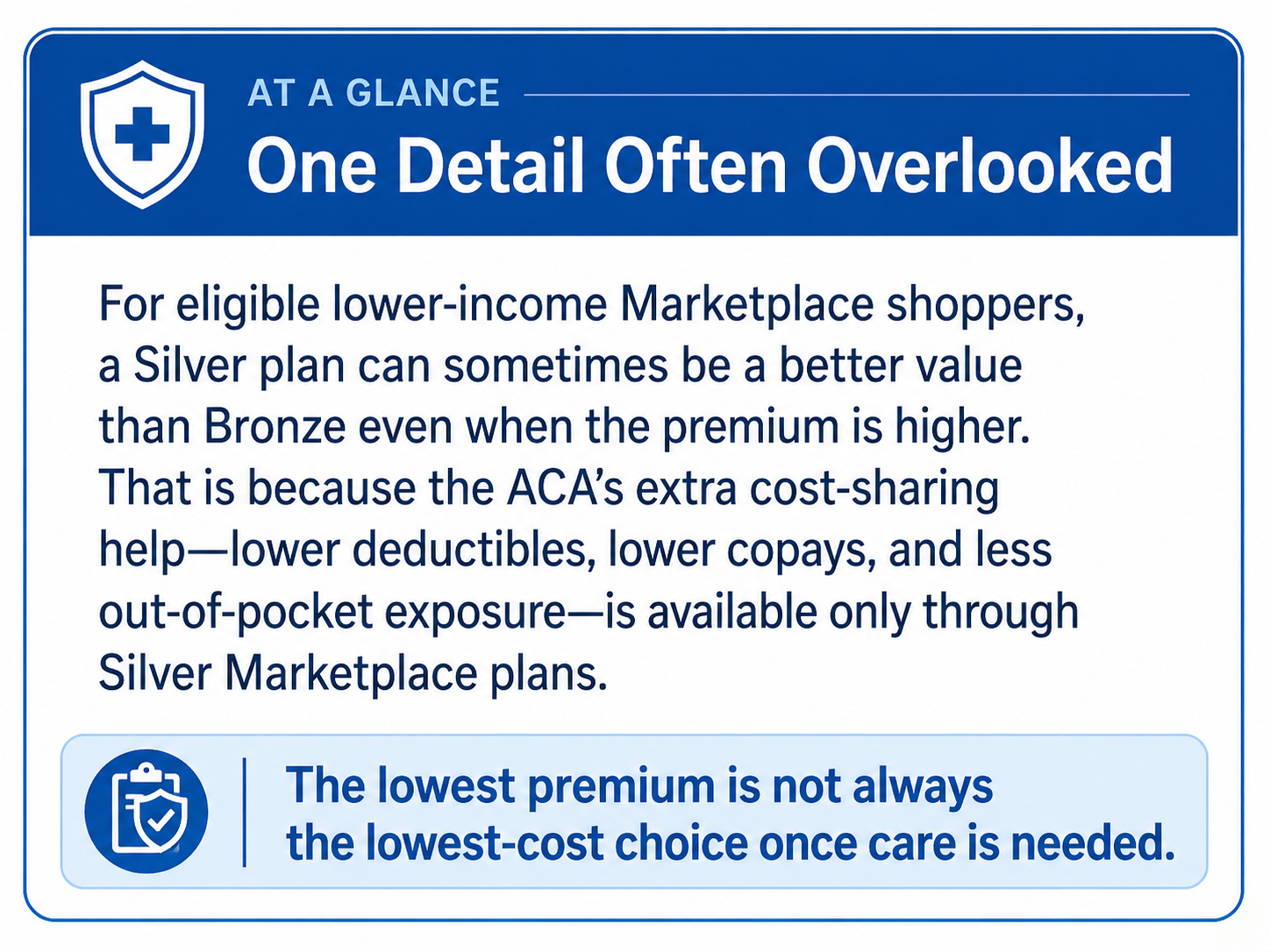
The cheapest premium is not always the best value. A plan with a low monthly price can still expose a consumer to very high costs later. Marketplace shoppers need to balance premium, deductible, network, and prescription coverage—not just pick the lowest number on the screen.
A Family of Four Buying Coverage
Now consider the Johnson family: two parents in their early 40s with two children. Their household income is about $75,000 per year, and they do not receive employer-sponsored insurance, so they turn to the ACA marketplace.
Without subsidies, a family plan in their region might cost about $1,800 per month. Because of their income, however, they qualify for subsidies that reduce their premium to about $520 per month for a Bronze-level option.
They are considering two choices:
Option 1 – Bronze Family Plan
Premium: $520/month
Deductible: $12,000 family
Doctor visits: Full cost until deductible is met
This plan keeps the monthly premium manageable, but it leaves the family exposed to large out-of-pocket expenses if anyone needs significant care. A hospitalization, surgery, or chronic condition could quickly make the deductible feel very real.
Option 2 – Silver Family Plan
Premium: $690/month
Deductible: $4,000 family
Doctor visits: $35 copay
This option costs about $170 more per month, but it significantly lowers the family’s risk if one of the children becomes ill, needs imaging or surgery, or develops an ongoing medical problem.
What the Johnsons have to decide
If the family stays healthy, the Bronze plan may cost less over the year. But if even one family member needs substantial care, the Silver plan could save them thousands of dollars because the deductible and cost-sharing are much lower.
Key consumer lesson
Families often focus first on the monthly premium because that is the most visible cost. But for households with children, deductibles, copays, and the out-of-pocket maximum may matter just as much, especially in an unpredictable medical year.
An Older Couple Not Yet Eligible for Medicare
Finally, consider Linda and Mark, a married couple ages 61 and 63. One recently retired, the other works part-time, and together they earn about $82,000 per year. Because neither has employer-sponsored insurance and neither is yet eligible for Medicare, they shop for coverage through the ACA marketplace.
Without subsidies, a typical plan in their area might cost about $1,950 per month. Because marketplace subsidies are tied to income, they still qualify for meaningful help, substantially lowering their premium.
They are considering two options:
Option 1 – Bronze Couple’s Plan
Premium: $650/month
Deductible: $14,000 family
Doctor visits: Full cost until deductible is met
This plan lowers their monthly premium, but it exposes them to considerable out-of-pocket risk. At their age, routine care, specialist visits, imaging, or prescription needs may be more common, which makes a high deductible more burdensome than it might be for a younger household.
Option 2 – Silver Couple’s Plan
Premium: $920/month
Deductible: $5,000 family
Doctor visits: $35 copay
This plan costs about $270 more per month, but it provides better protection if one of them needs more frequent care, outpatient procedures, or hospitalization. The higher premium buys more predictable costs and much less exposure to a major medical bill.
What Linda and Mark have to decide
Should they prioritize a lower monthly premium now, or pay more for better protection during a life stage when health needs are often less predictable?
Key consumer lesson
Older adults often face the sharpest tension between premium affordability and medical risk. Because age affects the cost of coverage, premiums can be much higher before subsidies are applied. For this group, the value of stronger coverage may be easier to justify because the odds of needing care are often greater.
How to Choose an ACA Plan
Choosing an ACA plan is not simply a matter of picking the lowest monthly premium. The better question is which plan best matches a household’s medical needs, financial cushion, and risk tolerance. A Bronze plan may look attractive because the premium is lower, but that lower price often comes with a much higher deductible and greater out-of-pocket exposure to costs if care is actually needed. A Silver plan usually costs more each month, but it can provide more predictable access to care and less financial shock in a bad medical year.
Before selecting a plan, patients should look beyond the headline premium and compare the full structure of coverage. That includes the deductible, copays, coinsurance, prescription coverage, physician and hospital networks, and the annual out-of-pocket maximum. The cheapest plan on the screen is not always the best value if it excludes preferred doctors, places certain medications on unfavorable tiers, or leaves the household exposed to large bills after an illness or injury.
Patients should also think concretely about how they use care. Do they see a physician regularly? Take ongoing medications? Expect imaging, procedures, or specialist visits? Have children whose medical needs may be unpredictable? A plan that works well in a healthy year may look very different in a year with surgery, hospitalization, or chronic illness. For that reason, consumers should ask not only, “What is my monthly premium?” but also, “What might I owe in a routine year, and what might I owe in a bad one?”
For many people, a licensed ACA broker can be helpful. A good broker can compare plans, explain subsidy eligibility, check physician and hospital networks, and review prescription coverage in plain English. That can be especially useful for families, older adults, and anyone with ongoing medical needs. But consumers should ask one important question up front: Are you showing me all Marketplace options in my area, or only the plans you represent? Patients who want more neutral help can also use Marketplace navigators or enrollment assisters.
Key questions patients should ask before enrolling
What will I pay each month in premiums?
What is the deductible, and how likely am I to meet it?
What are the copays and coinsurance for routine care, specialists, imaging, and hospital care?
Are my doctors, hospitals, and preferred health system in network?
Are my medications covered, and on what expense tier?
What is the annual out-of-pocket maximum?
In a bad medical year, could I realistically afford this plan?
Looking Ahead
In the next post, we will step back from the current ACA structure and explore alternative ways to fund coverage, including direct assistance to individuals, voucher-style approaches, expanded savings models, and other ideas that seek to balance affordability, choice, and government cost.
References
HealthCare.gov. 3 things to know before you pick a health insurance plan. Available at: original source. Accessed March 28, 2026.
HealthCare.gov. Your total costs for health care: Premium, deductible, and out-of-pocket costs. Available at: original source. Accessed March 28, 2026.
Centers for Medicare & Medicaid Services. Summary of Benefits & Coverage and Uniform Glossary. Updated March 13, 2026. Available at: original source. Accessed March 28, 2026.
HealthCare.gov. Cost-sharing reductions. Available at: original source. Accessed March 28, 2026.
HealthCare.gov. Getting regular medical care. Available at: original source. Accessed March 28, 2026.
HealthCare.gov. Getting prescription medications. Available at: original source. Accessed March 28, 2026.
KFF. Higher Premium Payments or Higher Deductibles: The Tradeoffs ACA Enrollees Face. Published January 14, 2026. Available at: original source. Accessed March 28, 2026.
