
Politics at the Door, Independence on the Bench
How partisan confirmations distorted our view of the Supreme Court—and why court packing solves the wrong problem
In Brief
The latest debate over the Supreme Court began, for me, with calls to expand it. House Minority Leader Hakeem Jeffries has called for substantial Supreme Court reform without ruling out expansion, while former Vice President Kamala Harris has suggested increasing the Court from nine justices to thirteen. My initial reaction was fairly simple: adding four seats to a Court currently composed of six Republican-presidential appointees and three Democratic-presidential appointees would certainly alter its balance, but it would be difficult to describe such a move as politically neutral.
That question, however, led somewhere more interesting. The Supreme Court is routinely described as “political,” and its members are sorted into conservative and liberal camps almost as casually as senators are sorted into parties. Yet the Court's actual record is substantially more complicated. Justices appointed by presidents of one party repeatedly rule against presidents, governments, litigants, and policy positions associated with that party. Large portions of the Court's docket are unanimous, and even important cases regularly produce coalitions that cross the lines of presidential appointment.
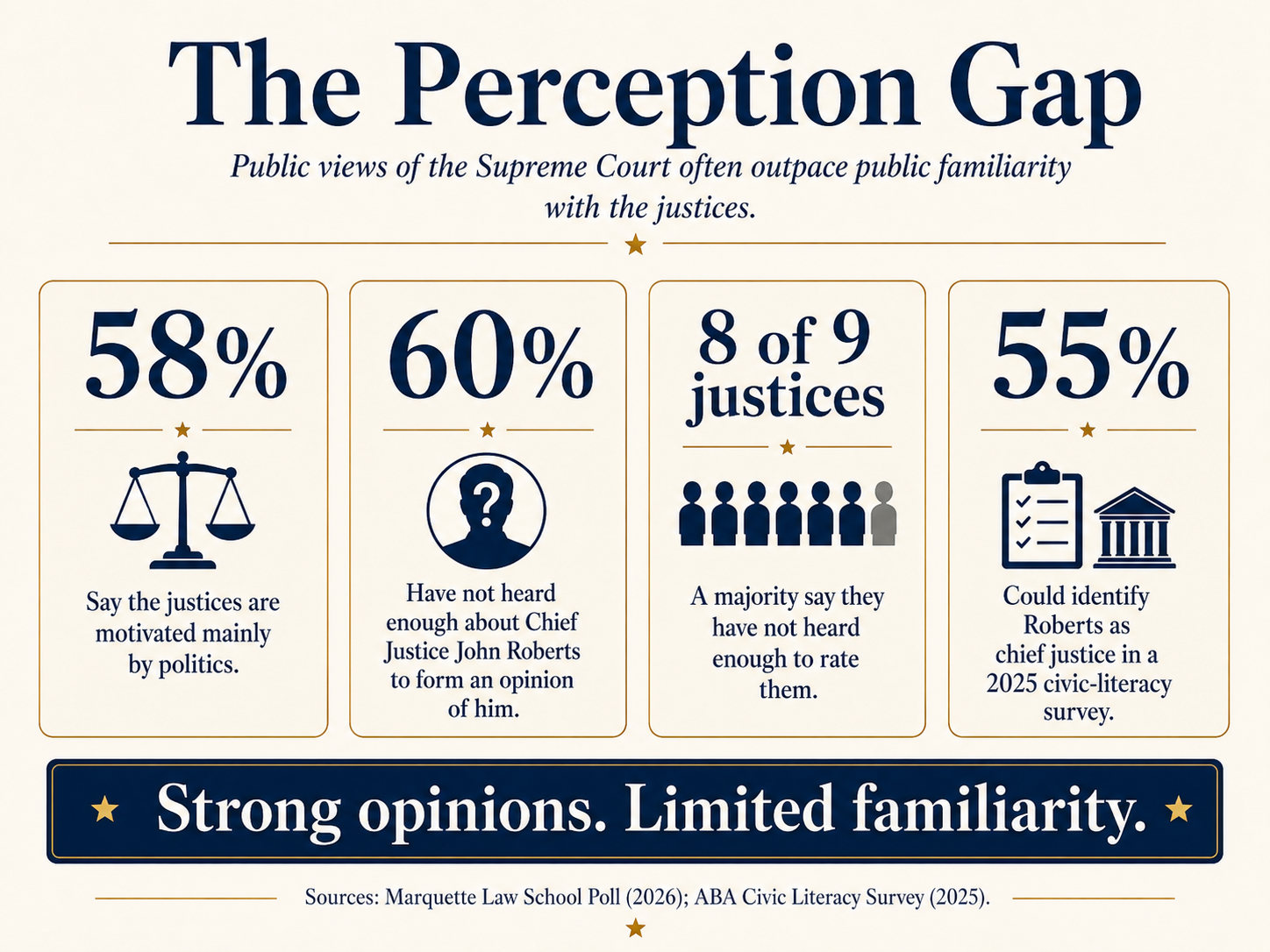
At the same time, public confidence has deteriorated. In a July 2026 Marquette Law School Poll, 58% of Americans said Supreme Court justices are motivated mainly by politics rather than law. Yet in the same survey, a majority of respondents said they had not heard enough to form an opinion about eight of the nine sitting justices; 60% said that about Chief Justice John Roberts. A separate 2025 American Bar Association civic-literacy survey found that only 55% of Americans could correctly identify Roberts as the chief justice. [1,2]
Supreme Court appointments necessarily pass through political institutions, but the nomination and confirmation process has become far more partisan than it once was. Presidents vet nominees carefully, advocacy organizations mobilize immediately, senators increasingly vote by party, and much of the media describes vacancies and decisions as victories and defeats for competing political camps. But political selection does not necessarily produce political judging. Indeed, lifetime tenure was designed in significant part to prevent exactly that: once confirmed, a justice no longer needs the president, the Senate, a political party, donors, or voters.
Perhaps we have confused a highly partisan selection process with partisan judging. Supreme Court nominees are not candidates running for office. They do not campaign for votes, adopt party platforms, or return to the Senate periodically for approval. Political institutions choose them because the Constitution requires it, but once confirmed, the design is meant to sever that relationship. A justice should not be presumed to remain an agent of the president who nominated him or her, or of the senators who supplied the votes for confirmation. When we carry the politics of the appointment battle onto the bench, we risk assigning partisan motives to judges simply because of how they arrived there.
If that is an important source of the Court’s perceived politicization, then expanding the Court attacks the wrong problem and may only deepen it. A more targeted response would be to demand broader agreement at the point of appointment—and then respect the extraordinary independence that follows.
The modern description of the Supreme Court has become remarkably simple: six conservative justices, three liberal justices, a conservative majority and a liberal minority. A decision becomes a “win for conservatives” or a “loss for liberals,” often before most readers have encountered even a paragraph of the opinion explaining why the Court ruled as it did.
There is enough truth in that shorthand to make it seductive. Presidents care about the judicial philosophies of the people they nominate. Justices unquestionably bring to the bench different understandings of constitutional text, history, precedent, federalism, executive authority, individual liberty, and the appropriate limits of government. Those differences sometimes produce highly predictable divisions. Judges are human beings; they do not arrive at the Court without experiences, assumptions, philosophies, or opinions.
But the word political can conceal several very different propositions. Supreme Court justices are selected through political institutions: an elected president nominates them, and an elected Senate confirms them. They also bring recognizable approaches to constitutional interpretation, precedent, statutory language, federalism, and the proper limits of governmental power. And their decisions can have enormous political consequences. All of that is true. None of it establishes that a justice reached a particular decision in order to advance a political party, reward the president who made the appointment, or produce a preferred electoral result. That final claim—partisan motivation—is far more serious, yet we have become surprisingly comfortable making it.
The Court's own record should make us more cautious. Justices repeatedly reach decisions that disappoint the presidents, parties, and constituencies associated with their appointments, and they explain those decisions in detailed written opinions grounded in constitutional text, statutes, precedent, history, and competing interpretations of the law. Those arguments can be challenged, and sometimes should be. But too often we take a handful of highly visible cases—abortion, guns, affirmative action, presidential power—and extrapolate from them to the entire institution, even though much of the Court's work receives little attention and frequently produces unanimous or cross-appointment coalitions. We may therefore be judging the Court less by the breadth of its actual work than by a small number of cases that generate the most political heat.
Before concluding that the Court itself has become a partisan institution, we should look more carefully at what it actually does.
First, Understand the Institution
The Supreme Court is only the top of a much larger federal judiciary. At its base are 94 federal judicial districts, where most federal litigation begins. Above them are 13 U.S. Courts of Appeals—twelve regional circuits and the Federal Circuit—which generally review whether lower courts properly interpreted and applied the law. At the top is the Supreme Court, which hears only a small fraction of the cases presented to it and concentrates on important constitutional questions, conflicts among lower courts, and other matters of broad national significance. The Supreme Court has nine justices, the appellate courts have 179 authorized judgeships, and the district courts have 677 authorized judgeships. [3,4]
Judges at all three levels are Article III judges. The president nominates them, the Senate confirms them, and they serve during “good Behavior,” an arrangement that has generally meant life tenure unless they retire, resign, die, or are impeached and removed. Lifetime tenure is therefore not an eccentric privilege created for nine Supreme Court justices. It is one of the federal judiciary's principal structural protections. The Supreme Court itself describes the purpose plainly: the arrangement is intended to protect judicial independence and insulate judges from partisan pressure. [5]
The American judiciary is not a single national pyramid. State and federal courts operate in parallel. State courts handle most criminal prosecutions, family law, probate, contracts, property disputes, tort claims, and questions of state statutory and constitutional law. Federal courts exercise the jurisdiction assigned to them by the Constitution and Congress. A state supreme court is generally the final authority on its own state law, although the U.S. Supreme Court may review a state decision when a federal constitutional or federal-law question is involved.
That distinction matters because Americans increasingly expect the Supreme Court to resolve disputes that may also belong to Congress, state legislatures, state courts, presidents, governors, and ultimately voters. The more political controversies are transformed into constitutional controversies, the more powerful the Supreme Court inevitably appears. Some of the Court's modern prominence may reflect judicial power; some may also reflect elected institutions' inability or unwillingness to settle difficult questions themselves.
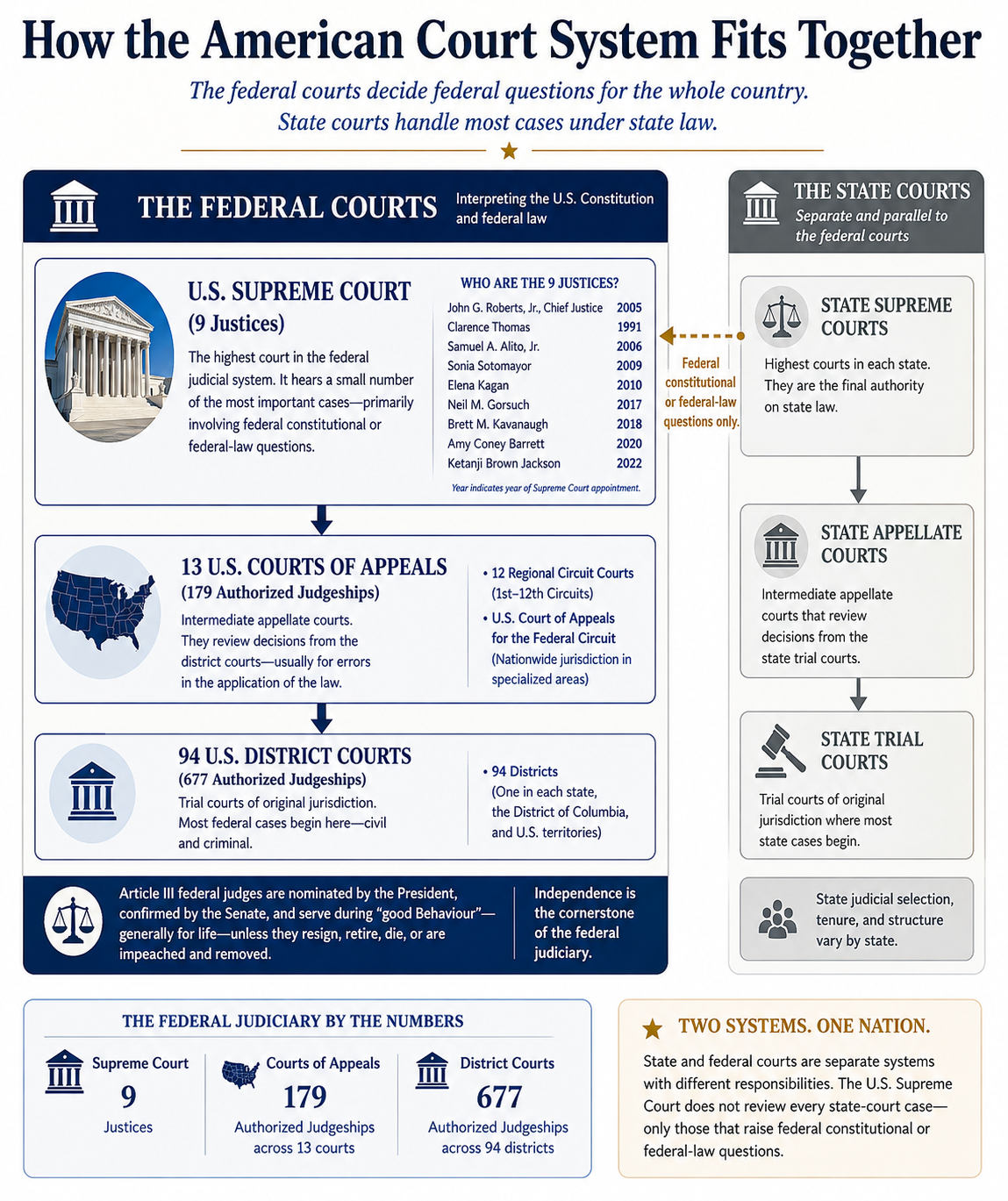
Politics Chooses. Independence Follows.
Alexander Hamilton's defense of the judiciary in Federalist No. 78 remains remarkably useful. The executive held the sword, Congress controlled the purse and wrote the laws, and the judiciary possessed neither force nor will, but primarily judgment. For that judgment to have constitutional meaning, judges must occasionally be able to tell presidents, legislatures, states, and popular majorities that they cannot do something they very much want to do. That is impossible without independence. [6]
The constitutional arrangement therefore contains an interesting compromise. It does not attempt to make judicial selection apolitical. An elected president makes the nomination and an elected Senate provides advice and consent. Politics is deliberately present at the entrance. Once the judge is confirmed, however, the relationship changes dramatically. The president cannot fire the justice, the Senate cannot refuse to renew the term, and the justice never again needs a party nomination, campaign contributions, electoral support, or the approval of the political coalition that supported the appointment.
That distinction is fundamental:
Supreme Court appointments are political by design. Supreme Court judging is not supposed to be.
The extraordinary protection of life tenure makes considerably more sense when viewed that way. The political branches choose the judge, but the Constitution then removes their principal means of controlling that judge.
The 6–3 Label Tells Us Less Than We Think
The current Supreme Court contains six justices appointed by Republican presidents and three appointed by Democratic presidents. That is an objective historical fact. Calling them immediately six “Republican” or “conservative” justices and three “Democratic” or “liberal” justices adds another layer: appointment history becomes judicial identity.
The distinction becomes obvious when we look at the rest of the federal courts. The active federal appellate judiciary is almost evenly divided between judges appointed by Republican and Democratic presidents, while Democratic-presidential appointees currently substantially outnumber Republican-presidential appointees on the federal district courts. The conspicuous 6–3 imbalance is therefore primarily a feature of nine Supreme Court seats, not the federal judiciary as a whole.
More importantly, appointment party is a weak substitute for judicial behavior. It tells us which president selected the judge. It does not tell us what the judge will conclude after decades of independent service (appointment and behavior are often quite different).
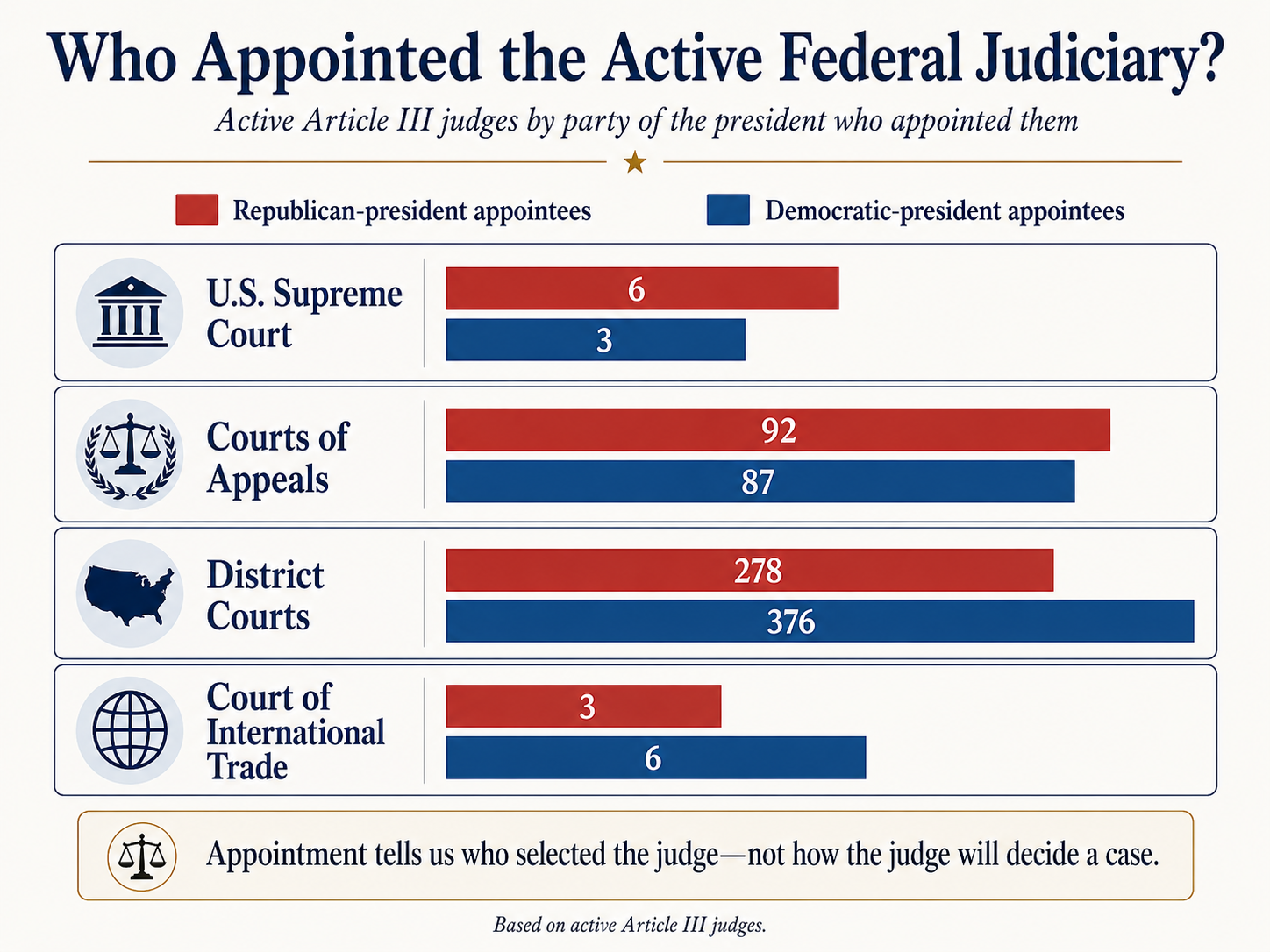
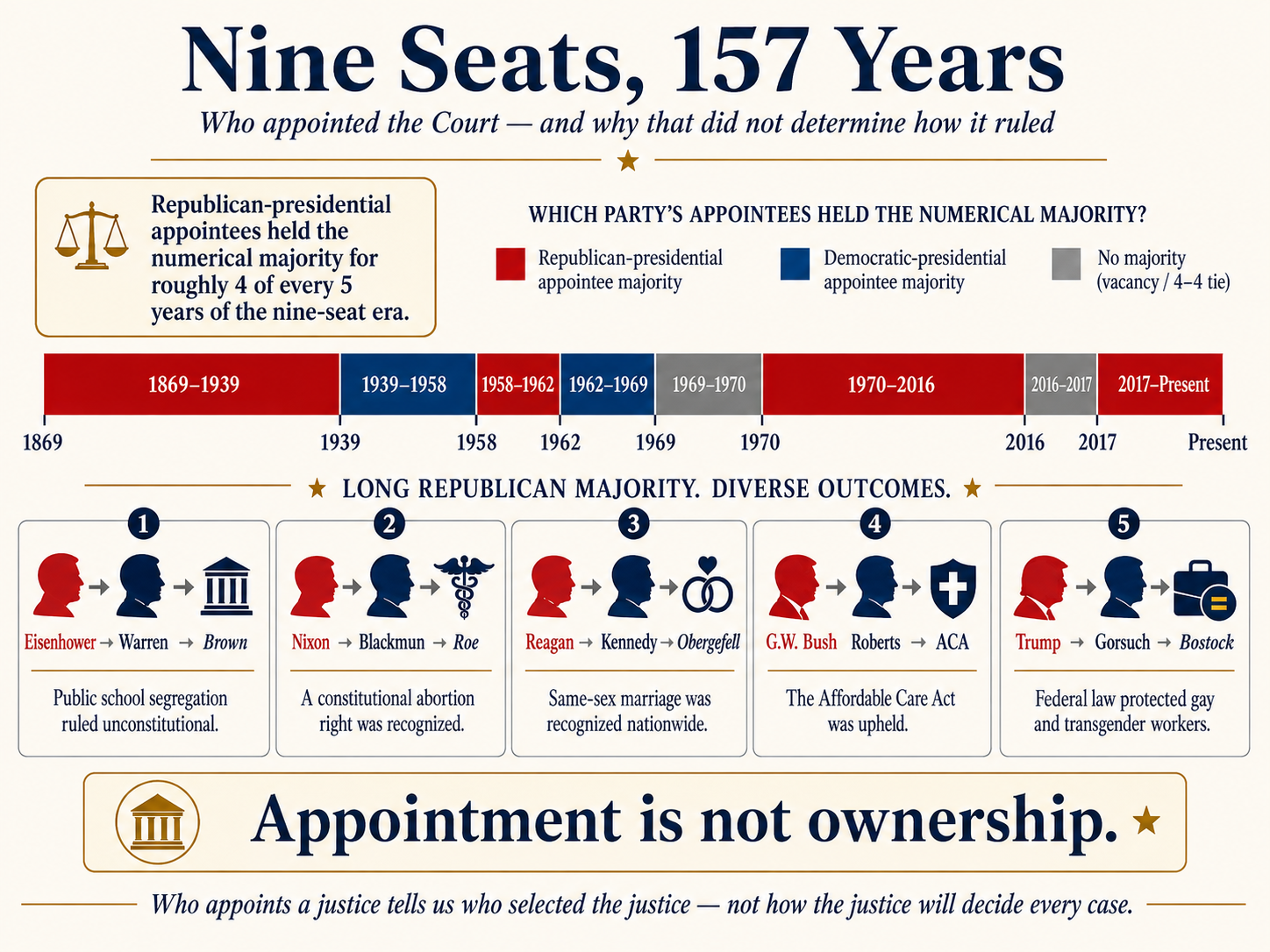
Appointment Is Not Ownership
The historical record makes that point far more convincingly than theory can.
The Supreme Court has had nine seats since 1869. Using the Court's official service records, appointees of Republican presidents have held a numerical majority of occupied seats for roughly four-fifths of the nine-seat era. [7] If presidential appointment meant partisan control, American constitutional history since the Civil War should therefore look overwhelmingly Republican.
It does not.
Dwight Eisenhower appointed Earl Warren, who wrote the unanimous opinion in Brown v. Board of Education and later the majority opinion in Miranda v. Arizona. Richard Nixon appointed Harry Blackmun, author of Roe v. Wade. Gerald Ford appointed John Paul Stevens, whose later jurisprudence regularly produced results opposed by Republican constituencies. Ronald Reagan appointed Anthony Kennedy, who wrote Obergefell v. Hodges, recognizing same-sex marriage nationwide. George H. W. Bush appointed David Souter, who often joined Justices Ginsburg, Breyer, and Stevens. George W. Bush appointed John Roberts, who cast the decisive vote sustaining the Affordable Care Act's individual mandate as an exercise of Congress's taxing authority. Donald Trump appointed Neil Gorsuch, who wrote Bostock v. Clayton County, holding that Title VII protects gay and transgender workers from discrimination because of sex. [8–12]
The point is not to place these decisions into a different partisan scorecard. Warren did not become a Democrat because of Brown. Gorsuch did not become a liberal politician because he wrote Bostock. Roberts did not join the Obama administration because of the ACA ruling. Rather, the cumulative record demonstrates something quite basic: presidents appoint justices; they do not own them.
What politicians sometimes describe as a president making a disappointing or unexpected appointment may instead show that the constitutional arrangement worked. The judge ceased being the president's nominee and became an independent justice.
Strong Opinions, Limited Familiarity
This is where public opinion becomes uncomfortable.
In July 2026, the Marquette Law School Poll asked Americans whether Supreme Court justices make decisions mainly on the basis of law or mainly on the basis of politics. Fifty-eight percent chose politics; only 42% chose law. Among Democrats, 74% said politics. Among independents, 59%. Even among Republicans, 43% believed politics predominated. [1]
That is a serious legitimacy problem. But another finding from the same survey belongs beside it. Americans were also asked whether they knew enough about each justice to hold a favorable or unfavorable opinion. For eight of the nine justices, a majority said they did not. Sixty percent had not heard enough about Chief Justice John Roberts to form an opinion of him; 61% said the same of Samuel Alito, 68% of Neil Gorsuch, and 69% of Elena Kagan. Even Clarence Thomas, the best-known individual justice in that survey, was too unfamiliar to 41% of respondents for them to express an opinion. [1]
A separate American Bar Association civic-literacy survey in 2025 asked respondents to identify the chief justice. Fifty-five percent correctly selected John Roberts; 44% could not. [2] That represents considerable improvement from an earlier era, but it still means that nearly half the country could not identify the person who has led the Supreme Court since 2005.
These numbers should not be used to dismiss public criticism. Citizens do not need to memorize judicial biographies before disagreeing with Dobbs, Bruen, Obergefell, or any other decision. Nor does unfamiliarity with a justice's name mean an opinion about the Court is necessarily wrong. But if most Americans believe the justices are principally political actors while most Americans know too little about most individual justices even to express an opinion about them, some humility seems appropriate.
We may know the narrative of a political Court better than we know the Court.
The Court's Actual Record Is Messier Than the Story
None of this means the Court lacks meaningful jurisprudential divisions. During the 2025–26 term, 22.7% of all decisions divided 6–3 with the six Republican-presidential appointees on one side and the three Democratic-presidential appointees on the other, a substantial increase from 9% the year before. Those figures deserve attention. [13,14]
But so do the rest of the decisions. Approximately 42% of the Court's decisions were unanimous in 2024–25, and about 44% were unanimous in 2025–26. Even in important cases, the familiar appointment-party alignment is far from universal. Recent terms have included consequential decisions in which Republican-appointed justices joined Democratic-appointed colleagues against Republican presidents, Republican litigants, or policy positions associated with Republican constituencies. [13,14]
In a structured sample of forty especially consequential cases from the past five Supreme Court terms—eight from each term—I found twenty-two that divided along the familiar appointment-party line and eighteen that did not. The sample deliberately overweights politically salient cases, so it should not be confused with the Court's full docket. Even so, 45% of these headline-level cases failed to follow the simple six-versus-three template. Independent analyses point in the same direction: in a separate study using amicus-brief activity to identify the most salient cases, between 68% and 82%of the most important cases in recent terms were not decided along a pure ideological alignment.
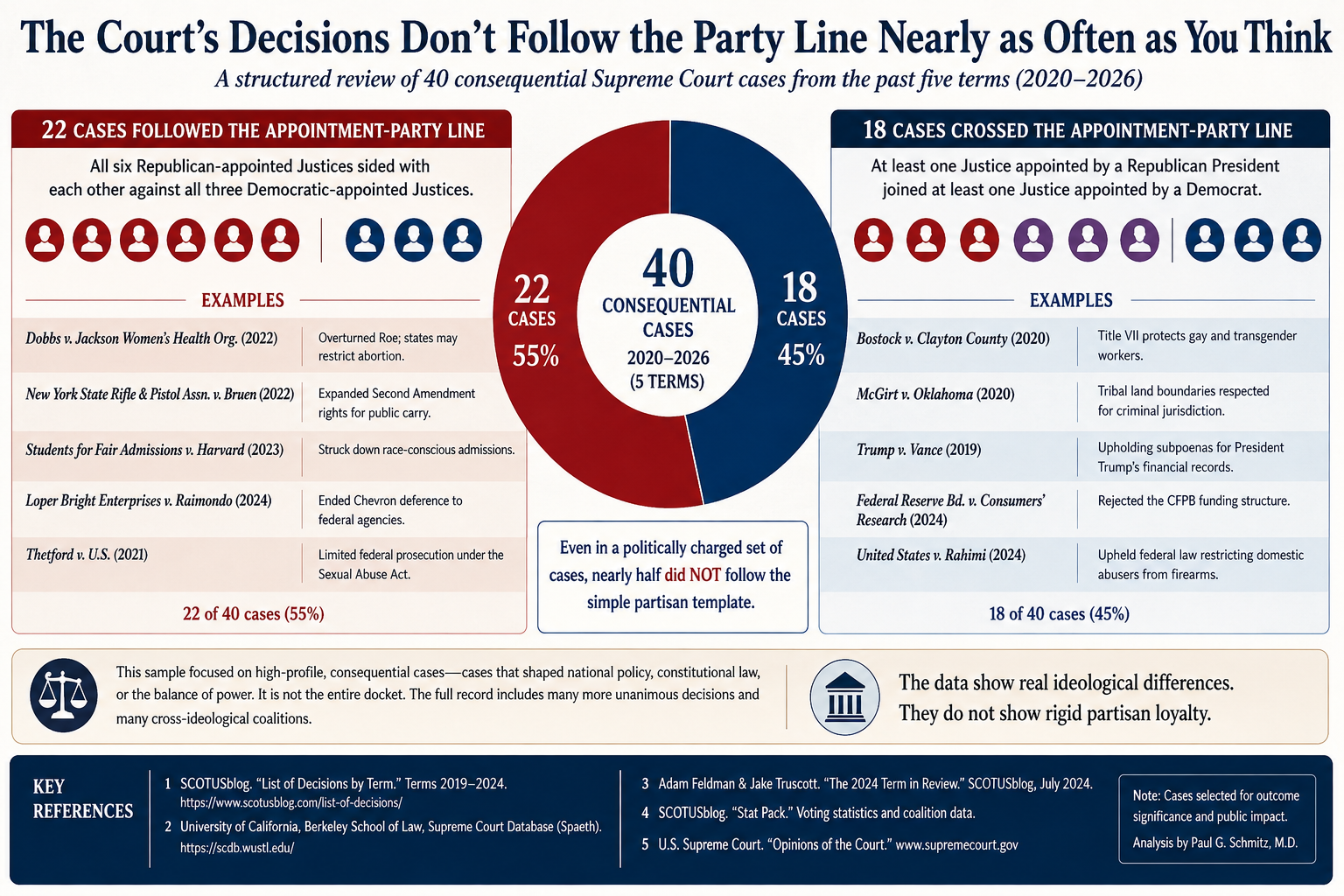
Recent examples also make the point. Republican-appointed justices supplied decisive votes against President Trump's sweeping tariff position. Republican-appointed members of the Court joined Democratic-appointed colleagues in rejecting his broad birthright-citizenship position. Chief Justice Roberts and Justice Kavanaugh joined the three Democratic-presidential appointees in preventing the immediate removal of Federal Reserve Governor Lisa Cook. Roberts and Justice Amy Coney Barrett joined them in rejecting the Republican National Committee's interpretation of federal Election Day law concerning timely mailed ballots.
None of this proves that the Court is “centrist,” whatever that might mean, just as unanimity does not prove impartiality and a 6–3 division does not prove partisan motivation. It demonstrates something more modest and useful: judges can have recognizable philosophies, those philosophies can produce recurring coalitions, and a decision can benefit one political constituency without the judge necessarily acting for political reasons.
We should be reluctant to infer motive from outcome.
We Politicized the Entrance
If the evidence that the justices themselves operate as partisan actors is much weaker than the rhetoric suggests, why does the Court feel so political? One answer is difficult to escape: we have made the appointment process look increasingly like ordinary partisan warfare.
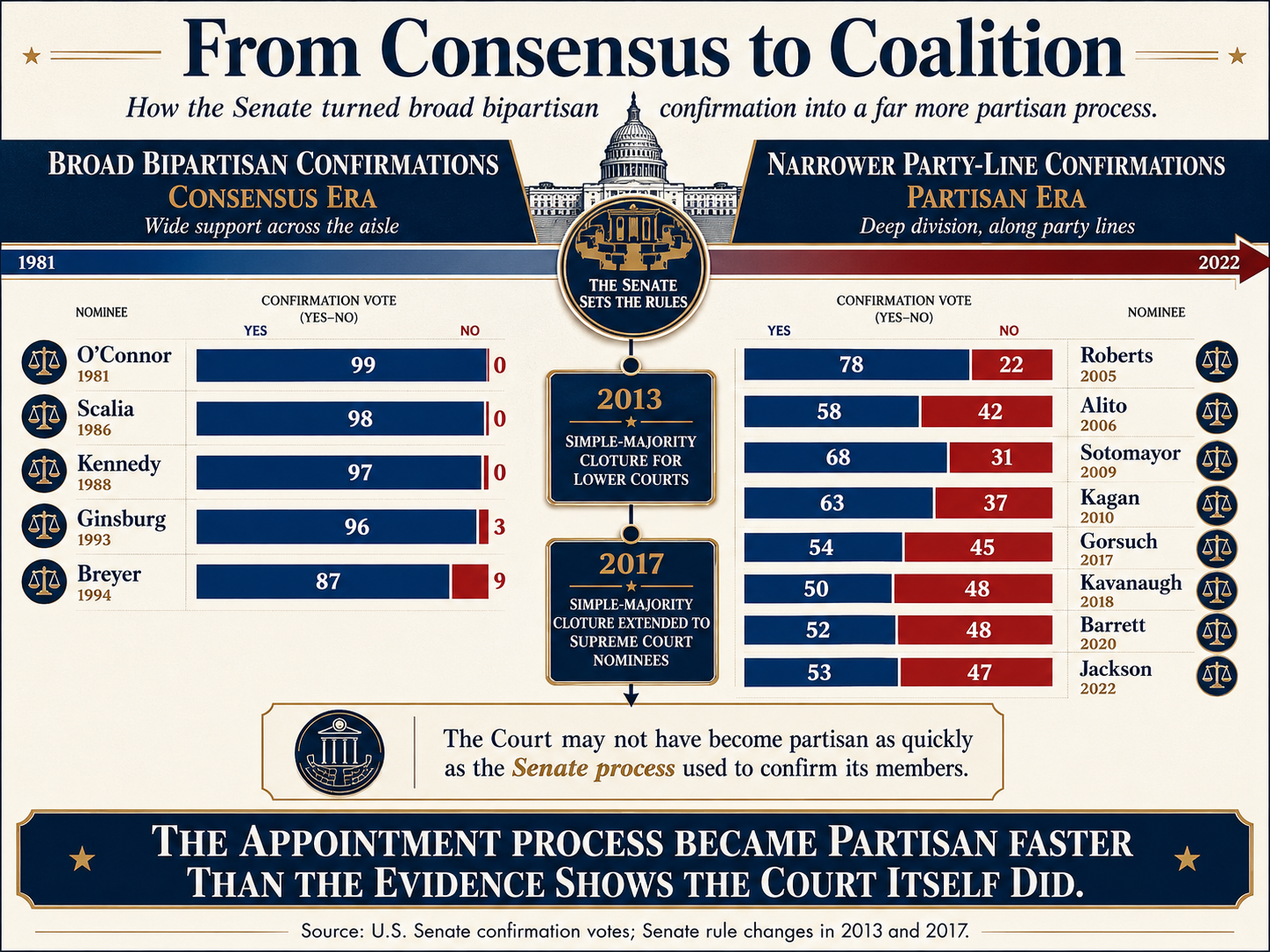
For much of the twentieth century, Supreme Court nominees routinely received overwhelming support across party lines. Sandra Day O'Connor was confirmed 99–0, Antonin Scalia 98–0, Anthony Kennedy 97–0, David Souter 90–9, Ruth Bader Ginsburg 96–3, and Stephen Breyer 87–9. [15]
These were not ideologically interchangeable judges. Senators who voted for Scalia were not endorsing every constitutional argument he would eventually make, just as Republican senators who overwhelmingly supported Ginsburg were not endorsing every future opinion she would write. The older confirmation norm appears to have preserved a distinction that is now increasingly difficult to find: I would not have chosen this nominee was not the same judgment as this nominee is unfit to serve.
Robert Bork's 1987 nomination was an important turning point, but it did not instantly destroy that culture. After Bork was rejected, Reagan nominated Anthony Kennedy, and a Democratic-controlled Senate confirmed him 97–0. Ginsburg received 96 votes only six years after Bork; Breyer received 87 votes the following year. The transformation therefore cannot be explained by a single nomination or a single party.
Instead, several developments accumulated. The parties became more ideologically sorted. The Supreme Court became more central to disputes the political branches could not or would not settle. Presidents became more systematic about identifying candidates whose jurisprudential approaches they valued. Advocacy organizations on both sides built sophisticated nomination campaigns. Senators increasingly treated judicial seats as political assets. A media environment rewarded for conflict and partisan scorekeeping reinforced the same framework, routinely describing Court vacancies and decisions in terms of which side had won or lost.
Both parties helped construct this system. Neither deserves to complain as though the other invented it.
When Sixty Became Fifty-One
The most consequential procedural change is often misunderstood. The Constitution has never required sixty votes to confirm a Supreme Court justice; a final confirmation has always required ordinary Senate consent. But the Senate's old cloture rules meant that a determined minority could require three-fifths of the Senate—normally sixty votes—to end debate on a judicial nomination. That did not formally require bipartisan confirmation, but it created an important practical incentive to find nominees capable of winning support outside the president's own party.
That barrier disappeared in stages. In 2013, Senate Democrats, frustrated by Republican obstruction of President Obama's executive and lower-court nominees, invoked the so-called nuclear option and reduced the cloture threshold for those nominations to a simple majority. Supreme Court nominations initially remained subject to the sixty-vote rule. In 2016, after Justice Antonin Scalia died, the Republican-controlled Senate declined to consider Obama's nomination of Merrick Garland. In 2017, Democrats attempted to block Donald Trump's nomination of Neil Gorsuch, and Senate Republicans responded by extending simple-majority cloture to Supreme Court nominations. [16]
The confirmation votes thereafter are revealing: Gorsuch 54–45, Kavanaugh 50–48, Barrett 52–48, and Jackson 53–47. [15] Those votes do not demonstrate that any of these four became partisan judges after taking office. They demonstrate instead that a Supreme Court justice can now be placed on the Court without meaningful support from the opposition party.
That change has consequences beyond arithmetic. A justice selected by a Republican president, vetted by a Republican administration, championed by Republican senators, opposed by Democratic organizations, and confirmed almost entirely by Republican votes begins service already wearing a political label. The same sequence works in reverse. The public then sees subsequent decisions through the identity the appointment process created.
Perhaps it is not surprising that Americans increasingly regard the justices as political. We have made the process of producing them unmistakably partisan.
Life Tenure May Be a Feature, Not a Bug
Life tenure is another obvious target for reform. Its defects are real: vacancies occur unpredictably; one president may appoint several justices while another appoints none; presidents have incentives to select younger candidates; justices can time retirement strategically; and an appointment can influence constitutional law for three or four decades.
Yet the argument against life tenure becomes less persuasive when weighed against what it preserves. Once confirmed, a justice never again needs another Senate vote, another party nomination, electoral approval, or reappointment. A justice may serve long enough to outlive the administration that selected him or her, the senators who confirmed the appointment, several political realignments, and the assumptions that surrounded the nomination itself. That distance creates the conditions for something the entire constitutional design depends upon: independent judgment.
Age is also a surprisingly weak argument for mandatory retirement. Judging is one of the few professions in which accumulated experience may remain a substantial advantage very late in life. Earl Warren was approximately 75 when he wrote Miranda. Anthony Kennedy was 78 when he wrote Obergefell. John Paul Stevens was 86 when he wrote the majority opinion in Massachusetts v. EPA. Ruth Bader Ginsburg was 82 when she joined the Obergefell majority. One may agree or disagree with every one of those decisions; the point is simply that chronological age did not render these justices incapable of consequential intellectual work.
For an institution whose central product is judgment, wisdom may matter. Some of what makes lifetime tenure politically inconvenient– its length, its unpredictability, its freedom from electoral cycles–may be precisely what makes it judicially valuable.
Eighteen Years Is Elegant—But Not Free
One prominent alternative to life tenure is an eighteen-year, nonrenewable Supreme Court term, staggered so that one seat turns over every two years. The arithmetic is undeniably attractive: nine justices, one scheduled replacement every two years, eighteen years of active service. Every four-year presidential term would ordinarily produce two appointments, strategic retirement would become far less important, and the accident of whether a justice happens to die or retire during a particular administration would largely disappear. [17] On first examination, it looks cleaner, fairer, and more rational than the system we have.
I initially found that argument quite persuasive, and I still do. But the very predictability that makes the proposal appealing also deserves scrutiny. Under such a system, every presidential election would carry with it a guaranteed reward: two Supreme Court appointments. Candidates could campaign on those appointments with certainty, voters could treat them as part of the electoral stakes, and political parties could calculate judicial control on a regular four-year timetable. We would solve the randomness of vacancies by tying the Court more closely—and more predictably—to presidential elections.
That may appeal to those who believe elections should have a more regular influence on the Court. But judicial independence rests on a somewhat different principle. The Supreme Court was not designed to change direction in step with electoral victories. Lifetime tenure deliberately weakens the connection between winning the presidency and gaining judicial power: a president may receive several appointments, one, or none. That unpredictability can look arbitrary and even unfair. Yet it also means that no election automatically transfers a fixed portion of the Court to the winning political coalition.
Seen from that perspective, the randomness of lifetime tenure may be less a design flaw than a form of constitutional insulation. A predictable appointment cycle would make the system more orderly, but it could also reinforce the very perception this essay questions—that Supreme Court seats are political assets to be won at election time. The eighteen-year proposal therefore presents a genuine tradeoff rather than an obvious improvement. It offers regularity and symmetry, but at the possible cost of making the Court more tightly synchronized with electoral politics. The Founders' arrangement deserves more respect than the assumption that a modern fixed-term system must necessarily be better.
Court Packing Solves the Wrong Problem
This brings us back to the issue that began the inquiry.
There is nothing sacred about the number nine. The Constitution does not specify it, and Congress altered the Court's size several times before nine became the current standard in 1869. [5] The constitutional question is therefore relatively straightforward. The institutional question is much harder.
Franklin Roosevelt's 1937 proposal remains the great warning. Frustrated by Supreme Court decisions threatening important portions of the New Deal, Roosevelt proposed legislation that could have allowed him to add several justices. His frustration was understandable: he had won an enormous electoral mandate, voters had repeatedly endorsed his program, and an unelected Court stood in the way. Yet even many of Roosevelt's own political allies recoiled from changing the Court's membership in a manner whose practical purpose was to alter its decisions. [18]
That episode captures the danger. If judicial independence means anything, it cannot mean independence only so long as judges produce results tolerable to the governing majority.
The problem with thirteen justices is therefore not thirteen. It is the absence of a stopping principle. If one party can move nine to thirteen because it regards the present Court as unacceptable, why should the next governing majority not move thirteen to seventeen? Once Court size becomes an accepted instrument for reversing judicial direction, every majority becomes provisional, and every election carries the possibility of reconstructing the Court.
That does not depoliticize the judiciary. It makes control of the judiciary an electoral prize.
Put Consensus Where Permanence Is
After considering expansion, fixed terms, retirement ages, and life tenure, the most persuasive reform may be the narrowest:
Keep nine justices. Preserve strong lifetime judicial independence. Require three-fifths of the Senate to confirm a Supreme Court justice.
This would not literally restore an old constitutional rule; the Senate never required sixty votes on the final confirmation itself. It would instead constitutionalize the broader-consensus function that the old cloture rule—and, perhaps more importantly, an older Senate culture—once supplied.
The incentive would change immediately. A president with 52 senators could no longer focus primarily on identifying the most jurisprudentially desirable nominee whom the governing party could confirm. The administration would have to ask which outstanding jurist could also command the confidence of senators outside the governing coalition.
That need not produce bland or indistinguishable centrists. Antonin Scalia received 98 votes. Ruth Bader Ginsburg received 96. Neither lacked a recognizable judicial philosophy. A three-fifths requirement would instead place greater weight on qualifications, temperament, intellectual seriousness, judicial credibility, and the ability of political opponents to say: I would not necessarily have chosen this person, but I trust this person to judge.
That may be the standard we have lost.
A supermajority requirement would also address perception. A justice confirmed with substantial support from both sides enters office under a different public presumption from one installed almost entirely by a single political coalition. We cannot legislate trust into existence, but the process by which an institution acquires its members inevitably affects how the public perceives their legitimacy.
The strongest objection is deadlock. A determined minority could refuse to confirm anyone, and the Garland episode demonstrates that obstruction is not hypothetical. Any constitutional reform would therefore need procedural safeguards requiring timely hearings and votes. I would resist an automatic fallback to 51 votes after several failures, because everyone would simply wait for the threshold to fall. Occasional vacancies may be the cost of requiring broader agreement before granting someone decades of extraordinary independence.
The relevant question is difficult but fair: should a temporary political majority, acting entirely alone, be able to select one of the nine people who may interpret the Constitution for the next thirty years?
The Filibuster Paradox
This proposal produces an interesting contrast with the legislative filibuster.
Under the present system, ordinary legislation may effectively require sixty votes to overcome a Senate filibuster, while a Supreme Court nominee can proceed with a simple majority. That creates an odd hierarchy of permanence. A tax provision can be repealed, an appropriation expires, and an ordinary statute can be amended by a later Congress. A Supreme Court justice may exercise constitutional authority for several decades.
Perhaps we have placed the supermajority requirement in the wrong place.
There is no inconsistency in arguing that ordinary legislation should generally proceed by majority rule while Supreme Court appointments should require broader agreement. Elections should permit majorities to govern. But choosing one of the people who will independently judge the constitutional boundaries of that government for decades is a different type of decision.
There may also be an indirect benefit. A Congress capable of legislating by majority vote is better able to respond when the Supreme Court interprets a federal statute in a way Congress dislikes. A functioning legislature therefore reduces the pressure to obtain policy outcomes through litigation. A stronger Congress could paradoxically make the Supreme Court less politically central.
The irony is that abolishing the legislative filibuster would also make statutory court expansion easier, reinforcing the argument that fundamental rules concerning Court size or Supreme Court confirmation may belong in the Constitution rather than in fragile Senate custom.
We May Be Fixing the Wrong Institution
The deepest irony in the court-packing debate may be that the clearest evidence of politicization lies not in the Supreme Court’s opinions, but in the way its justices are selected, confirmed, and portrayed.
Presidents select nominees strategically. Senators increasingly vote predictably by party. Advocacy organizations treat each vacancy as an existential struggle. Political leaders routinely describe seats as though they belong to one coalition or the other. A media system rewarded for conflict and immediacy translates complicated judicial reasoning into partisan winners and losers. The public absorbs that framework and then tells pollsters that the Court itself is political.
We may have helped create the perception that we now cite as evidence that the institution is broken.
None of this requires romanticizing judges. Supreme Court justices are human beings capable of error, inconsistency, bias, poor reasoning, and perhaps occasionally political calculation. We should criticize their decisions, scrutinize their ethics, and debate their constitutional role vigorously. But criticizing a decision is different from accusing the person who made it of having bad motives. We have become remarkably comfortable describing justices as political actors, sometimes little more than representatives of the president or party that appointed them, without much evidence that they understand their role that way.
Perhaps we owe the justices a measure of fairness. These are men and women who spent decades in the law, accepted positions deliberately insulated from electoral politics, and now must decide cases in which one side will almost inevitably leave unhappy. There is little reason to assume they sought the bench to become instruments of a political party, and the historical and contemporary voting record repeatedly shows them disappointing the coalitions that helped put them there. We are free to conclude that a justice is wrong. We should be more reluctant to conclude, without evidence, that the justice is dishonest about why.
The Court does not deserve immunity from criticism. It may deserve a stronger presumption of good faith than our politics currently gives it.
Consensus at the Door. Independence on the Bench.
I began this inquiry thinking primarily about court packing. I remain opposed to it, but the reason is now broader than my original objection.
Adding four justices attempts to solve a perceived political problem through one of the most overtly political actions available: changing the Court's membership so that its voting balance changes. It does nothing to restore confidence that judging is independent of politics and may instead reinforce the public belief that the Court is simply another institution to be captured whenever political power changes hands.
The more useful question is why Americans have come to believe so strongly that the justices are political actors. Part of the answer lies in highly consequential decisions that inevitably produce winners and losers, together with genuine differences in judicial philosophy. But part surely lies in an appointment process that has become almost indistinguishable from ordinary partisan combat.
The Constitution goes to extraordinary lengths to remove political leverage once that justice takes the oath. Perhaps we should strengthen both halves of that design rather than abandon either one.
Presidents should nominate jurists whose records, intellect, temperament, and commitment to the law can command confidence beyond a bare partisan majority. Senators, in turn, should remember what they are being asked to do. They are not choosing another member of their political coalition. They are entrusting an accomplished lawyer or judge—typically after decades of professional work, scrutiny, and public service—with extraordinary independence and one of the most consequential responsibilities in American government.
Then we should honor that bargain. Once the oath is taken, a justice does not belong to the president who nominated him or her, the senators who voted for confirmation, or the political party that celebrated the appointment. The whole purpose of the constitutional arrangement is that the justice is now free to disappoint all of them. We should expect serious reasoning, fidelity to the law, ethical conduct, and intellectual honesty. We should criticize opinions vigorously when we disagree. But disagreement with a decision is not evidence of partisan motive, and we should be slower to reduce men and women entrusted with judicial office to political labels simply because we dislike where their reasoning led.
That distinction matters. Political consequences are inevitable; political judging is not. If we want a Court worthy of public confidence, the answer is not to demand predictable outcomes or to change its membership whenever those outcomes disappoint us. It is to demand more of the appointment process, more of the Senate, and perhaps a little more fairness from ourselves in judging the judges.
Require broad consensus to put a justice on the Court. Then respect the independence we gave them.
References
1. Marquette Law School Poll. National survey, July 22–29, 2026. Public views of Supreme Court decision-making and familiarity with individual justices.
2. American Bar Association. 2025 Survey of Civic Literacy. Public knowledge of the Supreme Court and identification of the chief justice.
3. Administrative Office of the U.S. Courts. “About U.S. District Courts.”
4. Administrative Office of the U.S. Courts. “About the U.S. Courts of Appeals” and “Authorized Judgeships.”
5. Supreme Court of the United States. “The Court as an Institution.”
6. Alexander Hamilton. Federalist No. 78.
7. Supreme Court of the United States. “Justices 1789 to Present.” Historical service records used to calculate presidential-appointment majorities during the nine-seat era.
8. Supreme Court of the United States. Brown v. Board of Education, 1954; Miranda v. Arizona, 1966.
9. Supreme Court of the United States. Roe v. Wade, 1973.
10. Supreme Court of the United States. Obergefell v. Hodges, 2015.
11. Supreme Court of the United States. National Federation of Independent Business v. Sebelius, 2012.
12. Supreme Court of the United States. Bostock v. Clayton County, 2020.
13. SCOTUSblog. Stat Pack 2025. October Term 2024 voting statistics.
14. Jake S. Truscott and Adam Feldman. “The 2025–26 Term by the Numbers.” SCOTUSblog, July 2026.
15. U.S. Senate. “Supreme Court Nominations, 1789–Present.” Official nomination and confirmation-vote history.
16. U.S. Senate Historical Office. “About Judicial Nominations: Historical Overview.” History of judicial filibusters and the 2013 and 2017 cloture changes.
17. Congressional Research Service. Analysis of Supreme Court term-limit proposals and the eighteen-year staggered-term model.
18. Constitution Annotated. Article III materials concerning congressional authority over Supreme Court structure and the Roosevelt court-expansion controversy of 1937.
