
The Filibuster: From Freebooter to Minority Veto
How a procedural accident became a 60-vote barrier the Constitution never required—and why it may be time to end it.
In Brief
I did not begin this inquiry convinced that the Senate filibuster should be abolished. My instinct was almost the opposite. In a deeply divided country, requiring more than a bare majority to enact consequential national legislation seemed like sensible institutional restraint—a necessary evil that might slow abrupt policy swings, encourage negotiation, and prevent a temporary majority from making changes the country would later regret.
The more closely I examined the history, however, the less persuasive that defense became. The Constitution did not create the filibuster, nor did the Founders deliberately design it. Hamilton and Madison explicitly warned that routine supermajority requirements could transfer effective power from the majority to the minority. The Constitution already makes national legislation difficult through two separately elected chambers, staggered Senate terms, presidential vetoes, federalism, judicial review, and specific supermajority requirements for genuinely exceptional decisions.
Its historical record is no more reassuring. The filibuster’s most consequential use was not protecting vulnerable minorities from an overreaching majority. It was allowing a determined group of senators to block federal civil-rights protections. In the modern Senate, the rule often produces inaction rather than deliberation, and little evidence shows that compromises constructed to reach 60 votes are necessarily wiser, more coherent, or more durable than legislation supported by a majority.
The current system also contains a striking irony. The Senate can confirm a federal judge—or a Supreme Court justice who may influence constitutional law for 30 or 40 years—with a simple majority. Yet ordinary legislation, including annual funding for government functions Congress has already authorized, may require 60 votes simply to end debate and reach a final vote. Even stranger, Congress can use a special procedure called budget reconciliation to pass enormous tax-and-spending packages with a simple majority, while an ordinary annual appropriations bill may still confront the 60-vote hurdle. The required number of votes often depends less on the importance or durability of the policy than on which procedural lane Congress happens to use.
The strongest argument for retaining the filibuster is that eliminating it could produce greater policy volatility. That risk is real. The modern United States has not truly tested how highly polarized parties would behave if contested legislation could routinely proceed by majority vote. But uncertainty cuts both ways. We cannot know how much needed legislation has been lost, how often the 60-vote rule has forced inferior compromises, or how much congressional paralysis has encouraged presidents and administrative agencies to act in Congress’s place.
I have changed my mind. The modern, general-purpose legislative filibuster should end. That does not mean abandoning deliberation, minority participation, or every possible supermajority requirement. It means putting restraint where it makes institutional sense: protecting genuine debate, requiring a serious process for major structural legislation, keeping new policy from being hidden inside routine funding bills, and reconsidering whether unusually durable decisions—perhaps especially lifetime judicial appointments—deserve broader agreement.
The question is not whether American government needs friction. It does. The question is whether requiring 60 votes for nearly every contested Senate bill is the right kind of friction.
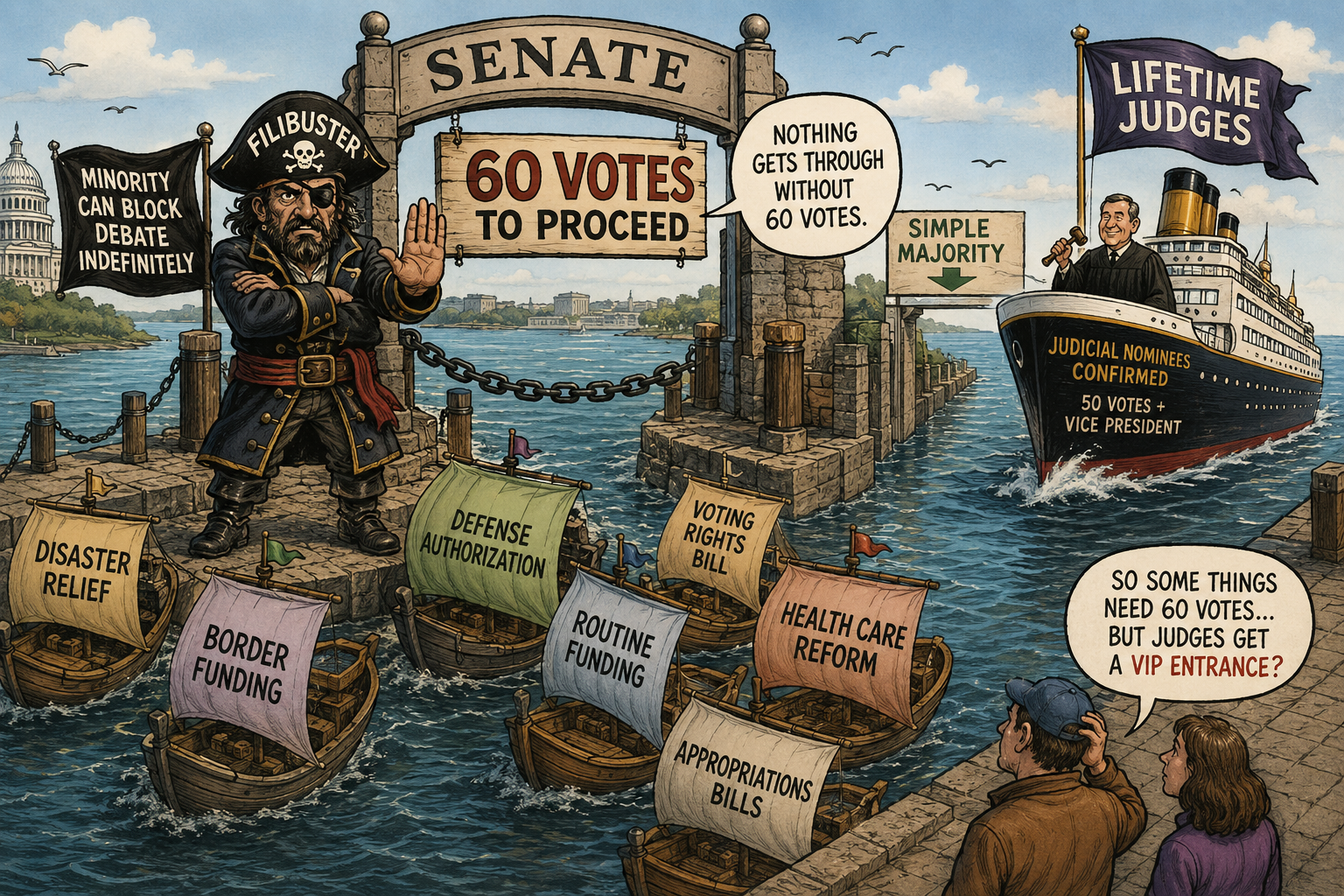
From Freebooter to Filibuster
Even the word has an unusual history.
Filibuster ultimately descends from the Dutch vrijbuiter, or “freebooter”—an adventurer or pirate operating outside ordinary authority in pursuit of plunder. Through France and Spain, the term came into 19th-century American usage to describe private military adventurers attempting unauthorized interventions in Latin America. By the 1850s, Americans used the word metaphorically to describe legislators who commandeered proceedings to prevent the chamber from acting. [1]
The Senate filibuster itself has an equally accidental pedigree. The House and Senate adopted similar rulebooks in 1789, and both contained a procedural device known as the previous-question motion (Enough debate. Shall we decide the matter now?). In 1805, Vice President Aaron Burr recommended simplifying the Senate’s rules by removing provisions he considered unnecessary or duplicative. The Senate followed his recommendation in 1806 and eliminated the motion. It was not presented as a deliberate attempt to establish unlimited debate or create minority veto power. That larger consequence emerged only later. [1][2]
Moreover, removing the motion did not immediately produce the modern filibuster. Early senators generally expected debate eventually to lead to a vote, and sustained obstruction remained uncommon for decades. By the middle of the 19th century, however, prolonged debate and other delaying tactics had become recognizable features of the Senate.
The Senate did not establish a formal mechanism for ending debate until 1917. That mechanism is called cloture—from the French word for “closure.” In plain English, cloture is the procedure by which the Senate says: Enough debate. It is time to move toward a vote.
Rule XXII originally allowed cloture when two-thirds of senators agreed to end debate. In 1975, the Senate changed the requirement to three-fifths of all senators duly chosen and sworn—normally 60 votes in the 100-member Senate. [2]
Accordingly, a bill may need only a simple majority to pass, but if opponents refuse to end debate, supporters may first need 60 votes for cloture before they reach that final majority vote. The modern filibuster therefore does not formally require 60 votes to pass legislation. In practice, however, it produces exactly that result.
Around the same period, the Senate expanded its use of a two-track system. Previously, a filibuster could occupy the floor and interfere with nearly everything else the chamber wanted to do. Under the newer system, leaders could set aside the contested measure and conduct other business. That made the Senate easier to operate, but it also made obstruction much less costly. Senators no longer necessarily had to stand on the floor and speak for hours. A credible threat to deny cloture could be sufficient to stop a bill. [3]
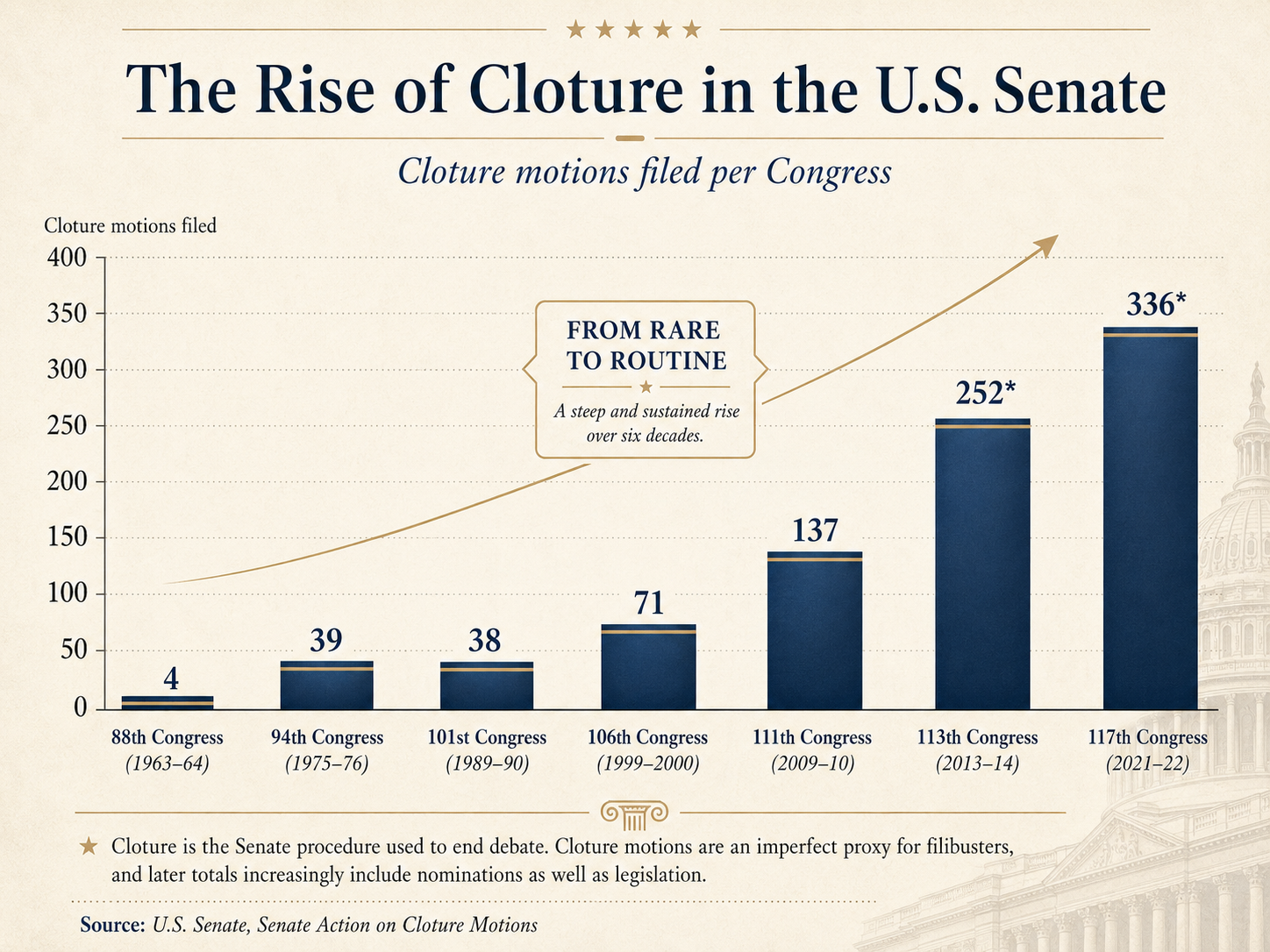
Official cloture statistics illustrate the transformation, though they do not perfectly count filibusters. The Senate recorded four cloture motions in the 1963–1964 Congress, seven in 1965–1966, 39 in 1975–1976, 137 in 2009–2010, and nearly 300 in 2022-2023. By the 21st century, cloture had become a routine part of Senate management rather than an exceptional response to extraordinary obstruction. [4]
The romantic image of the filibuster is reflected by Jimmy Stewart’s character in Mr. Smith Goes to Washington, exhausted but still speaking on the Senate floor. The modern reality is usually much less dramatic. Often the 60-vote threshold operates quietly in the background, determining which legislation leadership considers worth bringing forward at all.
The Founders Wanted Friction—But Not Minority Rule
The Founders did not create the filibuster, but that does not make it unconstitutional or automatically unwise. The Constitution lets each chamber set its own rules, and many useful legislative procedures developed long after 1787.
The more important question is whether the modern filibuster fits the broader constitutional design.
The Founders unquestionably wanted friction. They had experienced the weakness of the Articles of Confederation, studied earlier republics, and spent months debating how to control political power without making government incapable of acting. Their answer was not faith in future leaders' wisdom. It was faith in institutional design.
A bill must pass both the House and Senate. Those chambers represent the public differently and operate on different electoral calendars. Only one-third of the Senate normally faces election at a time. The president may veto legislation, requiring two-thirds of each chamber to override. Federal and state governments divide authority. Courts enforce constitutional limits. Every state receives two senators regardless of population, making the Senate itself a substantial check on simple national majoritarianism. [7]
The Constitution also identifies particular decisions for which ordinary majority approval is insufficient. Treaties, impeachment convictions, presidential veto overrides, constitutional amendments, and expulsion of members require supermajorities. The original Constitution did not require a supermajority for judicial appointments or ordinary legislation. [7]
Therefore, the Framers knew how to write a supermajority requirement. They used them when they believed a decision was sufficiently exceptional to justify it.
Hamilton addressed the danger of going too far in Federalist No. 22. Drawing partly upon the paralysis of the Confederation Congress, he warned that requiring more than a majority effectively gave the minority a “negative upon the majority.” What looked like an additional safeguard could instead produce weakness, bargaining, delay, and governmental incapacity. [5]
Madison made much the same argument in Federalist No. 58. He acknowledged that requiring more than a majority might create another obstacle to hasty legislation. But when the public interest required action, he warned, effective power could shift to the minority. He also anticipated something familiar to modern observers: a blocking minority using its procedural leverage to extract concessions from the majority. [6]
The more time I spent examining these arguments, the more striking the distinction became. The Founders were deeply suspicious of temporary majorities, yet they still declined to require a supermajority for ordinary legislation. Their solution was not to prevent majorities from governing. It was to make them govern deliberately. That is different from giving a legislative minority a standing veto after the constitutional hurdles have already been crossed.
Civil Rights and Two Different Kinds of Minorities
The strongest historical indictment of the filibuster is its role in delaying civil-rights legislation.
For decades, Southern senators used prolonged debate and procedural obstruction to stop federal anti-lynching measures and other civil-rights bills. The high cloture threshold made it extraordinarily difficult for a determined regional coalition to overcome. [2][8]
The best-known confrontation came in 1964. Opponents of the Civil Rights Act filibustered for roughly 60 working days. On June 10, the Senate finally voted 71–29 for cloture, with 44 Democrats and 27 Republicans joining to end debate. The bill subsequently passed and became law. [8] The lesson is not simply that segregationists once used the filibuster. Legitimate powers can serve illegitimate purposes. The deeper problem is that the conventional defense of the filibuster often speaks vaguely about protecting “minorities.” But the minority protected by Senate procedure is a legislative minority. That is not necessarily the same thing as a vulnerable minority in society.
During the civil-rights era, a legislative minority used the filibuster to prevent the federal government from protecting millions of Americans who had little effective political power in their own states. The filibuster did not protect a vulnerable minority from majority oppression. It protected an entrenched political minority from legislation intended to restrain that oppression.
That history does not prove that every filibuster is wrong. It does demonstrate that procedural friction is not inherently virtuous. It can stop a bad law. It can also preserve a bad legal order.
What Does the Filibuster Actually Produce?
The case for the filibuster often rests on an assumption that is surprisingly difficult to demonstrate: requiring 60 votes produces better legislation.
No controlled experiment lets us compare identical Senates operating with and without the rule. Increased use of the filibuster has also coincided with greater political polarization, stronger national parties, changes in media, divided government, and a much larger federal role. Sorting out cause and effect is difficult.
However, we can identify the direct outcomes of a filibuster: delay, defeat, or compromise.
Delay can be useful. Senators may need time to study a bill, expose defects, alert the public, or organize legitimate opposition. But delay can also simply consume the limited time available in a congressional session until the majority gives up.
Defeat may stop harmful legislation. It may also stop legislation that commands majority support. In 2013, the Manchin–Toomey background-check amendment received 54 votes and failed under a three-fifths requirement. In 2010, cloture on the DREAM Act received 55 votes and failed. That same year, cloture on the DISCLOSE Act received 59 votes and failed by one vote. Reasonable people can disagree about each proposal. The procedural point is independent of those disagreements: more senators supported advancing the measures than blocking them, yet the minority prevailed because 60 votes were required. [9]
Compromise sounds more attractive, and often is. Negotiation can remove ideological excesses, correct defects, and produce broader political ownership. But “compromise” is not synonymous with “good policy.” It can also produce exceptions, subsidies, side deals, contradictory provisions, or a bill less coherent than the proposal that began the negotiations.
A bill assembled to satisfy 60 senators is not automatically better than one supported by 53.
The filibuster does not judge the quality of compromise. It changes the bargaining power of those doing the compromising.
There is another possible cost. When Congress cannot legislate, presidents have stronger incentives to stretch executive authority, agencies are asked to apply old statutes to problems Congress has not addressed, and courts are drawn into disputes elected lawmakers failed to resolve. A rule intended to restrain legislative power can indirectly shift policymaking toward institutions that are less directly accountable to voters.
The filibuster clearly creates additional friction. The proposition that this friction reliably produces better government is much harder to establish.
Sixty Votes Is a Mandate Voters Almost Never Give
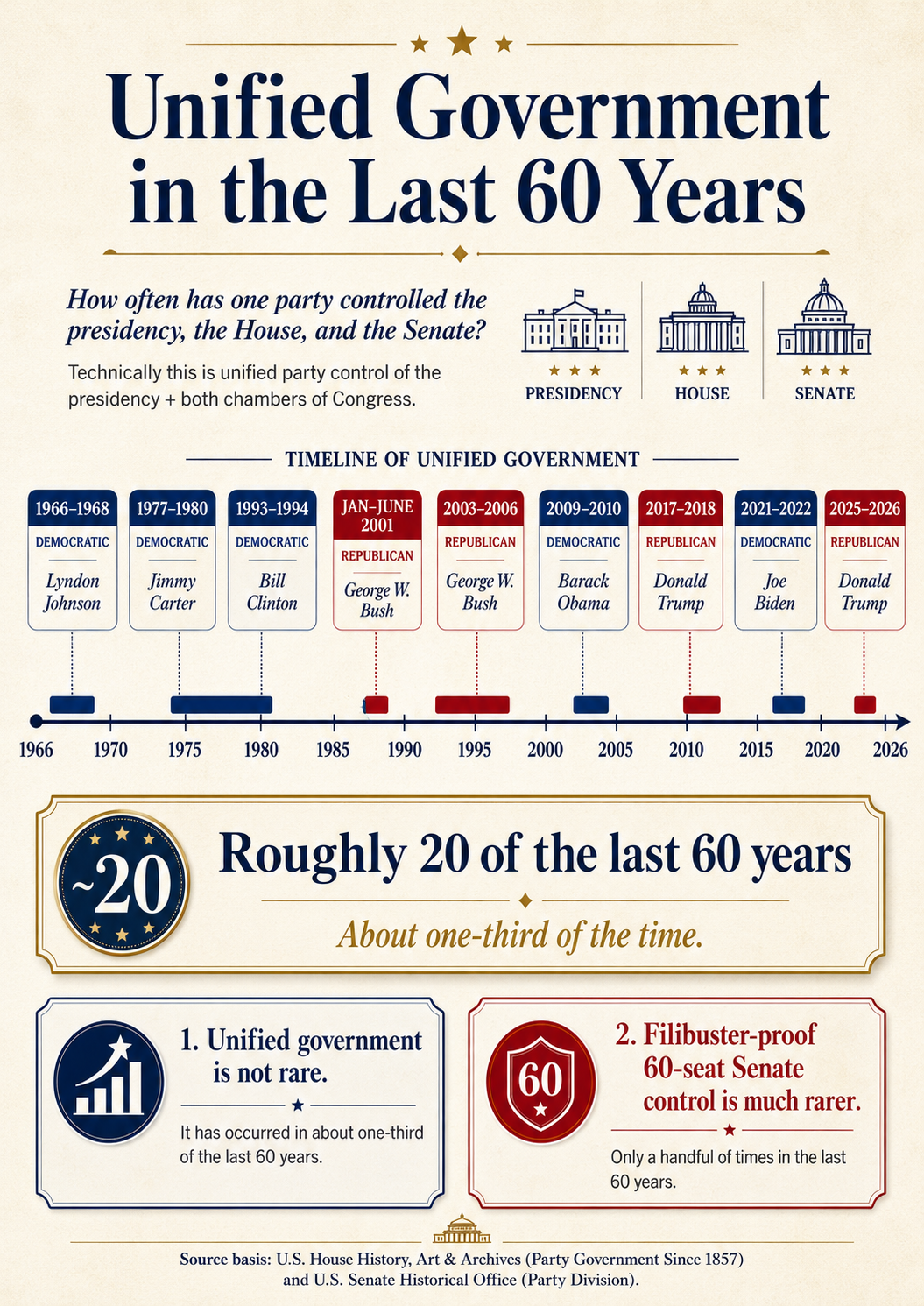
The practical severity of the modern filibuster becomes clearer when we ask how often voters give a single party the presidency, control of the House, and enough senators to overcome a filibuster without opposition-party votes.
Since the Senate adopted the modern three-fifths cloture threshold in 1975, that combination has been extraordinarily rare.
Jimmy Carter began his presidency in 1977 with 61 Democratic senators and a large Democratic House majority. After the 1978 election, Democrats fell below 60 Senate seats. Barack Obama briefly had a 60-member Democratic caucus in 2009 when two Democratic-aligned Independents were included, but that margin was fragile and short-lived. [10]
Bill Clinton began with 57 Democratic senators. George W. Bush’s Republicans peaked at 55. Donald Trump began his first term with 52 Republicans. Joe Biden initially governed with a 50–50 Senate and a vice-presidential tie-breaker. Unified government occurs, but unified government plus a durable 60-seat Senate coalition does not. [10]
That changes what the filibuster really means. It is not merely protection against an overwhelming electoral wave. In most circumstances, it means a party may win the presidency, House, and Senate and still lack the authority to enact contested ordinary legislation without opposition-party support.
Perhaps that is desirable. But it should be defended as such rather than treated as a natural feature of democracy.
The filibuster also operates inside a Senate that is already intentionally non-majoritarian. Wyoming and California receive the same number of senators despite enormous population differences. Only one-third of Senate seats normally face voters every two years. The constitutional structure already creates substantial inertia.
The question is whether another nearly universal 60-vote barrier improves that design or simply adds another veto point.
The ACA and the Difference Between 60 Votes and Consensus
The Affordable Care Act offers a useful test because it appears, at first, to vindicate the 60-vote rule.
The Senate passed its principal ACA bill on December 24, 2009, by 60–39. It was unquestionably consequential, restructuring large portions of American health-insurance policy and the relationship among individuals, employers, insurers, states, and the federal government. [11]
Yet those 60 votes did not produce bipartisan ownership. Every affirmative vote came from the Democratic caucus, including two Independents who caucused with Democrats. No Republican supported final passage.
The ACA therefore demonstrates that a supermajority is not necessarily a bipartisan majority. When one party has all 60 votes, the filibuster forces no cross-party agreement at all.
The law’s later history makes the point even more interesting. In 2017, Republicans controlled the presidency and both chambers of Congress and attempted to dismantle important portions of the ACA. A final “skinny repeal” amendment failed 49–51 when Republican senators Susan Collins, Lisa Murkowski, and John McCain joined the Democratic caucus in opposition. [11]
McCain’s argument was particularly revealing. He was not simply demanding a different vote count. He urged the Senate to return to hearings, committees, amendments, bipartisan negotiation, and what senators call regular order—the ordinary legislative process in which a bill is examined rather than rushed through as a party product.
That may tell us something important. If we want major legislation to have legitimacy and durability, process may matter more than the 60th vote.
The Essential Irony: Lifetime Judges Versus Routine Legislation
The Senate’s treatment of judges makes the current system even harder to explain.
In 2013, Senate Democrats under Majority Leader Harry Reid changed Senate precedent so that executive-branch and lower federal-court nominations could overcome a filibuster by simple majority. Supreme Court nominations were initially excluded. In 2017, Republicans under Mitch McConnell extended the same rule to Supreme Court nominees. [2][12]
The result is a peculiar hierarchy.
A federal judge can be confirmed by a simple majority and may serve for 30 or 40 years. A Supreme Court justice may influence constitutional interpretation for a generation.
Yet a routine statute that can be amended next year may require 60 votes merely to reach a final vote. So may an annual appropriations measure funding ordinary government operations Congress has already authorized.
If supermajority requirements make sense anywhere, one could make a stronger institutional argument for applying them to decisions that are unusually durable and difficult to reverse than to annual funding decisions.
The Constitution itself does not require a judicial supermajority, so the current nomination rules are constitutionally permissible. The point is not that Reid or McConnell violated the Constitution. The irony is that Senate procedure now imposes greater practical resistance on some temporary legislative decisions than on appointments that can last decades.
That does not prove judges should require 60 votes. Perhaps 55 would be enough. Perhaps a higher threshold would simply produce long judicial vacancies. But it raises a useful principle:
The harder a governmental decision is to reverse, the stronger the case for requiring broader agreement.
Our current rules do not consistently follow that principle.
The judicial fight also illustrates a recurring political problem. Democrats changed the rule when Republican obstruction became intolerable. Republicans kept the new precedent and extended it when it served their purposes. Each party fears changing Senate procedure while in power because it knows the opposing party will inherit the same “weapon”.
The legislative filibuster nearly followed that path in 2022. Democrats controlled a 50–50 Senate with Vice President Kamala Harris available to break ties. Most Democrats favored changing Senate rules to advance voting-rights legislation. Joe Manchin and Kyrsten Sinema refused, joining Republicans in preserving the existing rule. [13]
The episode illustrates why procedural reform is so difficult. Senators may recognize weaknesses in a rule while still fearing the consequences of changing it.
The Procedural Maze: Why “Budget” Does Not Always Mean Reconciliation
One of the strangest discoveries in examining the filibuster is how little the required vote sometimes reflects a bill's importance.
Consider federal spending.
An annual appropriations bill funding the Department of Homeland Security, the Coast Guard, TSA, FEMA, or another existing federal function is, in ordinary English, obviously a budget bill. Congress is deciding how much money the agency receives for the coming fiscal year.
Yet an appropriations bill is not automatically a budget-reconciliation bill.
That distinction is confusing because the words sound almost interchangeable.
Budget reconciliation is a special fast-track procedure created by the Congressional Budget Act of 1974. Congress first adopts a budget resolution that directs committees to change federal spending, revenues, or sometimes the debt limit by specified amounts. Those committees then write legislation carrying out those instructions. The resulting reconciliation bill receives special treatment in the Senate: debate is limited, and the bill cannot be filibustered, so it can pass by simple majority. [14]
That is why some extraordinarily consequential tax-and-spending legislation can move through the Senate with 51 votes even though a much less ambitious ordinary bill might require 60 votes for cloture.
Reconciliation has limits. Congress cannot simply label any preferred policy a budget matter and escape the filibuster. That is where the Byrd Rule, named for Senator Robert Byrd, enters the picture.
The Byrd Rule is essentially an anti-piggybacking rule for reconciliation. It allows senators to challenge provisions that are “extraneous” to the bill’s legitimate budgetary purpose. Among other tests, a provision may be vulnerable if it produces no meaningful budgetary effect or if its fiscal consequences are merely incidental to a much larger policy change. If the objection is sustained, the offending provision can be removed. Generally, 60 votes are required to waive the Byrd Rule and keep it. [14]
A simple example helps. Congress might use reconciliation to spend billions on additional border facilities because that directly changes federal spending. It could have much more difficulty using reconciliation to rewrite the legal standard for asylum if the principal purpose of that provision is immigration policy rather than the federal budget.
This produces an odd result. A very large tax-and-spending package may pass with a simple majority because it fits reconciliation. An annual appropriations bill funding ordinary government operations may still be filibustered because appropriations follow a different procedural track.
The voting threshold is therefore not consistently calibrated to the policy's size, importance, or durability.
It often depends on which procedural box the legislation fits into.
That strikes me as one of the strongest practical criticisms of the current system.
Routine Governance Is Not Structural Change
Part of the difficulty may come from treating all legislation alike.
Congress does at least two different things. It keeps the government already established by law operating, and it creates or substantially changes national policy. Those functions need not receive identical procedural treatment.
Routine governance includes the 12 regular annual appropriations measures, clean continuing resolutions, straightforward reauthorizations of existing programs, technical corrections, and limited extensions of existing authority. Requiring 60 votes simply to continue funding government Congress has already created is difficult to defend. A minority may disagree with a particular funding level, but the threat of shutting down existing operations should not become routine leverage merely because the majority cannot assemble 60 senators.
Structural legislation is different. A new federal entitlement, a comprehensive healthcare system, a major national regulatory regime, or a substantial transfer of authority between the states and the federal government can create obligations and dependencies that are difficult to unwind. The ACA is a good example regardless of whether one agrees with the law.
That suggests a straightforward compromise: routine legislation proceeds by majority vote, while genuinely new structural legislation remains subject to a higher threshold. The problem is deciding which is which. Congress is very good at attaching controversial policies to bills that must pass. If routine appropriations became filibuster-proof, lawmakers would have an enormous incentive to piggyback new policies onto them. Lawmakers could attach a sweeping immigration change to Homeland Security funding. Lawmakers could place a new environmental mandate in EPA appropriations. A substantive healthcare provision could be buried in a funding package and described as an adjustment to an existing program.
Any reform therefore needs an anti-piggybacking mechanism.
A Byrd Rule for Routine Legislation
This is where the existing Byrd Rule provides a useful model.
I would not literally apply the reconciliation Byrd Rule to annual appropriations, because its tests are specifically designed for budget reconciliation. I would create a Byrd Rule-like safeguard for legislation placed on a protected majority-vote track.
The concept is fairly simple. A routine bill could fund, administer, renew, or make technical adjustments to existing statutory authority. It could not create a major new federal program, impose a materially new tax, establish new regulatory authority, substantially change eligibility or benefits, or rewrite unrelated substantive law. If a senator believed a provision crossed that line, the senator could raise a point of order. If the challenge were sustained, the offending provision would be stripped from the bill while the routine funding measure continued. Congress could still override that restriction, but doing so might require 60 votes.
Notice how this reverses the present burden.
Today, senators may need 60 votes simply to overcome obstruction and fund existing government.
Under this approach, 51 votes could keep existing government operating, while 60 votes would be required to smuggle major new policy into the protected bill.
That seems much closer to where a supermajority requirement actually belongs.
The distinction would never be perfect. The real Byrd Rule itself produces disputes about what is and is not permissible. But imperfection is not the same thing as dysfunction. Congress already has experience policing special legislative pathways.
Government Shutdowns Should Not Be Bargaining Weapons
A majority-vote pathway for regular appropriations and clean continuing resolutions would also make one source of government shutdowns much harder to exploit. It would not make shutdowns impossible. The House could fail to pass funding. The House and Senate could disagree. A Senate majority itself could reject the proposal. The president could veto it. But a Senate minority could no longer use the filibuster itself to prevent a majority from continuing ordinary government operations.
Congress could go further and adopt an automatic continuing resolution. If lawmakers failed to enact new appropriations by the beginning of the fiscal year, existing funding would temporarily continue at a predetermined level until agreement was reached.
That would not solve the budget process. It might even reduce some pressure on Congress to finish its work on time. But it would establish a sensible default:
If Congress cannot agree on how government should be adjusted for next year, government should temporarily continue operating as it does now.
Federal workers, travelers, contractors, benefit recipients, and the public should not become bargaining chips in a dispute among elected officials.
The Strongest Objection: What If This Produces Chaos?
We should not minimize the strongest argument against ending the general filibuster.
We do not really know what would happen.
The modern United States has never run a controlled experiment in which highly polarized national parties routinely governed the Senate by simple majority across all policy areas. Early American experience is not directly comparable. Political parties were different, senators were not directly elected, and the federal government did far less. Parliamentary democracies operate under different constitutional structures. Budget reconciliation provides only a partial comparison.
A unified government without a filibuster could enact large changes with a narrow Senate majority. A subsequent government might try to repeal them. Tax policy, healthcare, environmental regulation, labor rules, immigration law, and social policy could become more responsive to election results—and potentially less stable.
That risk is real.
Historical evidence shows that elections can produce significant reversals. After Thomas Jefferson’s election, for example, Jeffersonian Republicans repealed the Federalist Judiciary Act of 1801 roughly 13 months after its enactment. [15]
But the phrase policy whiplash can also exaggerate the speed of the process. Presidents serve four-year terms. Senate seats are staggered. Unified government frequently disappears at midterm elections. Major programs develop beneficiaries, administrative structures, contracts, and political constituencies that make wholesale repeal difficult.
More importantly, keeping the filibuster also has consequences. Nonaction may allow serious problems to continue. Legislative paralysis encourages presidents to substitute executive action for statutes. Agencies are asked to stretch old laws. Courts are drawn into policy disputes Congress has failed to settle. Voters may reasonably wonder why winning elections so often changes who occupies office without changing what government can actually do.
Eliminating the filibuster would not eliminate the constitutional system. A bill would still have to pass the House and Senate, receive presidential approval or overcome a veto, comply with constitutional limits, and operate within a federal system containing powerful state governments. Courts, staggered elections, the Bill of Rights, and the Constitution’s explicit supermajority requirements would remain.
The choice is not between the filibuster and chaos.
It is between two judgments about how much additional restraint ordinary legislation requires.
Uncertainty argues for humility. It does not automatically argue for preserving the status quo.
Regular Order May Matter More Than the 60th Vote
If the goal is to prevent narrow majorities from casually restructuring national policy, there may be better tools than an indefinite minority veto.
Major structural legislation could be required to receive public committee hearings, recorded committee votes, independent fiscal analysis where appropriate, publication of final legislative text for a defined period before the vote, and meaningful opportunities for the minority to offer germane amendments.
Debate could be extensive without being endless.
Those procedures would not guarantee wise legislation. Nothing can. But they would force a majority to expose its proposal to scrutiny, defend it publicly, respond to criticism, and consider alternatives.
That is closer to what John McCain was arguing during the 2017 healthcare debate. His concern was not simply that Republicans lacked 60 votes. It was that legislation affecting a huge portion of American life deserved hearings, amendments, committee consideration, and bipartisan engagement.
A final vote could still be decided by majority after that process. Elections would have consequences, but governing would remain deliberately difficult.
For a narrow category of unusually durable decisions, a modest supermajority—perhaps 55 votes—might still be defensible. Lifetime Article III judges are an obvious candidate for that discussion. But I would resist recreating another general threshold merely because 55 sounds more moderate than 60.
The stronger principle is to match the restraint to the decision.
What I Would Change
I would end the general legislative filibuster, but I would not replace it with unconstrained majority rule.
Ordinary legislation should ultimately be capable of reaching a final Senate vote by simple majority after a defined period of debate. The minority should have guaranteed opportunities to debate, offer germane amendments, demand recorded votes, and appeal to the public. It should have substantial power to delay and expose legislation—but not an indefinite power to prevent a vote.
Regular appropriations, clean continuing resolutions, routine reauthorizations, and technical corrections should receive explicit majority-vote protection. A Byrd Rule-like procedure should strip major new policy from those protected bills unless a supermajority agrees to waive the restriction.
Congress should seriously consider an automatic continuing resolution so that failure to reach a new budget agreement does not shut down existing government operations.
Major structural legislation should face stronger procedural requirements: real committee consideration, public hearings, fiscal and regulatory analysis when appropriate, sufficient time to review final text, and meaningful minority amendments. If Congress ultimately chooses to retain a modest supermajority requirement for a very narrow category of exceptionally durable decisions, it should define those categories in advance and apply them symmetrically to enactment and repeal.
And the Senate should reconsider the peculiar treatment of lifetime judicial appointments. I am not certain that 55 votes is the correct answer. But if we are going to demand unusually broad agreement somewhere, a decision that may shape constitutional law for several decades deserves at least as much scrutiny as next year’s appropriations bill.
This framework would not eliminate partisan conflict, foolish legislation, or political reversals. No rule can accomplish that.
It would put responsibility more clearly where elections place it. The majority would possess the authority to govern after satisfying meaningful constitutional and procedural requirements. The minority would possess substantial power to challenge, debate, amend, delay, investigate, and persuade—but not to veto ordinary legislation indefinitely.
Conclusion: Giving the Constitutional Design More Credit
I began this inquiry believing that the filibuster was probably a necessary evil. A narrowly elected majority should not be able to reshape national policy casually, and a divided country benefits from institutions that slow political enthusiasm and force competing interests to confront one another.
But the more carefully I have examined the modern filibuster, the harder it becomes to defend.
The Founders did not design it. It developed gradually from an unintended procedural opening and eventually became something approaching a routine 60-vote requirement. Its most troubling historical use was not protecting powerless minorities but obstructing federal protection of civil rights. Its compromises are not necessarily wise, and its nonaction is not necessarily harmless. The electorate almost never produces the 60-seat governing coalition needed to overcome it without minority-party cooperation.
And the procedural system surrounding it is remarkably inconsistent. Enormous tax-and-spending packages may pass with a simple majority through budget reconciliation. Lifetime judges may be confirmed with a simple majority. Yet an ordinary appropriations bill funding government already authorized by Congress may face a 60-vote cloture hurdle.
That is difficult to defend as a coherent theory of democratic restraint.
Most importantly, the Constitution already contains extensive safeguards against narrow and impulsive majorities. It divides legislative authority between two chambers, staggers Senate terms, gives every state equal representation in the Senate, empowers the presidential veto, preserves state authority, creates an independent judiciary, and expressly requires supermajorities for decisions the Framers considered exceptional.
Hamilton and Madison understood the danger of majority excess. They also understood the danger of allowing a minority to make government incapable of acting. Their solution was structural restraint surrounding majority decision—not a standing minority veto over ordinary legislation.
Abolishing the modern filibuster would involve uncertainty. It could produce more partisan legislation and greater policy volatility. Anyone arguing for change should acknowledge those risks. But preserving the filibuster is also a decision made under uncertainty. It assumes that nonaction, procedural workarounds, executive substitution, government-shutdown brinkmanship, and compromises constructed merely to reach 60 votes are preferable to allowing an elected majority to govern.
I am no longer convinced that assumption is justified.
The better course is to end the blanket legislative filibuster while preserving strong debate, minority participation, regular order, safeguards against piggybacking, and heightened scrutiny where decisions are genuinely structural or unusually difficult to reverse.
That is not an abandonment of constitutional restraint. It is an attempt to put restraint where it belongs.
The Founders did not expect government to move quickly or effortlessly. But they also did not require an electoral result that modern America almost never produces before ordinary legislation could pass.
Perhaps the strongest case for ending the filibuster is not that the Constitution contains too much friction.
It is that the Constitution may already contain enough.
References
Sarah A. Binder, “The History of the Filibuster,” testimony before the Senate Committee on Rules and Administration, Brookings Institution, April 22, 2010.
Brookings InstitutionU.S. Senate Historical Office, “About Filibusters and Cloture: Historical Overview.”
U.S. SenateNational Constitution Center, “Filibustering in the Modern Senate,” including discussion of the two-track procedure and the evolution of the modern filibuster.
National Constitution CenterU.S. Senate, “Senate Action on Cloture Motions,” historical table of motions filed, cloture votes, and cloture invoked.
U.S. SenateAlexander Hamilton, Federalist No. 22, December 14, 1787.
Avalon Project, Yale Law SchoolJames Madison, Federalist No. 58, February 20, 1788.
Avalon Project, Yale Law SchoolNational Archives, “The Constitution of the United States: A Transcription,” including Articles I, II, III, and V.
National ArchivesU.S. Senate, “Cloture and Final Passage of the Civil Rights Act of 1964.”
U.S. SenateU.S. Senate roll-call records: Manchin Amendment No. 715, April 17, 2013, 54–46; DREAM Act cloture vote, December 18, 2010, 55–41; and DISCLOSE Act cloture vote, September 23, 2010, 59–39.
Manchin Amendment VoteU.S. Senate Historical Office, “Party Division”; U.S. House of Representatives Office of the Historian, “Party Government Since 1857.”
U.S. Senate Party DivisionU.S. Senate roll-call records: final Senate passage of the Patient Protection and Affordable Care Act, December 24, 2009, 60–39; and the July 28, 2017 healthcare amendment vote, 49–51.
ACA Senate Passage
2017 Healthcare VoteU.S. Senate Historical Office, “About Judicial Nominations: Historical Overview,” including changes to cloture rules governing nominations.
U.S. SenateU.S. Senate roll-call vote of January 19, 2022, sustaining the chair’s ruling, 52–48.
U.S. SenateU.S. Senate Committee on the Budget, materials on reconciliation and the Byrd Rule; U.S. Senate Committee on Appropriations, “The Budget Process”; and U.S. Government Accountability Office, Appropriations: Continuing Resolutions and an Assessment of Automatic Funding Approaches.
Senate Budget Committee
Senate Appropriations Committee
Government Accountability OfficeFederal Judicial Center, “The Judiciary Act of 1801,” including the 1802 repeal of the Federalist court reorganization.
Federal Judicial Center
