
Choosing candidates in an age of labels, powerful advertising, and imperfect choices
In Brief
Political campaigns give us plenty of reasons to dislike someone. They are less reliable at helping us decide who would govern well. Labels such as woke, socialist, RINO, and extremist can deliver an entire judgment before we examine a single position. A memorable advertisement can make one position seem sufficient to settle an election. Sometimes, for a particular voter, it is.
But we buy the whole package when we vote. Our choice carries consequences beyond the issue that first attracted or offended us. A more considered approach begins with our priorities, examines candidates’ records and proposals, and acknowledges the tradeoffs. I would like to think I vote that way: on balance, for things that matter to me and that I believe matter to our country. I also know I am not always right. That's why I keep examining my choices after the election.
The Campaign Ad and the Unanswered Question
Recently, I asked my wife whether she understood what the word “woke” meant. She is a smart physician. She grumbled something and walked away. I cannot say whether that reflected irritation with the word, the subject, or her husband. But the “exchange” stayed with me. Political language has become something we are expected to recognize immediately, react to appropriately, and rarely pause to define. Watch a few campaign advertisements, and you can see the problem. A candidate is woke. Another is an extremist. Someone is a socialist, a Washington insider, or a Republican in name only.
Here in Colorado Springs, the congressional contest between Republican Jeff Crank and Democrat Jessica Killin offers a local example. An outside group describes Killin as a “wealthy liberal lobbyist.” Her campaign has attacked Crank over an ethics waiver using the phrase “lobbyist buddies.” Both dispute the attacks against them. There may be something worth investigating in either case. But the adjectives have already done much of the work. We have been invited to distrust someone before learning exactly what happened.
The details matter. Crank’s waiver concerned his daughter’s wedding; his campaign says no lobbyists attended or gave gifts. The attack against Killin connected her husband’s financial-services work to companies using data centers. Those details give voters something to investigate. Did Crank use his office to benefit someone connected to the wedding? Did Killin have any role in the data-center projects raised in the advertisement? The connections described in the ads do not, on their own, answer those questions.
What should a busy voter do with an accusation like this? Start with one credible local report that examines the claim and includes the candidate’s response. Look for what the reporting actually establishes beyond the connection suggested by the ad. If the accusation concerns something important to your decision, follow the supporting evidence a little further. If it remains unresolved, leave it unresolved. You do not have to reach a verdict on every campaign accusation. Then return to the larger question: what does the available record tell you about this person’s judgment, priorities, and ability to do the job?
Most of us have neither the time nor the appetite to become full-time political researchers. However, we should still be able to explain why we are giving someone the authority to act on our behalf.
What Matters to Americans—and Who Gets to Ask?
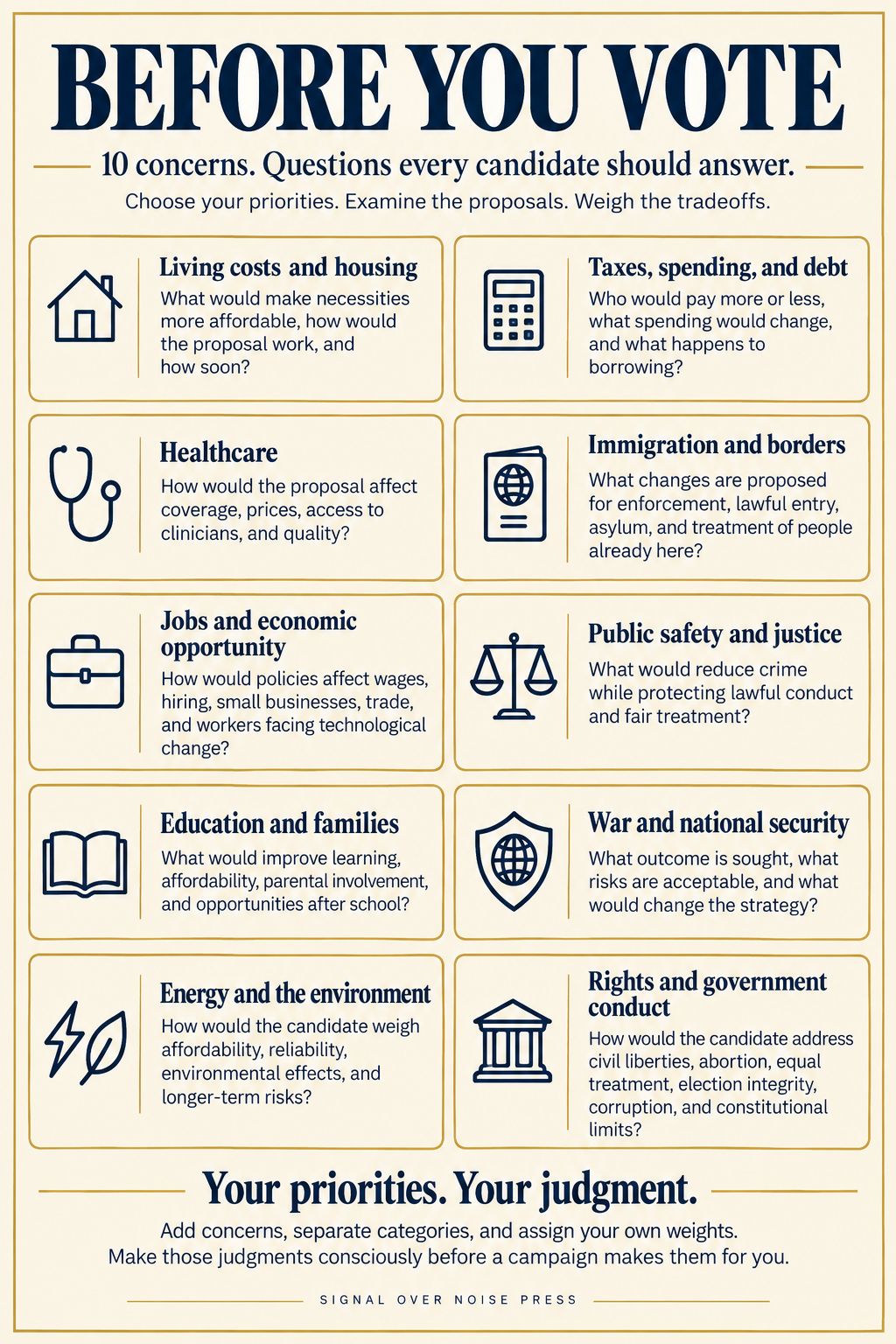
Before evaluating candidates, it helps to identify what we want our government to address. The familiar list includes living costs, taxes, healthcare, immigration, jobs, education, public safety, and foreign affairs (in particular, military action). But “the concerns of average Americans” can be a slippery slope. No single average American has priorities that satisfy everyone else.
Polling helps, provided we understand what was asked. An Associated Press–NORC poll conducted in December 2025 asked adults to name up to five problems they wanted government to address in 2026. Among respondents who named at least one problem, 44 percent mentioned immigration. Across its economic questions, the survey also found substantial attention to living costs, housing, jobs, and healthcare. These were priorities expressed at that time, not a current measure of attitudes in light of the recent Iran conflict.
A July 2026 a Pew survey asked about selected economic concerns. Sixty-nine percent were very concerned about healthcare costs, 66 percent about food and consumer goods, and 64 percent about housing. Immigration was absent from that chart because the questions focused on a specific set of economic issues.
Those surveys measured different things. Naming an issue without prompting is different from rating its importance after someone puts it before you. Neither approach is free of choices about wording, timing, categories, and interpretation. Even agreement that an issue matters does not establish agreement about what to do. Someone naming immigration may want tighter border enforcement. Another may be concerned about deportation practices. A third may want a more workable legal immigration system.
The wording becomes especially consequential when questions mix objectives and methods. Asking whether Americans favor preventing Iran from obtaining a nuclear weapon is different from asking whether they favor continuing a military conflict. A person could support the objective and oppose the means—or support military action only under particular conditions.
Most of us have jobs, families, and better things to do than spend hours sorting through campaign claims. You do not need to research every issue below. Start with the two or three that matter most to you, and use these questions to look for clear answers from the candidates. Then quickly scan the rest for anything you would find difficult to accept. A little focused homework can help you make a choice you understand—including the tradeoffs that come with it.
What The Labels Are Asking Us to Believe
Consider “woke.” One person uses it to describe awareness of unfair treatment. Another means ideological conformity, racial preferences, or intolerance of dissent. Two people using the same word may barely be discussing the same thing. The practical question is which policy or behavior is at issue. Calling the rubric “woke” does little to resolve the disagreement. Reading its criteria gives us something to judge.
If the dispute concerns diversity, equity, and inclusion, ask about the program. Does it broaden recruitment? Change selection criteria? Require particular statements of belief? What evidence shows whether it works? A person can favor equal opportunity and question a specific DEI practice.
UC Berkeley’s 2018 faculty-hiring guidelines offer a concrete example. Applicants could receive low scores for questioning whether groups organized around a shared identity, such as race or ethnicity, might leave students feeling more separated. Simply promising to mentor students and treat them equally also earned a low score in the section on future plans; applicants were expected to propose additional DEI activities.
A university may reasonably favor applicants whose approach fits its educational goals. But that preference should support its central mission: teaching well and giving students opportunities to learn. The concern arises when agreement with a preferred DEI approach carries more weight than a candidate’s subject knowledge, teaching ability, and record of helping students succeed. Applicants may disagree about the best methods while sharing a strong commitment to their students. In March 2025, the University of California directed its campuses to stop requiring diversity statements from applicants for new positions. The policy changed, but the example still raises a useful question: how should a university weigh its preferred approaches against an applicant’s ability to teach and help students succeed?
“RINO,” meaning Republican in Name Only, raises a different question: who is allowed to belong? The label may identify a departure from a stated principle. It may also punish disagreement with party leadership. For example, Liz Cheney voted for Trump’s 2017 tax legislation and for his impeachment in January 2021. Trump subsequently called her a RINO. Those are distinct facts: support for a major Republican policy, a judgment about presidential conduct, and an accusation of disloyalty.
A Republican voter could agree with Cheney’s tax vote and disagree with her impeachment vote—or the reverse. Calling her a “RINO” hides those distinctions. Political labels make complicated people seem simple, encouraging us to accept or reject the category before examining the person. We are all susceptible to that shortcut, especially when the label confirms something we already believe. I include myself.
Likewise, “MAGA extremist” requires an explanation. Does the criticism concern a tax proposal, an immigration practice, rejecting an election result, or disregarding a constitutional limit? Those are different matters, and a candidate’s position on one does not establish a position on all the others. Someone may support Trump’s economic policies while objecting to his conduct, or favor stronger border enforcement while opposing particular methods. The label bundles those distinctions into a single judgment. For someone who already dislikes Trump, it may feel like enough information. Instead, ask what the candidate actually said or did, then decide whether it warrants the criticism. A serious accusation deserves specific evidence, regardless of whom it targets.
“Socialist” also needs unpacking. Socialism concerns social or public ownership and control of major parts of the economy. The Democratic Socialists of America explicitly advocates replacing capitalism. That is a position voters should examine seriously. But it does not describe everyone who votes Democratic; the party’s 2024 platform also supported private enterprise, competition, and investment.
The useful question is what a particular candidate proposes. Bernie Sanders’s 2023 Medicare for All bill, for example, would replace much private health insurance with a federal program and prohibit private policies duplicating its benefits. That is a major change deserving scrutiny. What taxes would replace premiums? How would doctors and hospitals be paid? What would happen to access and patient choice?
Calling the proposal “socialist” does not answer those questions. Calling healthcare “a human right” does not answer them either. Voters need to understand how the proposal would work and what tradeoffs it would require.
Political labeling has a long history, as I explored in And You Think It Is Bad Now… In the election of 1800, John Adams was labeled a monarchist, Thomas Jefferson an atheist, and both were portrayed as enemies of the Constitution. These accusations targeted men we now remember as central figures in the country's founding.
The distance of history makes it easier to see what those labels left out. It is harder when the candidate is on today’s ballot, and the accusation fits what we already believe. That history should make us pause. A label can tell us a great deal about how opponents want someone perceived while telling us surprisingly little about how that person would govern.
Labels become useful when they lead us to the evidence. They become obstacles when they finish the conversation.
When An Ad Defines a Candidate
Some advertisements give voters a specific position that becomes a judgment about the whole candidate. Trump’s 2024 advertisement featuring Kamala Harris’s comments about gender-transition care for prisoners is one example. It used footage from a 2019 interview and closed with the line: “Kamala is for they/them. President Trump is for you.”
The position behind the advertisement was real. In her 2019 ACLU questionnaire, Harris supported government-provided gender-transition treatment, including surgery, for federal prisoners and detainees on the grounds of medical necessity. She also described efforts to make such treatment available in California prisons. That was her stated rationale; voters could question both that rationale and the policy itself.
For some viewers, the position may have been enough to rule her out. They saw a commitment fundamentally at odds with their beliefs about appropriate care, public spending, or government responsibility. The advertisement gave those voters something more concrete than a label: a position expressed in the candidate’s own words. Whether they considered it decisive was their judgment to make, and it required weighing the alternative’s full package as well.
To my ear, the advertisement invited voters to draw a larger conclusion about Harris’s beliefs, priorities, and judgment. For someone who found the policy fundamentally objectionable, debating the advertisement’s fairness might have changed little. Another voter could view her position as a reasonable approach to care in government custody. The ad’s memorability does not establish how much it affected the election, but it illustrates something a list of top concerns can miss: an issue need not dominate someone’s daily life to determine whether a candidate earns that person’s vote.
Voters have priorities, but they also have boundaries. A position on abortion, constitutional conduct, immigration, or public spending may be enough to rule a candidate out—even when the voter understands it accurately. That judgment deserves respect. It also carries a responsibility: if one position settles the choice, we still need to examine everything else that comes with the candidate we choose.
You Buy The Whole Package
A vote does not mean endorsing everything a candidate believes. It does, however, place that person in a position to exercise the full authority of the office. The candidate’s other policies come with the choice. So do judgment, conduct, appointments where applicable, and decisions about problems that have not yet appeared. One issue may be enough to rule someone out. But the alternative still needs examination. What else are we authorizing? Which weaknesses are we accepting? What consequences might follow for people whose circumstances differ from our own?
This is how I would like to think I vote: on balance, for the things that matter most to me, while asking whether they also serve the country. Those interests can align. They are not automatically identical. I also know I am not always right. That admission leaves room to revise a judgment when results disappoint, or new evidence appears. Voting for someone creates no obligation to defend every decision. Nor does voting against someone require denying that the person has done something worthwhile. The standard should be consistent enough to survive a change in party names.
Opposition Still Needs An Affirmative Case
Some voters will choose primarily to restrain Trump. A judgment about presidential conduct, constitutional limits, or a particular policy can reasonably outweigh other concerns. But opposition does not complete the case for the alternative.
The Democrats’ 2024 presidential campaign provides a useful example. The Wall Street Journal reported that Future Forward, the main pro-Harris super PAC, warned Democratic allies in October: “Our task remains more about Harris than Trump.” It urged them to explain specifically how her presidency would improve voters’ lives. Democrats had proposals on housing, healthcare, taxation, and other issues. My concern is the emphasis: repeated warnings about an opponent can crowd out an explanation of what a candidate would actually do, why it would work, and how it would be paid for.
Concerns about presidential conduct are substantive. Voters should also expect answers about the ordinary responsibilities of governing. The same obligation applies to Republicans. Calling an opponent socialist does not demonstrate that a Republican tax plan is fiscally sound. Criticizing regulation does not establish that the proposed replacement protects the public. Supporting Trump’s general direction does not make every decision wise. Each candidate owes voters a case for being entrusted with power.
Citizenship, Verification, and the Right to Vote
U.S. citizenship is required by federal law to vote in federal elections. It is not optional. Making sure voters meet that requirement should be a basic, uncontroversial responsibility of the officials who run our elections. Americans should understand what evidence establishes citizenship, how officials verify it, and why the process deserves their trust.
That expectation also has broad public support. In Gallup’s October 2024 survey, 84 percent favored requiring photo identification to vote, and 83 percent favored proof of citizenship when registering for the first time. Interestingly, the same survey found 76 percent support for early voting. Many Americans evidently want dependable verification alongside convenient access. Those answers do not establish support for every provision of a voting bill, but they provide a useful starting point.
Verifying who someone is and verifying that they are a U.S. citizen are two different things. An address helps establish residence; a photo ID helps establish identity. However, neither necessarily establishes citizenship. The standard national voter-registration application requires applicants to declare, under penalty of perjury, that they are U.S. citizens. Signing that declaration makes an applicant legally accountable for a false claim. But the signature itself does not establish that the claim is true. That requires checking reliable documents or records, and the additional checks used vary by state.
How would officials discover a false declaration? They can compare registration information with motor-vehicle records, immigration records, and other authorized sources that may reveal a discrepancy. Electronic screening allows large numbers of records to be checked, with individual investigation focused on cases requiring clarification. But the usefulness of those checks depends on the records’ accuracy and completeness, the ability to match them correctly, and the resources available for follow-up. An outdated record may flag someone who has become a citizen; a missing record may leave a false claim undetected. “No discrepancy found” is not always the same as “citizenship independently confirmed.”
The number of noncitizens living in the United States makes this a substantial administrative responsibility. Their presence does not establish that they are registering or voting unlawfully. Nevertheless, voters deserve a clear explanation of how the system distinguishes eligible voters from ineligible ones. Penalties deter, while dependable verification can prevent an ineligible registration before a ballot is cast. A credible system needs both.
The SAVE America Act, passed by the House in February 2026, would require documentary proof of citizenship for registration and photo identification for voting in federal elections. It remains a proposed bill, not law. The next section examines how it would work, including its potential benefits and practical challenges. Supporting reliable citizenship verification does not require endorsing every provision of this bill. Opposing its approach should come with a clear explanation of how citizenship would otherwise be reliably established.
Documented instances of noncitizen voting are rare, but require context. Audits have uncovered unlawful votes, and their ability to detect additional cases depends on their methods and coverage. A voter can reasonably ask, “How thoroughly are we checking?” A low number of detected cases is meaningful evidence; it is not a guarantee that every case has been found. Equally, the possibility of missed cases does not establish widespread abuse. Claims about scale require evidence.
Election officials should make the process and its results understandable. Are all registration records screened, or only selected cases? What happens when available records cannot establish citizenship? How many noncitizen registrations were confirmed, how many of those individuals actually voted, and how many cases remain unresolved? How often were eligible citizens mistakenly flagged? Reporting these findings in aggregate would help the public assess performance while protecting personal information.
A sound system must also give eligible citizens a practical way to meet the requirement. Where reliable government records already establish citizenship, officials should use them efficiently. Where additional documentation is needed, the instructions should be clear and the documents reasonably accessible and affordable. A lost birth certificate, a name change, or an incomplete record creates a problem to resolve; it does not determine someone’s citizenship. The standard should remain firm, and the means of meeting it should be workable.
Where does “Jim Crow 2.0” fit? Jim Crow involved systematic racial subordination. Poll taxes, literacy tests, discriminatory administration, and intimidation were used to deny Black citizens their voting rights. That history supplies a serious warning about how election rules can be abused. But the label does not establish that citizenship verification itself is equivalent to that system. Anyone making the comparison should identify the particular provision, explain how it unjustifiably excludes eligible citizens, and support that claim with evidence. Proponents, in turn, should demonstrate that their safeguards establish eligibility accurately and address avoidable barriers.
My standard is straightforward: citizenship must be reliably established, eligible citizens must have a practical way to establish it, and errors must be corrected before they cost someone a lawful vote. A credible system must account for both failures, allowing an ineligible person to vote and wrongly preventing an eligible citizen from doing so. Public confidence should rest on a process people can understand and results they can examine.
What Would the SAVE America Act Actually Require?
Establishing citizenship should be straightforward and trustworthy. Deciding whether a particular bill establishes it accurately and fairly requires a closer look. The SAVE America Act passed by the House in February 2026 would change both registration and voting in federal elections. Here is what its requirements would mean in practice.
Registering would require evidence of citizenship. A valid U.S. passport would qualify. Another common route would be a government-issued photo ID paired with a qualifying certified birth certificate or naturalization document. The bill also accepts certain other records. An ordinary driver’s license would not, by itself, establish citizenship. Even a REAL ID would qualify on its own only if it indicated U.S. citizenship. The requirement would apply to registration applications submitted after enactment; it would not automatically require every existing voter to register again.
Missing documents or a changed name would not automatically disqualify someone. The bill requires states to establish an alternative process for applicants without the listed citizenship documents. An applicant would provide a sworn declaration and other evidence; an election official would have to determine that the evidence establishes citizenship and sign an affidavit explaining that determination. For a name discrepancy, the bill expressly allows additional documentation or a signed affidavit attesting to the previous name. Voters would need clear instructions, and officials would need consistent standards for deciding what evidence is sufficient.
Registration by mail would involve an additional trip. Applicants using the federal mail registration form would have to present citizenship evidence in person by the registration deadline, or at the polling place where same-day registration is available. That could be manageable for someone living near an election office and more demanding for someone with limited transportation, inflexible work hours, or a long distance to travel. The Bipartisan Policy Center also identifies uncertainty about how the bill’s documentary requirement would operate through online registration.
Existing voter rolls would also be checked. The bill directs states to take affirmative steps within 30 days to identify noncitizens on their rolls, including submitting the statewide voter list for comparison with the Department of Homeland Security’s SAVE verification system. Before removing someone identified as a noncitizen through that process, officials would have to provide notice and an opportunity to present citizenship evidence. This addresses a question voters reasonably ask: who actually checks? But a database comparison is only as dependable as its records and matching procedures. A disputed result needs resolution, particularly when someone has become a citizen since an older record was created.
Casting a ballot would require a separate identity check. In-person voters would generally need a valid physical photo ID from the bill’s approved list, including a driver’s license, motor-vehicle-agency identification card, U.S. passport, military ID, or qualifying tribal ID. Someone arriving without it could cast a provisional ballot but would generally have to provide the required ID within three days for that ballot to count. The bill provides a limited affidavit exception for religious objections to being photographed.
For mail voting, voters would generally submit a copy of an approved photo ID with their ballot. Those unable to obtain a copy after reasonable efforts could instead provide the last four digits of their Social Security number and a sworn statement explaining the omission. The bill includes specified exceptions, including for absent uniformed-services voters, and calls for free public access to copying equipment in government buildings where practicable.
The potential benefit is a more explicit, enforceable verification process. Citizenship evidence at registration, checks of existing rolls, and identification when voting would create several opportunities to detect ineligible participation. Supporters can reasonably argue that eligibility should be established before a ballot is cast, rather than relying primarily on penalties afterward.
The practical concerns are access, accuracy, and execution. Eligible citizens may face document costs, travel, processing delays, or mistaken database matches. The alternative procedures could help, but their usefulness would depend on whether ordinary people could navigate them in time. The House text would take effect immediately and provide no dedicated implementation funding—raising legitimate questions about training, staffing, public instructions, and readiness.
My standard remains firm: citizenship must be reliably established. Proponents should explain how this system would improve verification and keep eligible citizens from falling through administrative cracks. Opponents should explain what dependable alternative they would put in its place. Americans deserve more than assurances from either side. They deserve a process that establishes eligibility, corrects mistakes, and produces results the public can examine.
What Can Candidates Actually Deliver?
Campaign promises face a high hurdle: winning an election does not necessarily give a candidate the power to deliver them. Voters should ask what would have to happen for a proposal to become law, and whether there is a plausible path to getting there.
That hurdle is especially high for Democrats promising major policy changes in this midterm election. Under the ordinary constitutional timetable, Trump will remain president. A Democratic House could block legislation, investigate executive actions, and use spending negotiations to seek concessions. A Democratic Senate could also approve or reject presidential nominees. Those are substantial powers. But enacting a new Democratic legislative agenda would generally require agreement between both chambers and a Republican president, or enough votes to override his veto. Winning congressional control would create opportunities for restraint and negotiation; it would not give Democrats unrestricted authority to carry out their platform.
Continued Republican control would give Trump’s legislative agenda a more favorable route, but Republican promises deserve the same scrutiny. Narrow majorities, internal disagreements, Senate procedures, and competing spending priorities can defeat proposals even when one party controls Congress and the presidency. Candidates should explain which promises have a workable route to enactment, which would require compromise, and which are longer-term goals.
The practical question is: What can you realistically accomplish in the office you seek, and whose cooperation will you need? A candidate running to restrain the president should explain which actions warrant restraint. A candidate running to advance their agenda should identify the measures worth advancing and the compromises needed to pass them. Opposition and support become more useful to voters when attached to specific decisions.
That test applies closer to home, too. Congressional candidates may talk at length about schools, housing, or a proposed data center. Ask which decisions Congress can actually make, what federal funding or legislation could influence, and what remains under state or local control. A persuasive promise should come with a credible explanation of how the candidate could deliver it.
Compare Party Governing Records
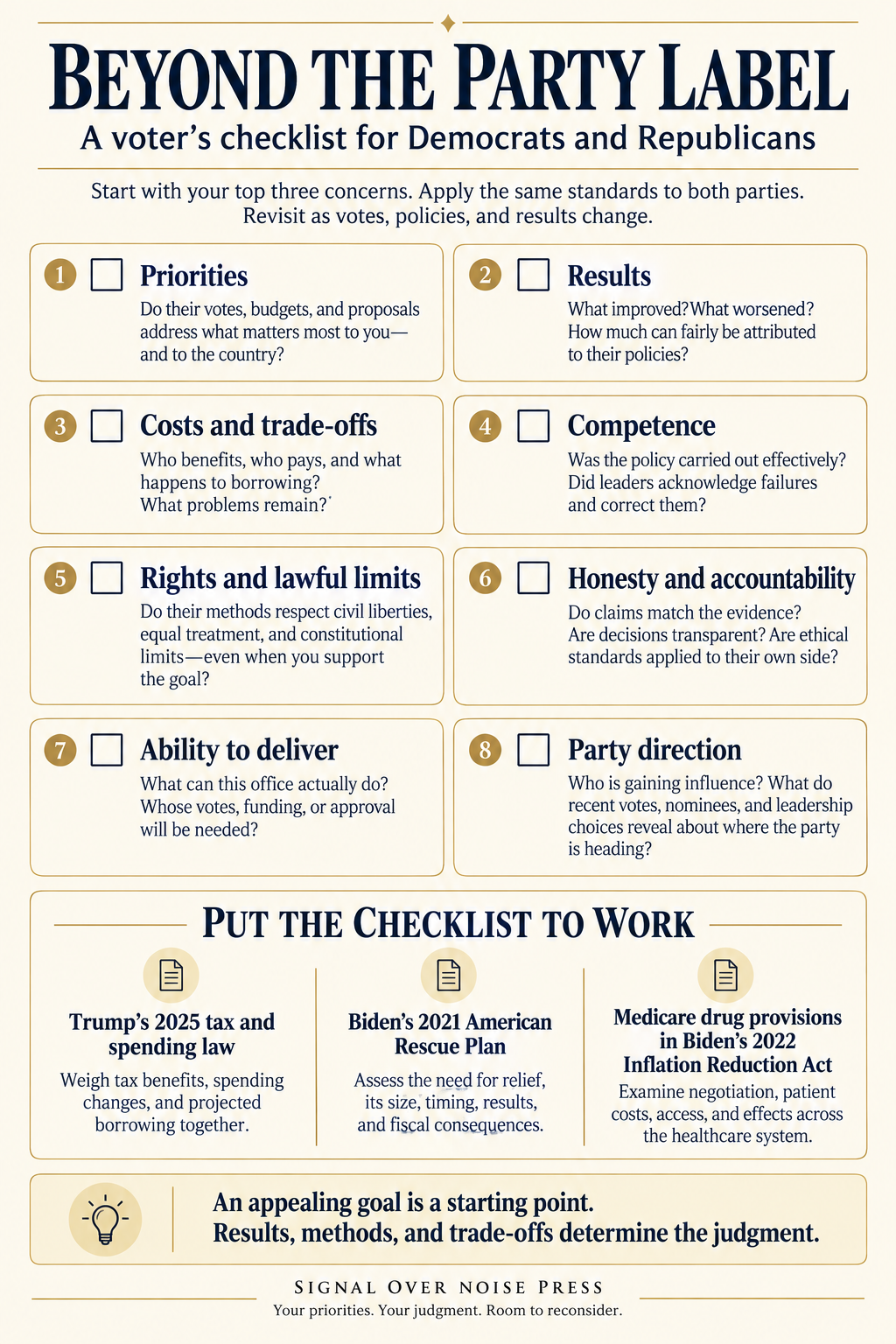
Trump and Biden offer records that help us understand competing approaches. The comparison is imperfect because Trump’s first term, Biden’s completed term, and Trump’s ongoing second term cover different circumstances. A pandemic, a war, interest rates, and decisions by Congress or the Federal Reserve cannot all be credited or charged to one president. For each issue, ask what the administration did, what followed, and how strong the evidence is that the policy produced the result. You do not need to research every issue to vote thoughtfully. Start with the two or three that matter most to you, then apply the same questions to both parties. Look at their records, who is shaping their priorities, and what they could realistically deliver next. Leave room for an honest “not enough evidence yet.”
Iran Requires An Actual Plan About What Happens Next
Iran brings several questions into sharp focus. Military decisions affect American service members, civilians in the region, allies, shipping, and household budgets. The consequences are too serious for an answer that stops at approval or disapproval of Trump. Whether the war should have begun remains relevant to judgment and accountability. But “I would not have started it” leaves the immediate question unanswered. We are entitled to ask what a candidate would do given the situation that exists now.
Supporters of continued military pressure should identify the objective and explain how further action is expected to achieve it. Preventing a nuclear weapon, protecting shipping, and changing the Iranian government’s behavior are related concerns. They are not interchangeable definitions of success. What conditions would justify ending operations? What costs and risks are acceptable? What would lead the candidate to conclude that the strategy was failing?
Advocates of withdrawal or negotiation should explain the terms they would seek, the pressures they would maintain, and how they would address remaining threats. Negotiation requires a position on what is acceptable and how compliance would be assessed. Withdrawal requires an account of what follows it.
A congressional candidate need not publish military plans or pretend to possess classified information. The candidate should be able to explain a position on authorization, funding, oversight, and the conditions for continued American involvement. “End the war” requires more than a promise of relief. “Finish the job” requires more than confidence that further fighting will produce a durable result. Voters deserve to understand the risks a candidate would accept in pursuing either course.
Someone Needs To Get Serious About The Deficit
The annual deficit is the gap between what the federal government spends and collects. The debt reflects accumulated borrowing. Reducing a deficit can slow debt growth while leaving the debt itself higher. Those distinctions are pivotal because fiscal language is remarkably forgiving of fiscal behavior. A candidate can celebrate a tax cut, defend a new benefit, protect favored spending, and promise to control the debt without explaining how the commitments affect the deficit.
In its July 2025 conventional estimate, CBO projected that the 2025 tax and spending law would increase cumulative deficits by $3.4 trillion over 2025–2034 relative to its specified January 2025 baseline. It projected about $1.1 trillion less direct spending and $4.5 trillion less revenue. Spending reductions did not make the overall package deficit-reducing against that baseline. Bear in mind these are projections.
Biden’s American Rescue Plan also warrants examination. CBO’s final March 2021 estimate put the additional deficits from that legislation at roughly $1.9 trillion. Its purposes, time horizon, and economic circumstances differed from those of the 2025 law. The figures are therefore examples of consequential choices, not complete presidential scorecards.
Borrowing can be justified during an emergency or for an investment with substantial benefits. Even then, voters should ask how much is necessary, whether the program works, and how long the commitment will last.
A serious fiscal proposal names the spending changes, the revenue changes, and the period over which improvement should occur. It explains assumptions about growth and interest costs. It addresses major obligations rather than implying that every difficult choice can be avoided by finding waste. One useful question is which popular promise the candidate is willing to modify to make the arithmetic work.
A Local Report Card That Leaves Room For Judgment
Return to Crank and Killin. Suppose a voter cares especially about healthcare costs, the deficit, and Iran. The task is to compare evidence on those priorities and identify what still needs an answer. Crank voted for the final 2025 tax and spending legislation. That vote establishes a choice with identifiable benefits and costs. It is stronger evidence than an advertisement describing him as either responsible or uncaring.
Killin’s published priorities call for reversing Medicaid reductions and expanding Medicare drug negotiation. She also promises to balance the budget and reduce the debt. The priorities page reviewed for this essay does not provide a quantified reconciliation of those commitments.
That gives each candidate a different question to answer. Crank should explain why the law’s benefits justify its projected fiscal and coverage consequences, and what he would change if those consequences prove unacceptable. Killin should specify the cost of her alternative, the revenue or savings to finance it, and a plausible route through Congress.
On Iran, each should explain the outcome sought and the congressional actions that would help achieve it.
An incumbent has votes and outcomes to examine. A challenger has proposals, prior experience, and evidence of judgment in other roles. We should not invent a legislative record for the challenger or assume that criticizing the incumbent establishes a better plan.
An overall grade comes afterward, if it is useful at all. Voters may weigh the same evidence differently. What matters is that they can explain the weighting and recognize unanswered questions.
Have you done your homework?
No one needs to master every bill. Start with three issues that matter most to you and one race you can examine carefully.
Before settling on a candidate, ask:
Can I state my priorities without naming a party or politician?
Can I explain what each candidate would actually do about them?
Have I checked a consequential claim against the original statement, proposal, or vote?
Am I distinguishing a desirable goal from a workable plan?
Does the office have the authority to deliver what is promised?
Can I identify a weakness in my preferred candidate and something the opponent gets right?
If one issue is decisive, have I examined the rest of the package?
What cost or compromise am I accepting, and what result would make me reconsider?
This is also where our own information habits deserve scrutiny. Reading only sources that confirm our expectations can make a weak conclusion feel thoroughly researched. A broader range of sources can reveal omissions and competing interpretations. Their biases do not automatically cancel out. We still need to examine the evidence, distinguish reporting from advocacy, and recognize when several articles are repeating the same underlying claim. If the research ends with “I still do not know,” keep that answer visible. An unresolved question is more useful than confidence borrowed from a slogan.
Make The Vote Your Own
I regard the vote as sacred. That word expresses the seriousness of giving another person power over matters that affect our lives and the lives of people we may never meet. A party, family, profession, or community may influence our thinking. No group is entitled to our vote, and belonging should not require surrendering the right to reconsider. We will disagree about what deserves the greatest weight. One voter may put the deficit first; another may prioritize healthcare, immigration, abortion, or presidential conduct. Some will have a boundary they cannot cross. Others will reach a judgment by balancing several imperfect alternatives. What I hope for is a choice we have examined honestly. For me, that means asking whether my priorities serve both my own circumstances and the country I want to leave to my children and grandchildren. It means accepting that another thoughtful person may reach a different conclusion. And it means remaining willing to acknowledge that my candidate, or my own judgment, has fallen short.
Where To Look Before You Vote
Explore the resources
Far more election information is available than any voter could reasonably absorb. The sites below are starting points. They serve different purposes, vary in coverage, and differ in what they include and emphasize. Candidate responses tell you what someone says; voting records show particular actions; reporting and analysis help interpret them. None provides a complete picture.
Explore a few to see what you find useful and whether they cover the candidates and issues you care most about. Look for clear explanations, accessible evidence, and enough context to understand a disagreement. A useful resource may challenge your views as well as inform them. Over time, you will develop a sense of where to look, what each source does well, and what may be missing. With familiarity, the process should become simpler and more useful.
This does require an investment of time, but you can begin with one race and a few concerns that matter most to you. I believe that effort can pay dividends: a clearer understanding of your choices and greater confidence that your decision is your own, reached through your judgment rather than borrowed from an advertisement or a caricature someone else created.
Your state or county election office: Confirm your ballot, registration, deadlines, and voting procedures.
Ballotpedia: Find races, candidate biographies, and available candidate questionnaire responses.
VOTE411: Compare candidates’ answers in the League of Women Voters Education Fund’s guide, where available.
Vote Smart: Review positions, public statements, selected votes, and interest-group ratings. Each rating reflects that group’s priorities.
Congress.gov: Read federal legislation and check its status. A proposal is not necessarily a law.
House roll calls and Senate roll calls: Verify how members voted and whether the vote concerned final passage, an amendment, or procedure.
Each candidate’s official campaign website: Read the candidate’s own agenda, including the opponent’s strongest explanation. Look for costs, implementation details, and unanswered questions.
AllSides: Compare coverage across editorial perspectives. Its ratings involve judgment; the strongest evidence need not fall halfway between competing claims.
Federal Election Commission: Examine reported federal campaign contributions and spending. Financial support alone does not establish an improper favor.
Congressional Budget Office: Review available estimates of federal costs, revenue, and borrowing. Check the assumptions; projections are not guarantees.
When physicians in training recommended a course of care, I wanted them to defend it. What evidence supported the recommendation? What alternatives had they considered? What risks were they accepting? They did not have to be certain. They did have to explain their reasoning and recognize what might change their minds.
I think voters should ask themselves something similar. Can I explain why this candidate deserves my vote? Can I acknowledge the weaknesses, identify the trade-offs, and say why, on balance, this is the better choice? You do not have to defend everything your candidate says or does. But you should be able to defend your decision to give that person power.
Voting is deeply empowering when you pause to consider it. Whatever your occupation, income, or standing, you have a voice in deciding who will govern, and the right to help replace them. You can listen, question, disagree, and reach your own conclusion. Millions of people exercising that judgment together is a beautiful thing, even when the choices are difficult and the outcome is not the one we hoped for.
The people asking for your vote are asking for power. Your vote is yours to give. Make it your judgment, too.
Selected References
AP-NORC Center for Public Affairs Research. 2026: The Public’s Priorities and Expectations. Survey findings and methodology on the problems Americans want government to address.
Gallup. Americans Endorse Both Early Voting and Voter Verification. October 24, 2024. Source for the figures on support for photo identification, proof of citizenship at first registration, and early voting.
University of California, Berkeley, Office for Faculty Equity & Welfare. Rubric to Assess Candidate Contributions to Diversity, Equity, and Inclusion. August 2018. Original rubric, preserved by the Foundation for Individual Rights and Expression. Read alongside the University of California’s March 19, 2025 statement on eliminating required diversity statements in hiring. Together, these document the historical example and subsequent policy change.
American Civil Liberties Union. Kamala Harris: ACLU Rights for All Candidate Questionnaire. 2019. Harris’s own responses, including her position on gender-transition treatment for people in government custody. This establishes her stated position at the time, not the advertisement’s effect on the election.
Democratic Socialists of America and Democratic National Committee. What Is Democratic Socialism? and 2024 Democratic Party Platform release and document link. Primary sources for distinguishing DSA’s stated objectives from the Democratic Party’s platform. These are the organizations’ own presentations, not independent evaluations.
National Conference of State Legislatures. Legislative Approaches to Ensuring Only Citizens Vote. Overview of state approaches to citizenship verification. Its companion, List Maintenance and Removing Noncitizens from Voter Lists, explains available records, verification methods, and limitations.
North Carolina State Board of Elections. Post-Election Audit Report: 2016 General Election. Official findings on ineligible voting, including noncitizen voting, mistaken flags, and investigative methods. A concrete state-level example, not a national estimate.
National Archives. Voting Rights Act (1965). Historical background and the law’s text, providing context for the discussion of racial disenfranchisement and comparisons with Jim Crow.
Congress.gov, Library of Congress. Legislative records for H.R. 1, the 2025 tax and spending law; the American Rescue Plan Act of 2021; and the Inflation Reduction Act of 2022. These provide legislative text, summaries, actions, and voting information. Enacted provisions establish what the laws did legally; evaluating their results requires additional evidence.
Congressional Budget Office. CBO Explains Common Sources of Uncertainty in Cost Estimates for Legislation.2025. Explains why fiscal estimates depend on assumptions and why projected effects should be distinguished from observed outcomes.
