
The Resilience of American Democracy
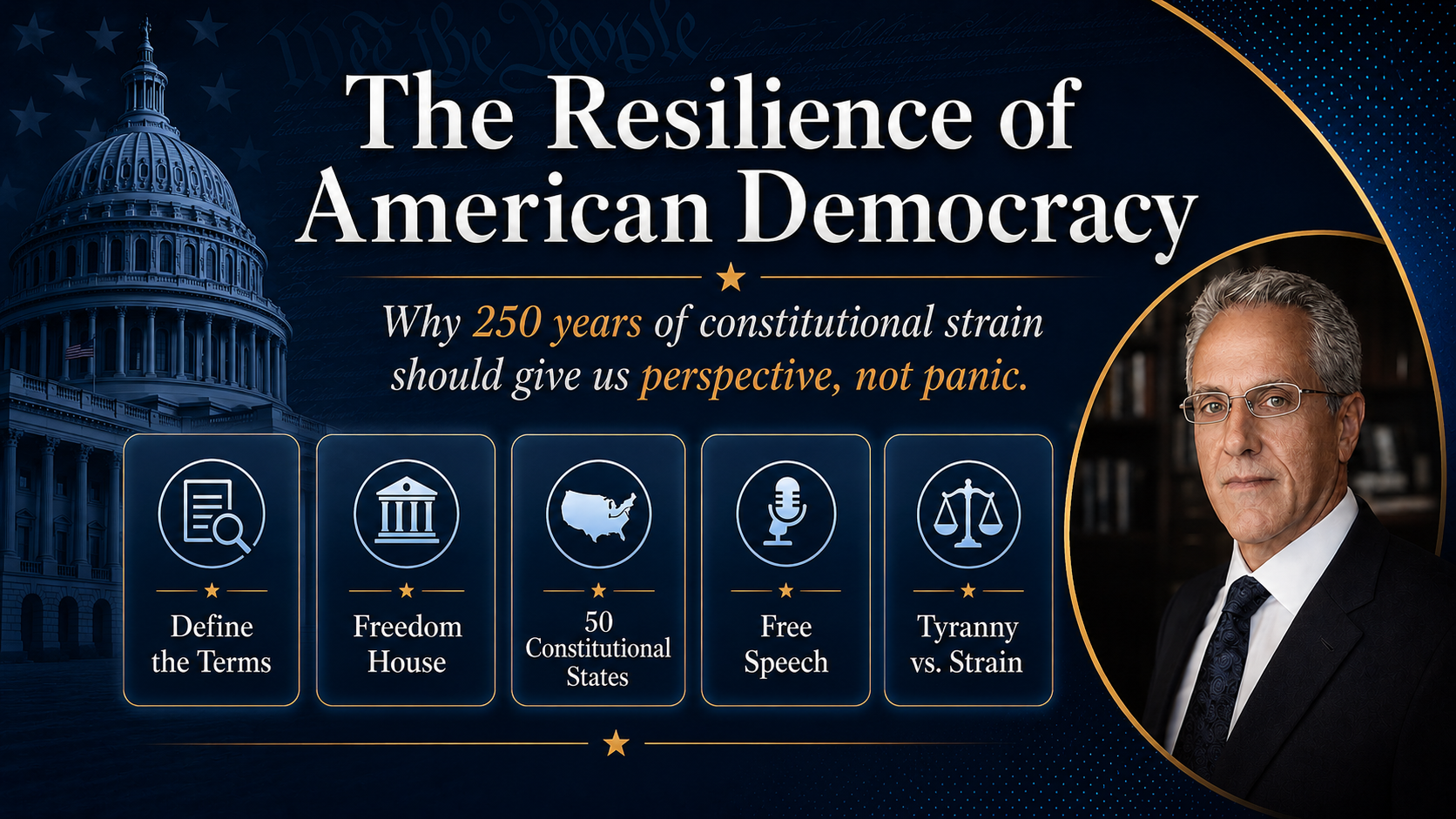
America Is Strained, Not Tyrannical
American political language has become so overheated that it is often difficult to distinguish genuine warning from rhetorical excess. We are told that democracy is dying, tyranny is already here, fascism is around the corner, and every election may be the last meaningful one.
Some of that anxiety is understandable. The United States is plainly strained. Trust is low. Institutions are under pressure. Political rhetoric is often reckless. Respected democracy monitors report measurable deterioration in the quality of American democratic life.
But diagnosis still matters. A warning sign is not the same thing as a terminal condition. Political strain is not the same thing as tyranny. If we use words such as democracy, republic, authoritarianism, fascism, and tyranny as slogans rather than definitions, they stop clarifying reality and start inflaming it.
The first obligation of a free people is to describe their condition accurately.
What Freedom House Can and Cannot Tell Us
Freedom House is worth explaining before citing. It is a U.S.-based nonprofit founded in 1941 that describes its mission as defending and expanding freedom globally. Its annual Freedom in the World report assesses political rights and civil liberties across countries and territories. The 2026 edition covers developments in 195 countries and 13 territories during the calendar year 2025. Its methodology relies on 25 indicators: 10 for political rights and 15 for civil liberties. The final score produces a broad status category: Free, Partly Free, or Not Free (1–4).
That makes Freedom House useful. It does not make it infallible. Its scores are structured expert judgments, not a blood test for democracy. Freedom House also has an explicit pro-democracy and pro-human-rights mission, and its financial statements show substantial support from the U.S. government. None of that invalidates its work. It does mean its ratings should be treated as one serious indicator among others, not as the final word on whether a country is democratic, authoritarian, or tyrannical (4,5).
By Freedom House’s measure, the United States remains classified as “Free,” but its 2026 score fell to 81 out of 100, down from 84 the year before. That decline does not prove that the United States has ceased to be a free country (2).
The reasons for the lower score matter. Freedom House did not downgrade the United States because American elections had become fake. In fact, it gave the 2024 presidential election and congressional elections full scores for being free and fair. The 2024 election, according to Freedom House, proceeded smoothly, with no high-profile attempt to challenge the outcome and no evidence of significant foreign interference (2).
The weaker areas were different: legislative dysfunction, the longest federal government shutdown in U.S. history, increasingly aggressive assertions of executive authority, weakened anticorruption safeguards, pressure on media and academic institutions, and concerns about personal expression. Those are serious problems. They also differ from saying that the United States has become a dictatorship (2,3).
My own judgment is that American democracy may be stronger than Freedom House’s national score alone suggests. The warning signs it identifies are real: institutional distrust, executive overreach, legislative dysfunction, pressure on expression, and weakening safeguards against corruption. Those should not be minimized.
But the United States is also a deeply layered constitutional republic. Power is dispersed across 50 states, each with its own constitution, courts, elected officials, election machinery, legal traditions, and political culture. Governors, state legislatures, state courts, attorneys, local governments, civic groups, journalists, universities, churches, businesses, and voters all operate within overlapping centers of authority.
That complexity can be maddening. It can also be protective. America is difficult to govern, but it is also unusually difficult to capture.
Freedom House should therefore be read as a serious warning rather than a final verdict. It tells us something important about democratic strain. It does not tell us everything about constitutional resilience.
America’s System Is Unusual by Design
The United States is not a pure direct democracy. It is a constitutional federal republic with representative democratic elections. The Constitution guarantees every state a “Republican Form of Government,” and the country’s basic architecture was designed to divide power rather than concentrate it (6).
That division runs in two directions. Power is divided horizontally among the legislative, executive, and judicial branches, and vertically between the national government and the states through the system of federalism. The Framers did not place authority in one person, one institution, or even one national majority. They created a system of separated and overlapping powers (7).
This structure matters because the United States is not simply one national government with local administrative districts. It is a union of 50 states. Every state has its own constitution. Every state has its own elected government, courts, laws, fiscal structure, election system, and political culture. Many states are larger in population, geography, or economic output than sovereign countries (8).
There are historical analogs, but few true equivalents. The American system is a nation-state, a continental federation, and a union of 50 constitutional republics at once. That does not make the system simple. It often makes it frustrating, uneven, slow, and inefficient. But it also helps explain why American democracy is unusually resistant to capture by any single faction, office, or election.
Because each American state has its own constitution, courts, election rules, legal culture, and civil-liberties protections, American democracy cannot be fully understood through a single national score. One could plausibly rank states by Freedom House–like criteria: political rights, civil liberties, rule of law, electoral fairness, government transparency, and constitutional safeguards. Scholars have already moved in this direction through the State Democracy Index, which measures electoral democracy across all 50 states. A broader state-level freedom index would be even more revealing. It would show that American democracy is not a single, flat national system but a layered constitutional order in which the details of democracy vary meaningfully from state to state (1,8,9).
National polarization is real. But power in the United States remains widely dispersed. Courts, governors, legislatures, attorneys general, election officials, local governments, civic institutions, and state constitutions all form part of the democratic structure. That dispersion can produce conflict and inefficiency. It is also one of the system’s most important safeguards.
America is hard to govern. That is obvious. But it is also hard to seize. That is easier to forget.
What Real Democratic Failure Looks Like
A democracy has not failed merely because trust is low, rhetoric is vulgar, institutions are strained, or one side believes the other side is dangerous. Democratic failure is more concrete than that.
It begins when citizens can no longer meaningfully vote rulers out of office; when opposition parties lose a real path back to power; when courts cease to restrain those in power; when dissent becomes unsafe; and when law becomes an instrument of a faction rather than a restraint on it.
That is why even a pessimistic democracy monitor still distinguishes between American erosion and outright dictatorship. Freedom House continues to classify the United States as “Free,” while warning of real deterioration (2,3).
So the practical threshold should be clear. If Americans could no longer vote in genuinely competitive elections, if critics of the government began disappearing, if protest became routinely impossible, if courts ruled only for one man or one faction, or if ordinary citizens lived in regular fear of the state, we would have crossed into something much darker than a democratic strain.
That is the kind of evidence history associates with tyranny.
What Tyranny Means and Why The Definition Matters
The classical definition remains the best starting point. Britannica defines tyranny, in its Greco-Roman sense, as an autocratic form of rule in which one individual exercises power without legal restraint. In modern usage, the term connotes illegitimate or unaccountable power. Aristotle’s famous formulation emphasized rule for the private interest of the ruler rather than the good of the ruled (10).
Put plainly, tyranny exists when power becomes effectively unaccountable, law serves rulers rather than restraining them, opposition is neutralized rather than contested, and fear becomes a normal instrument of government.
In such systems, elections are absent, fake, or tightly controlled; speech is conditional; courts are decorative; and obedience rests increasingly on coercion.
That is why the term should be used carefully. Tyranny is not simply strong government. It is not unpopular policy, partisan anger, media bias, bureaucratic arrogance, or even serious executive overreach by itself. It is a political order in which the normal mechanisms of correction have broken down.
Fascism Is Also a Word That Should Be Used Carefully
The same caution applies to fascism. Historically, fascism is not just aggressive leadership, nationalism, or harsh rhetoric. Britannica describes fascism as a political ideology and mass movement historically associated with extreme nationalism, authoritarianism, hierarchy, contempt for liberal democracy, and subordination of the individual to the nation or state (11).
That means not every illiberal or authoritarian tendency is fascism. A politician may attack opponents, manipulate parts of the media environment, pressure institutions, or encourage a cult of personality without thereby creating a fascist state.
Some conduct may fairly be called authoritarian, demagogic, illiberal, reckless, or constitutionally dangerous without meeting the much more specific historical threshold of fascism. If we collapse those distinctions, we do not sharpen judgment. We weaken it.
Labels Can Mislead: The Sweden Example
Sweden offers a useful reminder that political labels often obscure more than they explain. Americans sometimes describe Sweden as “socialist,” but Sweden is better understood as a market capitalist economy with a large welfare state, high levels of public trust, and strong democratic institutions.
Sweden’s official economic profile emphasizes its openness, export orientation, competitiveness, and liberal approach to trade and doing business. Sweden also remains one of the highest-rated countries in the world in Freedom House’s 2026 report, with a score of 99 out of 100 (12,13).
That does not mean Sweden is a model America must copy. Nor does it mean Sweden’s system is free of problems. It means only that words such as capitalism, socialism, democracy, and tyranny should be used with care. Sweden combines private enterprise, open trade, substantial social benefits, and high scores on democratic-freedom indices. Political systems are rarely captured by slogans.
That is one reason clear definitions matter. Bad labels produce bad arguments.
Patterns Matter, but They Are Not Destiny
This is where Steven Levitsky, Daniel Ziblatt, and similar writers are both useful and limited.
Their work draws attention to real warning patterns: norm-breaking, executive aggrandizement, delegitimizing opponents, intimidation of critics, and gradual institutional erosion. Democracies often weaken gradually rather than collapse all at once. As pattern recognition, that approach has value (14).
But the framework becomes less persuasive when it is treated as a script. The United States is not a generic presidential system. It is an unusually old constitutional republic with federalism, multiple veto points, decentralized elections, entrenched civil society, independent state governments, and a long history of ambitious presidents testing institutional limits without extinguishing self-government.
Levitsky and Ziblatt’s critique of the Constitution is serious. They argue that the American system is too counter-majoritarian by modern democratic standards, pointing to institutions such as the Electoral College, the Senate, the filibuster, and life tenure for federal judges. Those are real debates (14).
But that critique is strongest as a case for specific reforms, not as a general indictment of a constitution merely because it is old. It also tends to understate the historical problem the Constitution was written to solve: preserving union among sovereignty-conscious states, not maximizing simple national majority rule at all times.
A more majoritarian Constitution might solve some distortions. It would also change the balance among liberty, federalism, stability, and restraint that the American system—however imperfectly—has preserved for more than two centuries. That tradeoff deserves more respect than many critics give it.
Trump Is Not the First President to Test the Boundaries
Donald Trump is often treated as though he introduced Americans to presidential norm-breaking. He did not. The presidency has always contained tension between constitutional restraint and executive ambition, and some of America’s most consequential presidents pushed the boundaries of accepted practice in ways that deeply alarmed their contemporaries.
John Adams signed the Alien and Sedition Acts, which made it a crime to publish “false, scandalous, and malicious” writing about the government (15).
Andrew Jackson used executive power so aggressively that his opponents organized in part around resistance to what they saw as monarchical tendencies; his controversial conduct helped galvanize the emergence of the Whig Party (16).
James K. Polk pressed presidential power in the march toward the Mexican-American War (17). Abraham Lincoln suspended habeas corpus during the Civil War, prompting the famous Ex parte Merryman clash over civil liberties and executive power (18).
Theodore Roosevelt explicitly embraced a broad “stewardship” theory of presidential power, arguing that the president could do what the nation's needs required unless forbidden by the Constitution or by law (19).
Woodrow Wilson backed the Espionage Act of 1917 and the Sedition Act of 1918, which criminalized broad categories of dissenting speech during World War I (20).
Franklin Roosevelt sought to reshape the Supreme Court through his 1937 court-packing plan after the Court struck down New Deal measures (21).
These presidents were not the same. Their circumstances, motives, and achievements were profoundly different. Lincoln governed during the Civil War. Roosevelt governed during the Depression and World War II. Some expanded power in the name of necessity; others did so through ideology, ambition, or temperament.
The point is not moral equivalence. The point is historical perspective.
Nor should historical perspective become complacency. Trump’s efforts to discredit the 2020 election result, pressure institutions, and normalize retaliation against political enemies deserve serious criticism. Those are not small matters. But criticism is strongest when it is precise.
Yes, patterns matter. Democracies can be weakened by executive overreach, contempt for institutional restraint, and the habit of treating opponents as illegitimate.
No, Trump is not historically unique in testing constitutional boundaries.
And no, the existence of a dangerous pattern does not, by itself, prove democratic collapse. What matters is whether the constitutional order still contains the president; whether courts still resist; whether elections still matter; whether Congress and the states retain power; and whether the opposition remains free to organize, criticize, and compete.
Free Speech is the Bedrock
The Free Speech question illustrates why democratic analysis is surprisingly complex.
Vice President J.D. Vance made this point sharply in his 2025 speech at the Munich Security Conference. He argued that Europe’s greatest danger was not only external threat, but “the threat from within”—what he called Europe’s retreat from shared democratic values. “In Britain, and across Europe,” he said, “free speech, I fear, is in retreat” (22).
As a broad claim about Europe, that can be overstated. Freedom House rates many European democracies higher than the United States overall. Sweden, for example, scores 99 out of 100, compared with the United States at 81. By that measure, Europe is not simply less free than America (2,13).
But Vance’s narrower free-speech concern is harder to dismiss. European democracies generally do not share the American First Amendment tradition in its full force. They are more willing to regulate hate speech, extremist expression, online harms, misinformation, and speech thought to threaten dignity, equality, public order, or democratic stability. Supporters see this as responsible democratic regulation. Critics see it as a slippery path toward state-managed opinion.
The European Union’s Digital Services Act and the United Kingdom’s Online Safety Act illustrate that tension. Both are defended as efforts to protect users and democratic life online. Both also raise legitimate questions about overreach, chilling effects, and who decides what speech is too harmful to tolerate (23,24).
That is why Freedom House and Vance are not necessarily in contradiction. Freedom House is measuring broad access to political rights and civil liberties. Vance is making a more specifically American argument about the dangers of narrowing the permissible range of public speech.
The right conclusion is not that Europe has become tyrannical. The better conclusion is that even free societies can weaken their own democratic legitimacy if they police speech so aggressively that citizens begin to feel their views are being managed rather than debated.
The American Version of Free-Speech: Government Pressure and Social Media
The free-speech problem is not only European. The United States has its own version, and it often appears through indirect pressure rather than formal censorship.
The Biden administration’s interactions with social media companies during the pandemic are a useful example. Senior officials, both publicly and privately, urged platforms to do more about COVID-related misinformation. The administration defended this as responsible public-health communication during an emergency. Critics saw something more troubling: government pressure on private platforms to suppress disfavored views.
The legal record is nuanced. In Murthy v. Missouri, the Supreme Court did not bless the government’s conduct. It held that the plaintiffs had not established standing for the forward-looking injunction they sought (25).
Another Supreme Court case, NRA v. Vullo, clearly articulated the broader constitutional principle: government officials may criticize private speakers, but they may not use state power to coerce private parties into punishing or suppressing disfavored views (26).
Alex Berenson’s litigation also belongs in this discussion, but carefully. In May 2026, the Justice Department announced a settlement of litigation alleging that the Biden administration induced Twitter to suppress Berenson’s speech. The settlement was a practical win for Berenson, but it was not the same thing as a final Supreme Court merits ruling that the Biden administration violated the First Amendment (27).
Still, the issue is serious. A free society can endanger speech without formally banning it. When government officials use public pressure, regulatory threats, privileged access, or behind-the-scenes demands to influence what private platforms allow citizens to say, the constitutional danger is real.
The First Amendment problem is not limited to statutory censorship. It can also arise when government power quietly pressures private institutions to do what the government cannot do directly.
This issue should not be treated as a partisan trophy. Conservatives are right to worry about government pressure on platforms. Liberals are right to worry about deliberate misinformation, intimidation, and online harms. But neither concern cancels the other. A serious republic must be able to fight falsehood without letting government become the manager of permissible opinion.
What Real Tyranny Looks Like
History provides examples extreme enough to keep our vocabulary honest.
Nazi Germany was not merely divisive or illiberal. It was a regime of total political domination, racial ideology, aggressive war, and mass murder. The U.S. Holocaust Memorial Museum defines the Holocaust as the systematic, state-sponsored persecution and murder of six million Jews by Nazi Germany and its allies and collaborators (28).
Present-day tyrannical systems are not hard to identify. Freedom House’s 2026 report describes a continuing global decline in freedom, driven by coups, attacks on peaceful protesters, weakening constitutional safeguards, and authoritarian consolidation. Freedom House rates countries such as Iran and North Korea as Not Free, in which political competition, civil liberties, and institutional independence are fundamentally absent or severely suppressed (3,29,30).
A country where opposition can organize openly, courts can check the government, journalists can criticize the authorities, and citizens can protest in public is not the same kind of regime as one in which coercion is the ordinary method of rule.
America Under Strain Is Still Not a Tyranny
This is the distinction that matters most. A free society can be polarized, distrustful, vulgar, and institutionally strained without becoming tyrannical. It can suffer executive overreach, media manipulation, selective outrage, constitutional carelessness, and civic exhaustion without crossing into despotism.
Freedom House’s 2026 report reflects exactly that tension. It warns about real deterioration in the United States, but still describes the country as a federal republic with a strong rule-of-law tradition and robust formal protections for freedom of expression, religious belief, and other civil liberties (2).
That is not the language used for tyrannies. It is the language of a free country under pressure.
So one can criticize Trump sharply and still reject the claim that America is already tyrannical. One can criticize the Biden-era pressure on social media platforms and still reject the claim that America became a censorship state. One can criticize European speech laws and still acknowledge that many European countries remain highly free democracies.
That is what proportion requires.
A system in which citizens may publicly denounce the president, protest in the streets, sue the government, publish hostile journalism, organize opposition, and vote the governing party out of office is not a tyranny. It is a turbulent republic.
What Actually Threatens Democracy?
What threatens democracy is not disagreement itself. Democracy assumes disagreement. What threatens democracy is the slow erosion of the habits and restraints that make disagreement governable: contempt for constitutional limits, routine delegitimization of institutions, indifference to due process, selective commitment to free speech, and the temptation to excuse abuses when committed by one’s own side.
A republic does not usually die because one faction shouts that democracy is doomed. It weakens when citizens stop caring about restraints as long as their side is winning. It weakens when every question becomes apocalyptic, every opponent becomes illegitimate, and the language of crisis is used so constantly that people lose the ability to recognize genuine crisis when it comes.
That danger is not confined to one party. It is a habit of mind. It appears whenever citizens treat constitutional limits as obstacles, courts as tools, speech as a privilege, opponents as enemies, and power as justified whenever “our side” holds it.
A Better American Response
A free people should be vigilant without becoming theatrical. We do not need complacency, but we do need proportion.
The healthier civic posture is neither denial nor hysteria. It is disciplined citizenship: voting seriously, reading seriously, resisting exaggeration, defending institutions when they deserve defense, insisting on due process, and pursuing public goals larger than partisan emotional release.
That is the more constructive answer to democratic anxiety. Not endless declarations of collapse, but steadier citizenship. Not panic, but purpose. Not the misuse of words like tyranny and fascism, but the recovery of moral and political proportion.
John F. Kennedy captured that spirit in 1958:
“Let us not despair but act. Let us not seek the Republican answer or the Democratic answer but the right answer. Let us not seek to fix the blame for the past. Let us accept our own responsibility for the future.” (31).
Conclusion
The United States is polarized, distrustful, institutionally strained, and at times reckless. None of that should be minimized. But neither should it be mistaken for tyranny.
Tyranny is what follows when elections no longer provide a real path to change, courts no longer restrain power, opposition can no longer compete freely, and fear becomes an ordinary instrument of government. That is not where the United States is. Not yet—and not inevitably.
The more useful question is why the republic has bent so often without breaking. Part of the answer lies in its structure: separated powers, federalism, state constitutions, independent courts, local governments, civic institutions, a free press, and a political culture that still argues fiercely over the meaning of liberty. These features do not make American democracy immune to decay. But they do make it deeper, broader, and more difficult to sever than a single national score can fully convey.
The better response, then, is not despair but seriousness; not apocalyptic language but constitutional clarity; not endless declarations of collapse but renewed commitment to the hard and hopeful work of self-government.
America’s democracy is under strain. It has been under strain before. Its resilience is neither automatic nor guaranteed. But 250 years of constitutional conflict should give us perspective and encouragement.
The task now is vigilance with proportion.
Looking Ahead
In the next post, we continue this civic and constitutional turn by looking at one of the most debated features of the American system: the Electoral College. Few institutions generate more frustration, misunderstanding, or partisan suspicion. Is it an outdated barrier to majority rule, a necessary protection for federalism, or something more complicated than either label allows?
The goal will not be to defend or condemn it reflexively, but to understand why it exists, how it works, what problems it creates, and what might be lost or gained if we changed it.
References
Freedom House. “Freedom in the World Research Methodology.”
Freedom House. “United States: Freedom in the World 2026 Country Report.”
Freedom House. “Freedom in the World 2026.”
Freedom House. “Freedom in the World.”
Freedom House. Financial Statements, Year Ended June 30, 2024.
Library of Congress, Constitution Annotated. “Article IV, Section 4: Republican Form of Government.”
National Constitution Center. “Module 6: Separation of Powers and Federalism.”
State Court Report. “How Much Do You Know About State Constitutions and Courts?”
Democracy Policy Lab, UC Berkeley. “State Democracy Index.”
Encyclopaedia Britannica. “Tyranny.”
Encyclopaedia Britannica. “Fascism.”
Sweden.se. “The Swedish Economy.”
Freedom House. “Sweden: Freedom in the World 2026 Country Report.”
Harvard Gazette. “‘Tyranny of the Minority’ Warns Constitution Is Dangerously Outdated.”
National Archives. “Alien and Sedition Acts (1798).”
Miller Center, University of Virginia. “Andrew Jackson: Impact and Legacy.”
Miller Center, University of Virginia. “May 11, 1846: War Message to Congress.”
Federal Judicial Center. “Ex parte Merryman: Habeas Corpus During the Civil War.”
Theodore Roosevelt. Theodore Roosevelt: An Autobiography. Excerpt on stewardship theory.
National Constitution Center. “Espionage Act of 1917 and Sedition Act of 1918.”
Federal Judicial Center. “FDR’s ‘Court-Packing’ Plan.”
American Presidency Project. “Remarks by the Vice President at the Munich Security Conference.” February 14, 2025.
European Commission. “The Digital Services Act.”
Ofcom. “Illegal Content Duties Under the Online Safety Act.”
Supreme Court of the United States. Murthy v. Missouri, 603 U.S. ___ (2024).
Supreme Court of the United States. National Rifle Association of America v. Vullo, 602 U.S. ___ (2024).
U.S. Department of Justice. “Justice Department Settles Lawsuit Challenging Biden Administration’s Alleged Social Media Coercion and Censorship.” May 13, 2026.
United States Holocaust Memorial Museum. “Learn About the Holocaust.”
Freedom House. “Iran: Freedom in the World 2026 Country Report.”
Freedom House. “North Korea: Freedom in the World 2026 Country Report.”
John F. Kennedy Presidential Library and Museum. “Remarks of Senator John F. Kennedy at the Loyola College Annual Alumni Banquet, Baltimore, Maryland, February 18, 1958.”
