
Is Reform Even Possible? A Path Forward for American Healthcare
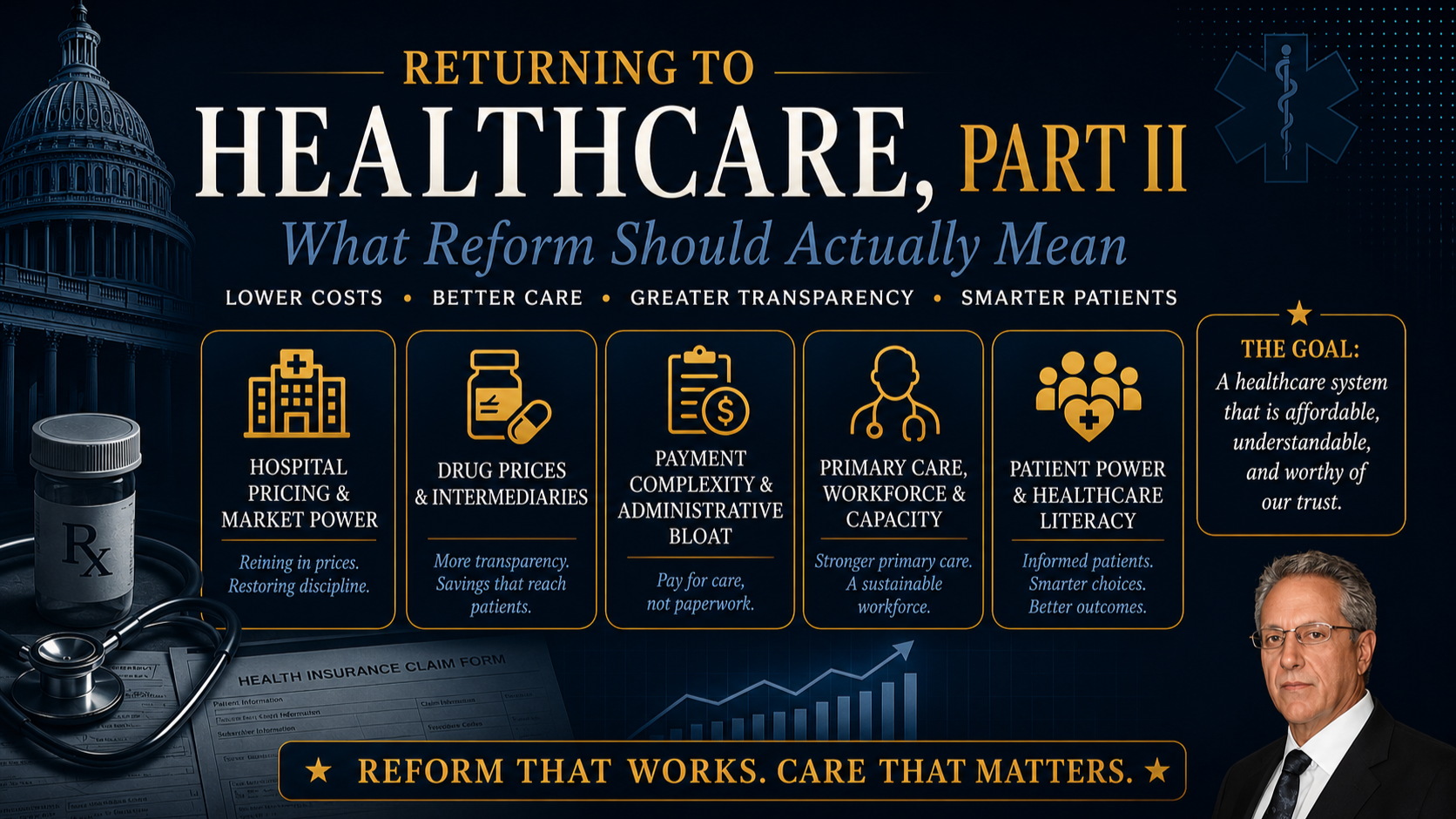
In the last post, I argued that American healthcare remains expensive because the system itself is costly, opaque, layered, and badly misaligned. Hospital spending sits near the epicenter of the affordability problem. Administrative complexity has become a cost center in its own right. Payment typically rewards robust billing practices more than time, judgment, and physician skill. And patients are left to navigate a maze of charges, contracts, formularies, networks, and denials that few people fully understand.
That diagnosis leads naturally to the next question: what would meaningful reform actually look like?
Importantly, real reform is unlikely to come from a single grand ideological plan. The American healthcare system is too large, too fragmented, too politically entrenched, and too institutionally defended to be reinvented all at once. Sweeping promises may stir applause, but they collapse when they meet the reality of cost, disruption, and political resistance. A more serious reform agenda has to begin with a more modest premise: not how to build a perfect system, but how to build a more transparent, affordable, and humane one.
Healthcare reform may be one of the most challenging peacetime governance problems in modern life because the system brings together everything that makes reform difficult: human vulnerability, expanding scientific possibility, finite resources, powerful interests, and a public that needs the service most when it has the least power to bargain over it.
Power, Patients, and Why Reform Stalls
Too much of the healthcare debate still proceeds as if the main argument is between government and markets, public coverage and private coverage, or universalism and consumer choice. Those debates become too abstract if they ignore the day-to-day structure of the system.
The system patients encounter is a world of hospital contracts, physician reimbursement, insurer adjudication, prior authorization, pharmacy benefit managers (PBMs), coding rules, facility fees, deductible design, and bills that arrive in fragments long after the episode of care is over. The patient experiences one hospitalization. The system experiences a chain of intermediaries, claims, and financial obligations. That distinction is one reason so many discussions about reform feel unsatisfying. They address the headlines rather than the gears.
A serious reform agenda has to start by acknowledging that the system is not malfunctioning at random. It is producing many of the outcomes its incentives were built to produce. If dominant hospital systems can command very high commercial prices, that shifts the balance. If primary care is persistently underrewarded relative to procedures, that weakens the front line of care. If patients are nominally insured but still cannot understand what they owe or why, that produces frustration and distrust. If clinicians spend increasing amounts of time documenting to maximize payment rather than communicating clinical judgment, that distorts the relationship between doctor and patient. And if routine episodes of care can turn into a Gordian knot of charges, allowed amounts, payment rules, and downstream bills, then that too is part of the problem.
A major obstacle to meaningful reform is lobbying. American healthcare is not only expensive and complex; it is politically fortified. Every major revenue stream in the system tends to have an organized constituency defending it — hospitals, drug manufacturers, insurers, physicians, nursing homes, device makers, pharmacy benefit managers, and the trade groups that represent them. That does not mean every lobbyist is malign or every cause is unjustified. But it does mean that reform is never only a matter of evidence. It is also a matter of organized resistance.
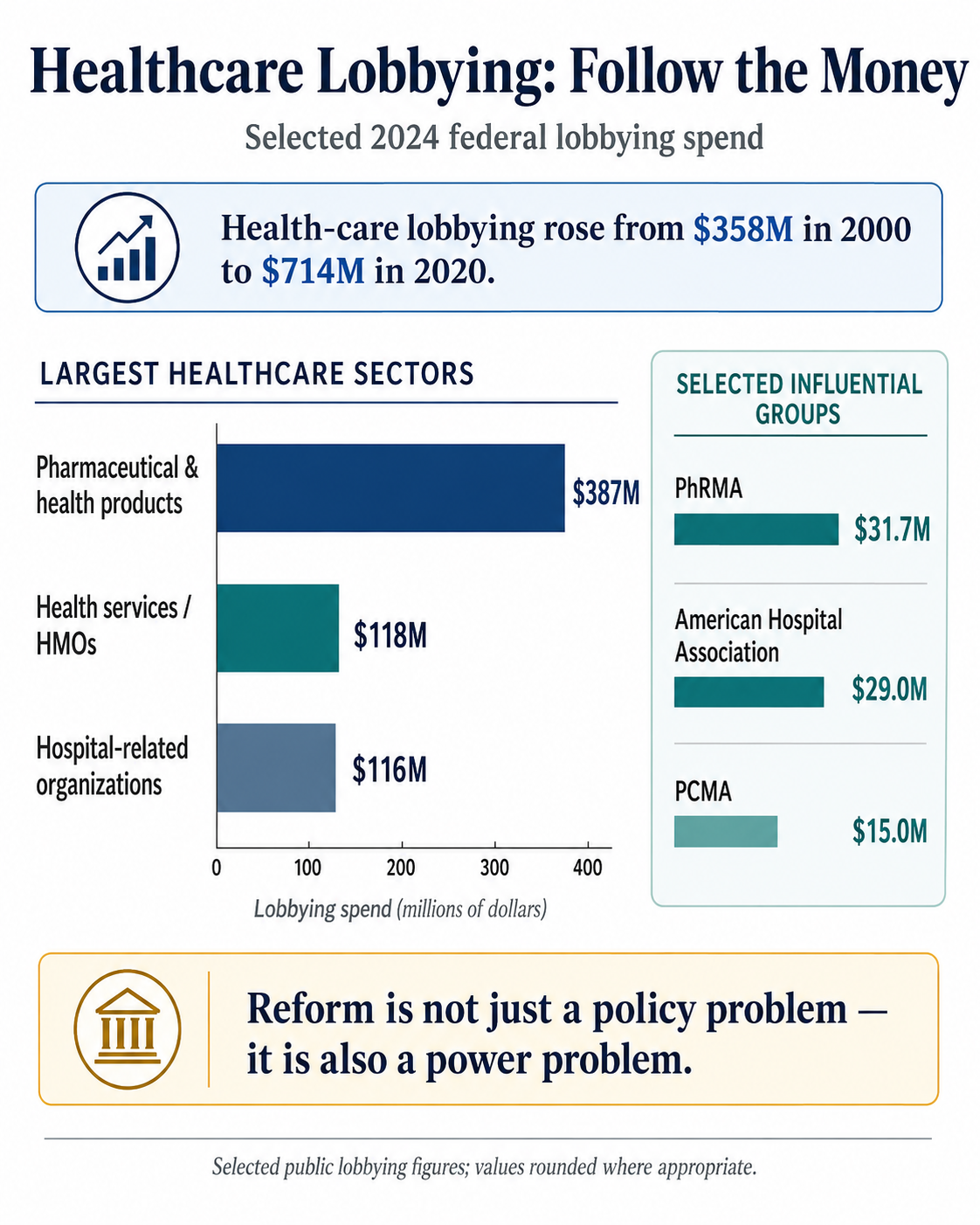
This helps explain why so many obvious problems remain so difficult to fix. Every line item in the system is attached to someone’s income, someone’s institution, someone’s prestige, or someone’s political influence. Hospitals defend reimbursement and tax advantages. Drug makers defend pricing power and intellectual property. Insurers defend benefit design, network management, and payment leverage. PBMs defend their intermediary role and compensation structure. Physicians defend autonomy and reimbursement. Each argument contains some truth. But taken together, they create a system in which nearly every serious reform threatens an organized interest, and nearly every organized interest has professional representation ready to soften, delay, narrow, or redirect change.
Patients, meanwhile, exercise remarkably little real power. They do not set prices, write contracts, design networks, determine coding, negotiate payment rules, or understand most of the institutional structure they are moving through. Yet when the episode is over, they are often the ones left to absorb the confusion, the uncertainty, and the bill. That imbalance is built into the structure of care itself. Patients usually enter the system when they are sick, frightened, in pain, or dependent. They are not approaching healthcare as ordinary consumers with time to compare prices, study alternatives, bargain intelligently, or walk away from a bad deal. By the time the financial consequences become visible, the care has usually already been delivered, and the real decisions have already been made by hospitals, insurers, employers, and intermediaries operating behind the scenes.
This is one reason so much market language feels disconnected in healthcare. It is not as though patients can simply boycott the product, punish the seller, or vote with their feet in any meaningful way when the need is urgent. They cannot easily refuse the service, hold out for a better price, or walk away from the institution without risking their health. In that sense, the patient is not entering a normal market relationship. They are entering a structure of dependence under conditions of vulnerability and uncertainty.
And yet that is not quite the end of the story. If patients can be armed with better knowledge — about prices, coverage rules, referral barriers, billing practices, and the institutional incentives surrounding care — some of this imbalance can begin to shift. People who understand the system are better able to question it, challenge it, and resist being quietly managed by it. Patients may be the weakest party in the system today, but that may also reveal the strongest leverage reform still has.
Coverage Matters, but Reform Must Go Well Beyond Coverage
Whatever one thinks of the Affordable Care Act, some of its major protections are now embedded in the structure of American healthcare. Protections for preexisting conditions, the ban on lifetime limits, and some form of assistance for lower-income households have become expected features of the system. Repealing them would simply create more instability and insecurity.
So any serious reform agenda should begin by preserving a stable coverage floor.
But that should not be confused with declaring the job finished. Insurance is only the entry point into the system. It is not the same thing as affordability, and it is certainly not the same thing as rational pricing. A patient can be covered and still face a baffling deductible, a bill that arrives months later, an out-of-network clinician inside an in-network hospital, or a drug that technically exists on the formulary but is practically inaccessible. A reform movement that celebrates coverage while leaving the rest of the infrastructure untouched has not solved the problem.
No discussion of reform in the United States is complete without directly confronting universal coverage. The appeal is obvious. A wealthy country should not leave millions of people uninsured or underinsured, and the United States still stands apart from many of its peers on that front. But universal coverage is a goal, not a magic formula.
Critics are not wrong to argue that a move toward universal coverage could increase wait times if demand expands faster than supply. A system that opens the front door wider without expanding primary care, specialist access, and delivery capacity can create more congestion even as it improves formal access. But it is too simple to say that universal coverage automatically means long waits. Wait times are shaped not only by coverage design but also by capacity, funding, management, and prioritization.
There is also a deeper source of anxiety in universal care systems: gatekeeping. Patients experience this as, “I cannot get to a specialist because my primary doctor will not allow it.” A primary-care-centered model asks patients to place a great deal of faith not only in the motives of the primary care physician, but in the breadth of the physician’s knowledge and in the incentives of the institution employing that physician. It assumes that one clinician, working under time pressure and inside a large system, can reliably judge when referral is necessary, when it can wait, and when it is not warranted across an increasingly specialized and expanding medical world.
Universal coverage also raises a more practical American problem: scale. The United States is not a small, centralized country. It is a vast federal system in which states still control major aspects of implementation, licensure, insurance regulation, public health, and Medicaid administration. That makes the American problem harder than simply importing a model from a smaller, more centralized peer nation. Scale and federalism are part of the problem itself.
And finally, if specialist access becomes slower, more filtered, or more bureaucratic, people with financial resources will often find ways around it — concierge care, direct-pay consultations, boutique imaging, private centers, or treatment elsewhere. Everyone else will be left to navigate the official system and may rightly feel that equality has been promised while hierarchy has been preserved. In that sense, the danger is the creation of a two-tier reality in which universal coverage exists in principle, but unequal access persists in practice.
The United States, of course, already has its own form of rationing. It often rations by price rather than by queue. Universal coverage would solve an important part of that problem. But it would not, by itself, solve hospital pricing, administrative opacity/bloat, weak and marginalized primary care, drug intermediaries, or the complex cost structure of care.
Where the Money Actually Goes is the Key to Reform
At the most basic level, healthcare reform begins with the same rule that governs any institution or household: know your expenses.
That sounds obvious until one tries to do it. Coming up with the line items is the hard part. A hospital is not just a building where doctors and nurses work. It is a small city with a pharmacy, laboratory, kitchen, warehouse, transport system, sanitation system, data system, legal department, billing operation, and physical plant all attached to it. The bill is paying not only for the surgeon, the anesthesiologist, the implant, and the room for one night. It also covers cleaning the room, transporting the patient, making calls, rescheduling, preparing and serving meals, sterilizing equipment, washing floors, maintaining records, staffing the lab and pharmacy, keeping the lights on, and meeting regulatory and billing requirements.
That reality raises an equally important, but related question: how much of modern care truly requires hospitalization in the first place?
Once one sees how much institutional overhead is attached to inpatient care, it becomes harder not to ask whether some patients could be cared for more appropriately, more comfortably, and less expensively in outpatient settings, ambulatory centers, skilled home-based programs, or other lower-intensity sites of care. In many ways, the system is already moving in that direction. Outpatient centers and ambulatory surgery centers continue to expand for colonoscopies and other relatively safe, standardized procedures. In many cases, that shift makes sense. It can lower cost, reduce institutional overhead, improve convenience, and reserve hospitals for sicker and more medically complex patients.
But the site-of-care question is not purely economic. Hospitals do not merely deliver treatment; they absorb uncertainty, provide continuous monitoring, and reduce certain clinical and legal risks. If a patient is cared for at home or in a lower-intensity setting and then deteriorates, falls, becomes infected, misses medications, or lacks adequate support, the medical consequences and the liability questions become much harder to ignore. So the economics point in one direction while safety and liability often point in another.
Even the boundary between outpatient and inpatient care is often less clear than patients imagine. A person may spend the night in a hospital bed and still be classified financially as an outpatient under observation rather than a full inpatient admission. To the patient, it looks and feels like hospitalization. But in billing terms, it may carry different payment and cost-sharing consequences. That distinction can seem bewildering at the bedside, yet it helps explain why hospitals often push for a quick decision: discharge the patient if stable, or convert to full admission if the clinical picture clearly warrants it.
Any honest discussion of hospital costs must also acknowledge uncompensated care. Hospitals do, in fact, provide substantial amounts of care for which they are never fully paid. Some patients qualify for charity care. Others are billed but ultimately cannot pay. Emergency departments, in particular, remain one of the few parts of the system that are always open and always obliged to respond, regardless of a patient’s financial condition. Hospitals are not wrong to argue that unreimbursed care creates genuine financial pressure. But that argument can also be overstated. Uncompensated care is real and deserves honest recognition, but it cannot serve as an all-purpose defense of the cost the system now commands.
If hospitals sit near the center of the affordability problem, then hospital pricing must sit near the center of the reform agenda. Some hospitals operate on narrow margins. Rural hospitals, safety-net institutions, and facilities serving large numbers of uninsured or underinsured patients face genuine pressures. It would be crude and inaccurate to pretend that all hospitals are simply overpaid. But it would be equally naïve to ignore the degree to which consolidation and negotiating leverage have allowed some systems to command extremely high commercial rates. In many markets, the issue is no longer merely cost recovery. It is pricing power.
That suggests several reforms: stronger antitrust scrutiny in concentrated markets, more serious use of site-neutral payment, tougher questions for tax-exempt hospitals about community benefit and pricing behavior, and a greater willingness to ask whether commercial rate increases reflect clinical value or simply negotiating leverage.
A system that allows prices to drift upward because concentrated providers can insist on them is not a system with meaningful discipline.
Payment Complexity, Drugs, and the Administrative Apparatus Surrounding Care
One of the most underappreciated truths in healthcare is how much money and professional energy are devoted to the administrative apparatus surrounding care: coding, documentation, revenue-cycle management, appeals, audits, prior authorization, utilization review, payment disputes, contract interpretation, and the endless effort to build a bill that will survive scrutiny.
Some of that is unavoidable. A large and expensive system does require accountability. But far too much of it reflects a payment architecture so complicated that entire industries now exist to navigate, defend, and exploit it.
Where feasible, reform should move away from payment systems that reward exhaustive billing and coding, and toward simpler models that pay for care prospectively, by episode, or for a defined patient population. The goal is not to remove accountability, but rather reduce the amount of energy devoted to proving, coding, and defending care that has already been delivered. In short, the system should pay more for patient care and less for building the perfect bill.
Drug pricing belongs in this conversation, because it reflects many of the same pathologies: opacity, intermediation, and diffuse responsibility. Most patients have little idea why one drug is inexpensive, another requires prior authorization, and a third carries a startling out-of-pocket burden even though everyone in the chain insists that discounts and rebates are being negotiated somewhere in the background. PBMs are not the sole villain in American drug pricing, but they are central intermediaries in a benefit structure that many patients experience as opaque and untrustworthy.
Reform here should aim for three things: greater transparency, simpler benefit design, and a clearer route by which negotiated savings actually reach patients. A system in which everyone claims to be lowering drug costs while the patient experiences only confusion and financial friction is a system that has lost sight of the point.
Reducing cost, however, does not automatically improve care. Some efficiencies are real and desirable, especially when they reduce waste, duplication, or unnecessary institutional overhead. But many cost-cutting efforts fall elsewhere. They reduce time at the bedside, thin staffing, increase clerical burden, narrow margins for safety, and make the patient experience feel more hurried and less humane. A lower-cost system is not necessarily a better-care system.
In some respects, the opposite is more often true. Better care may reduce cost over time. Fewer complications, fewer readmissions, better chronic disease management, stronger primary care, clearer discharge planning, and more appropriate site-of-care decisions can all improve outcomes while also lowering downstream expense. But that is very different from indiscriminate cutting.
Primary Care, Workforce, and the Fragile Front Line
For years, American healthcare has talked admiringly about prevention, continuity, and chronic disease management while quietly rewarding other things. Primary care is praised rhetorically and often marginalized operationally. Yet many of the conditions that most burden the system are not solved by isolated procedures alone. They are managed over time through follow-up, medication adjustment, counseling, coordination, and judgment. That is slower work. It is less dramatic work. It is also essential work.
The difficulty is that the system asks an enormous amount of primary care while marginalizing it financially. Primary care physicians are expected to serve as first-contact providers, longitudinal managers, referral filters, and general diagnosticians across an increasingly specialized medical world. That is a heavy burden, especially when reimbursement lags behind many specialties, administrative load is high, and the field often carries less prestige than the procedural lanes surrounding it. A system that asks so much of primary care while rewarding it so modestly should not be surprised if it struggles to recruit as strongly as it needs.
That pressure helps explain the rapid proliferation of nurse practitioners and physician assistants. In many settings, they are not simply an ideological choice but a practical response to physician shortages, access problems, and the sheer volume of unmet need. Used well, NPs and PAs can expand capacity, improve continuity, and strengthen team-based care, especially in routine primary care, chronic disease management, and underserved settings. But their growth also raises difficult questions. They should be part of a stronger primary care foundation, not a convenient excuse to avoid rebuilding the physician pipeline or to pretend that every clinical role is interchangeable.
This leads to a broader issue of standards. Medicine is not an ordinary profession. It is a high-consequence field in which errors can injure patients, which means admissions, training, credentialing, and hiring must be handled with unusual seriousness. The answer is not to abandon the goal of widening opportunity. It is to pursue it without weakening standards — through stronger early pipelines, better mentoring, more honest evaluation, and training structures that support excellence rather than dilute it. In medicine, the tension matters because the costs of getting it wrong are ultimately borne by patients.
If primary care is to play a larger role in reform, it cannot be rebuilt on sentiment alone. It has to be rebuilt on payment, prestige, staffing, and standards. It needs more physicians, better support, and a thoughtful place for NPs and PAs within a team model that patients can trust. It also needs to function as a guide rather than a barrier: clinically grounded, intellectually strong, and sufficiently supported so that patients believe referral decisions are being made in their best interests rather than under the pressure of institutional convenience or financial constraints.
A weak primary care system also helps explain two other recurring complaints in American medicine. The first is the accusation that Americans “abuse” the emergency department. Some patients do use the ED inefficiently, but that is often a system story rather than a morality tale. The ED is the one part of the system that is always open, always staffed, always equipped, and always obliged to respond. When primary care access is limited, after-hours care is scarce, transportation is unreliable, or patients do not know where else to go, the ED becomes the default portal.
The second is the role of unhealthy lifestyles. Poor nutrition, obesity, physical inactivity, smoking, alcohol misuse, and poor medication adherence do contribute substantially to the burden of chronic disease and therefore to healthcare demand. But lifestyle is not the same as blame, and it still does not explain why each unit of care in the United States is so extraordinarily expensive once it is delivered. Lifestyle helps explain why we need so much care. It does not fully explain why the care itself costs so much (see procedure costs figure below).
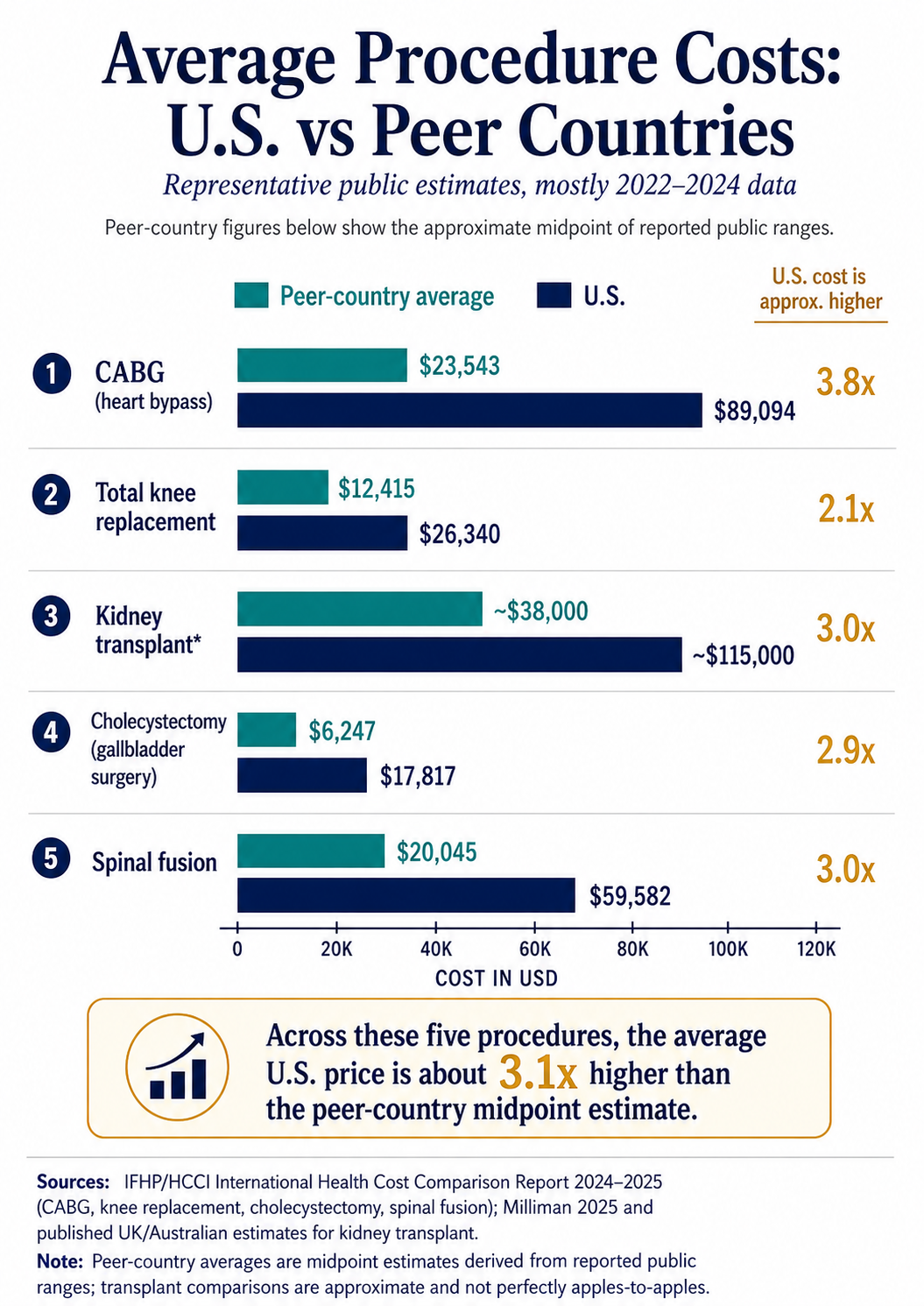
The U.S. is not just a little higher. It is in a different financial universe.
Other Structural Pressures Reform Cannot Ignore
Even after one accounts for hospital pricing, payment complexity, dwindling primary care, and drug intermediaries, other structural pressures remain. They do not always fit neatly into one budget line, but they help explain why the system keeps drifting toward higher cost, weaker accountability, and a more frustrating patient experience.
One is the structure of employer-based insurance itself. For many Americans, health coverage is not something they choose in an open market at all. It is inherited through employment, partially paid for by employers, lost when jobs change, and generally poorly understood. That arrangement weakens the ordinary connection between user, buyer, and price. The patient consumes the care, the employer helps finance the premium, the insurer administers the benefit, and the hospital or physician delivers the service, but no single actor sees the entire transaction cleanly. The result is a system in which people often do not know the true cost of their coverage, cannot easily compare alternatives, and may remain tied to jobs in part because leaving would jeopardize access to care.
Another pressure comes from ownership, integration, and financialization. Hospitals have acquired physician practices. Insurers have acquired physician groups, pharmacies, and PBMs. Private equity and investor logic have entered more corners of care. These arrangements can sometimes improve coordination, but they can also make the system multilayered and difficult to assess from the outside. When the same corporate structure touches insurance design, pharmacy benefit management, physician referral patterns, and care delivery, patients are left wondering who is actually making the decision and in whose interest it is being made.
A third pressure is the culture of liability and institutional self-protection. Even when malpractice costs do not account for the largest share of national spending, fear of error, litigation, and reputational damage shapes behavior. It encourages overdocumentation, defensive ordering, procedural redundancy, and a general preference for caution when uncertainty is high. Hospitals and clinicians do not merely practice medicine; they practice medicine under legal, regulatory, and reputational pressure.
Mental health adds another layer. Because it remains fragmented from much of mainstream medical care, its failures often reappear elsewhere — in emergency departments, addiction crises, poorly controlled chronic disease, and the social instability that later returns as medical costs.
And then there is the largest pressure of all: healthcare is not a fixed enterprise. It behaves more like an expanding frontier. New drugs, new devices, new diagnostics, new biologics, new procedures, and new forms of monitoring keep arriving. Many are genuine advances. They save lives, reduce suffering, and widen what medicine can do. But they also widen what patients hope for, what institutions want to offer, and what payers are asked to finance. That expansion becomes most morally difficult in advanced illness and end-of-life care, where the line between meaningful treatment and costly prolongation can be hard to draw and harder still to discuss. In that environment, more medicine becomes the default, even when better judgment might sometimes mean less.
Knowledge, Technology, and the Possibility of Counterpower
Another part of the problem, and one that is too often ignored, is healthcare literacy.
Patients are routinely asked to navigate deductibles, coinsurance, formularies, prior authorization, network status, facility fees, explanations of benefits, consent forms, discharge instructions, follow-up schedules, and appeal rights at precisely the moments when they are sick, anxious, or under stress. Even well-educated people can find this difficult. That is not simply a patient weakness. It is evidence of a system that has become too complicated for ordinary human use.
If the system is too complicated for many physicians, nurses, and other frontline professionals to explain clearly, it should not surprise us that many patients struggle to navigate it as well. That suggests an important reform principle: healthcare literacy should not be seen only as a patient problem, but also as a professional and institutional one. Clinicians themselves should be better equipped to understand the financial, administrative, and coverage-related nuances surrounding care so they can pass that understanding along to patients in real time.
Poor healthcare literacy has real consequences. It contributes to delayed care, medication errors, missed follow-up, unnecessary emergency visits, financial distress, and a broader erosion of trust. It also feeds the sense that the system is not merely complex, but opaque in a way that can feel intentional. Perhaps not because anyone sat down and designed the entire system to be confusing, but because the system has evolved in ways that tolerate opacity, protect insiders, and shift the burden of understanding onto patients least prepared to carry it.
This is where technology, and especially AI, may become part of the reform story. The strongest case for AI in healthcare is not that it will replace clinicians or somehow solve the system with a single dramatic leap. It is hoped that it may help reduce some of the administrative and informational friction that now surrounds care. Used well, AI could assist with documentation, prior authorization, scheduling, patient communication, coding support, billing review, and translating complex institutional rules into language that patients and clinicians can actually use. In a system weighed down by clerical burden and operational drag, AI presents a real possibility for reform.
The cautions are also obvious. Technology does not automatically improve care. AI can reproduce bias, conceal errors behind a veneer of sophistication, and tempt institutions to use automation mainly for throughput, surveillance, or denial management rather than for clarity and human care. So the reform test is not whether healthcare adopts AI, but how it adopts it. If artificial intelligence is used to reduce clerical burden, clarify information, improve patient understanding, and support clinical judgment under human supervision, it could become one of the more constructive tools in the reform effort. If it is used mainly to obscure, automate denial, deskill judgment, or accelerate billing, it will simply become one more sophisticated layer in an already multilayered system.
In the long run, one of the strongest reform angles may be patient knowledge itself. If patients are better armed with a clear understanding of pricing, coverage rules, referral barriers, billing practices, and the institutional incentives surrounding care, they are no longer moving through the system in quite the same passive way. They become better able to ask harder questions, challenge dubious charges, push back against delays or denials, and make more confident decisions about where and how they receive care. That does not eliminate the structural imbalance, but it begins to narrow it. A patient who understands the system is less easily dominated by it.
What Is Being Tried Now — and Why Progress Will Be Slow
Reform is already underway, but it is happening through a patchwork rather than a single coherent national redesign.
Some of the most meaningful current efforts are relatively narrow but still important: site-neutral payment pressure, hospital price transparency, PBM scrutiny, Medicare drug negotiation, episode-based payment models, stronger primary-care-centered payment experiments, state total-cost-of-care models, Hospital at Home, and interoperability rules that aim to reduce prior-authorization friction. AI is also beginning to enter the reform mix — not only through clinical tools but also through federal strategy, governance, and transparency rules designed to shape how it is used within health systems and health IT.
These efforts matter because they target real distortions. Site-neutral payment goes after the irrational premium attached to hospital-owned outpatient settings. PBM reform attacks one of the least trusted intermediary structures in the drug-benefit chain. Price transparency tries to expose what has too often been hidden. Episode-based models push providers to think beyond the procedure itself and take more responsibility for what happens before, during, and after it. AI, at its best, could reduce clerical burden and improve intelligibility.
But none of this amounts to a grand redesign. The United States still lacks an integrated command structure for reform. It works instead through a mixture of congressional committees, CMS and CMMI models, federal agencies, watchdogs, antitrust enforcement, and state action. That is why future improvements are likely to be slow. The barriers are not only intellectual. They are institutional, financial, and political. Every serious reform threatens someone’s revenue, someone’s workflow, someone’s market power, or someone’s sense of status. As a result, even good ideas tend to move in stages, often through narrow fixes rather than sweeping redesign.
That can be frustrating, but it is probably the more realistic view. In American healthcare, meaningful change is likely to come less as a single breakthrough than as a series of smaller advances — some helpful, some compromised, and all slower than the scale of the problem would seem to demand.
A Real Pathway, Not Just a Wish
If reform is going to mean anything, it has to be assigned to real institutions and real people.
The executive branch should begin where it already has authority. Secretary Kennedy and HHS should use CMS to tighten hospital price-transparency enforcement, continue pushing site-neutral payment where the law allows, expand plain-language billing and patient-facing disclosure, and make AI earn its place by reducing clerical burden, simplifying prior authorization, and improving patient understanding rather than deepening surveillance and denial. CMS already has live vehicles for this work in TEAM, ACO Primary Care Flex, AHEAD, and Hospital at Home (see the figure below). Those models should not remain isolated experiments. They should become the proving grounds for a more coherent reform strategy.
Congress, meanwhile, should stop pretending that every healthcare bill has to solve the entire healthcare problem at once. A serious first package should be narrow, visible, and hard to misrepresent. The House Energy and Commerce Committee, under Brett Guthrie and working with Frank Pallone, should move forward on price-transparency, PBM, and site-of-care legislation. Jason Smith and Richard Neal on Ways and Means should take up the financing and Medicare payment side, especially site-neutral payment, primary care support, and clearer rules for tax-exempt hospital obligations. Mike Crapo and Ron Wyden on Senate Finance should be forced to decide whether they actually want to discipline price and payment distortions or merely talk about them. Bill Cassidy and Bernie Sanders on Senate HELP should focus on primary care, workforce, behavioral health, administrative simplification, and the patient-facing dimensions of affordability. The point is not to wait for a perfect grand bargain. It is to move a series of reforms through the committees that already control the relevant choke points.
The next step is to make reform concrete enough for the public to see. Require hospitals and insurers to make prices understandable. Require clearer explanations of benefits and patient bills. Push savings from drug and PBM reform closer to the patient. Expand primary care capacity through payment reform, workforce support, and a more thoughtful use of NPs and PAs. Use antitrust and oversight tools more aggressively where market power is obviously inflating prices. And make clinicians themselves more fluent in the financial and administrative rules surrounding care so that patients are not left alone inside a system few people can explain clearly.
That would not solve everything. But it would create a visible pathway: executive action where possible, targeted legislation where Congress controls the levers, and a far more deliberate effort to convert experiments into durable reform. In American healthcare, real improvement is likely to come less as one dramatic victory than as a series of disciplined steps. The mistake is to confuse that with inaction. It is still a path.
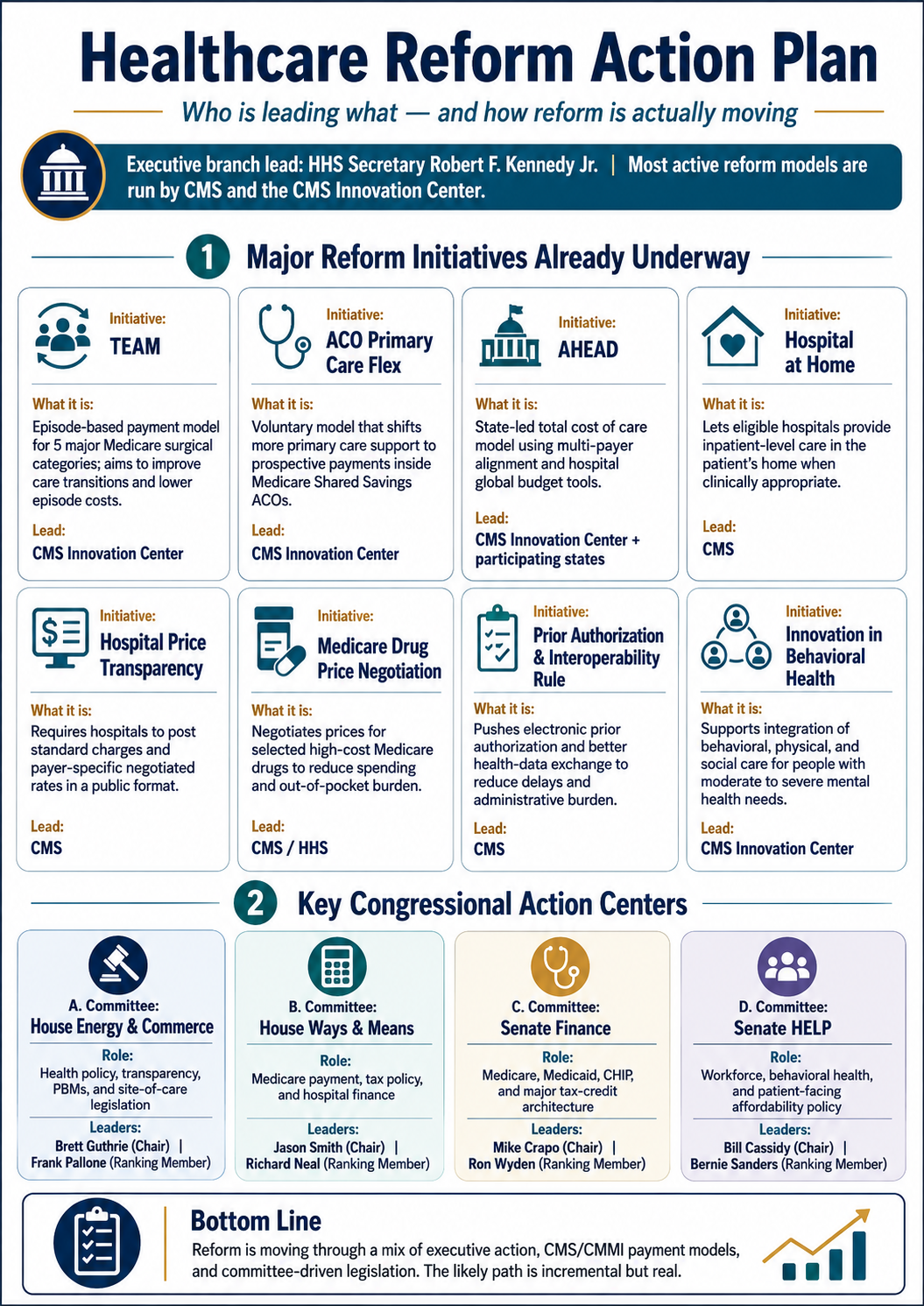
Healthcare reform will not arrive in one sweeping victory. It is already moving through a series of targeted federal initiatives—TEAM, ACO Primary Care Flex, AHEAD, Hospital at Home, price transparency, drug-price negotiation, and administrative simplification—each aimed at a different point of dysfunction in the system. The larger question is whether these scattered efforts can be strengthened, coordinated, and translated into durable reform.
Conclusion
American healthcare is still, in many respects, an extraordinary achievement. It saves lives, performs technical feats unimaginable a generation ago, and continues to expand the reach of medicine in ways that are often deeply admirable. But it has also become too expensive, too opaque, too administratively burdened, and too difficult for ordinary patients to navigate with trust or confidence. The problem is that American healthcare excellence now sits inside a system whose prices, incentives, and complexity too often undermine the experience of care itself.
That is why reform must address hospital pricing, market power, administrative bloat, fragmented payment, weak primary care, drug intermediaries, patient confusion, and the extraordinary difficulty of making the system intelligible to the people who depend on it most.
And yet the complexity of the system should not become an excuse for passivity. There is a path forward, even if it is less dramatic than many would prefer. Tighten price transparency. Expand site-neutral payment. Push savings from drug and PBM reform closer to patients. Rebuild primary care with real payment support, stronger workforce planning, and clear standards. Use technology and AI to reduce clerical burden and improve clarity, not to deepen denial and surveillance. And above all, make the system understandable enough that patients and clinicians can begin to challenge it rather than simply endure it.
No single law will solve this. No single election will tame it. But real reform does not require perfection before it begins. It requires honesty about where the money goes, where the confusion comes from, and who benefits from keeping the system as difficult to understand as it is. If there is one reform lever that may prove more powerful than it first appears, it is probably knowledge. American healthcare does not need more mystique. It needs more clarity, more discipline, and a patient population finally equipped to demand both.
Congressional Contact List
If readers want to press for serious reform, below is a current Washington contact list for the main federal players on healthcare reform. A practical note first: most congressional offices route policy messages through constituent-only contact forms or prioritize messages from people in their own state or district. The Senate explicitly tells people to contact their own senators, and some offices note they may acknowledge but not respond to non-constituents. House and Senate member sites often require a ZIP code or state residency to submit issue messages online, so for readers outside those jurisdictions, a D.C. office phone call or a letter to the relevant committee office is often the cleaner route.
Executive branch
Robert F. Kennedy Jr., Secretary of Health and Human Services — HHS headquarters: 200 Independence Avenue SW, Washington, DC 20201; HHS call center: 1-877-696-6775.
House — key healthcare committees
Rep. Brett Guthrie (R-KY), Chair, House Energy and Commerce Committee — 2161 Rayburn House Office Building, Washington, DC 20515; (202) 225-3501.
Rep. Frank Pallone Jr. (D-NJ), Ranking Member, House Energy and Commerce Committee — 2107 Rayburn House Office Building, Washington, DC 20515; (202) 225-4671.
Rep. Jason Smith (R-MO), Chair, House Ways and Means Committee — 1011 Longworth House Office Building, Washington, DC 20515; (202) 225-4404.
Rep. Richard Neal (D-MA), Ranking Member, House Ways and Means Committee — 372 Cannon House Office Building, Washington, DC 20515; (202) 225-5601.
Senate — key healthcare committees
Sen. Mike Crapo (R-ID), Chair, Senate Finance Committee — 239 Dirksen Senate Office Building, Washington, DC 20510; (202) 224-6142.
Sen. Ron Wyden (D-OR), Ranking Member, Senate Finance Committee — 221 Dirksen Senate Office Building, Washington, DC 20510; (202) 224-5244.
Sen. Bill Cassidy (R-LA), Chair, Senate HELP Committee — 455 Dirksen Senate Office Building, Washington, DC 20510; (202) 224-5824.
Sen. Bernie Sanders (I-VT), Ranking Member, Senate HELP Committee — 332 Dirksen Senate Office Building, Washington, DC 20510; (202) 224-5141.
Useful committee office
Senate Finance Committee main office — 219 Dirksen Senate Office Building, Washington, DC 20510-6200; (202) 224-4515. This is useful when the issue is clearly committee-jurisdictional.
References
Coverage, Universal Coverage, and International System Comparisons
Blumenthal D, Collins SR, Fowler EJ. The Affordable Care Act at 10 Years—Its Coverage and Access Provisions. N Engl J Med. 2020;382(10):963-969. doi:10.1056/NEJMhpr1916091.
Sanders B. NEWS: Sanders, Jayapal, Dingell, Hundreds of Health Care Workers Introduce Medicare for All.U.S. Senate. Published April 29, 2025. Accessed June 28, 2026.
Congressional Budget Office. Testimony on a Single-Payer Health Care System That Is Based on Medicare’s Fee-for-Service Program. Published May 12, 2022. Accessed June 28, 2026.
Gunja MZ, Gumas ED, Williams RD II. U.S. Health Care from a Global Perspective, 2026: Expanded Edition.Commonwealth Fund. Published May 28, 2026. doi:10.26099/2egm-8b76.
Commonwealth Fund. Mirror, Mirror 2024: A Portrait of the Failing U.S. Health System—Comparing Performance in 10 Nations. Published September 19, 2024. doi:10.26099/ta0g-zp66.
Organisation for Economic Co-operation and Development. Health at a Glance 2025: United States. Published November 13, 2025. Accessed June 28, 2026.
Organisation for Economic Co-operation and Development. Health at a Glance 2025: Waiting Times. Published November 13, 2025. Accessed June 28, 2026.
National Spending, Hospitals, and Comparative Procedure Prices
Centers for Medicare & Medicaid Services. NHE Fact Sheet. Updated January 14, 2026. Accessed June 28, 2026.
Congressional Budget Office. The Budget and Economic Outlook: 2026 to 2036. Published February 11, 2026. Accessed June 28, 2026.
KFF. Hospital Spending Accounted for 40% of the Growth in National Health Spending Between 2022 and 2024, a Far Larger Share Than Any Other Health Spending Category. Published February 11, 2026. Accessed June 28, 2026.
KFF. Key Facts About Hospitals. Published February 19, 2025. Accessed June 28, 2026.
Peterson-KFF Health System Tracker. What Drives Health Spending in the U.S. Compared to Other Countries? Published August 2, 2024. Accessed June 28, 2026.
International Federation of Health Plans; Health Care Cost Institute. International Health Cost Comparison Report 2024–2025. Published 2025. Accessed June 28, 2026.
Agency for Healthcare Research and Quality, Healthcare Cost and Utilization Project. Overview of Operating Room Procedures During Inpatient Stays in U.S. Hospitals, 2018. Statistical Brief No. 281. Published August 30, 2021. Accessed June 28, 2026.
American Hospital Association. 2025 The Cost of Caring Report. Published March 9, 2026. Accessed June 28, 2026.
Prescription Drugs and Intermediaries
Assistant Secretary for Planning and Evaluation, U.S. Department of Health and Human Services. Comparing Prescription Drugs in the U.S. and Other Countries: Prices and Availability. Published January 31, 2024. Accessed June 28, 2026.
Federal Trade Commission. Pharmacy Benefit Managers: The Powerful Middlemen Inflating Drug Costs and Squeezing Main Street Pharmacies. Interim Staff Report. Published July 2024. Accessed June 28, 2026.
Centers for Medicare & Medicaid Services. Negotiated Prices for Initial Price Applicability Year 2026.Published August 15, 2024. Accessed June 28, 2026.
Primary Care, Workforce, Chronic Disease, Emergency Care, and Health Literacy
Centers for Disease Control and Prevention. Fast Facts: Health and Economic Costs of Chronic Conditions.Updated May 26, 2026. Accessed June 28, 2026.
Centers for Disease Control and Prevention, National Center for Health Statistics. Emergency Department Visit Rates by Selected Characteristics: United States, 2022. Data Brief No. 503. Published August 2024. Accessed June 28, 2026.
Gumas ED, Shah A, Gunja MZ, Doty MM, Williams RD II. Finger on the Pulse: The State of Primary Care in the U.S. and Nine Other Countries. Commonwealth Fund. Published March 28, 2024. doi:10.26099/p3y4-5g38.
Health Resources and Services Administration. State of the Primary Care Workforce, 2025. Published December 2, 2025. Accessed June 28, 2026.
Brach C, ed. AHRQ Health Literacy Universal Precautions Toolkit. 3rd ed. Rockville, MD: Agency for Healthcare Research and Quality; 2024.
Policy Levers, Reforms in Progress, AI, and Organized Power
Medicare Payment Advisory Commission. March 2026 Report to the Congress: Medicare Payment Policy.Published March 2026. Accessed June 28, 2026.
Centers for Medicare & Medicaid Services. Hospital Price Transparency. Updated May 12, 2026. Accessed June 28, 2026.
Centers for Medicare & Medicaid Services, Innovation Center. Transforming Episode Accountability Model (TEAM). Updated June 2026. Accessed June 28, 2026.
Centers for Medicare & Medicaid Services, Innovation Center. ACO Primary Care Flex (ACO PC Flex) Model.Updated June 17, 2026. Accessed June 28, 2026.
Centers for Medicare & Medicaid Services, Innovation Center. AHEAD (Achieving Healthcare Efficiency through Accountable Design) Model. Updated 2026. Accessed June 28, 2026.
Centers for Medicare & Medicaid Services. Acute Hospital Care at Home Data Release Fact Sheet. Published March 17, 2026. Accessed June 28, 2026.
U.S. Department of Health and Human Services. Artificial Intelligence Strategy v3. Published December 2025. Accessed June 28, 2026.
Office of the National Coordinator for Health Information Technology. HTI-1 Final Rule. Accessed June 28, 2026.
Schpero WL, Wiener T, Carter S, Chatterjee P. Lobbying Expenditures in the US Health Care Sector, 2000-2020. JAMA Health Forum. 2022;3(10). doi:10.1001/jamahealthforum.2022.3801.
Korostoff-Larsson O, Taylor LA, Chatterjee P, et al. Patterns of Federal Lobbying by the Hospital Industry. JAMA Health Forum. 2026;7(3). doi:10.1001/jamahealthforum.2026.0117.
